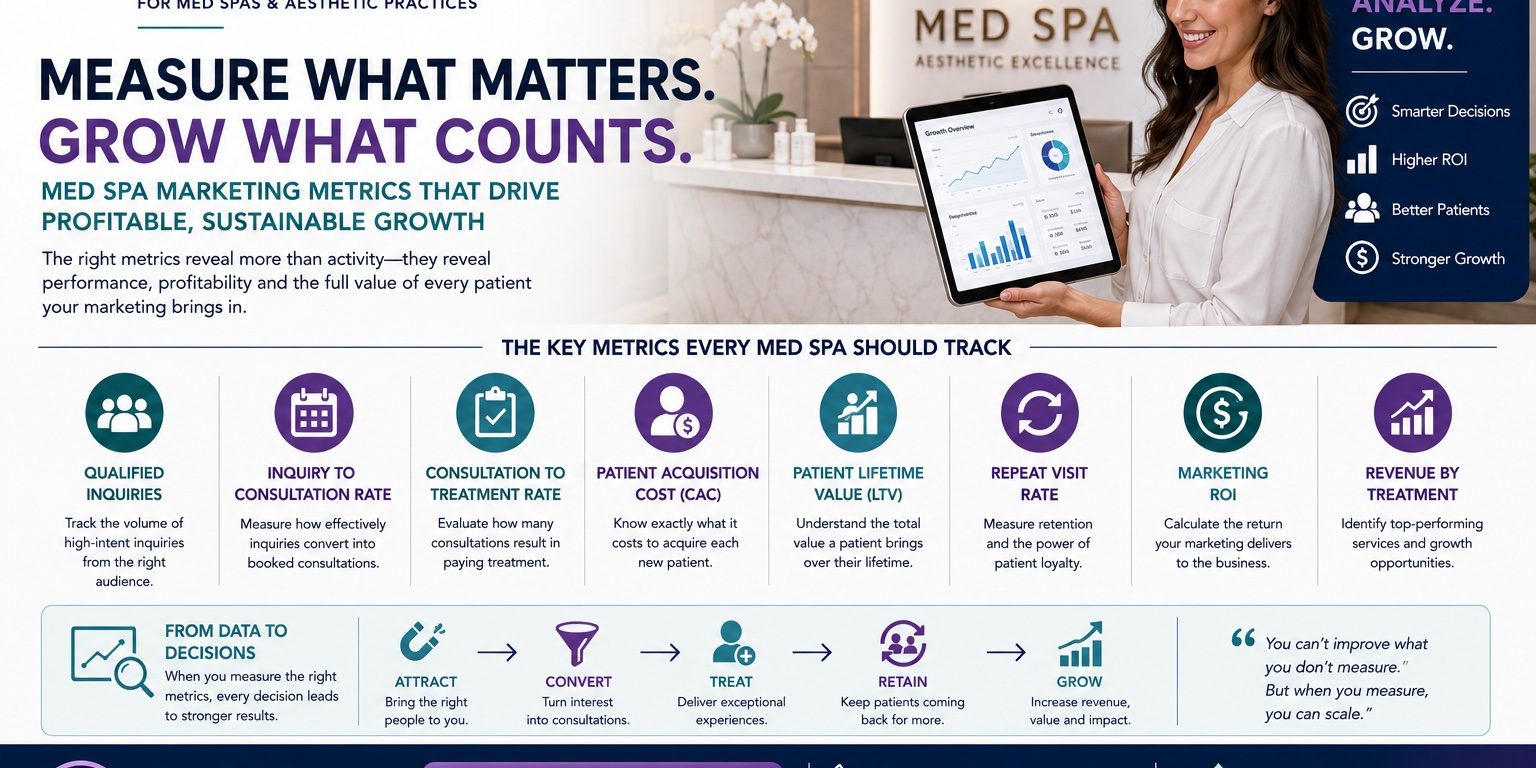
Med spa marketing becomes much easier to manage when owners know which numbers actually matter. Website traffic, social media followers, impressions, clicks, and keyword rankings can provide useful information, but none of them independently tells a practice whether its marketing is producing profitable growth. The more important measurements connect marketing activity to qualified inquiries, consultations, new patients, revenue, retention, and patient lifetime value.
For a growing practice, the objective should be to understand the economics behind patient acquisition. How much does it cost to acquire a new patient? How effectively are inquiries converted into consultations? How much revenue does an average patient generate? How often do patients return? Which treatments and marketing channels create the strongest financial return?
Answering those questions gives owners a much clearer foundation for allocating budgets and improving their overall med spa marketing strategy.
Why Med Spa Marketing Metrics Matter
Marketing performance can look impressive while the underlying economics remain weak.
A campaign might generate thousands of website visits without producing enough qualified patient inquiries. Another campaign could deliver hundreds of leads, but the clinic may convert very few into consultations. A third campaign might acquire patients efficiently, yet those patients purchase only low-value treatments and never return.
This is why practices need to measure the entire patient acquisition process.
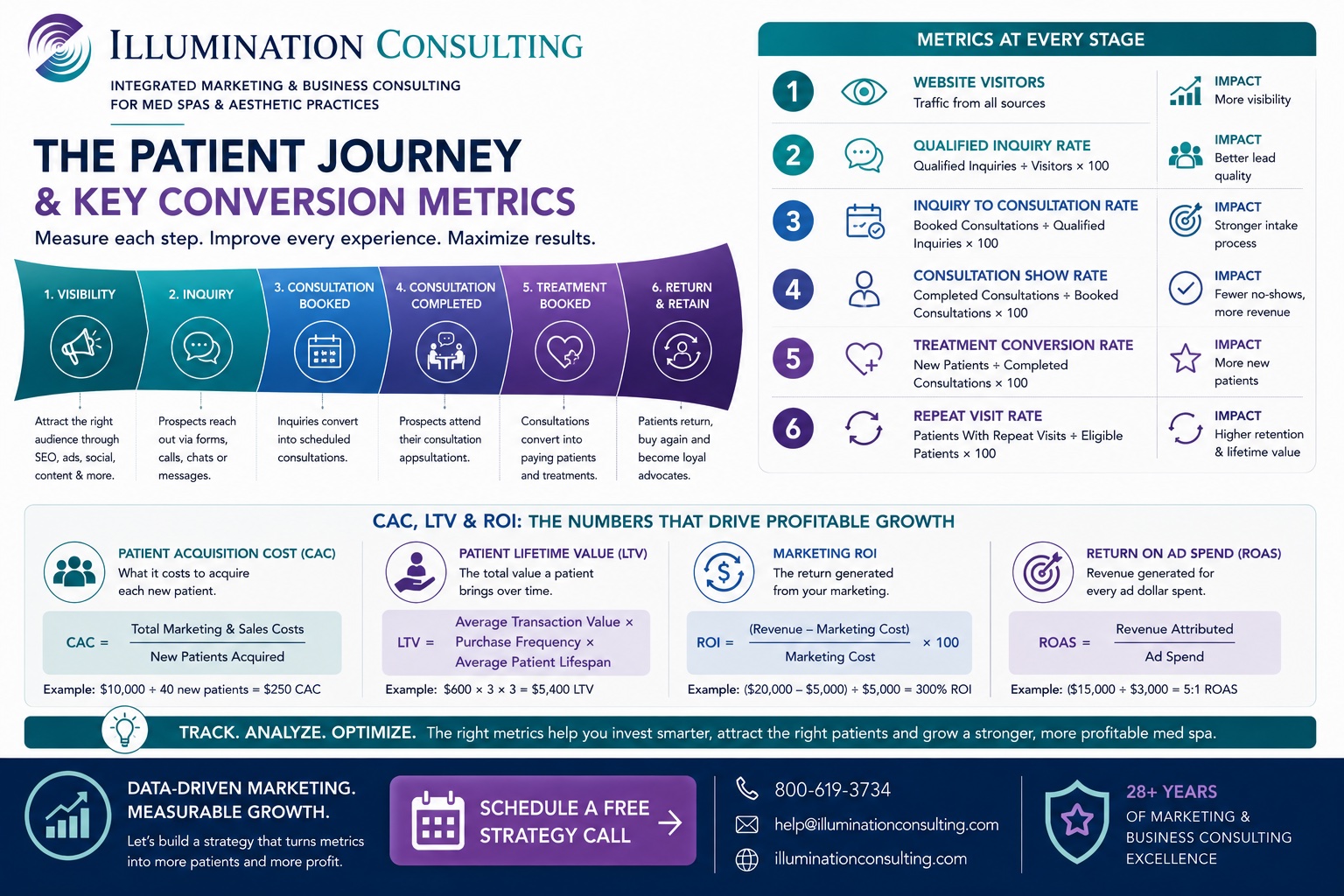
The basic journey looks something like this:
Marketing visibility → inquiry → consultation → treatment → repeat treatment → long-term patient value
Every stage affects the financial return generated by marketing.
If one stage performs poorly, increasing marketing spending may simply send more prospects into an inefficient system.
Start With Qualified Patient Inquiries
Leads are one of the most commonly reported marketing metrics, but not every lead has equal value.
A qualified patient inquiry generally represents someone with legitimate interest in a treatment the practice offers and a realistic possibility of becoming a patient.
This distinction matters.
Suppose two campaigns each generate 50 leads.
Campaign A generates 50 inexpensive inquiries, but only five schedule consultations.
Campaign B generates 25 more expensive inquiries, but 15 schedule consultations.
Campaign A may initially appear more efficient because its cost per lead is lower. Yet Campaign B may ultimately produce considerably more revenue.
That is why cost per lead should never be evaluated without lead quality and downstream conversion data.
Measure Inquiry-to-Consultation Conversion
Once inquiries arrive, the next question is how many become scheduled consultations.
The formula is:
Inquiry-to-Consultation Rate = Booked Consultations ÷ Qualified Inquiries × 100
For example, if a clinic receives 100 qualified inquiries and 40 schedule consultations:
40 ÷ 100 × 100 = 40%
This metric helps determine whether the clinic is effectively converting marketing interest into appointments.
A weak conversion rate may indicate problems involving:
- slow response times
- missed phone calls
- ineffective follow-up
- confusing booking procedures
- poor staff communication
- pricing objections
- inadequate lead qualification
- lack of trust
- weak offers or messaging
If marketing generates strong inquiries but few consultations, the primary problem may not be marketing at all.
It may be the intake process.
Track Consultation Show Rate
A scheduled consultation has limited value if the prospective patient does not attend.
The consultation show rate measures how many scheduled prospects actually arrive.
The formula is:
Consultation Show Rate = Completed Consultations ÷ Scheduled Consultations × 100
Appointment reminders, confirmation processes, scheduling convenience, deposits where appropriate, and communication can all influence this metric.
Tracking show rate also helps management distinguish between a lead-generation problem and a scheduling or patient-engagement problem.
Measure Consultation-to-Treatment Conversion
After the consultation, clinics should understand how many prospects become paying patients.
The formula is:
Treatment Conversion Rate = New Paying Patients ÷ Completed Consultations × 100
Suppose 30 prospective patients attend consultations and 18 proceed with treatment.
The conversion rate is:
18 ÷ 30 × 100 = 60%
This metric can reveal issues involving consultation quality, patient expectations, pricing, financing, provider communication, treatment recommendations, trust, or competitive positioning.
It also demonstrates why evaluating marketing exclusively through lead volume is incomplete.
Marketing may be delivering qualified prospects while revenue is being lost later in the patient journey.
What Is Patient Acquisition Cost?
Patient acquisition cost, or CAC, estimates how much a practice spends to acquire a new patient.
A simplified formula is:
Patient Acquisition Cost = Marketing and Sales Acquisition Costs ÷ New Patients Acquired
For example, suppose a med spa spends $10,000 during a month on activities directly associated with patient acquisition and acquires 40 new patients.
The simplified CAC would be:
$10,000 ÷ 40 = $250 per new patient
That number becomes useful when compared with the economic value of those patients.
A $250 acquisition cost could be excellent for one treatment category and unsustainable for another.
Context matters.
Calculate CAC by Marketing Channel
Blended acquisition cost provides an overall view, but med spas should also measure individual channels whenever tracking allows.
Potential channels include:
- organic search
- Google Ads
- social advertising
- referrals
- organic social media
- local search
- partnerships
- events
- direct traffic
Channel-level CAC helps determine where additional marketing dollars are most likely to generate productive growth.
For example, paid search might acquire patients at $300 each while organic search eventually produces patients at a lower effective acquisition cost.
That does not automatically mean paid search should be eliminated.
Paid advertising may create immediate demand while SEO services build a longer-term organic acquisition asset.
The correct decision depends on volume, profitability, capacity, treatment priorities, and overall return.
What Is Patient Lifetime Value?
Patient lifetime value estimates the economic value a patient creates throughout the relationship with the practice.
This metric is especially important in medical aesthetics because many treatments involve repeat visits.
Patients may return for:
- neuromodulators
- dermal fillers
- facials
- laser treatments
- skin rejuvenation
- maintenance procedures
- memberships
- skincare products
- additional aesthetic services
A patient who initially spends $500 may eventually generate substantially more revenue if the relationship continues for several years.
A simplified revenue-based formula is:
Patient Lifetime Value = Average Transaction Value × Average Purchase Frequency × Average Patient Lifespan
Suppose the average patient spends $600 per visit, visits three times per year, and remains with the practice for three years.
The simplified revenue-based lifetime value would be:
$600 × 3 × 3 = $5,400
This is an illustrative calculation, not a benchmark for what a med spa should expect.
Practices should calculate lifetime value from their own financial and patient data.
Revenue Is Not the Same as Profit
Lifetime revenue alone can overstate patient value.
Different treatments have different costs and margins.
Consumables, provider compensation, equipment costs, merchant fees, discounts, commissions, and other expenses influence profitability.
For more sophisticated decision-making, practices should evaluate contribution margin or another appropriate profit measure rather than relying exclusively on gross revenue.
A patient generating $5,000 in lifetime revenue from high-margin services may be economically different from a patient generating the same revenue through services with significantly higher delivery costs.
This distinction becomes especially important when deciding how much the practice can afford to spend on acquisition.
Compare CAC With Patient Lifetime Value
CAC becomes much more informative when evaluated alongside lifetime value.
Suppose a practice acquires a new patient for $250.
If that patient generates only $200 in economically meaningful value, the acquisition model is unsustainable.
If the patient creates thousands of dollars in profitable lifetime value, the practice may have room to invest more aggressively in acquisition.
This relationship helps management answer a critical question:
How much can we rationally spend to acquire the right patient?
There is no universal CAC-to-LTV ratio appropriate for every med spa.
Treatment mix, margins, retention, overhead, growth stage, and business objectives all affect what constitutes an acceptable acquisition cost.
Measure Average Revenue per New Patient
Another useful metric is the revenue generated by newly acquired patients.
The calculation can be performed over several periods.
For example:
Initial Revenue per New Patient = Initial Revenue From New Patients ÷ Number of New Patients
Management can then compare initial value with 90-day, six-month, 12-month, and longer-term patient revenue.
This helps reveal whether certain acquisition channels attract stronger long-term patients.
A channel generating expensive leads may actually be highly profitable if those patients purchase more treatments and remain with the practice longer.
Track Revenue by Treatment
Total clinic revenue does not tell management which services are driving growth.
Revenue should be evaluated by treatment category.
This helps answer questions such as:
- Which treatments are growing?
- Which treatments are declining?
- Which procedures generate repeat business?
- Which services have available capacity?
- Which treatments attract valuable new patients?
- Which services lead to cross-treatment opportunities?
- Which treatments justify greater marketing investment?
Treatment-level data should influence the marketing plan.
A clinic should not necessarily spend equally to promote every service.
Measure Patient Retention
Acquisition receives substantial attention, but retention can dramatically affect marketing economics.
Patient retention measures the clinic’s ability to maintain relationships over time.
The exact calculation depends on the measurement period and business model, but management should understand how many patients return and how frequently.
Retention can be influenced by:
- treatment outcomes
- patient experience
- provider relationships
- communication
- follow-up
- convenience
- scheduling
- treatment planning
- memberships
- loyalty programs
- competitive alternatives
Improving retention can increase lifetime value without requiring an equivalent increase in acquisition spending.
Track Repeat Visit Rate
A related measurement is the percentage of patients who return for another treatment within a defined period.
For example:
Repeat Visit Rate = Patients With Repeat Visits ÷ Eligible Patients × 100
The clinic can analyze repeat behavior at 90 days, six months, 12 months, or another interval appropriate to its treatment mix.
Different procedures naturally have different treatment cycles, so management should avoid applying one arbitrary retention period to every service.
Understand Marketing ROI
Marketing return on investment attempts to measure the financial return generated relative to marketing cost.
A simplified formula is:
Marketing ROI = (Revenue Attributable to Marketing − Marketing Cost) ÷ Marketing Cost × 100
Suppose a campaign costs $5,000 and generates $20,000 in attributable revenue.
The simplified calculation is:
($20,000 − $5,000) ÷ $5,000 × 100 = 300%
Again, revenue-based ROI does not account for all treatment costs or overhead.
For stronger financial analysis, practices should evaluate contribution or profit rather than revenue alone.
The purpose of the calculation is to connect marketing activity with economic outcomes.
Measuring and Optimizing Your Return on Advertising Spend
Return on advertising spend, or ROAS, is commonly used for paid advertising.
The formula is:
ROAS = Revenue Attributed to Advertising ÷ Advertising Spend
If a campaign generates $15,000 in attributable revenue from $3,000 in advertising:
$15,000 ÷ $3,000 = 5.0
That is commonly described as a 5:1 ROAS.
ROAS can be useful, but it should not become the only measure of performance.
It does not automatically account for:
- agency or management fees
- creative costs
- treatment margins
- patient lifetime value
- organic influence
- repeat purchases
- attribution limitations
A campaign with a lower initial ROAS may still acquire highly valuable long-term patients.
Know the Difference Between ROI and ROAS
The terms are often used interchangeably, but they measure different things.
ROAS focuses specifically on revenue relative to advertising spend.
ROI attempts to evaluate the broader return relative to the investment.
Both can be useful.
Neither should be interpreted without understanding how revenue was attributed and what costs were included.
Measure Website Conversion Rate
The website is often the bridge between marketing visibility and patient action.
Website conversion rate measures how many visitors complete a desired action.
The formula is:
Website Conversion Rate = Desired Actions ÷ Website Visitors × 100
Desired actions might include:
- consultation requests
- appointment bookings
- qualified form submissions
- phone calls
- text inquiries
A website receiving 10,000 monthly visitors but generating few inquiries has a different problem from one receiving 1,000 visitors and converting strongly.
Increasing traffic is not always the highest-return next step.
Sometimes improving conversion produces greater value.
Measure Organic Search Performance Correctly
SEO performance should include more than keyword rankings.
Useful organic metrics include:
- search impressions
- organic clicks
- click-through rate
- average ranking position
- organic landing-page traffic
- treatment-related keyword visibility
- qualified organic inquiries
- organic consultation requests
- new patients attributable to search
Rankings are leading indicators.
Patient acquisition is the business outcome.
A practice can rank for hundreds of informational terms without generating meaningful treatment demand if the keyword strategy is poorly aligned with patient intent.
Measure Paid Advertising Beyond Cost per Lead
Paid advertising dashboards make it easy to focus on impressions, clicks, click-through rates, and cost per lead.
Those numbers are useful for campaign optimization.
However, practice owners should eventually connect advertising with:
Cost per qualified inquiry
Cost per booked consultation
Cost per attended consultation
Cost per new patient
Revenue per acquired patient
Lifetime value by acquisition source
A $30 lead that never schedules is more expensive than a $100 lead that becomes a profitable long-term patient.
Track Lead Response Time
Lead response time is an operational metric with direct marketing implications.
A prospective patient may contact several clinics.
If one practice responds quickly while another waits hours or days, marketing performance can be lost after the lead has already been generated.
Practices should understand:
- average response time
- unanswered calls
- abandoned inquiries
- after-hours leads
- follow-up frequency
- contact rate
This is one reason marketing and operations cannot be managed as completely separate functions.
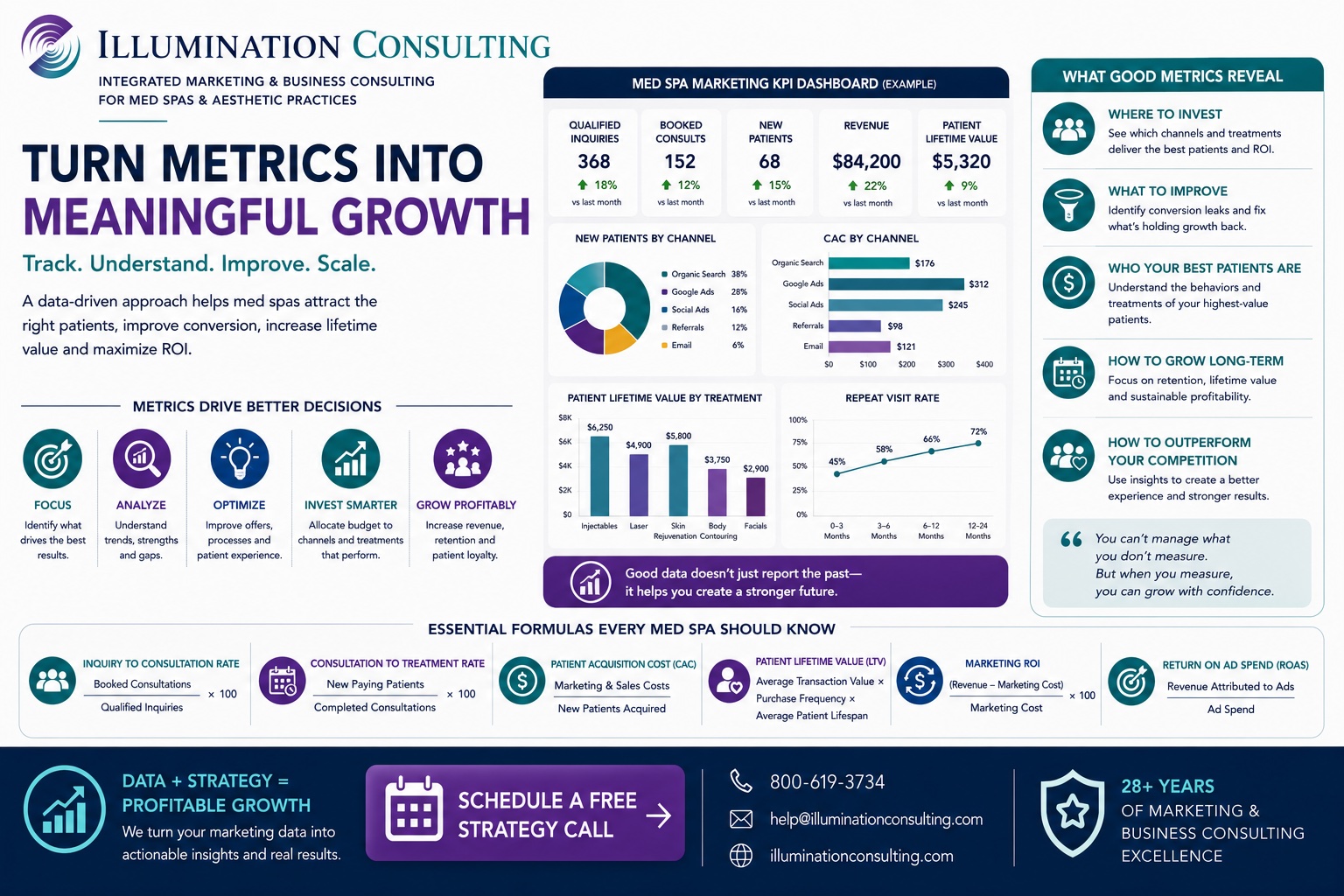
Build a Med Spa Marketing Dashboard
Owners do not need dozens of disconnected reports.
A practical dashboard can focus on the metrics that reveal the health of the patient acquisition system.
A useful monthly view might include:
| Metric | What It Reveals |
|---|---|
| Qualified inquiries | Demand generated |
| Booked consultations | Intake effectiveness |
| Consultation show rate | Appointment quality |
| New patients | Acquisition outcome |
| Patient acquisition cost | Acquisition efficiency |
| Revenue per new patient | Initial economic value |
| Patient lifetime value | Long-term economic value |
| Repeat visit rate | Retention strength |
| Website conversion rate | Digital conversion |
| Revenue by treatment | Service performance |
| Marketing ROI | Financial return |
The objective is not collecting more data.
It is making better decisions.
Segment Metrics by Channel and Treatment
Aggregate numbers can hide important differences.
Whenever possible, segment performance by:
Marketing channel
Organic search, paid search, social advertising, referrals, email, and other sources.
Treatment
Injectables, laser treatments, body procedures, skincare, and other categories.
Location
For multi-location practices.
New versus existing patients
These groups have different economics.
Time period
Monthly data may reveal short-term changes, while quarterly and annual analysis reveals broader trends.
Segmentation helps management identify where growth is actually coming from.
Avoid Vanity Metrics
Vanity metrics are not inherently useless.
Social followers, video views, impressions, traffic, and keyword rankings can provide valuable diagnostic information.
The problem occurs when they become substitutes for business performance.
A clinic can gain 10,000 social followers without acquiring meaningful patients.
Website traffic can rise while revenue remains flat.
Keyword rankings can improve for searches with little commercial value.
Marketing measurement should therefore create a hierarchy:
Visibility → engagement → inquiry → consultation → patient → revenue → retention → lifetime value
The further the measurement moves toward the right side of that sequence, the closer it gets to actual business performance.
Use Metrics to Decide Where to Invest Next
The greatest value of measurement is not reporting what already happened.
It is improving the next decision.
Consider several scenarios.
Traffic Is Low, but Conversion Is Strong
The clinic may benefit from increasing qualified visibility through SEO, advertising, content, or other acquisition channels.
Traffic Is Strong, but Inquiries Are Low
The website, treatment positioning, offers, credibility, or calls to action may need improvement.
Inquiries Are Strong, but Consultations Are Low
The intake and follow-up process may be the constraint.
Consultations Are Strong, but Treatments Are Low
Management should evaluate consultation quality, pricing, patient expectations, provider communication, and competitive positioning.
New Patient Acquisition Is Strong, but Growth Is Weak
Retention, treatment mix, margins, or lifetime value may require attention.
This diagnostic approach is considerably more useful than simply asking whether marketing “worked.”
Connect Marketing Metrics With Business Strategy
Marketing decisions should reflect the financial and operational realities of the practice.
A med spa with unused provider capacity may prioritize new-patient acquisition.
A practice operating near capacity may benefit more from improving treatment mix, retention, pricing, or patient lifetime value.
A multi-location organization may need to understand performance by location before expanding further.
This is where marketing analysis intersects with med spa business consulting.
Growth is not simply about generating more leads.
It is about improving the economics and performance of the entire business.
Measure What Creates Sustainable Med Spa Growth
The most valuable med spa marketing metrics connect marketing activity to actual patient and financial outcomes.
Traffic matters.
Rankings matter.
Advertising clicks matter.
Social engagement matters.
But they become significantly more useful when management can follow their impact through the entire patient journey.
Qualified inquiries reveal demand.
Consultation rates reveal intake effectiveness.
New patients reveal acquisition performance.
CAC reveals efficiency.
Revenue reveals immediate economic value.
Retention and patient lifetime value reveal whether acquisition creates durable growth.
ROI helps management determine whether marketing capital is being deployed productively.
When these measurements are viewed together, owners can stop making marketing decisions based primarily on activity and begin managing patient acquisition as an economic system.
Illumination Consulting helps aesthetic practices integrate med spa marketing services, digital strategy, patient acquisition, and business consulting around measurable growth objectives. The goal is not simply generating more marketing activity. It is identifying what drives qualified patients, profitable treatments, stronger retention, and sustainable business performance.
Frequently Asked Questions
What are the most important med spa marketing metrics?
Important metrics include qualified inquiries, consultation booking rate, consultation show rate, new patients acquired, patient acquisition cost, website conversion rate, revenue per patient, patient retention, patient lifetime value, treatment revenue, and marketing ROI.
How do you calculate patient acquisition cost for a med spa?
A simplified CAC calculation divides the marketing and sales costs associated with acquiring patients by the number of new patients acquired during the same period. More detailed analysis can calculate CAC separately by marketing channel, treatment, and location.
How do you calculate med spa patient lifetime value?
A simplified revenue-based calculation multiplies average transaction value by purchase frequency and average patient lifespan. More sophisticated calculations should consider retention patterns, treatment mix, margins, and actual historical patient data.
What is a good patient acquisition cost for a med spa?
There is no universal number. An acceptable CAC depends on treatment value, gross margin, patient lifetime value, retention, overhead, available capacity, and the clinic’s growth objectives. CAC should be evaluated relative to the economic value generated by the acquired patient.
What is the difference between ROAS and marketing ROI?
ROAS measures revenue attributed to advertising relative to advertising spend. Marketing ROI attempts to evaluate the broader financial return generated by the marketing investment. Both are useful but should be interpreted according to which costs and revenue are included.