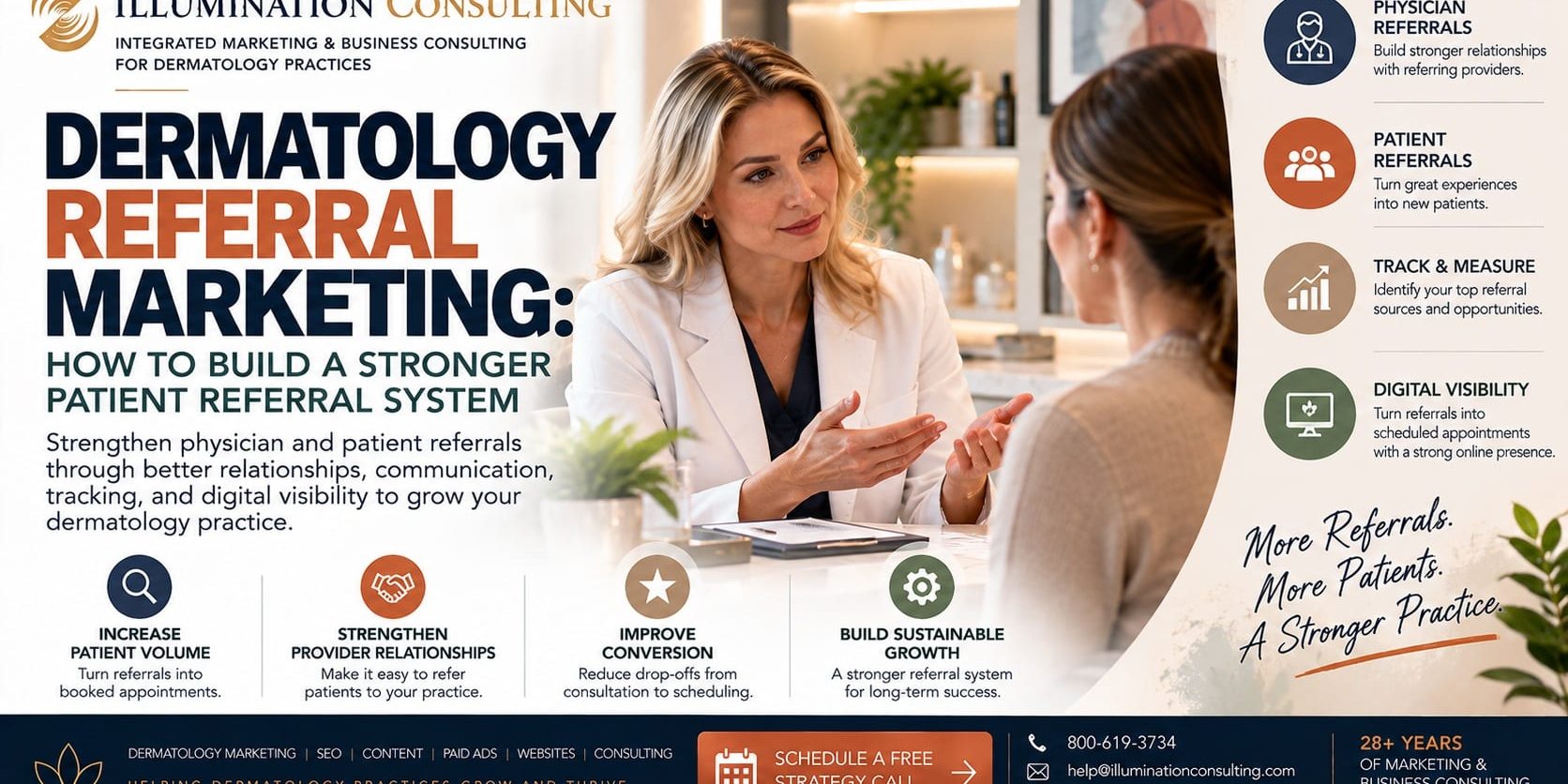
Dermatology practices often invest heavily in search engine optimization, paid advertising, websites, social media, content, and local search to attract new patients. Those channels can create substantial growth, but they represent only part of the patient-acquisition system. Dermatology also has access to another valuable source of demand: referrals from physicians, healthcare professionals, existing patients, and other trusted relationships within the community.
Referral growth, however, should not be left entirely to chance. A practice may provide excellent care and receive referrals organically while still having little understanding of where those patients originate, which relationships generate meaningful volume, which services are being referred, or whether referral partners receive an efficient experience when sending patients to the practice. Without structure, an important acquisition channel can remain largely invisible to management.
A stronger dermatology referral marketing strategy combines relationship development, patient experience, reputation, communication, tracking, digital visibility, and operational follow-through. For practices investing in professional Dermatology Marketing, referrals should complement SEO, advertising, content, and direct patient acquisition rather than operate as a disconnected source of business.
Why Referrals Matter Differently in Dermatology
Dermatology practices frequently operate across several distinct areas of care.
These can include:
- general medical dermatology
- skin cancer evaluation
- acne
- eczema
- psoriasis
- surgical dermatology
- cosmetic dermatology
- laser services
- injectables
- medical-grade skincare
Patients can enter the practice through very different pathways.
Someone seeking cosmetic treatment may discover the practice through Instagram or Google.
A patient with a suspicious skin lesion may be referred by a primary-care physician.
Another patient may schedule because a friend recommended the dermatologist.
These are fundamentally different acquisition journeys.
A referral strategy should recognize those differences.
Understand the Major Referral Sources
A dermatology practice can receive referrals from several broad categories.
Physician Referrals
Potential sources can include:
- primary-care physicians
- family medicine practices
- internists
- pediatricians
- other specialists
- urgent-care providers
The relevant relationships depend on the dermatology practice’s services and local healthcare environment.
Existing Patient Referrals
Satisfied patients may recommend the practice to:
- family
- friends
- coworkers
- community members
Professional Referrals
Depending on the practice and services, other healthcare or aesthetic professionals may encounter people who need dermatological care.
Digital Word of Mouth
Online reviews, community recommendations, social discussions, and local search can increasingly function as referral mechanisms.
The patient may never personally know the reviewer, yet trust is transferred through another person’s experience.
Referrals Are Built on Trust
Referral marketing differs from conventional advertising because someone else is effectively transferring a portion of their credibility to the practice.
A physician referring a patient is saying:
I believe this practice is an appropriate place for you to receive care.
A patient recommending a dermatologist to a friend is communicating something similar.
That makes the referral experience particularly important.
A poor experience does not affect only one patient.
It can influence whether the referral source sends another person in the future.
Start With the Patient Experience
Before attempting to generate more referrals, evaluate whether the practice consistently delivers an experience people are comfortable recommending.
Consider:
Was scheduling straightforward?
Was communication professional?
Were expectations clear?
Did the patient feel respected?
Were questions addressed appropriately?
Was follow-up handled effectively?
Did the overall experience reinforce confidence in the practice?
Referral marketing cannot sustainably compensate for poor patient experience.
The underlying service experience creates the foundation.
Build a Referral Source Database
Many practices know generally that they “get referrals” without maintaining useful data about them.
A referral-source database can identify:
Referral Source
Organization
Contact Information
Referral Type
Patients Referred
Service Line
Date
Appointment Outcome
Relevant Follow-Up
The system does not need to become unnecessarily complicated.
The objective is knowing where referred patients originate.
Ask Every New Patient How They Found the Practice
This simple step can substantially improve attribution.
Potential responses might include:
- physician referral
- existing patient
- insurance directory
- social media
- online review
- advertising
- another healthcare professional
- other
When someone selects physician referral, capture the referring provider where appropriate.
When someone selects patient referral, the practice can record that category according to its privacy and operational policies.
Without consistent intake data, referral attribution quickly becomes unreliable.
Do Not Rely Exclusively on “How Did You Hear About Us?”
Self-reported attribution is useful, but patients may have encountered the practice several times.
For example:
Primary-care physician recommends dermatologist
↓
Patient searches practice on Google
↓
Reads reviews
↓
Visits website
↓
Schedules appointment
What generated the patient?
The physician referral clearly mattered.
Google visibility mattered too.
The website and reputation may have helped validate the decision.
This is a multi-touch acquisition journey.
Referral and digital marketing frequently work together.
Physician Referrals Still Need Digital Validation
A physician recommendation does not guarantee that the patient immediately schedules.
Many patients will research the referred dermatologist.
They may examine:
- Google results
- website
- physician biography
- reviews
- location
- services
- insurance information
- appointment availability
This means SEO Services can support referral conversion even when SEO did not create the initial referral.
Digital visibility validates offline trust.
Strengthen Provider Biography Pages
A referred patient may search specifically for the dermatologist’s name.
Provider pages should therefore communicate relevant information clearly.
Depending on the practice, this can include:
- education
- credentials
- professional background
- clinical interests
- services
- philosophy of care
- locations
- appropriate professional affiliations
The page should make it easy for the patient to understand who the provider is and how to schedule.
A weak biography page can create unnecessary uncertainty after a strong referral.
Strengthen Service Pages
A referring physician may recommend the practice for a specific concern.
The patient then searches that condition or service on the website.
Strong service pages can help explain:
- what the practice addresses
- relevant providers
- general evaluation process
- what patients may expect
- how to schedule
This is another area where referral strategy and Content Marketing overlap.
Educational information reinforces confidence.
Map the Physician Referral Journey
The referring-provider experience matters too.
Consider the complete pathway:
Provider Identifies Need
↓
Chooses Dermatology Practice
↓
Referral Is Sent
↓
Practice Receives Referral
↓
Patient Is Contacted
↓
Appointment Is Scheduled
↓
Patient Receives Care
↓
Appropriate Communication Returns to Referrer
Every transition can create friction.
A referral program is only as strong as the process supporting it.
Make It Easy to Refer Patients
Referring offices should clearly understand how to send a patient.
Depending on the practice’s systems, this might involve:
- referral forms
- appropriate electronic processes
- secure communication
- telephone procedures
- designated referral contacts
The exact process must reflect applicable healthcare, privacy, payer, and operational requirements.
The principle is simple:
Reduce unnecessary administrative friction.
If another office repeatedly struggles to send referrals, that relationship becomes harder to maintain.
Establish Referral Ownership
Someone inside the practice should understand who manages incoming referrals.
Without ownership, referrals can become:
- delayed
- incomplete
- lost
- duplicated
- poorly tracked
Ownership does not necessarily require a dedicated employee.
It requires clear responsibility.
Who confirms receipt?
Who contacts the patient?
Who follows unresolved referrals?
Who updates the status?
Who handles questions from referring offices?
Those responsibilities should be defined.
Measure Referral-to-Appointment Conversion
A referral does not automatically become an appointment.
A simplified calculation is:
Referral-to-Appointment Conversion = Referred Patients Scheduled ÷ Qualified Referrals Received × 100
Suppose a hypothetical practice receives 80 appropriate referrals during a period and 60 result in scheduled appointments.
The illustrative conversion rate would be:
60 ÷ 80 × 100 = 75%
This is purely a mathematical example, not a dermatology benchmark.
The important issue is understanding what happens to the other 20 referrals.
Track Completed Visits, Not Just Referrals
The funnel continues:
Referral Received
↓
Patient Contacted
↓
Appointment Scheduled
↓
Appointment Confirmed
↓
Completed Visit
A practice can report strong referral volume while losing substantial patient opportunity during scheduling.
This connects directly with our article on Dermatology Appointment Conversion.
Referral generation and referral conversion should be measured separately.
Identify Why Referred Patients Do Not Schedule
Potential reasons may include:
- patient cannot be reached
- appointment availability
- insurance considerations
- location
- patient changed their mind
- patient chose another provider
- referral information was incomplete
- service mismatch
- scheduling friction
The practice should rely on actual recorded reasons rather than assumptions.
Patterns can reveal operational problems.
Appointment Availability Influences Referral Relationships
A referring physician may value a dermatology practice but eventually send patients elsewhere if appropriate appointments are consistently unavailable.
That does not necessarily indicate a marketing failure.
It may indicate:
- insufficient provider capacity
- scheduling limitations
- service-line constraints
Marketing and referral development should therefore remain connected to operational capacity.
There is little value in aggressively increasing referrals for a service the practice cannot reasonably accommodate.
Segment Referrals by Service Line
Not all referrals have equal strategic relevance.
Track which services receive referrals.
For example:
Medical Dermatology
Skin Cancer Evaluation
Acne
Surgical Dermatology
Cosmetic Dermatology
The categories should reflect the actual practice.
This data can reveal whether the referral network aligns with the practice’s desired growth areas.
Our Dermatology Service-Line Marketing article explores how practices can prioritize services based on demand, economics, capacity, and strategic objectives.
Referral development can support the same priorities.
Identify High-Value Referral Relationships
“High-value” should not necessarily mean the source that sends the largest number of patients.
A strong referral relationship might consistently send:
- appropriate patients
- patients for priority services
- patients the practice can accommodate effectively
Quality matters.
A large volume of inappropriate referrals can create administrative work without creating equivalent value.
Measure Referral Quality
A referral-quality analysis might consider:
Total Referrals
Qualified Referrals
Appointments Scheduled
Completed Visits
Service Line
Patient Fit
The practice can then understand which relationships consistently produce appropriate patient demand.
This information should guide relationship management.
Avoid Treating Physician Relationships Like Sales Leads
Physician referral development should remain professional.
The objective is not aggressive selling.
The practice should communicate:
- capabilities
- relevant expertise
- access
- referral process
- appropriate clinical services
Healthcare relationships are built through credibility and dependable patient care.
Marketing should support that credibility rather than undermine it.
Develop Clear Referral Materials
Referring providers may benefit from concise information explaining:
- practice locations
- dermatologists
- clinical focus areas
- services
- referral process
- contact information
Materials should be current.
Outdated provider lists, telephone numbers, or referral instructions create unnecessary friction.
Digital materials are particularly useful because they can be updated more easily.
Build Condition-Specific Referral Awareness
A dermatology practice does not necessarily need every physician in the market to remember every service it offers.
It may be more useful to create strong associations around particular capabilities.
For example, the practice may want local providers to clearly understand where it can help with:
- difficult acne
- chronic inflammatory conditions
- suspicious lesions
- skin cancer
- pediatric dermatology
- surgical needs
The priorities depend on the practice.
Focused awareness is easier to communicate than an undifferentiated list of everything the practice does.
Use Educational Content With Referral Partners
Educational materials can create value beyond direct patient marketing.
Appropriate resources might include:
- condition guides
- referral criteria
- physician information
- patient preparation resources
- service updates
- new-provider announcements
The purpose should be useful communication.
Content should not simply become repeated promotional messaging.
Communicate New Capabilities
Referral partners cannot refer patients for services they do not know the practice offers.
When relevant, communicate meaningful developments such as:
- new dermatologist
- new location
- expanded service
- new clinical capability
- additional appointment capacity
This is particularly important for growing practices.
The referral network’s perception of the practice may lag behind reality unless changes are communicated.
Close the Communication Loop
Referring providers often need appropriate information about what happened after the referral.
The exact communication depends on the patient’s care, authorization, privacy requirements, and clinical workflow.
But operationally, practices should evaluate whether the referral loop is being closed appropriately.
Poor communication can weaken otherwise strong professional relationships.
Track Referral Leakage
Referral leakage occurs when a referral enters the system but does not become care within the practice.
Some leakage is unavoidable.
Patients have choices.
Circumstances change.
But excessive leakage can reveal:
- slow response
- poor scheduling
- insufficient availability
- communication problems
- inappropriate referrals
Quantifying leakage turns an invisible problem into something management can investigate.
Patient Referrals Require a Different Strategy
Existing patients can also become important advocates.
But patient referral development should not be treated exactly like physician referral development.
Patients recommend practices because of:
- trust
- positive experience
- confidence in the provider
- communication
- convenience
- results from appropriate care
The strongest patient-referral strategy therefore begins with patient satisfaction.
Make the Practice Easy to Recommend
When a patient tells someone about the practice, the next person may search online.
Make sure the practice is easy to:
Find
Understand
Trust
Contact
This again demonstrates why referral marketing and digital marketing are not separate systems.
A recommendation creates interest.
The digital presence converts that interest into action.
Reputation Amplifies Patient Referrals
Online reputation can reinforce personal recommendations.
A prospective patient may hear:
“You should see my dermatologist.”
Then search the practice and find substantial positive feedback from other patients.
That creates multiple layers of trust.
Conversely, a weak or inconsistent online reputation can create doubt after a personal recommendation.
Reputation management therefore supports referral conversion.
Ask for Reviews Appropriately
Practices may implement compliant processes for requesting patient feedback or reviews according to applicable platform rules, healthcare requirements, and internal policies.
The objective should be collecting authentic patient feedback.
Do not attempt to manufacture reputation.
Authenticity is the asset.
Do Not Confuse Reviews With Referrals
Reviews and referrals overlap, but they are not identical.
A referral usually involves one person or professional directing someone toward the practice.
A review creates public social proof available to many prospective patients.
Both transfer trust.
But they should be tracked differently.
Measure Patient Referral Volume
When possible, identify how many new patients report that an existing patient recommended the practice.
Track this over time.
An increasing patient-referral share can indicate:
- strong experience
- strong reputation
- growing local awareness
A decline may warrant investigation.
But referral volume should always be interpreted alongside overall patient volume and data quality.
Consider the Ethics and Rules Around Referral Incentives
Healthcare referral arrangements require particular care.
Practices should not assume that referral incentives commonly used in ordinary consumer businesses are appropriate in healthcare.
Federal and state laws, professional requirements, payer relationships, and the exact structure of an arrangement can matter.
Before introducing compensation, gifts, discounts, or other incentives tied to healthcare referrals, obtain appropriate legal and compliance guidance.
A referral strategy does not require financial incentives to work.
Trust, communication, access, and patient experience can be much more durable foundations.
Avoid Buying Referral Relationships
Referral marketing should never become an attempt to purchase clinical referrals.
A physician relationship should exist because the practice provides appropriate care and a reliable referral experience.
Similarly, patient advocacy should reflect genuine satisfaction.
This protects both reputation and the integrity of the referral system.
Connect Local SEO With Referral Marketing
Local search can amplify referrals.
After receiving a recommendation, patients frequently need practical information:
- location
- telephone
- directions
- hours
- reviews
- website
- appointment options
A strong Google presence helps convert referred interest into action.
This makes local SEO part of referral infrastructure.
Keep Practice Information Consistent
Incorrect information creates unnecessary referral loss.
Verify that major digital properties consistently display:
- practice name
- location
- telephone number
- website
- relevant provider information
If a referred patient cannot confidently determine which listing is correct, the practice has introduced avoidable friction.
Build Provider Search Visibility
Referral patients may search:
Dr. Jane Smith dermatologist
rather than:
dermatologist near me
Provider-specific search visibility matters.
Strong provider pages, structured website information, professional profiles, and accurate listings can help referred patients verify the recommendation.
This is especially important for multi-provider practices.
Use Paid Advertising Differently
Paid advertising does not directly create physician referrals in the same way relationship development does.
But it can support referral conversion.
A referred patient may search the practice or dermatologist by name.
Brand-search campaigns can help the practice maintain visibility for its own name where appropriate.
Paid campaigns can also support service lines the referral network is not generating sufficiently.
Referral data therefore helps inform paid acquisition strategy.
Compare Referral Acquisition With Paid Acquisition
Management can evaluate referral channels alongside other acquisition sources.
For example:
| Source | Qualified Patients | Completed Appointments | Priority Services | Acquisition Cost |
|---|---|---|---|---|
| Physician Referrals | Track | Track | Track | Track |
| Patient Referrals | Track | Track | Track | Track |
| Organic Search | Track | Track | Track | Track |
| Paid Search | Track | Track | Track | Track |
| Social Media | Track | Track | Track | Track |
The table intentionally contains no benchmark numbers.
The purpose is creating comparable measurement.
Referral Acquisition Is Not Free
Referrals are sometimes described as “free patients.”
That is misleading.
A strong referral system may require investment in:
- patient experience
- staff
- relationship management
- communication
- materials
- reputation
- technology
- tracking
- content
The acquisition cost may be different from paid advertising, but resources are still required.
Understanding those resources creates more realistic marketing economics.
Calculate Referral Acquisition Cost Carefully
If the practice dedicates measurable resources to referral development, it may estimate:
Referral Development Costs ÷ New Patients Acquired Through Referral Activity
However, attribution can be difficult.
Many referral-related investments also strengthen:
- reputation
- brand awareness
- patient retention
- professional relationships
The metric should therefore be interpreted as an estimate rather than false precision.
Measure Revenue Only Where Appropriate
Referral analysis can eventually connect to financial outcomes.
But healthcare practices should avoid allowing revenue alone to dictate clinical priorities.
Management can still legitimately understand:
- service mix
- patient volume
- capacity
- financial sustainability
- marketing economics
Clinical decisions remain based on patient needs.
Business analysis helps ensure the practice can sustainably deliver care.
Track Referral Trends Over Time
One month may not reveal much.
Review:
Referral volume
Referral sources
Conversion
Service mix
Completed appointments
over longer periods.
Look for changes.
Perhaps a historically strong referring practice suddenly sends fewer patients.
Perhaps a new physician begins sending appropriate referrals.
Perhaps patient recommendations are increasing.
Trends identify where management should investigate.
Identify Referral Concentration Risk
A practice may receive a substantial portion of its referrals from only a few sources.
That can create vulnerability.
If one large referral relationship changes, patient volume can fall quickly.
Diversification can make the acquisition system more resilient.
This is similar to avoiding excessive dependence on a single paid advertising platform.
Do Not Abandon Digital Acquisition Because Referrals Are Strong
A successful referral network is an asset.
It should not become the practice’s only acquisition engine.
Physician relationships can change because of:
- provider retirement
- employment changes
- health-system consolidation
- insurance changes
- geographic shifts
A diversified patient-acquisition strategy is more resilient.
Referral marketing, SEO, reputation, content, and advertising can work together.
Do Not Ignore Referrals Because Digital Marketing Works
The opposite mistake is equally common.
A practice may become so focused on:
- Google rankings
- PPC
- website traffic
- social media
that established professional relationships receive little attention.
Digital acquisition and referral development solve different problems.
Both can contribute to sustainable growth.
Build Referral Marketing Around Priority Services
Referral strategy should support the practice’s business and capacity priorities.
Ask:
Which services have available capacity?
Which patient groups are appropriate for the practice?
Which providers need additional demand?
Which services do referral partners need?
This prevents the practice from generating demand indiscriminately.
Connect Referral Strategy With Provider Capacity
Suppose one dermatologist is booked far in advance while another has substantial availability.
The practice may be able to educate referral partners about:
- additional provider capacity
- relevant expertise
- appropriate services
This can help distribute demand.
Again, the objective is not manipulating referrals.
It is ensuring that referring providers understand the resources actually available.
Referral Marketing Can Support New Providers
A newly hired dermatologist may have little established patient volume.
Referral development can help introduce the provider to:
- local physicians
- existing patients
- community professionals
Digital marketing should reinforce that introduction through:
- provider page
- biography
- content
- local visibility
- service pages
This creates an integrated provider-launch strategy.
Referral Marketing Can Support New Locations
The same principle applies to geographic expansion.
A new location needs:
- local awareness
- local search visibility
- community relationships
- professional relationships
- reputation
Referral development can accelerate familiarity within the local healthcare ecosystem while SEO and advertising build direct patient demand.
Create a Referral Performance Dashboard
A practical dashboard might include:
| Metric | Management Question |
|---|---|
| Referral Volume | How many referrals are entering? |
| Referral Source | Where are they coming from? |
| Qualified Referrals | Are they appropriate? |
| Appointment Conversion | Do referrals become bookings? |
| Completed Visits | Do booked patients receive care? |
| Service Line | What care is being referred? |
| Appointment Lead Time | Can we accommodate demand? |
| Referral Leakage | Where are patients being lost? |
| Patient Referrals | Are existing patients advocating? |
| Source Concentration | Are we overly dependent on a few relationships? |
This creates visibility without turning the referral program into an overly complicated analytics project.
Review Referral Performance Regularly
A monthly or quarterly review can ask:
Which sources increased?
Which declined?
Where are referrals being lost?
Which services are growing?
Which relationships need communication?
Are appointment delays affecting referrals?
Are new providers or services being understood by the market?
The review should lead to actions.
Data without follow-through has little value.
Integrate Referral Data With Marketing Attribution
The strongest marketing measurement does not isolate channels unnecessarily.
A patient journey may look like:
Physician Referral
↓
Google Search
↓
Provider Biography
↓
Online Reviews
↓
Website
↓
Appointment Request
↓
Completed Visit
Which channel gets credit?
The better answer is:
Several influenced the acquisition.
Marketing attribution should preserve the original referral source while also capturing digital interactions where possible.
That creates a more realistic picture of how patients make decisions.
Use Referral Insights to Improve Content
Referral data can reveal what patients and referring providers need.
If a large number of patients are referred for a particular condition, the practice may benefit from stronger educational content around it.
If patients repeatedly ask the same questions before scheduling, those questions can inform:
- FAQs
- service pages
- articles
- appointment information
Referral intelligence becomes content intelligence.
Use Referral Insights to Improve SEO
Referral patterns can also reveal valuable search opportunities.
If a dermatologist becomes known locally for a particular condition or procedure, SEO Services can reinforce that authority digitally.
This creates a reinforcing cycle:
Clinical Reputation
↓
Professional Referrals
↓
Patient Interest
↓
Search Demand
↓
Educational Content
↓
Organic Visibility
↓
Additional Patient Acquisition
Offline authority and online authority can strengthen each other.
Use Referral Insights to Improve Service-Line Strategy
Referral data may reveal demand the practice did not fully appreciate.
Perhaps local physicians consistently refer patients for one condition.
Perhaps cosmetic patients frequently recommend one particular service.
These signals can inform strategic planning.
They do not automatically dictate expansion.
Management still needs to consider:
- provider expertise
- capacity
- economics
- competitive position
- patient needs
But referral behavior provides useful market intelligence.
Build a Repeatable Referral Growth System
A mature referral system can follow a continuous process:
Identify Referral Sources
↓
Create Strong Patient Experience
↓
Make Referral Process Easy
↓
Track Referral Origin
↓
Convert Referral Into Appointment
↓
Deliver Appropriate Care
↓
Communicate Appropriately
↓
Measure Outcomes
↓
Strengthen Relationships
↓
Repeat
This creates a system rather than relying on goodwill alone.
Referrals Should Strengthen the Entire Growth Engine
Referral marketing works best when integrated with the rest of the practice.
A physician referral can be reinforced by strong Google visibility.
A patient recommendation can be reinforced by excellent reviews.
A provider introduction can be reinforced by authoritative content.
A new service can be supported by both professional relationships and search visibility.
The complete dermatology acquisition system becomes:
Professional Referrals
Patient Referrals
SEO
Local Search
Reputation
Content
Advertising
↓
Qualified Patient Demand
↓
Appointment Conversion
↓
Completed Care
↓
Patient Experience
↓
Retention and Advocacy
That is much more resilient than depending on any single acquisition channel.
From Word of Mouth to a Measurable Growth Channel
Dermatology referrals should remain rooted in trust, appropriate patient care, and professional relationships. But that does not mean they need to remain invisible to management.
Practices can understand:
Who refers patients?
What services are being referred?
Do referred patients schedule?
Do they complete appointments?
Where does referral leakage occur?
Which relationships need better communication?
How does digital visibility support the referral journey?
Those answers allow referral growth to become more intentional without turning healthcare relationships into transactional sales programs.
Illumination Consulting helps dermatology practices connect Dermatology Marketing, SEO Services, Content Marketing, patient acquisition, reputation, referral development, appointment conversion, and service-line strategy into integrated growth systems. The objective is not simply generating more inquiries. It is building diversified, measurable pathways through which appropriate patients can discover, trust, choose, and continue with the practice.
Frequently Asked Questions
What is dermatology referral marketing?
Dermatology referral marketing is the structured development and management of patient-acquisition relationships involving physicians, healthcare professionals, existing patients, and other appropriate referral sources. It can include relationship development, referral processes, communication, digital reputation, tracking, and conversion.
How can dermatologists get more physician referrals?
Practices can strengthen physician referrals by providing appropriate care, making the referral process straightforward, communicating capabilities clearly, maintaining reasonable access where possible, and supporting strong professional communication. Referral development should remain compliant with applicable healthcare laws and professional requirements.
Should dermatology practices track physician referrals?
Yes. Tracking referral sources, appointment conversion, completed visits, service lines, and referral trends can help practices understand which relationships generate appropriate patient demand and where referrals may be lost operationally.
How does SEO support physician referrals?
A referred patient may still search the dermatologist or practice online before scheduling. Strong provider pages, local search visibility, reviews, service content, and an effective website can validate the recommendation and help convert referred interest into an appointment.
Are patient referrals different from online reviews?
Yes. A patient referral generally involves a direct recommendation, while an online review provides public social proof to a larger audience. Both can transfer trust and influence prospective patients, but they should be measured separately.
Should dermatology practices offer incentives for referrals?
Healthcare referral incentives can raise legal, regulatory, ethical, payer, and professional issues depending on their structure and jurisdiction. Practices should obtain appropriate legal and compliance guidance before implementing incentives tied to healthcare referrals.
How should dermatology practices measure referral performance?
Useful measurements can include referral volume, referral source, qualified referrals, scheduled appointments, completed visits, appointment lead time, service line, referral leakage, patient referrals, and trends over time.