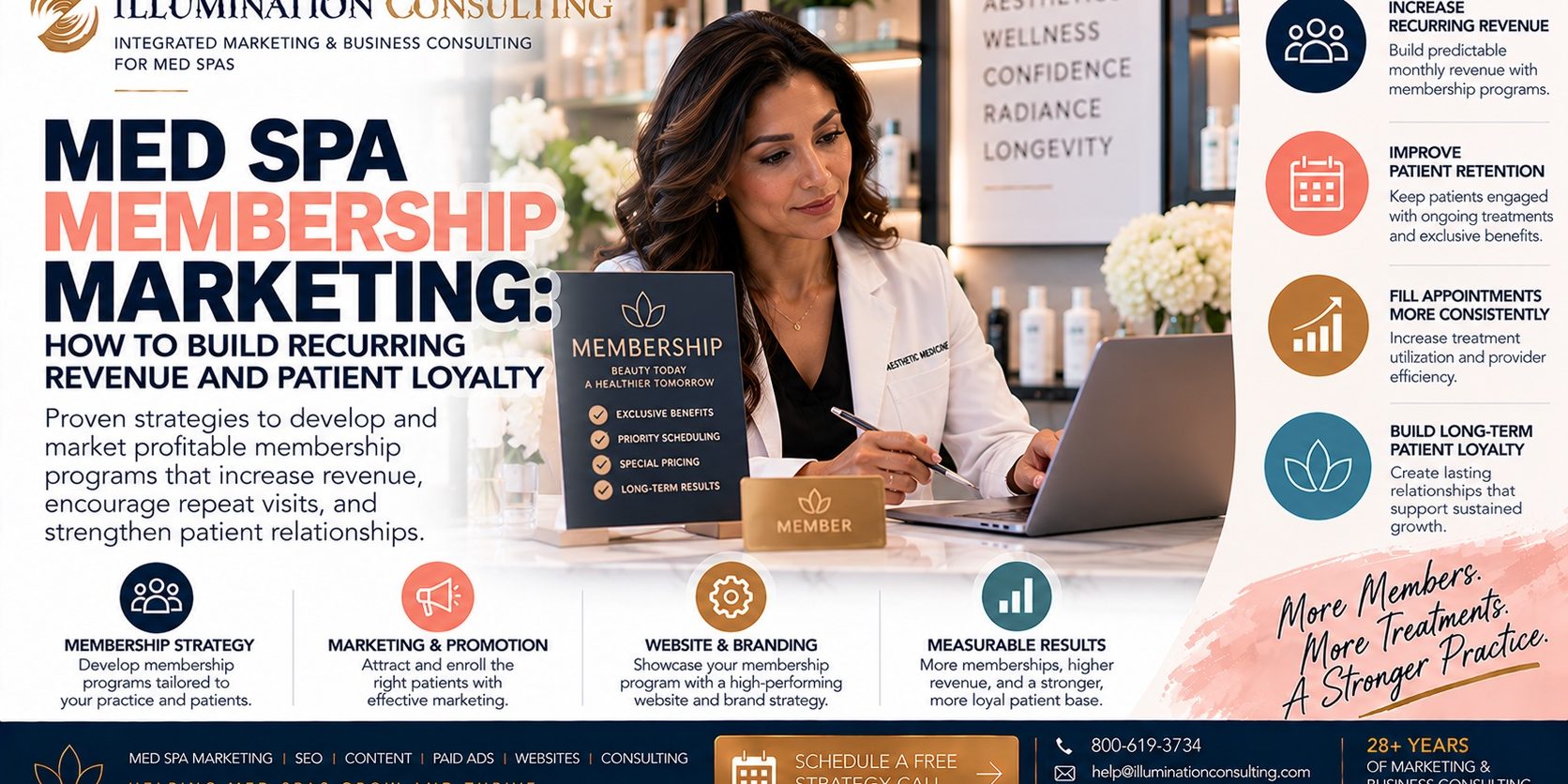
Medical spas operate in an increasingly competitive aesthetic services market where patient acquisition costs, treatment expenses, provider availability, and consumer expectations influence business performance. While attracting new patients remains essential, many practices also want to develop more predictable revenue and stronger relationships with existing patients. Membership programs can support these objectives by offering structured benefits, convenient payment arrangements, and ongoing access to selected aesthetic services.
Med spa membership marketing involves developing, positioning, promoting, and managing membership programs that deliver meaningful patient value while supporting sustainable practice economics. A successful program requires more than offering monthly discounts or collecting recurring payments. Practices must consider treatment suitability, membership pricing, service utilization, operating costs, communication, and the experience members receive throughout their relationship with the business.
For aesthetic clinics investing in professional Med Spa Marketing, memberships can become an important component of the overall growth strategy. When carefully designed, these programs may strengthen patient engagement, encourage appropriate repeat purchasing, and improve revenue visibility. However, the financial success of a membership depends on its actual contribution, fulfillment obligations, and retention performance rather than the number of enrolled patients alone.
Why Membership Programs Appeal to Medical Spas
Many aesthetic treatments involve ongoing maintenance, repeat visits, or a series of appointments. Depending on the service and individual patient needs, some patients may prefer a structured program that simplifies scheduling, provides predictable pricing, or offers benefits across multiple treatments.
From the business perspective, memberships can help practices develop recurring relationships rather than relying exclusively on one-time transactions. Monthly payments may also improve short-term revenue visibility when members remain active and the practice manages its obligations effectively.
However, recurring billing does not automatically create recurring profit. A membership that includes expensive treatments, excessive discounts, or poorly controlled benefits may generate predictable payments while weakening margins.
Practices should evaluate membership opportunities using patient demand, treatment economics, available capacity, and the long-term value of the program.
Understand the Different Types of Med Spa Memberships
Membership programs can take several forms, and the appropriate structure depends on the services offered and the practice’s business model.
Some memberships provide access to selected services at defined intervals. Others offer monthly account credits, preferential pricing, or benefits that can be applied toward eligible treatments.
A practice may also develop tiered memberships with different pricing and benefit levels.
Each model introduces different operational and financial considerations. Service-based memberships create direct fulfillment obligations, while credit-based programs require careful accounting and clear rules governing how credits are earned, used, and potentially expire.
Practices should avoid adopting a membership structure simply because a competitor offers something similar. The program must fit the clinic’s treatment portfolio, patient population, and financial requirements.
Identify Which Treatments Are Appropriate for Memberships
Not every aesthetic treatment is suitable for recurring membership benefits.
Some services may be performed periodically as part of an appropriate maintenance plan. Others require individualized clinical assessment, have longer treatment intervals, or involve costs that make frequent inclusion financially impractical.
Practices should evaluate treatment suitability before developing membership packages.
Relevant considerations include:
-
Clinical appropriateness and recommended treatment frequency
-
Direct treatment costs and provider time
-
Equipment and consumable expenses
-
Appointment availability and room utilization
-
Patient demand and purchasing behavior
-
Expected contribution per service
-
Potential follow-up requirements
Clinical professionals should determine whether treatments are appropriate for individual patients. Membership benefits should never create pressure to undergo procedures that are unnecessary or unsuitable.
Develop a Membership Value Proposition
A membership program needs a clear reason for patients to participate.
Discounts may attract attention, but they are not always sufficient to establish long-term value. Patients may also appreciate predictable spending, convenient scheduling, access to educational resources, or benefits that simplify their relationship with the practice.
The value proposition should explain what members receive, how the program works, and why it may be useful for the intended audience.
For example, a membership designed around appropriate skincare maintenance may emphasize structured benefits and convenient scheduling rather than promising dramatic aesthetic transformations.
The strongest programs communicate value accurately and make it easy for patients to understand their commitments.
Establish Profitable Med Spa Membership Pricing
Membership pricing should reflect the economic cost of delivering benefits and the revenue required to support the program.
Practices must account for treatment supplies, provider labor, equipment usage, payment processing, administrative expenses, and other relevant costs.
A simple contribution calculation is:
Monthly Membership Contribution = Monthly Membership Revenue – Monthly Variable Membership Costs
For example, a hypothetical membership priced at $149 per month may involve $55 in expected monthly variable service costs and $9 in other variable expenses.
Under these assumptions, the membership generates $85 in monthly contribution before fixed overhead and customer acquisition expenses.
Actual results depend on how frequently members use their benefits, which services they select, and whether additional purchases occur.
Practices should model different utilization scenarios rather than relying exclusively on average assumptions.
Understand Membership Utilization and Financial Risk
Membership utilization refers to how frequently members use the services or benefits included in their plans.
Utilization can significantly affect profitability.
A program may appear financially attractive when members use only a portion of their available benefits. However, if utilization increases substantially, treatment costs and provider demand may rise without corresponding increases in membership revenue.
Practices should not design programs that depend on patients forgetting to use benefits or being unable to schedule services.
Instead, membership pricing should remain sustainable under realistic utilization scenarios.
Management should also consider whether membership benefits create liabilities or future service obligations that require appropriate accounting treatment.
Build Membership Tiers Around Patient Needs
Tiered memberships can provide options for patients with different preferences and budgets.
For example, a practice may offer a basic program with limited benefits, a mid-level program with additional service options, and a premium program with expanded privileges.
However, too many tiers can create confusion and increase administrative complexity.
Each level should have a distinct purpose and clearly defined benefits.
Practices should evaluate whether higher-priced tiers generate sufficient additional contribution after accounting for the increased cost of included services.
The objective is providing meaningful choices rather than creating complicated packages that are difficult for patients or staff to understand.
Use Membership Credits Carefully
Credit-based memberships allow patients to accumulate or apply funds toward eligible services under defined program rules.
These arrangements can provide flexibility, but they also require clear financial and administrative controls.
Practices should explain how credits are earned, which services qualify, whether balances carry forward, and what happens when a membership is canceled.
Applicable laws and accounting requirements may affect how prepaid amounts, unused credits, and expiration policies are handled.
The practice should obtain appropriate professional guidance when establishing program terms.
Transparent rules help prevent misunderstandings and protect patient confidence.
Avoid Excessive Discounts in Membership Programs
Memberships are sometimes marketed primarily through discounted treatment prices.
While preferential pricing may be appropriate, excessive discounts can reduce contribution and undermine the perceived value of services.
Practices should evaluate whether members would have purchased treatments at regular prices and whether the program creates genuinely incremental revenue.
For example, converting an existing full-price patient into a heavily discounted membership may reduce profitability if the membership does not generate sufficient additional value.
A successful program should balance patient benefits with sustainable economics.
Discounts should support the membership strategy rather than serve as its only distinguishing feature.
Create a Dedicated Med Spa Membership Website Page
A membership program should have a clear, informative page on the practice website.
The page should explain available plans, pricing, included benefits, eligibility requirements, and relevant program terms.
Patients should be able to understand how enrollment works and what happens after joining.
Professional Website Design Services can help practices create membership pages that are easy to navigate and understand.
The page should also provide appropriate links to treatment information and consultation scheduling.
Clear presentation reduces administrative questions and helps patients evaluate whether the program fits their needs.
Develop a Membership SEO Strategy
Search engine optimization can help prospective patients discover med spa membership programs when researching local aesthetic services and treatment packages.
Relevant searches may include location-specific membership terms, skincare maintenance programs, and questions about membership benefits.
Practices should create useful content that explains the program rather than repeating promotional language across multiple pages.
Professional SEO Services can support membership visibility through relevant page optimization, internal linking, and local search strategies.
However, membership SEO should remain part of the broader med spa marketing strategy. The program should not compete unnecessarily with existing treatment pages targeting different search intent.
Promote Memberships Through Existing Patient Relationships
Established patients may be interested in membership programs when the benefits align with their treatment preferences and individual circumstances.
Practices can introduce memberships through appropriate consultations, educational materials, authorized email communications, and patient-facing information.
Staff should explain the program accurately without implying that enrollment is necessary to receive appropriate care.
Patients should have sufficient time to review pricing, benefits, and terms before joining.
Existing patient promotion can be effective because these individuals may already understand the practice’s services and experience.
However, marketing should respect patient privacy, communication preferences, and applicable consent requirements.
Use Email Marketing to Explain Membership Benefits
Email can help practices communicate membership availability, program features, and enrollment information.
An effective campaign should explain the intended audience, available benefits, pricing structure, and relevant terms.
Educational content may also help patients understand how certain treatments fit into appropriate long-term care plans.
Practices should avoid excessive promotional messages and misleading claims about guaranteed results.
Email marketing must comply with applicable privacy and marketing requirements.
The objective is providing useful information that helps interested patients make informed decisions.
Use Social Media to Build Membership Awareness
Social media can introduce membership programs to existing followers and prospective patients.
Content may explain membership benefits, answer common questions, highlight the patient experience, and clarify how enrollment works.
Educational videos and short informational posts can be particularly useful when programs involve several benefit options.
Practices should avoid suggesting that every patient needs recurring aesthetic treatments.
Social media messaging should emphasize appropriate services, accurate expectations, and transparent program information.
Train Staff to Explain Memberships Consistently
Membership marketing can become ineffective when patients receive inconsistent explanations from different team members.
Front-desk staff, patient coordinators, and relevant providers should understand membership pricing, benefits, eligibility, enrollment procedures, and cancellation policies.
Training should also clarify which questions require clinical input.
Staff should not recommend treatments beyond their professional qualifications or pressure patients into enrollment.
A consistent explanation helps patients understand the program and reduces confusion after joining.
Improve the Membership Enrollment Experience
Enrollment should be straightforward and transparent.
Patients should understand the monthly payment amount, billing schedule, included benefits, cancellation procedures, and any minimum commitment before authorizing recurring charges.
Practices should provide clear documentation and confirmation of enrollment.
Online enrollment may improve convenience, but systems should support accurate billing, secure payment handling, and appropriate customer records.
A simple enrollment experience helps build trust and reduces avoidable administrative problems.
Develop an Effective Member Onboarding Process
The experience immediately after enrollment can influence how members perceive the program.
New members should receive confirmation of their plan, instructions for accessing benefits, and clear information about scheduling.
Where appropriate, the practice may provide educational materials and explain how members can contact staff with questions.
Onboarding should also clarify relevant restrictions and program terms.
A reliable process helps members understand the value of their enrollment without creating unrealistic expectations.
Measure Med Spa Membership Retention
Membership retention helps practices understand how consistently members remain enrolled over time.
One useful metric is the membership retention rate.
Membership Retention Rate (%) = (Members Remaining at Period End / Members Active at Period Start) x 100
For accurate measurement, this simplified calculation should exclude new enrollments from the ending member count and track the original starting cohort.
For example, if a practice begins a quarter with 200 members and 170 of those original members remain active at the end, cohort retention is 85%.
This is an illustrative calculation rather than an industry benchmark.
Retention should be evaluated alongside patient satisfaction, utilization, contribution, and cancellation reasons.
Understand Membership Churn
Membership churn measures the percentage of members who cancel during a defined period.
Membership Churn Rate (%) = (Members From the Starting Cohort Who Canceled / Members Active at Period Start) x 100
For example, if a practice begins a month with 150 members and 9 of those members cancel during the month, the starting-cohort churn rate is 6%.
Practices should use consistent definitions and distinguish voluntary cancellations from failed payments, administrative closures, or other membership changes.
Churn analysis can reveal problems involving pricing, benefit relevance, scheduling availability, or customer experience.
The objective is understanding why members leave and whether improvements are appropriate.
Evaluate Membership Lifetime Value
Membership lifetime value estimates the financial contribution generated by a member during the relationship.
A simplified model is:
Estimated Membership Lifetime Contribution = Average Monthly Contribution per Member x Expected Membership Duration in Months
For example, if a hypothetical membership generates $75 in average monthly contribution and members remain active for an average of 12 months, estimated lifetime contribution is $900 before acquisition costs and other expenses not included in the monthly contribution figure.
Actual performance depends on retention patterns, benefit utilization, additional purchases, and operating conditions.
Practices should use observed data whenever possible rather than relying on optimistic assumptions.
Track Membership Acquisition Costs
Membership acquisition cost measures the investment required to enroll new members under a defined methodology.
Membership Acquisition Cost = Defined Membership Acquisition Spending / New Members Acquired
For example, if a practice spends $2,400 on a membership campaign and enrolls 24 new members, the calculated acquisition cost is $100 per member.
Whether this cost is financially acceptable depends on expected contribution, retention, and the cost of fulfilling benefits.
A program with low acquisition costs may still perform poorly if members cancel quickly or utilization expenses exceed expectations.
Acquisition reporting should therefore be connected to long-term membership economics.
Coordinate Memberships With Provider Capacity
Membership programs can influence appointment demand and provider utilization.
When members receive recurring treatment benefits, the practice must ensure that sufficient appointment capacity is available to deliver those services.
A program that enrolls more members than the clinic can reasonably accommodate may create scheduling delays and dissatisfaction.
Management should evaluate provider schedules, treatment-room availability, equipment requirements, and seasonal demand.
Membership growth should be coordinated with operational capacity rather than managed exclusively through marketing targets.
Improve Member Retention Through Customer Experience
Membership retention depends on more than pricing and benefits.
Members may value convenient scheduling, consistent communication, professional treatment, accurate billing, and responsive customer service.
Practices should regularly evaluate member feedback and identify recurring operational concerns.
A program that is financially attractive on paper may still experience high churn when members struggle to access benefits or misunderstand program terms.
Improving the experience can support retention without requiring increasingly generous discounts.
Evaluate Membership Program Profitability
Membership profitability should be reviewed using collected revenue, fulfillment costs, administrative expenses, acquisition costs, and relevant liabilities.
A practice should distinguish recurring payments from earned revenue and recognize obligations according to applicable accounting requirements.
Management should also evaluate whether memberships affect full-price service purchases and overall treatment contribution.
For example, a program may increase patient visit frequency while reducing average contribution per visit.
The appropriate objective is sustainable financial performance combined with meaningful patient value.
Develop a 90-Day Med Spa Membership Marketing Plan
A structured implementation plan helps practices evaluate membership opportunities before committing substantial resources.
Days 1–30: Evaluate Membership Feasibility
Review patient demand, treatment suitability, service contribution, provider capacity, and existing purchasing patterns.
Identify the services and benefits that may support a sustainable membership model.
Develop preliminary pricing scenarios and evaluate utilization risk.
Review relevant legal, billing, and accounting requirements before finalizing program terms.
Days 31–60: Develop and Prepare the Program
Finalize membership tiers, pricing, benefits, and enrollment procedures.
Create a dedicated website page, educational materials, and appropriate marketing communications.
Train staff and configure billing, scheduling, and reporting systems.
Test enrollment and cancellation processes before launching the program.
Days 61–90: Launch and Measure Performance
Introduce the membership program to appropriate audiences through the website, authorized patient communications, and relevant marketing channels.
Monitor enrollment, utilization, contribution, scheduling capacity, and patient feedback.
Evaluate early retention indicators while recognizing that meaningful lifetime value data requires longer observation.
Adjust the program based on actual operating results rather than enrollment volume alone.
Common Med Spa Membership Marketing Mistakes
Medical spas can undermine membership performance through several recurring problems.
Setting prices without modeling utilization. Memberships may become unprofitable when service usage exceeds expectations.
Offering excessive discounts. Aggressive pricing can reduce contribution and weaken the value of existing services.
Creating complicated membership tiers. Too many options may confuse patients and increase administrative workload.
Failing to explain cancellation terms. Unclear policies can damage trust and create billing disputes.
Ignoring provider capacity. Membership growth can create scheduling problems when benefits cannot be delivered conveniently.
Measuring enrollment without profitability. A large member base does not automatically indicate a financially successful program.
Depending on unused benefits for profit. Programs should provide meaningful value and remain sustainable under realistic utilization.
Promoting unnecessary treatments. Clinical recommendations must remain independent of membership revenue objectives.
Avoiding these mistakes requires coordination between clinical leadership, finance, operations, and marketing.
Build a Sustainable Med Spa Membership Growth Strategy
Med spa memberships can provide meaningful benefits for patients while helping practices develop more predictable business relationships. However, successful programs require careful planning, transparent pricing, appropriate treatment selection, and consistent operational execution.
Effective med spa membership marketing connects program design with patient demand, website visibility, educational content, enrollment processes, and long-term retention. Practices that evaluate membership economics and patient experience together are better positioned to build programs that support sustainable growth.
Illumination Consulting helps aesthetic clinics connect Med Spa Marketing, Med Spa Business Consulting, Website Design Services, and business growth planning into coordinated strategies. Our objective is to help medical spas improve patient acquisition, strengthen retention, develop sustainable revenue opportunities, and build more profitable businesses.
Frequently Asked Questions
What is med spa membership marketing?
Med spa membership marketing involves promoting structured membership programs that provide defined benefits, recurring payment arrangements, or access to selected aesthetic services. Effective programs balance patient value with sustainable financial performance.
How can a med spa create a profitable membership program?
Practices should evaluate treatment costs, utilization, provider capacity, pricing, retention, and acquisition expenses. Membership benefits should be clinically appropriate and financially sustainable under realistic usage scenarios.
What services work best for med spa memberships?
The appropriate services depend on the clinic’s treatment portfolio, provider qualifications, patient needs, and treatment economics. Services involving suitable ongoing maintenance may be candidates, but clinical appropriateness must determine individual treatment recommendations.
How do med spas increase membership enrollment?
Practices can improve enrollment through clear website information, transparent pricing, patient education, appropriate email marketing, social media awareness, and consistent staff communication. Enrollment should remain voluntary and informed.
How should med spas measure membership success?
Important metrics include enrollment, retention, churn, utilization, monthly contribution, acquisition cost, member satisfaction, and overall program profitability. No single metric provides a complete picture of membership performance.