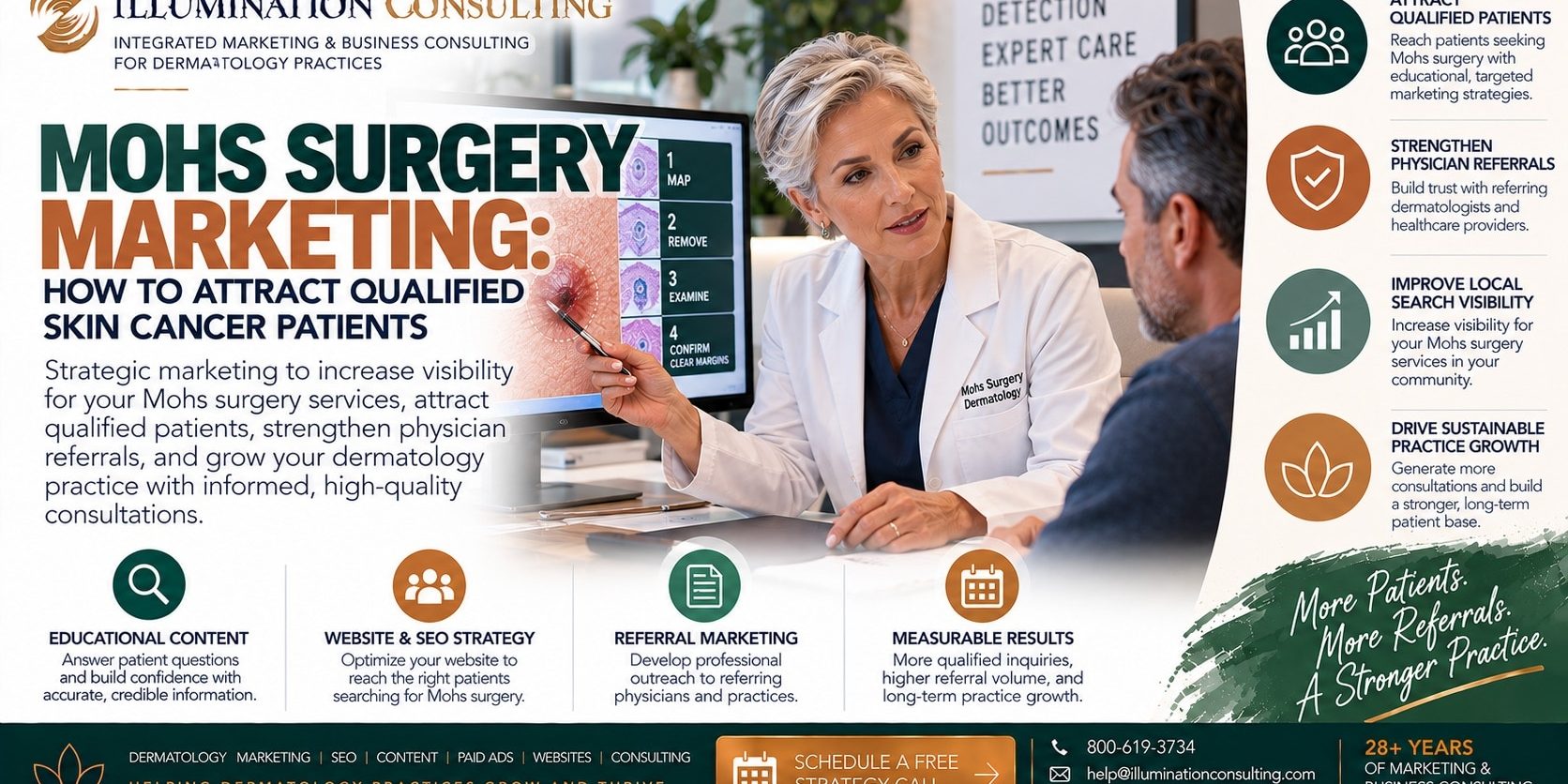
Skin cancer diagnosis and treatment represent an important part of medical dermatology, requiring specialized clinical expertise, effective patient communication, and coordinated access to appropriate care. Dermatology practices offering Mohs micrographic surgery must establish visibility among patients researching treatment options while also developing professional relationships with referring physicians. Unlike elective aesthetic services, marketing for skin cancer treatment requires particular sensitivity because patients may be dealing with a serious diagnosis, uncertainty about treatment, and concerns about recovery or long-term outcomes.
Mohs surgery marketing involves helping patients and referring healthcare professionals find qualified dermatologic surgeons through accurate educational content, professional positioning, local search visibility, and effective referral communication. Successful strategies emphasize clinical qualifications, treatment indications, consultation requirements, and patient access rather than aggressive promotional tactics. Practices should explain the role of Mohs surgery without suggesting that it is appropriate for every skin cancer or that treatment outcomes can be guaranteed. Marketing should support informed decisions and timely access to qualified medical evaluation.
For dermatology practices investing in professional Dermatology Marketing, Mohs surgery can be a distinct service line requiring its own content strategy, referral development efforts, and performance measurements. Practices that coordinate clinical expertise, website information, patient scheduling, and professional outreach can improve access to appropriate patients while supporting sustainable practice growth. The objective is to strengthen the practice’s visibility and reputation without compromising clinical standards or patient trust.
Why Mohs Surgery Requires Specialized Marketing
Mohs micrographic surgery is a specialized technique used to treat certain skin cancers by removing tissue in stages and examining the margins microscopically during the procedure. It is commonly considered for selected skin cancers where tissue preservation, location, recurrence risk, and other clinical factors make precise margin assessment particularly valuable. Treatment selection depends on the diagnosis and individual patient circumstances, and not every skin cancer requires Mohs surgery. Because of these distinctions, marketing content must be medically accurate and reviewed by appropriately qualified professionals.
Patients researching Mohs surgery may have recently received a diagnosis or been referred by another physician. Their questions often involve why the procedure was recommended, what happens during surgery, how long treatment takes, and what recovery may involve. Some patients may also want to understand whether their insurance is accepted and how to obtain an appointment. Marketing that addresses these practical concerns can be more useful than broad promotional messaging about cosmetic outcomes or practice growth.
Understand the Mohs Surgery Patient Journey
The patient journey for Mohs surgery often differs from the process associated with elective dermatology or aesthetic treatments. Many patients first learn about the procedure after a biopsy result, consultation, or referral from a dermatologist or another healthcare professional. Others independently research treatment options after receiving information about a skin cancer diagnosis. The practice website may therefore serve as an important source of education and reassurance during a period when patients need clear, reliable information.
A typical patient may begin by researching the procedure, reviewing the surgeon’s qualifications, confirming insurance participation, and understanding the referral or scheduling process. The patient may also need instructions about medical records, pathology reports, medication information, and preoperative preparation. Practices that make these requirements easy to understand can reduce administrative confusion and improve the patient experience. The marketing strategy should support this journey by connecting relevant search visibility with practical scheduling and educational resources.
Position the Practice Around Relevant Clinical Expertise
Professional qualifications are central to how patients and referring physicians evaluate a Mohs surgery provider. A practice should clearly identify the physicians performing Mohs procedures and accurately describe their medical education, board certifications, fellowship training where applicable, and relevant clinical experience. Information should be current, verifiable, and presented in a way that helps patients understand the surgeon’s background. Practices should avoid unsupported claims of superiority or guarantees regarding treatment outcomes.
Surgeon biography pages should also explain the physician’s role within the practice and provide clear links to the Mohs surgery service page. Where appropriate, professional memberships, teaching activities, publications, or other relevant experience may provide additional context. These details should support an accurate representation of expertise rather than become an exercise in promotional exaggeration. For a medically specialized service, credible information is often more valuable than aggressive advertising language.
Develop a Dedicated Mohs Surgery Website Page
A dedicated Mohs surgery page should serve as the central educational and conversion resource for the service line. It should explain the procedure in understandable language, describe the types of circumstances in which Mohs surgery may be considered, and outline what patients can expect before, during, and after treatment. The page should also identify the surgeon or surgeons providing the service and explain how patients can arrange an evaluation or schedule an appointment following a referral. This combination of clinical information and practical guidance helps prospective patients move from research to appropriate care.
The page should be organized around genuine patient questions rather than excessive keyword repetition. Important information may include consultation requirements, the potential need for previous pathology records, insurance verification, postoperative instructions, and the availability of additional educational resources. Professional Website Design Services can help dermatology practices present this information through accessible navigation and clear page structure. The website should also function reliably on mobile devices, since patients and family members may research treatment options using smartphones.
Build a Mohs Surgery SEO Strategy Around Patient Intent
Search engine optimization helps patients discover relevant medical services when they search for qualified providers, treatment information, and local appointment options. For Mohs surgery, search intent may include finding a surgeon nearby, understanding the procedure, comparing treatment approaches, or learning about recovery. A useful SEO strategy should address these different needs through a dedicated service page and supporting educational content. The practice should prioritize accuracy, relevance, and accessibility rather than producing numerous pages targeting minor variations of the same keyword.
Location-specific visibility is particularly important for practices serving a defined geographic market. Website content should accurately communicate the practice’s actual location, the availability of Mohs surgery, and the process for requesting an appointment. Professional SEO Services can support technical optimization, relevant content development, and local search performance. However, no SEO campaign should promise particular rankings or patient volumes, especially when local competition and search behavior vary.
Create Educational Content About Mohs Surgery
Patients often have questions that cannot be answered adequately through a brief service description. Supporting articles can explain the general purpose of Mohs surgery, how it differs from other treatment approaches, and why a physician may recommend it in selected circumstances. Additional topics may address what happens on the day of surgery, why the appointment may take several hours, and what patients should discuss with their care team before treatment. Educational content should reinforce that treatment recommendations depend on individual medical circumstances.
A useful content strategy may also address wound care, recovery expectations, scar considerations, and follow-up appointments at a general educational level. These articles should be reviewed by qualified clinical professionals and should not replace individualized medical instructions. Professional Content Marketing can help organize topics into a coherent resource library that supports both patients and referring physicians. Internal links should guide readers naturally between the main Mohs surgery page, surgeon biographies, and related educational materials.
Explain Treatment Indications Without Overpromising Results
Mohs surgery is frequently discussed in connection with its tissue-sparing approach and precise examination of surgical margins. However, marketing should not imply that the procedure is necessary for every skin cancer or that it guarantees a particular clinical or cosmetic outcome. The appropriate treatment depends on factors such as cancer type, location, size, recurrence risk, and the patient’s overall medical circumstances. Accurate explanations help patients understand why individualized evaluation is essential.
Practices should also be cautious when presenting cure rates or comparisons with other treatment methods. Published outcomes may depend on the patient population, tumor characteristics, and study methodology, and generalized figures may not apply to an individual case. Any numerical claims used in marketing should be supported by credible clinical sources and presented with appropriate context. The objective is to educate patients about the procedure’s role rather than use statistics to create unrealistic expectations.
Improve Local Search Visibility for Mohs Surgery
Patients seeking Mohs surgery frequently look for qualified care within a practical travel distance. Practices should ensure that their Google Business Profile, website, and other relevant business listings contain accurate contact information, office locations, and service details. When appropriate, the practice should clearly identify which locations actually provide Mohs surgery rather than implying that every office offers the same services. Accurate information helps patients avoid unnecessary travel and reduces confusion when scheduling.
Local search visibility also depends on the quality and relevance of the website’s content. A dedicated service page can help search engines and prospective patients understand the practice’s Mohs surgery offering. Location pages should provide genuine information about each office and avoid repetitive content created solely to target geographic keywords. Practices should monitor search performance and update information when providers, locations, or scheduling arrangements change.
Develop Professional Physician Referral Relationships
Physician referrals can be an important source of appropriate Mohs surgery patients. Dermatologists who do not perform Mohs procedures may refer selected patients to qualified surgeons, while other healthcare professionals may direct patients for specialized evaluation when clinically appropriate. Building these relationships requires professional credibility, clear communication, and dependable coordination of care. Marketing should support referring physicians by making it easy to understand the practice’s qualifications, services, and referral process.
Professional outreach may include educational introductions, accurate service information, physician biographies, and clearly documented referral procedures. Practices should avoid financial incentives or arrangements that conflict with applicable referral laws and professional standards. A successful referral relationship is built on clinical appropriateness and confidence in the receiving practice. Consistent communication and respect for the referring physician’s role can help support continuity of care.
Create a Reliable Referral Intake Process
A practice can lose valuable time when referral information is incomplete or difficult to process. Patients may need pathology documentation, relevant medical records, insurance information, and other details before a procedure can be scheduled. Administrative teams should have clear workflows for receiving and reviewing referrals while ensuring that clinical decisions remain under the direction of qualified professionals. A well-organized intake process can reduce unnecessary delays and repeated requests for information.
Referral instructions should be accessible to referring offices and appropriately communicated to patients. Practices may provide a secure referral channel, contact information for scheduling assistance, and a clear explanation of documentation requirements. Staff should understand when incomplete or concerning information requires clinical review rather than routine administrative handling. Effective referral coordination improves the experience for patients and professional partners while supporting operational efficiency.
Make Insurance and Financial Information Accessible
Insurance coverage and potential out-of-pocket expenses are important practical concerns for many patients seeking Mohs surgery. Coverage depends on the patient’s plan, medical circumstances, provider participation, and applicable authorization requirements. Practices should clearly explain how insurance verification works and what patients may need to provide before their appointment. When relevant, patients should also understand that professional fees, facility arrangements, reconstruction, or other services may involve separate billing considerations.
Website content should avoid promising coverage or quoting universal patient costs when individual circumstances differ. Administrative staff should provide accurate information within their responsibilities and direct complex questions to the appropriate billing specialists or insurers. Transparent financial communication can reduce anxiety and help patients prepare for treatment. It also supports a more professional patient experience by minimizing avoidable surprises.
Use Video to Explain the Mohs Surgery Experience
Educational video can make specialized medical information more accessible to patients who are unfamiliar with Mohs surgery. A qualified surgeon may explain the general treatment process, the staged examination of tissue, the possibility of waiting between stages, and the importance of postoperative instructions. These explanations can help patients prepare questions and understand why the appointment may differ from a routine office visit. Video content should remain informative rather than suggesting that the procedure is simple or free of risk.
Practices may incorporate videos into their Mohs surgery service page, patient education library, and appropriate social media communications. Production quality should support clear audio, readable visuals, and a professional presentation, but elaborate production is not necessary for every educational topic. Any patient images or testimonials must be used with appropriate authorization and privacy safeguards. The primary objective is improving understanding and confidence through accurate communication.
Manage Online Reputation With Patient Privacy in Mind
Patients researching Mohs surgery may review a practice’s online reputation as part of their decision-making process. Reviews can provide insight into scheduling, communication, staff professionalism, and the overall patient experience, although they cannot independently establish clinical quality. Practices should monitor feedback and respond professionally without confirming that a reviewer is a patient or disclosing protected health information. Public responses should focus on general service standards and appropriate channels for addressing concerns.
Reputation management should also include internal evaluation of recurring feedback. If patients consistently report difficulty scheduling appointments or obtaining preparation instructions, those patterns may indicate operational problems worth addressing. Practices should not rely exclusively on positive review volume as evidence of successful patient care. A stronger approach combines professional communication, patient experience improvements, and accurate public information.
Coordinate Marketing With Surgical Scheduling Capacity
Marketing initiatives should reflect the practice’s actual ability to accommodate patients requiring Mohs surgery. Appointment availability depends on surgeon schedules, staffing, treatment-room capacity, pathology processing arrangements, and the time required for individual cases. Because some procedures require multiple stages, practices must account for variability rather than treating every appointment as a fixed-duration service. Increasing inquiries without adequate scheduling capacity may create unnecessary delays and patient frustration.
Clinical leadership and administrative management should review capacity before expanding promotional activities. If the practice has available appointment capacity, improving referral coordination and local visibility may help appropriate patients access care. When schedules are already heavily utilized, operational improvements may be more valuable than additional advertising. The objective is matching qualified patient demand with the resources needed to deliver safe, timely, and appropriate treatment.
Measure Mohs Surgery Marketing Performance
Dermatology practices should measure marketing performance through meaningful patient access, referral, and operational indicators. Website traffic and search rankings can demonstrate visibility, but they do not establish whether prospective patients receive appropriate care. Management should also evaluate qualified inquiries, completed referral submissions, consultation scheduling, and completed appointments. These measurements help identify whether the marketing strategy is generating relevant demand and whether administrative systems are effectively supporting patients.
Useful performance indicators include organic search visibility for Mohs-related terms, traffic to the primary service page, appointment inquiries, referral volume, referral processing time, completed consultations, and patient scheduling experience. Practices may also evaluate acquisition costs and service-line financial performance using appropriate accounting methods. Reporting should distinguish patients referred for evaluation from those ultimately receiving Mohs surgery, because treatment decisions depend on clinical suitability. Consistent measurement enables management to improve marketing efficiency without treating surgical volume as the only indicator of success.
Evaluate Patient Acquisition Costs Responsibly
Patient acquisition cost can help practices understand the relationship between marketing investment and completed patient appointments. However, Mohs surgery marketing may involve both direct patient inquiries and physician referrals, making attribution more complex than in some elective services. Practices should establish consistent definitions for the expenses and outcomes included in their calculations. They should also avoid assigning all referred patients to a particular campaign without reliable evidence.
A simplified calculation is:
Patient Acquisition Cost = Defined Marketing Expenditure / New Patients Attributed to Marketing
For example, a hypothetical dermatology practice that spends $4,000 on a defined marketing initiative and attributes 20 new patients to that activity would calculate an acquisition cost of $200 per patient. This is an illustrative example, not an industry benchmark or a recommended spending target. Financial analysis should consider collected revenue, relevant service costs, referral patterns, and the practice’s overall operating structure. Acquisition efficiency is useful for business planning, but clinical appropriateness must remain independent of marketing performance.
Strengthen Patient Communication Before Surgery
Clear preoperative communication is an important component of the patient experience. Patients may need information about appointment duration, transportation considerations, medication questions, documentation requirements, and the possibility of additional care following the procedure. These instructions should come from the clinical team and reflect the patient’s individual circumstances. Marketing and administrative staff can support the process by ensuring that approved information is accessible and delivered through appropriate communication channels.
The practice website may include general preparation resources and frequently asked questions, while individualized instructions should be communicated through authorized clinical systems. Appointment reminders can help patients remember scheduling details and understand where to obtain assistance. Practices should avoid including unnecessary sensitive medical information in routine messages and should follow applicable privacy requirements. Consistent communication can reduce confusion and help patients arrive better prepared for their appointments.
Support Postoperative Education and Continuity of Care
The patient experience continues after Mohs surgery, making postoperative communication an important part of the overall service strategy. Patients may need wound-care instructions, follow-up appointments, information about warning signs, or coordination with other qualified professionals. The appropriate instructions and follow-up schedule depend on the procedure and individual clinical circumstances. Practices should ensure that patients understand how to contact the clinical team when questions or concerns arise.
Educational website content can reinforce general information about recovery and follow-up, but it should never replace individualized medical instructions. Practices should also distinguish routine patient education from promotional marketing communications. A patient-centered approach supports continuity of care and helps maintain professional trust after treatment. Operationally, reliable postoperative communication may also reduce avoidable administrative confusion and improve coordination across the practice.
Develop a 90-Day Mohs Surgery Marketing Plan
A structured marketing plan can help dermatology practices improve visibility and patient access without introducing unnecessary operational complexity. The initial priority should be evaluating the practice’s existing clinical capabilities, referral processes, website content, and scheduling capacity. Marketing improvements can then be implemented around verified service availability and genuine patient information needs. The following framework provides a practical sequence for assessing and improving Mohs surgery marketing.
Days 1–30: Audit Visibility, Referrals, and Patient Access
Begin by reviewing the existing Mohs surgery service page, surgeon biographies, local search presence, and patient educational resources. Evaluate whether patients can easily find information about qualifications, appointment requirements, insurance verification, and the referral process. Management should also examine referral intake procedures, scheduling delays, and recurring administrative questions. These findings establish a baseline for determining which improvements are most important.
During this period, review search performance and identify relevant patient questions that are not adequately addressed by the website. Clinical leadership should confirm that public information accurately describes available services and provider qualifications. Referral partners may also benefit from clearer instructions or updated contact information. By the end of the first month, the practice should have a prioritized improvement plan supported by operational and marketing evidence.
Days 31–60: Improve Content and Referral Communication
The second phase should focus on implementing high-priority website and communication improvements. Update the Mohs surgery page with clear educational information, accurate surgeon credentials, and practical scheduling instructions. Develop supporting articles that address distinct patient questions and connect them through relevant internal links. Ensure that all clinical content receives appropriate professional review before publication.
At the same time, improve referral materials and administrative workflows where necessary. Staff should understand documentation requirements, scheduling responsibilities, and procedures for escalating clinical questions. Local business information should be reviewed for accuracy, and any advertising initiatives should reflect actual appointment capacity. These improvements create a stronger foundation for qualified patient inquiries and professional referrals.
Days 61–90: Measure Performance and Refine the Strategy
The final phase should evaluate changes in search visibility, relevant website engagement, referral processing, qualified inquiries, and appointment completion. Management should also review patient feedback and determine whether communication improvements have reduced common sources of confusion. Results should be compared with the original baseline while accounting for normal fluctuations in demand. A short measurement period may provide useful directional information, but it is not sufficient to establish every long-term outcome.
Successful improvements can be incorporated into ongoing website maintenance, patient education, and referral coordination. Initiatives that generate irrelevant inquiries or create administrative difficulties should be reconsidered. The practice should continue reviewing clinical capacity and patient access as demand changes. This approach supports gradual, measurable improvement rather than relying on unrealistic growth projections.
Common Mohs Surgery Marketing Mistakes
Specialized dermatology marketing can become ineffective when practices prioritize promotional visibility without addressing the clinical and operational requirements of the service. One common mistake is publishing generic skin cancer content that provides little information about the actual Mohs surgery offering. Another is failing to identify the qualified surgeon or explain the referral and appointment process. These gaps can make it difficult for prospective patients to determine whether the practice is appropriate for their needs.
Practices may also weaken their credibility by making unsupported cure-rate claims, using misleading comparisons, or suggesting that Mohs surgery is necessary for every skin cancer. Inaccurate insurance information and unclear scheduling instructions can create additional frustration. Marketing campaigns that generate more inquiries than the practice can accommodate may further compromise the patient experience. Effective marketing requires accurate information, responsible messaging, and coordination with clinical operations.
A separate mistake is evaluating success exclusively through traffic, rankings, or surgical volume. These measurements do not reveal whether the practice is attracting appropriate patients or providing a satisfactory experience. Management should evaluate referral quality, appointment access, administrative efficiency, and relevant financial outcomes together. This broader perspective helps ensure that marketing supports the practice’s medical responsibilities and business objectives.
Build a Sustainable Mohs Surgery Marketing Strategy
Successful Mohs surgery marketing begins with understanding the needs of patients and referring healthcare professionals. Patients require accurate information, qualified clinical expertise, clear appointment instructions, and realistic expectations about treatment. Referring physicians need dependable communication and confidence that patients will receive appropriate evaluation. Marketing should connect these needs through credible website content, local visibility, professional education, and efficient administrative systems.
Dermatology practices that coordinate their marketing with clinical operations can improve the accessibility and effectiveness of specialized services. Dedicated procedure pages, medically reviewed educational content, accurate physician positioning, and reliable referral workflows create a stronger foundation than promotional campaigns alone. Consistent performance measurement can help practices identify opportunities to improve visibility, patient experience, and operational efficiency. These strategies support sustainable growth while keeping patient care at the center of the business.
Illumination Consulting helps dermatology practices develop coordinated strategies involving Dermatology Marketing, Content Marketing, website development, search visibility, and practice growth planning. With more than 28 years of business consulting and marketing experience, we help medical practices strengthen their digital presence and connect with appropriate audiences. Our services combine strategic planning with practical implementation tailored to the needs of each organization. Contact Illumination Consulting to discuss your dermatology practice’s marketing and growth objectives.
Frequently Asked Questions
What is Mohs surgery marketing?
Mohs surgery marketing involves improving the visibility of qualified dermatologic surgeons through educational website content, local search optimization, professional referral relationships, and patient communication. Its purpose is to help appropriate patients and referring physicians find relevant clinical expertise. Effective marketing emphasizes accurate treatment information, surgeon qualifications, and accessible scheduling rather than aggressive promotion.
How can dermatology practices attract more Mohs surgery patients?
Practices can improve qualified patient inquiries by developing dedicated Mohs surgery pages, strengthening local search visibility, publishing medically reviewed educational content, and improving physician referral communication. Accurate surgeon biographies and clear appointment instructions can also help prospective patients evaluate the practice. Marketing initiatives should be coordinated with clinical capacity and appropriate treatment indications.
How important is SEO for Mohs surgery practices?
SEO can help patients and referring professionals discover relevant information when researching Mohs surgery providers and treatment options. A strong strategy includes a useful primary service page, accurate local business information, and supporting educational articles that address distinct patient questions. Search visibility should be evaluated alongside qualified inquiries and appointment outcomes rather than rankings alone.
What should a Mohs surgery website page include?
A Mohs surgery page should explain the general procedure, circumstances in which it may be considered, relevant surgeon qualifications, consultation requirements, and practical scheduling information. It may also provide general information about recovery, insurance verification, and preparation. Clinical content should be accurate, appropriately reviewed, and supported by clear navigation to related patient resources.
How can dermatology practices improve Mohs surgery referrals?
Practices can strengthen referral relationships by providing accurate physician information, clear referral instructions, secure documentation channels, and reliable communication with referring offices. Administrative teams should understand how to process referrals efficiently while directing clinical decisions to qualified professionals. Referral development must follow applicable legal and professional standards.