Launching a skincare product line requires more than creating an appealing formula and attractive packaging. Every moisturizer, serum, cleanser, and treatment product involves manufacturing expenses that directly influence profitability, cash flow, pricing, and long-term business sustainability. Entrepreneurs often underestimate these costs because they focus on the manufacturer’s quoted price per unit rather than the total investment required to develop, manufacture, package, and deliver a finished product.
Skincare product manufacturing costs depend on several factors, including formulation complexity, ingredient selection, packaging specifications, testing requirements, production quantities, and supplier arrangements. Private-label products may reduce initial formulation expenses, while custom formulations can require greater investment in research, development, and testing. Neither approach automatically produces better financial results, because the total cost depends on manufacturing agreements, minimum order quantities, and the business’s intended distribution strategy.
For entrepreneurs launching a skincare brand or established companies expanding their product portfolios, understanding these expenses is essential to making sound financial decisions. A product may have an attractive retail price but still generate disappointing profits if manufacturing costs, inventory commitments, and operating expenses are underestimated. Working with experienced skin care business consultants can help businesses evaluate manufacturing options, establish realistic budgets, and align product development with commercial objectives.
What Does It Cost to Manufacture a Skincare Product?
The cost of manufacturing a skincare product varies according to the product’s formulation, packaging, production volume, and manufacturing requirements. A basic cleanser produced using an established formula and stock packaging may involve considerably different expenses from a custom facial serum containing specialized ingredients and premium components. Manufacturing volume also influences pricing because certain production expenses can be distributed across a larger number of finished units.
There is no single manufacturing cost that applies to every skincare product. General estimates found online may exclude packaging, testing, freight, or development expenses, making them unreliable for financial planning. A better approach is to obtain detailed supplier quotations and calculate the complete cost of receiving finished, saleable inventory. This allows entrepreneurs to evaluate the financial requirements of a specific product rather than relying on broad industry assumptions.
The Main Categories of Skincare Manufacturing Costs
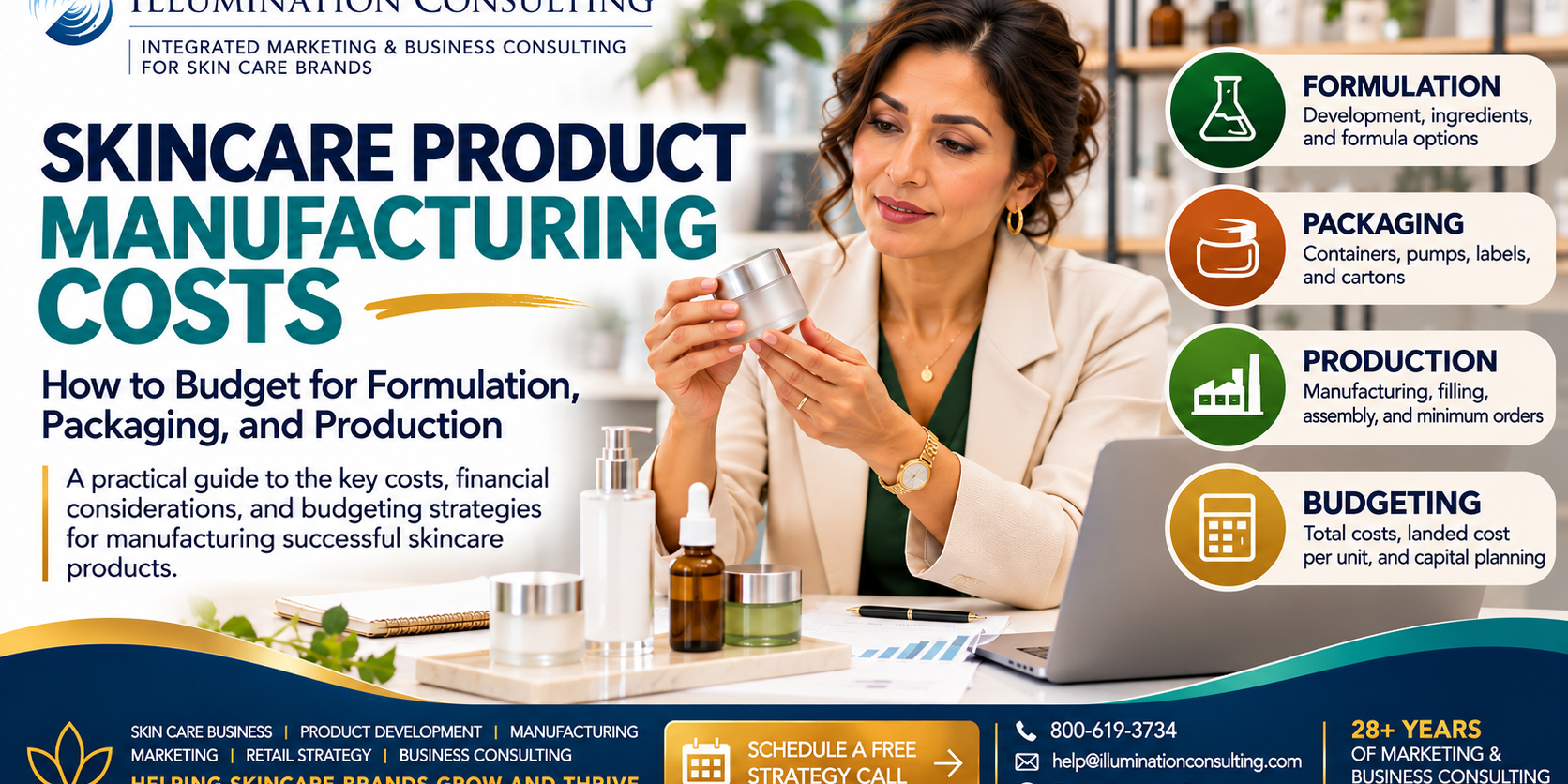
A comprehensive manufacturing budget should account for the following expenses:
-
Formulation development: Creating, modifying, or licensing a skincare formula.
-
Raw materials: Purchasing ingredients required for commercial production.
-
Packaging: Bottles, jars, tubes, pumps, caps, labels, cartons, and related components.
-
Testing and quality control: Evaluating stability, microbiological quality, packaging compatibility, and other applicable requirements.
-
Manufacturing and filling: Producing, filling, sealing, labeling, and assembling finished products.
-
Regulatory and documentation expenses: Supporting applicable product safety, labeling, and compliance requirements.
-
Freight and receiving: Transporting ingredients, packaging, and finished inventory between suppliers, manufacturers, and warehouses.
-
Production contingencies: Maintaining financial flexibility for unexpected expenses, delays, or additional production requirements.
Not every manufacturer separates these expenses in the same way. Some offer turnkey manufacturing arrangements that include formulation, packaging, filling, and assembly within a finished-unit quotation, while others charge separately for development and production services. Businesses should establish exactly what is included before comparing prices or committing to a manufacturing agreement.
Private-Label Versus Custom Skincare Manufacturing Costs
One of the earliest financial decisions for a skincare brand is whether to manufacture products using existing formulas or develop custom formulations. Both approaches can support successful businesses, but they involve different development requirements, capital commitments, and long-term considerations. The appropriate choice depends on the company’s available resources, competitive positioning, target customers, and desired level of product differentiation.
Private-Label Skincare Manufacturing
Private-label skincare typically uses formulas already developed by a manufacturer. This approach may reduce initial development expenses and allow a business to focus more resources on branding, packaging, marketing, and customer acquisition. It can also simplify certain development activities because the manufacturer may already have established production processes and product specifications.
However, private labeling does not eliminate the need to evaluate product quality, labeling, testing, and supplier agreements. Entrepreneurs should determine whether the formulas are available to competing brands, whether customization is permitted, and what minimum production quantities apply. They should also confirm whether packaging and labeling are included in the manufacturer’s quotation. These details influence the actual investment required and the brand’s ability to differentiate itself in the marketplace.
Custom Skincare Formulation
Custom formulation involves developing a product around specific ingredients, performance characteristics, sensory preferences, or brand requirements. This approach can provide greater opportunities for differentiation, particularly when the company has identified a clear customer need that existing products do not adequately address. Development may involve laboratory samples, formulation revisions, compatibility evaluations, and additional testing before commercial manufacturing begins.
Custom formulation can introduce greater development complexity, although actual expenses depend on the laboratory and manufacturing agreement. Businesses should clarify whether they are paying for formulation services, acquiring ownership rights, licensing a formula, or purchasing manufacturing services under a supplier-controlled arrangement. These contractual distinctions are important because the ability to transfer production to another manufacturer can affect future negotiating power, operational flexibility, and business continuity.
How to Choose the Right Manufacturing Approach
Before selecting private-label or custom development, evaluate:
-
Available capital for formulation, testing, and inventory.
-
The level of product differentiation required.
-
Expected development and launch timelines.
-
Formula ownership and transfer rights.
-
Minimum production quantities.
-
Recurring manufacturing costs.
-
Long-term supplier dependence.
-
Compatibility with planned sales channels.
The lowest upfront development expense is not necessarily the most economical option over the life of the business. Entrepreneurs should evaluate initial investment alongside recurring production costs, product positioning, and the flexibility needed to support future growth.
Skincare Formulation and Ingredient Costs
Ingredients represent a recurring manufacturing expense and can significantly influence the cost of each finished skincare product. Formulations may include humectants, emollients, emulsifiers, preservatives, botanical extracts, fragrances, and other ingredients selected for their intended functions. The total ingredient cost depends on ingredient specifications, concentrations, sourcing arrangements, manufacturing losses, and production volume.
A brand should not assume that expensive ingredients automatically produce a superior product. Formulation performance depends on how ingredients work together, their suitability for the intended application, and the quality of the overall development process. Financial planning should balance product objectives with formulation feasibility and realistic manufacturing targets. This approach helps prevent situations where ingredient costs make the finished product commercially impractical.
Factors That Increase Skincare Ingredient Costs
Several considerations can influence ingredient spending:
-
Specialized or difficult-to-source raw materials.
-
Supplier minimum purchase quantities.
-
Ingredient quality specifications and documentation.
-
Imported ingredients and associated transportation expenses.
-
Changes in supplier availability or pricing.
-
Manufacturing losses and material waste.
-
Special storage or handling requirements.
Brands should establish target ingredient costs before approving final formulations whenever possible. This gives formulation professionals an opportunity to consider commercial requirements during development rather than attempting to reduce expenses after the product has been finalized.
Skincare Packaging Costs: Bottles, Jars, Pumps, and Cartons
Packaging is one of the most important components of skincare manufacturing economics because it influences product functionality, presentation, transportation, and customer experience. A finished product may require a container, closure, dispensing component, printed label, carton, and protective materials. Each element can involve separate suppliers, minimum purchase quantities, production lead times, and quality requirements.
Packaging decisions should reflect the product’s physical characteristics and intended market positioning. Glass containers may support a premium brand presentation but can increase transportation weight and breakage exposure. Specialized pumps or dispensing systems may provide functional advantages while increasing component costs or procurement complexity. Businesses should evaluate these considerations before committing to packaging that exceeds their financial objectives.
Stock Packaging Versus Custom Packaging
Stock packaging uses existing containers and components available through established suppliers. It may provide greater flexibility for smaller production runs and avoid certain custom tooling expenses. Custom packaging can create a distinctive visual identity but may require additional design, engineering, sampling, tooling, and purchasing commitments.
When comparing packaging options, brands should request quotations identifying:
-
Container and closure costs.
-
Pump, dropper, or dispenser expenses.
-
Label printing and decorative finishes.
-
Secondary cartons and protective inserts.
-
Tooling and production setup fees.
-
Minimum purchase quantities.
-
Freight and component delivery requirements.
Packaging selection should also account for product compatibility and manufacturing requirements. An attractive container is not commercially useful if it cannot reliably accommodate the formulation or the manufacturer’s filling process.
Understanding Skincare Manufacturing Minimum Order Quantities
A minimum order quantity, commonly called an MOQ, is the smallest production quantity a manufacturer will accept for a particular product or arrangement. MOQs vary according to equipment requirements, formulation characteristics, packaging specifications, and the manufacturer’s operating model. Some manufacturers accommodate relatively small production runs, while others require higher volumes to make production economically practical.
Larger orders can reduce the manufacturing cost per unit by distributing certain fixed expenses across more products. However, the financial benefit must be weighed against the additional capital required to purchase and hold inventory. New skincare brands should be especially cautious about producing more units than their expected sales can reasonably support. Excessive inventory commitments can restrict marketing budgets and create unnecessary financial pressure.
Example: Comparing Two Skincare Manufacturing Quotes
Consider a hypothetical skincare brand evaluating two manufacturing offers for the same product.
Manufacturer A:
-
Production quantity: 2,000 units.
-
Manufacturing cost per unit: $7.50.
-
Total production investment: $15,000.
Manufacturer B:
-
Production quantity: 5,000 units.
-
Manufacturing cost per unit: $5.75.
-
Total production investment: $28,750.
Manufacturer B offers a lower unit cost, but the company must commit an additional $13,750 to production. That difference may be significant for a new business that also needs capital for marketing, customer acquisition, fulfillment, and operating expenses. If customer demand remains uncertain, the smaller production order may provide greater financial flexibility despite its higher unit price.
The appropriate decision depends on expected sales velocity, available working capital, product shelf life, and replenishment requirements. Entrepreneurs should evaluate multiple demand scenarios before selecting a production quantity rather than making the decision based solely on discounted manufacturing prices.
Product Testing, Quality Control, and Regulatory Costs
Skincare products may require several evaluations to support product safety, stability, and suitability for commercial distribution. Depending on the formulation and intended use, these activities can include stability testing, microbiological assessments, preservative efficacy testing, and packaging compatibility evaluations. The appropriate testing program should be established with qualified professionals rather than selected solely according to price.
Regulatory considerations are equally important. In the United States, a product’s intended use and marketing claims can affect whether it is regulated as a cosmetic or as a drug. Businesses must also consider applicable cosmetic safety, labeling, documentation, and other requirements, including relevant provisions of the Modernization of Cosmetics Regulation Act of 2022. The exact obligations depend on the product and business circumstances, making qualified regulatory review an important part of development planning.
Questions to Ask About Testing and Compliance
Before approving a manufacturing agreement, clarify:
-
Which testing activities are included in the quoted price?
-
Which evaluations must be purchased separately?
-
Who maintains required product documentation?
-
What happens if the formulation or packaging changes?
-
Who reviews labeling and marketing claims?
-
Which party is responsible for applicable regulatory obligations?
-
Are additional tests necessary before subsequent production runs?
These questions help identify costs that may otherwise emerge late in development. Regulatory responsibilities should be confirmed through qualified professionals and current guidance from the U.S. Food and Drug Administration.
Manufacturing, Filling, and Assembly Expenses
The manufacturing process may involve preparing raw materials, mixing ingredients, processing bulk product, filling containers, applying closures, labeling, inspecting finished units, and preparing inventory for shipment. The labor, equipment, and production time required depend on the product and the manufacturer’s facilities. Some suppliers include these activities within a turnkey quotation, while others distinguish bulk manufacturing from filling and packaging services.
Businesses should compare quotations using identical finished-product specifications. A price for bulk formulation cannot be compared directly with a quotation that includes filled, labeled, and boxed inventory. Production losses, rejected units, and agreed quality standards should also be considered when evaluating how many saleable products the company will receive. These details influence the actual manufacturing cost per finished unit and the amount of capital required for inventory.
Freight, Receiving, and Landed Skincare Product Costs
Freight expenses can arise at several stages of skincare manufacturing. Ingredients may be transported to a manufacturer, packaging components may arrive from separate suppliers, and finished products must eventually reach a warehouse or fulfillment location. Imported materials can introduce additional duties, brokerage expenses, and transportation requirements. Businesses should identify which shipping expenses are included in supplier quotations and which remain their responsibility.
The landed cost per unit provides a useful management measure of the cost associated with bringing finished inventory to its receiving location. The specific expenses included should be defined consistently and aligned with the company’s accounting approach. For product-level planning, the calculation may include manufacturing, packaging, relevant production expenses, and inbound logistics. This provides a more complete picture of product economics than the manufacturer’s base unit price alone.
Example: Calculating Skincare Product Landed Cost
Consider a hypothetical production run of 3,000 facial moisturizers with the following expenses:
-
Ingredients and bulk formulation: $6,000.
-
Packaging components: $7,500.
-
Manufacturing, filling, and assembly: $4,500.
-
Production-related testing allocation: $1,500.
-
Inbound freight and receiving: $1,500.
Total included production costs: $21,000.
Saleable units received: 3,000.
Landed cost per unit: $7.00.
The calculation is:
Landed Cost Per Unit = Total Included Production and Inbound Costs / Saleable Units Received
In this example, the business calculates a landed cost of $7 per unit. This does not include customer acquisition, outbound fulfillment, ongoing overhead, or one-time launch expenses tracked separately. These figures are hypothetical and do not represent typical manufacturing prices or industry benchmarks.
Why Landed Cost Matters for Skincare Profitability
Landed cost helps businesses determine whether a product can support its intended sales channels. A company selling directly to consumers may retain a different amount of revenue per unit than a company selling through wholesale distributors or retail partners. Both models involve operating expenses beyond manufacturing, so the financial analysis must consider more than the difference between retail price and landed cost.
Brands should use landed cost as an input into broader financial planning, including contribution margin analysis and sales channel evaluation. For a more detailed examination of selling-price decisions, our article on skincare product pricing strategy addresses how brands can establish retail and wholesale prices while protecting profitability. Manufacturing cost analysis supports these decisions without replacing a complete pricing and distribution strategy.
How Much Capital Is Needed to Launch a Skincare Product?
The capital required to launch a skincare product is greater than the cost of the initial manufacturing order. Entrepreneurs must often finance formulation development, packaging preparation, testing, inventory purchases, and other activities before receiving customer revenue. They also need sufficient operating capital to market the product, fulfill orders, and manage the business while sales develop.
A practical launch budget should separate expenses into three major categories. This distinction helps entrepreneurs understand which investments are required before production, which costs are associated with inventory, and how much additional capital may be needed to support commercial operations.
1. Upfront Product Development Investment
This category includes initial expenses such as formulation development, laboratory samples, packaging design, applicable testing, and production setup. Some expenses may recur when products are reformulated or packaging changes, but they should not automatically be treated as identical to recurring manufacturing costs. Tracking them separately helps management understand the investment required to establish a product.
2. Initial Inventory Investment
Inventory investment includes the cost of purchasing the first commercial production run and bringing finished products to the intended receiving location. The amount depends heavily on manufacturing minimums, packaging commitments, and supplier payment terms. Businesses should understand whether deposits are required before production and when remaining balances become due.
3. Working Capital and Launch Expenses
Working capital supports the business while inventory is marketed and sold. Relevant expenses may include website operations, customer acquisition, fulfillment, storage, insurance, and administrative requirements. These costs are not necessarily manufacturing expenses, but they must be considered when determining whether the company can afford to launch.
A skincare brand that spends its entire available budget on inventory may have insufficient resources to generate customer demand. This is why manufacturing decisions should be evaluated within a complete business and cash flow plan rather than treated as isolated purchasing decisions.
Manufacturing Costs for Direct-to-Consumer and Wholesale Skincare Brands
The financial requirements of a skincare product depend partly on where the company intends to sell it. Direct-to-consumer businesses generally sell through their own websites or other direct channels, while wholesale businesses sell to retailers, distributors, or professional accounts. Each arrangement produces different revenue per unit and involves different operating costs.
A product with acceptable economics at its direct retail price may have a narrower contribution margin when sold through wholesale channels. Retail and distribution arrangements can also introduce additional inventory commitments, payment terms, packaging requirements, and promotional expenses. Businesses should therefore evaluate manufacturing feasibility against their intended distribution model rather than assuming that direct-to-consumer profitability automatically supports wholesale expansion.
Manufacturing Considerations Before Entering Retail
Brands preparing for retail distribution should evaluate:
-
Wholesale selling prices and expected contribution margins.
-
Retailer packaging and case-pack requirements.
-
Production capacity and replenishment lead times.
-
Inventory financing and customer payment terms.
-
Potential promotional and distribution expenses.
-
The impact of larger production commitments on cash flow.
These considerations connect manufacturing planning with retail business strategy. A brand may gain access to more customers through retail distribution while simultaneously increasing inventory and working capital requirements. Sustainable expansion requires attractive product economics and sufficient financial capacity to support the channel.
How to Reduce Skincare Manufacturing Costs Without Sacrificing Quality
Cost management should focus on eliminating unnecessary complexity and improving operational efficiency rather than compromising product safety or performance. Businesses may be able to simplify packaging, coordinate procurement, improve forecasting, or negotiate more appropriate manufacturing arrangements. Some companies can also reduce component costs by using compatible stock packaging or consolidating purchases across product lines.
The most useful opportunities depend on the product and existing supplier arrangements. A packaging change that reduces costs for one formulation may be unsuitable for another, while a larger production order may improve unit economics but create unacceptable inventory risk. Cost reductions should be evaluated alongside quality requirements, product compatibility, customer expectations, and cash flow. The objective is improving total business economics rather than simply obtaining the lowest possible quoted price.
Practical Manufacturing Cost Optimization Opportunities
-
Review ingredient sourcing and unnecessary formulation complexity with qualified professionals.
-
Compare stock and custom packaging based on total expenses.
-
Request transparent, comparable manufacturing quotations.
-
Coordinate packaging and production lead times to avoid rush charges.
-
Improve demand forecasting before increasing order quantities.
-
Monitor manufacturing losses and rejected inventory.
-
Review freight arrangements and supplier payment terms.
-
Reassess production costs as sales volume changes.
Businesses should document the expected savings and any additional expenses associated with each proposed change. A reduction in unit cost is valuable only when it improves the overall financial performance of the business without creating disproportionate operational risks.
Common Skincare Manufacturing Budget Mistakes
Many skincare brands experience financial difficulties because they underestimate the capital required before products generate revenue. One common mistake is comparing manufacturers solely by quoted unit prices without examining included services, testing, packaging, and freight. Another is committing to larger inventory orders than customer demand can support because the lower unit cost appears attractive. These decisions can create significant cash flow pressure even when the product itself is commercially promising.
Businesses may also approve elaborate packaging or complex formulations before establishing realistic financial targets. By the time production quotations are finalized, the product may no longer support the intended selling price or distribution model. Supplier agreements can create additional risks when formulation ownership, minimum orders, and production responsibilities are not clearly documented. A disciplined development process addresses these issues before substantial financial commitments are made.
Five Manufacturing Budget Mistakes to Avoid
-
Comparing incomplete manufacturing quotations.
-
Underestimating packaging and testing expenses.
-
Ordering excessive inventory to obtain lower unit prices.
-
Failing to budget for marketing and working capital.
-
Approving production before validating financial feasibility.
Avoiding these mistakes requires coordination between product development, financial planning, and commercial strategy. Entrepreneurs should evaluate manufacturing decisions based on their effect on the entire business rather than treating each supplier expense independently.
A 90-Day Skincare Manufacturing Budget Planning Framework
A structured planning process can help entrepreneurs assess manufacturing feasibility before placing major production orders. The purpose of this framework is to establish a sound financial and operational plan, not to suggest that every custom skincare product can be fully developed, tested, and launched within 90 days. Actual timelines depend on formulation complexity, supplier capacity, testing requirements, and packaging availability.
Days 1–30: Define Product Requirements and Financial Targets
Establish the target customer, intended product characteristics, sales channels, and preliminary financial objectives. Determine whether private-label or custom formulation is more appropriate and develop an initial manufacturing budget identifying expected cost categories. Research potential suppliers and establish a consistent list of questions for quotation requests. This stage should produce a clear product brief and preliminary financial assumptions.
Days 31–60: Obtain Quotes and Evaluate Manufacturing Options
Request detailed quotations from suitable manufacturers and compare them using consistent specifications. Review formulation arrangements, minimum orders, packaging responsibilities, testing requirements, payment terms, and production timelines. Where appropriate, begin sampling and consult qualified professionals about regulatory and quality considerations. The objective is identifying realistic manufacturing options and the capital each arrangement requires.
Days 61–90: Build the Financial Model and Production Plan
Consolidate supplier quotations into a complete development, production, and cash flow budget. Calculate projected landed costs, evaluate inventory commitments, and test different sales-demand scenarios. Confirm unresolved supplier responsibilities and identify the technical, contractual, and financial conditions that must be satisfied before approving production. The business should finish this phase with a clearer understanding of product feasibility and a documented plan for the next stage.
Frequently Asked Questions About Skincare Product Manufacturing Costs
How much does it cost to manufacture skincare products?
Skincare manufacturing costs depend on formulation complexity, ingredients, packaging, testing, production quantities, and supplier agreements. Private-label products may require less upfront development spending than custom formulations, but total costs must be evaluated using complete quotations. Brands should calculate landed costs and account separately for development expenses, launch costs, and working capital.
What is the minimum order quantity for skincare manufacturing?
Minimum order quantities vary by manufacturer, formula, packaging, and production process. Some suppliers support relatively small batches, while others require higher volumes. The most appropriate order quantity depends on expected demand, available capital, product shelf life, and replenishment requirements rather than unit price alone.
Is private-label skincare cheaper than custom skincare?
Private labeling often reduces upfront formulation development requirements because the manufacturer already has an established formula. Custom development can involve additional research, sampling, testing, and preparation expenses, but may offer greater differentiation. Brands should compare both approaches based on total investment, recurring costs, commercial flexibility, and long-term objectives.
What is included in the landed cost of a skincare product?
For management planning, landed cost may include ingredients, packaging, manufacturing, filling, relevant production expenses, and inbound freight required to receive saleable inventory. The exact definition should be applied consistently and aligned with the company’s accounting approach. Customer acquisition, outbound fulfillment, and general overhead should be evaluated separately when calculating profitability.
How can a skincare brand lower manufacturing costs?
Brands can explore more efficient packaging, improved procurement, better demand forecasting, appropriate production quantities, and clearer supplier arrangements. Cost reductions should not compromise product safety, stability, quality, or regulatory compliance. The objective is improving total business economics rather than simply obtaining the lowest quoted unit price.
Build a Profitable Skincare Business With Better Manufacturing Planning
Understanding skincare product manufacturing costs is essential to building a financially sustainable brand. Formulation, ingredients, packaging, testing, production quantities, and supplier agreements all influence the capital required to launch a product and the economics of future production runs. Businesses that evaluate these expenses early can make more informed decisions about product development, inventory, pricing, and distribution. This preparation is particularly important for entrepreneurs entering a competitive market with limited capital.
Successful manufacturing planning requires more than identifying an affordable supplier. It involves evaluating product quality, commercial feasibility, working capital, and the flexibility needed to support future growth. A comprehensive financial model helps skincare companies identify risks before committing substantial resources and provides a stronger foundation for direct-to-consumer and wholesale expansion.
Illumination Consulting helps entrepreneurs and established brands develop commercially sound skincare businesses through Skin Care Business Consulting, Business Startup Consulting, and Skin Care Marketing Services. With more than 28 years of business consulting and marketing experience, we support business planning, market positioning, product launch strategy, and growth initiatives.
Planning to launch or expand a skincare product line? Contact Illumination Consulting to discuss your manufacturing budget, commercial strategy, and business growth objectives.