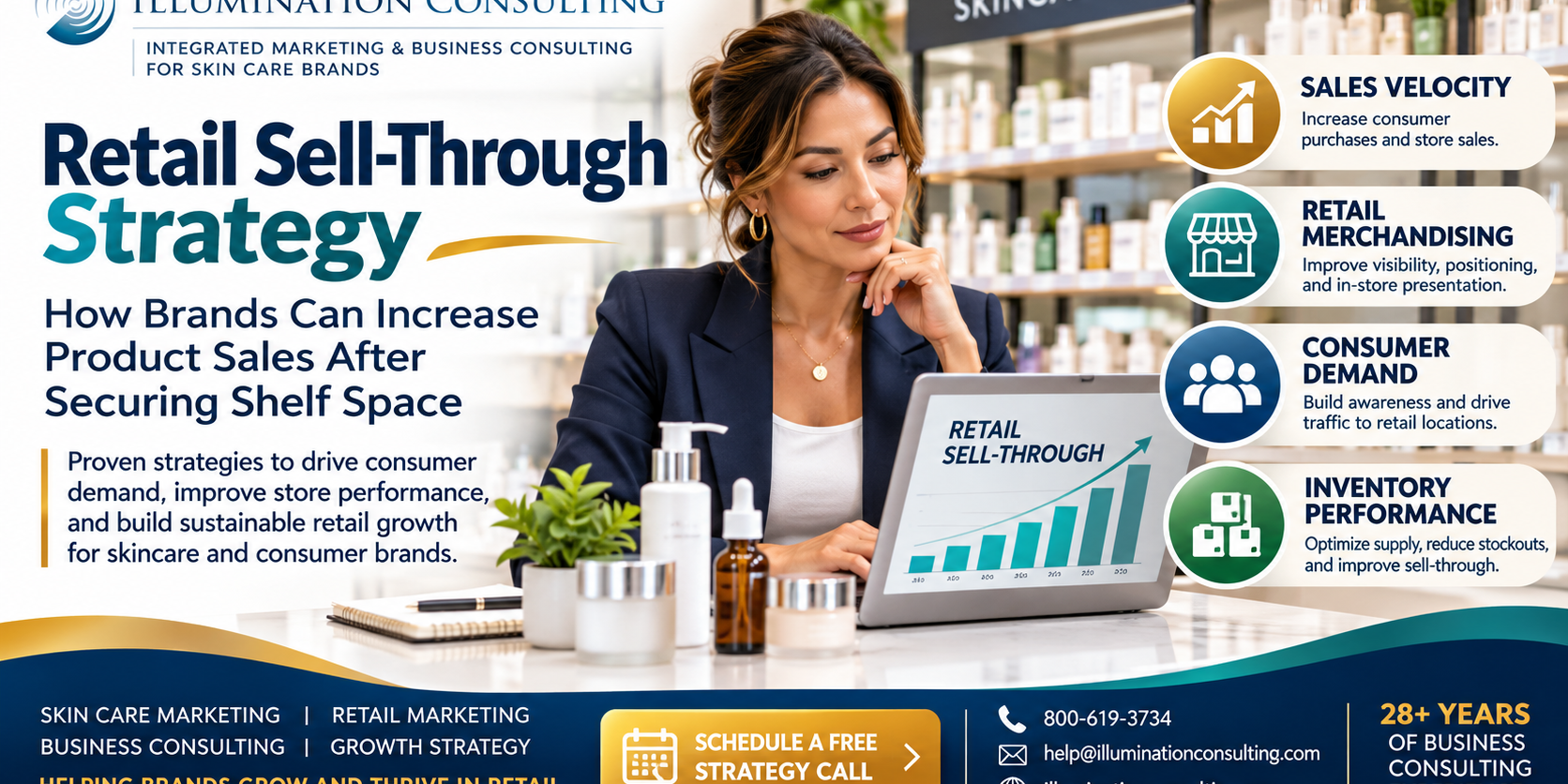
Securing shelf space in retail stores is an important milestone for consumer product brands, but distribution alone does not guarantee commercial success. A product can be available in dozens or hundreds of stores without generating sufficient consumer demand to justify its continued presence. Retailers ultimately evaluate how merchandise performs, how efficiently inventory moves, and whether products contribute to the financial performance of their categories. Brands that fail to generate consistent sales may face reduced shelf space, discontinued distribution, or declining retailer confidence.
A successful retail sell-through strategy focuses on converting product availability into actual consumer purchases. It connects retail marketing, product positioning, merchandising, inventory planning, promotional activities, and retailer relationships into a coordinated approach designed to improve sales performance. Rather than measuring success solely by the number of retail accounts secured, brands must understand how quickly products sell, which locations perform best, and what activities influence purchasing decisions.
For skincare brands, cosmetics companies, wellness businesses, and other consumer product manufacturers, retail sell-through is particularly important because competition for shelf space is intense. Products must attract attention, communicate their benefits, and provide customers with compelling reasons to purchase. Working with experienced retail marketing consultants can help brands develop coordinated strategies that support consumer demand, improve retail execution, and strengthen long-term distribution relationships.
What Is Retail Sell-Through?
Retail sell-through measures the proportion of available inventory sold to consumers during a defined period. It helps brands and retailers evaluate how effectively products are moving through retail locations rather than simply measuring the amount of inventory shipped into stores. Sell-through analysis is particularly useful for identifying strong-performing products, slow-moving inventory, and differences in performance between retail locations.
For example, a brand may deliver 1,000 units of a skincare product to a retail partner and discover that only 300 units were purchased by consumers during the reporting period. Although the brand successfully placed inventory with the retailer, actual consumer demand has not yet matched the initial distribution volume. This distinction matters because retailer purchases and consumer purchases represent different stages of the sales process.
Retail Sell-In Versus Retail Sell-Through
Retail sell-in refers to products sold by a manufacturer or brand to a retailer, distributor, or other wholesale customer. These transactions generate wholesale revenue for the brand, but they do not necessarily indicate that consumers are purchasing the products. Retail sell-through, by contrast, reflects sales to end customers and provides a clearer indication of consumer demand.
Understanding this distinction is essential when evaluating retail expansion. A brand may experience strong initial wholesale orders while consumer sales remain relatively weak. If products do not move through stores, retailers may reduce future orders or request additional promotional support. Sustainable retail growth requires both successful distribution and sufficient consumer demand to support replenishment.
How to Calculate Retail Sell-Through Rate
A commonly used sell-through calculation compares units sold during a defined period with the inventory available for sale during that period.
Sell-Through Rate = Units Sold / Units Available for Sale × 100
For example, consider a skincare brand with the following results during a monthly reporting period:
-
Beginning inventory: 400 units.
-
Additional inventory received: 600 units.
-
Total inventory available: 1,000 units.
-
Units sold to consumers: 650 units.
-
Ending inventory: 350 units.
The sell-through rate is 65% for the reporting period.
This calculation provides a useful measure of inventory movement, but it should not be evaluated in isolation. The reporting period, product category, replenishment frequency, stock availability, and retailer operating conditions can influence how the result should be interpreted. Brands should establish consistent measurement methods and compare performance against appropriate internal targets rather than assuming that one universal sell-through percentage defines success.
Why Retail Sell-Through Matters for Consumer Product Brands
Retail sell-through influences several aspects of a consumer brand’s commercial performance. Strong consumer sales support retailer confidence, encourage replenishment, and provide evidence that a product deserves continued shelf space. Weak sell-through can create excess inventory, increase promotional pressure, and make future distribution negotiations more difficult.
Retailers have limited shelf space and must allocate that space among competing products. A brand that consistently generates sales may be better positioned to maintain distribution or pursue additional placements. Conversely, products that occupy valuable shelf space without generating sufficient sales may be replaced by alternatives with stronger performance. Retail brands should therefore view sell-through as a central operating metric rather than a secondary reporting measure.
The Business Benefits of Improving Sell-Through
A well-executed retail sell-through strategy can support:
-
Higher consumer sales across existing retail locations.
-
More consistent retailer replenishment orders.
-
Improved inventory turnover and reduced excess stock.
-
Stronger relationships with retail buyers and category managers.
-
Better evidence for negotiating expanded distribution.
-
More effective allocation of retail marketing budgets.
-
Greater visibility into product-level profitability.
-
Reduced dependence on excessive discounting.
These benefits are connected. Improved consumer demand can increase replenishment activity, while better inventory management can reduce lost sales caused by unavailable products. The objective is not simply to generate a temporary sales increase but to create a repeatable system for maintaining profitable retail performance.
Start With Retail Sales Data and Store-Level Performance
Before developing promotional campaigns or increasing marketing spending, brands should understand how their products currently perform. Retail sales data can reveal which products sell consistently, which locations generate the strongest demand, and where inventory is accumulating. Without this information, marketing decisions may be based on assumptions rather than measurable commercial opportunities.
Retailers and distributors provide different levels of reporting access. Some brands receive detailed point-of-sale information, while others rely on periodic sales reports, inventory updates, or replenishment orders. Regardless of reporting sophistication, the business should establish a consistent process for reviewing available data and identifying actionable trends. The objective is to connect sales performance with decisions about marketing, merchandising, distribution, and inventory.
Key Retail Sell-Through Metrics to Monitor
Brands should evaluate several complementary indicators:
-
Units sold: The number of products purchased by consumers during a reporting period.
-
Sales velocity: Units sold per store per week or another consistent period.
-
Sell-through rate: The proportion of available inventory sold during the period.
-
On-shelf availability: Whether products are available for purchase when customers seek them.
-
Inventory turnover: How efficiently inventory moves through the retail channel.
-
Replenishment frequency: How often retailers reorder products.
-
Promotional lift: Changes in sales associated with specific marketing activities.
-
Gross margin and contribution: Whether sales generate sufficient financial returns after relevant costs.
These measurements provide different perspectives on performance. A product may have a high sell-through rate because inventory was limited, while another may generate more total sales despite a lower percentage. Brands should interpret the metrics together and investigate the operating conditions behind the numbers.
Identify High-Performing and Underperforming Retail Locations
Retail performance often varies considerably between stores, even within the same retail chain. Customer demographics, local competition, store traffic, merchandising conditions, staff familiarity, and regional preferences can all influence product sales. A brand that performs strongly in one market may require a different approach in another.
Store-level analysis helps businesses identify where additional marketing investment is justified and where operational problems may be limiting performance. High-performing locations can provide insights into effective merchandising, customer preferences, and product positioning. Underperforming stores may reveal issues involving visibility, pricing, availability, or insufficient consumer awareness. Understanding these differences allows brands to develop more targeted strategies rather than applying identical promotional tactics across every location.
Segment Retail Locations by Performance
A practical approach is to classify stores into three groups:
-
High-performing stores: Locations with strong sales velocity and consistent replenishment.
-
Developing stores: Locations with moderate performance and identifiable growth opportunities.
-
Underperforming stores: Locations with weak consumer sales or persistent inventory accumulation.
Each group requires a different management approach. High-performing stores may justify additional inventory support or carefully planned expansion opportunities, while developing stores may benefit from improved merchandising and targeted marketing. Underperforming locations should be evaluated before additional promotional spending is approved, since the underlying problem may involve product availability, customer fit, or store execution rather than insufficient advertising.
Improve Retail Product Positioning and Shelf Visibility
Consumers frequently make purchasing decisions in environments where numerous products compete for attention. Packaging, shelf placement, product descriptions, pricing, and surrounding merchandise can influence whether shoppers notice and consider a particular brand. A product may offer compelling benefits but still struggle commercially if those benefits are difficult to understand at the point of purchase.
Retail positioning should communicate what the product is, who it is intended for, and why customers should consider purchasing it. For skincare products, this may involve clearly identifying the product category, intended use, relevant ingredients, and appropriate benefits without making unsupported claims. The objective is to reduce uncertainty and help consumers evaluate the product quickly.
Strengthen Product Packaging and Shelf Communication
Effective retail packaging should support both brand identity and consumer understanding. Brands should review whether the product name, key information, and visual presentation remain clear when displayed alongside competing merchandise. Packaging must also satisfy applicable labeling requirements and work within retailer merchandising specifications.
Important considerations include:
-
Clear product identification and intended use.
-
Readable labeling and product information.
-
Consistent branding across the product collection.
-
Appropriate packaging size and shelf presentation.
-
Accurate and supportable product benefit statements.
-
Visual differentiation from competing products.
-
Compatibility with retailer display requirements.
Packaging improvements should be informed by consumer research and actual retail observations. Changes that appear attractive in a design presentation may not improve purchasing decisions in a crowded retail environment. Brands should evaluate how products are displayed under realistic store conditions before investing in expensive redesigns.
Use Retail Merchandising to Support Consumer Purchases
Retail merchandising influences how products are presented, discovered, and evaluated inside stores. Shelf placement, displays, product grouping, signage, and promotional materials can affect consumer visibility and purchasing behavior. However, brands must work within the merchandising requirements and commercial arrangements established by their retail partners.
A strong merchandising strategy begins with understanding the shopper’s experience. Products should be easy to locate, clearly identified, and positioned in a way that supports their intended use. Brands should also consider whether complementary products can be presented together to encourage appropriate purchasing decisions. Merchandising improvements should support the retailer’s category objectives while reinforcing the brand’s positioning.
Retail Merchandising Opportunities
Depending on retailer permissions and available programs, brands may explore:
-
Improved shelf placement and product visibility.
-
Approved point-of-purchase displays.
-
Educational shelf signage and product information.
-
Seasonal or category-specific merchandising opportunities.
-
Complementary product groupings.
-
Product sampling or demonstration programs.
-
Consistent shelf presentation across participating locations.
Not every merchandising opportunity will be available to every brand. Retailers may charge for certain programs or restrict how products are displayed. Businesses should evaluate expected benefits, costs, and operational requirements before committing resources.
Build Consumer Demand Around Retail Store Locations
One of the most important retail marketing opportunities is connecting brand awareness with actual product availability. A company may invest heavily in digital marketing while failing to communicate where customers can purchase its products. Consumers who discover a brand online may not know that it is available at nearby retail stores, reducing the potential value of existing distribution.
Location-aware marketing helps connect interested consumers with participating retailers. Brands can promote store availability through their websites, email campaigns, social media, retailer partnerships, and other appropriate channels. The messaging should make purchasing convenient and reinforce the product’s value rather than relying exclusively on promotional discounts.
Localized Retail Marketing Strategies
Brands can support store-level consumer demand through:
-
Store locator pages that identify participating retailers.
-
Geographic digital campaigns focused on relevant markets.
-
Social media announcements highlighting retail availability.
-
Email campaigns introducing new retail locations.
-
Approved retailer collaborations and promotional content.
-
Local influencer partnerships where commercially appropriate.
-
Educational content that helps customers select suitable products.
These activities should be coordinated with actual inventory availability. Advertising products at locations where inventory is unavailable can frustrate customers and waste marketing resources. Brands should therefore connect retail marketing plans with replenishment and store-level inventory information whenever possible.
Coordinate Digital Marketing With In-Store Sales
Digital marketing and physical retail should reinforce one another rather than operate as unrelated channels. Consumers may discover a product through search engines, social media, video content, or online reviews before purchasing it in a store. Others may first encounter the product on a retail shelf and later research the brand online. A coordinated strategy supports both purchasing journeys.
Brands should maintain consistent product information, positioning, and approved claims across their websites, social media accounts, retailer product listings, and in-store materials. Educational content can help customers understand product uses and characteristics before making purchasing decisions. This is particularly relevant for skincare and wellness products, where consumers may compare ingredients, formulations, and intended benefits before buying.
Connect Online Product Discovery to Retail Availability
A coordinated approach may include:
-
Accurate retailer listings on the brand website.
-
Product pages with clear descriptions and supporting information.
-
Consistent imagery across brand and retailer channels.
-
Retail availability announcements.
-
Educational articles and videos addressing customer questions.
-
Campaign tracking that distinguishes online engagement from verified retail sales.
Digital engagement metrics should not be confused with actual sell-through results. Website traffic, social media reach, and advertising impressions may indicate consumer interest, but they do not establish that retail purchases occurred. Brands should evaluate these indicators alongside available point-of-sale information and other relevant commercial evidence.
Improve Retail Staff Product Knowledge
Retail employees can influence purchasing decisions when customers ask questions or seek assistance selecting products. This is particularly relevant for categories such as skincare, cosmetics, wellness, and specialized consumer products. Employees who understand a product’s intended use, characteristics, and differences from competing options may be better equipped to provide accurate information.
Brands should develop concise, practical educational materials that support appropriate product communication. Training content should focus on factual product information rather than exaggerated sales claims. Retailers may have specific policies governing supplier training, employee engagement, and promotional activities, so programs should be developed collaboratively.
Effective Retail Product Education Materials
Useful resources may include:
-
Product overview sheets explaining intended uses.
-
Ingredient and formulation information.
-
Frequently asked customer questions.
-
Clear distinctions between products in the collection.
-
Approved product benefit statements.
-
Guidance on where customers can find additional information.
Training should be easy for retail teams to access and understand. Lengthy presentations may be less useful than concise resources that answer common customer questions. Brands should also evaluate whether educational programs are improving product understanding and supporting sales rather than assuming that training activity automatically generates results.
Use Retail Promotions Without Creating Excessive Discount Dependence
Retail promotions can increase consumer awareness, encourage trial, and support short-term sales activity. However, frequent discounting can reduce margins and influence customer expectations about regular pricing. Brands that rely heavily on promotions may generate temporary sales increases without establishing sustainable demand.
A disciplined promotional strategy should begin with a clear commercial objective. Some campaigns may introduce new products, while others may support seasonal demand or encourage trial in developing markets. The business should evaluate promotional costs, retailer participation requirements, and expected profitability before approving a campaign.
Evaluate the Financial Impact of Retail Promotions
Before launching a promotion, determine:
-
The specific sales objective.
-
Participating retail locations.
-
Promotional pricing and margin implications.
-
Retailer fees or required allowances.
-
Expected inventory requirements.
-
How sales performance will be measured.
-
Whether incremental sales justify the promotional investment.
A promotion should not be judged solely by the number of units sold during the campaign. Management should also consider profitability, post-promotion demand, inventory effects, and whether the activity attracted new customers or simply shifted purchases that might otherwise have occurred at regular prices.
Align Retail Inventory With Consumer Demand
Retail marketing cannot generate sustainable sales when products are consistently unavailable. Stockouts interrupt purchasing opportunities, frustrate customers, and may weaken retailer confidence. At the same time, excessive inventory creates financial pressure and can increase the risk of markdowns or unsold products.
Brands should coordinate manufacturing, inventory planning, retailer replenishment, and promotional activity. Sales forecasts should consider historical performance, seasonality, marketing plans, lead times, and the reliability of available retail data. The objective is to maintain appropriate inventory availability without tying up unnecessary capital.
Prevent Stockouts and Excess Retail Inventory
Effective coordination includes:
-
Reviewing store-level sales velocity.
-
Monitoring inventory availability where data permits.
-
Forecasting replenishment requirements.
-
Accounting for manufacturing and transportation lead times.
-
Coordinating promotional calendars with inventory planning.
-
Identifying slow-moving products before inventory becomes excessive.
-
Maintaining regular communication with retail partners.
Inventory decisions should reflect realistic demand rather than optimistic growth assumptions. A product that sells consistently may justify increased replenishment, while a slower-moving product may require changes to marketing, merchandising, or distribution strategy. Better inventory coordination supports both retail sales and financial stability.
Strengthen Relationships With Retail Buyers and Category Managers
Retail buyers and category managers evaluate products within the broader performance of their merchandise categories. They must consider consumer demand, inventory movement, profitability, assortment decisions, and available shelf space. Brands that understand these priorities are better positioned to develop productive commercial relationships.
Regular communication should focus on meaningful business information rather than promotional claims. Brands can share available sales trends, marketing initiatives, consumer insights, inventory plans, and proposed improvements. A collaborative approach demonstrates that the supplier is committed to supporting the retailer’s commercial objectives rather than simply securing additional purchase orders.
Prepare for Retail Performance Reviews
Brands should be prepared to discuss:
-
Sales performance by product and location.
-
Inventory movement and replenishment trends.
-
Results of completed promotional activities.
-
Consumer feedback and product-related questions.
-
Planned marketing support.
-
Supply reliability and operational improvements.
-
Opportunities for improving category performance.
Retail performance reviews should lead to specific decisions and responsibilities. If a product is underperforming, the brand and retailer should identify possible causes and determine which actions are commercially reasonable. Consistent follow-through can strengthen confidence and support more effective long-term relationships.
Measure Retail Marketing ROI and Sell-Through Performance
Retail marketing investments should be evaluated according to their contribution to business performance. Brands may spend money on advertising, displays, sampling, promotions, staff education, and retailer programs without clearly understanding which activities influence consumer sales. A measurement framework helps management determine where marketing resources generate value and where spending should be reconsidered.
Attribution can be challenging because consumers interact with multiple channels before purchasing. A customer may encounter social media content, visit a brand website, and later purchase the product in a retail store. Retail data access may also be limited, making it difficult to connect individual marketing activities with specific transactions. Brands should use the most reliable available evidence and avoid claiming precise attribution when the data does not support it.
Retail Performance Metrics That Matter
A practical performance dashboard should monitor:
-
Consumer units sold.
-
Sales velocity by location.
-
Sell-through rate.
-
Retail replenishment activity.
-
Inventory availability.
-
Promotional sales performance.
-
Product-level contribution margins.
-
Retail marketing expenditures.
-
Distribution growth supported by demonstrated demand.
The objective is to understand whether marketing activity improves commercially meaningful outcomes. Increased advertising reach or social engagement may be useful, but those indicators should ultimately support stronger consumer demand and sustainable retail economics.
Common Retail Sell-Through Strategy Mistakes
One of the most common mistakes consumer brands make is treating retail distribution as the final objective. Securing new accounts can create excitement and generate wholesale revenue, but long-term success depends on consumers purchasing products consistently. Brands that do not support consumer demand may struggle to maintain distribution after the initial inventory placement.
Another mistake is investing in marketing without evaluating store-level performance. A campaign may generate broad awareness while failing to support the specific locations where inventory needs to move. Businesses may also rely excessively on discounts, overlook product availability, or fail to provide retail partners with useful performance information. These weaknesses can reduce marketing efficiency and undermine retailer relationships.
Five Retail Sell-Through Mistakes to Avoid
-
Measuring success only by the number of stores carrying the product.
-
Ignoring differences in sales performance between locations.
-
Promoting products without confirming retail availability.
-
Relying on frequent discounts instead of building sustainable demand.
-
Failing to coordinate marketing, inventory, and retailer communication.
Avoiding these mistakes requires a coordinated commercial approach. Retail sales performance should inform marketing decisions, while inventory and retailer relationships should support the demand that marketing generates. Businesses that integrate these activities are better positioned to improve performance across existing distribution.
A 90-Day Retail Sell-Through Improvement Plan
Improving retail sell-through requires a structured process that begins with understanding current performance. Rather than immediately increasing advertising or discounting, brands should identify the factors limiting consumer purchases and prioritize improvements with the greatest commercial potential. A 90-day planning framework can help organize this work, although meaningful results may require longer depending on product category, sales cycles, and data availability.
Days 1–30: Audit Retail Performance
Review available point-of-sale data, replenishment activity, inventory levels, and store-level sales trends. Identify strong-performing products and locations, as well as stores where inventory is moving slowly. Evaluate packaging visibility, merchandising conditions, product information, and retailer feedback. The objective is to establish a reliable performance baseline and identify the most significant opportunities.
Days 31–60: Implement Targeted Improvements
Develop focused initiatives based on the findings of the initial audit. These may include improved product education, localized digital marketing, updated retailer listings, merchandising support, or coordinated promotional activity. Prioritize initiatives that address documented performance problems rather than launching broad campaigns without a clear objective. Establish measurement methods before implementation so results can be evaluated consistently.
Days 61–90: Evaluate Results and Refine the Strategy
Review changes in sales velocity, sell-through, inventory availability, and other relevant performance indicators. Compare results against the baseline while considering seasonality, promotional effects, and changes in distribution or inventory. Identify which initiatives appear commercially valuable and which require adjustment or discontinuation. Use the findings to develop a longer-term retail growth plan based on measurable consumer demand.
Frequently Asked Questions About Retail Sell-Through
What is a retail sell-through strategy?
A retail sell-through strategy is a coordinated approach to increasing consumer purchases of products already available through retail distribution. It may include merchandising, retail marketing, product education, inventory coordination, promotions, and performance analysis. The objective is to improve sales velocity and support sustainable retailer replenishment rather than focusing exclusively on initial wholesale orders.
How do you calculate retail sell-through rate?
A common calculation divides the number of units sold during a defined period by the total units available for sale during that period, then multiplies the result by 100. For example, selling 650 units from 1,000 available units produces a 65% sell-through rate. The result should be interpreted alongside the reporting period, inventory availability, replenishment activity, and product category.
What is the difference between sell-in and sell-through?
Sell-in measures products sold by a brand or manufacturer to a retailer or distributor. Sell-through measures products purchased by consumers from the retailer. Both are important, but sell-through provides a more direct indication of consumer demand and the likelihood of continued retail replenishment.
How can skincare brands improve retail sell-through?
Skincare brands can improve sell-through by strengthening product positioning, increasing local consumer awareness, supporting retailer education, improving merchandising, coordinating inventory, and evaluating store-level sales data. Strategies should reflect the product’s intended customer and the requirements of each retail partner. Sustainable improvement depends on generating genuine consumer demand rather than relying exclusively on discounting.
Why do products fail to sell after entering retail stores?
Products may underperform because of insufficient consumer awareness, weak shelf visibility, unclear positioning, inappropriate pricing, inventory problems, or poor alignment with local customer preferences. In some cases, the product may not meet a sufficiently strong consumer need. Brands should evaluate sales data and retail conditions before assuming that additional advertising alone will solve the problem.
Build Sustainable Retail Growth Through Better Sell-Through Performance
Retail distribution creates an opportunity for consumer product brands to reach new customers, but it does not guarantee sustained sales. Long-term retail success depends on generating consumer demand, maintaining appropriate inventory, communicating product value, and supporting productive retailer relationships. Brands that measure actual sell-through can make better decisions about marketing investment, merchandising, replenishment, and future distribution expansion.
A successful retail sell-through strategy connects commercial planning with execution at the store level. It uses sales data to identify opportunities, coordinates digital and physical retail marketing, and evaluates performance based on meaningful financial outcomes. For skincare, cosmetics, wellness, and other consumer product brands, this approach can help transform initial shelf placement into a more sustainable retail business.
Illumination Consulting provides Retail Marketing Services, Skin Care Marketing, and Business Consulting to help brands improve market positioning, strengthen consumer demand, and develop effective growth strategies. With more than 28 years of business consulting and marketing experience, we support companies seeking to improve retail performance and expand their commercial opportunities.
Ready to improve retail product sales and strengthen your distribution strategy? Schedule a free strategy call with Illumination Consulting to discuss your retail marketing objectives and opportunities for sustainable growth.