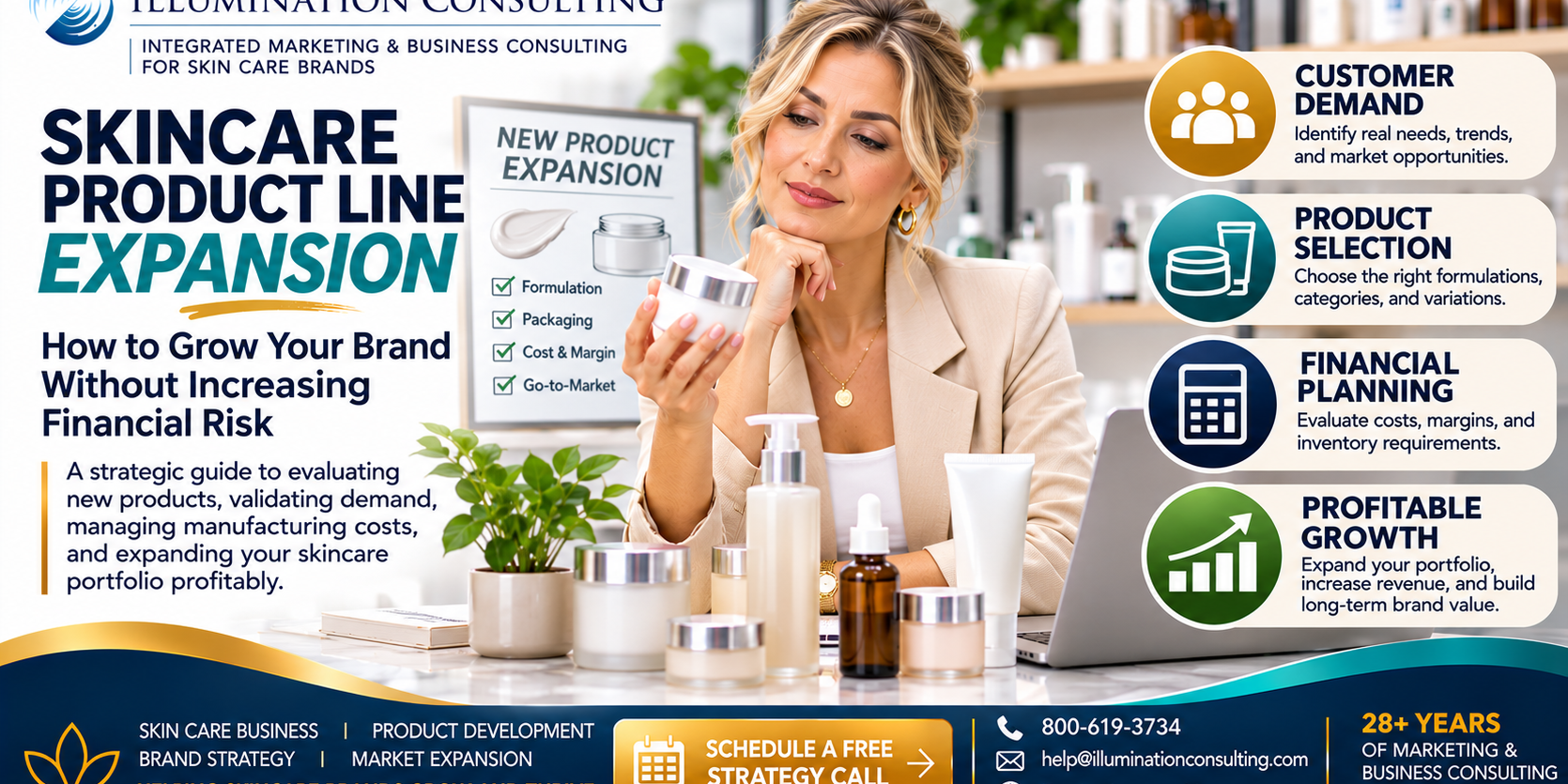
Expanding a skincare product line can create new revenue opportunities, increase customer lifetime value, and strengthen a brand’s position in a competitive marketplace. However, introducing additional products also increases manufacturing commitments, inventory requirements, marketing expenses, and operational complexity. A skincare company that expands too quickly may find itself managing a larger product catalog without generating sufficient additional profit to justify the investment.
Skincare product line expansion is the process of introducing new products, formulations, sizes, or complementary categories to an existing skincare portfolio. Successful expansion involves identifying genuine customer demand, evaluating financial feasibility, and selecting products that support the brand’s positioning and long-term commercial objectives. Rather than adding products simply to increase assortment size, businesses should prioritize opportunities that improve customer value and contribute positively to profitability.
For established skincare brands, product line expansion should be treated as a strategic business investment rather than an isolated product development initiative. Each new product requires capital, management attention, and ongoing operational support. Working with experienced skin care business consultants can help companies evaluate expansion opportunities, develop realistic financial plans, and introduce new products in ways that support sustainable business growth.
What Is Skincare Product Line Expansion?
Skincare product line expansion involves adding products or variations to an existing collection to serve additional customer needs, purchasing occasions, or market segments. A brand that initially sells facial cleansers may introduce moisturizers, serums, or complementary products designed to support a broader skincare routine. Another company may expand an established product into different sizes, formulations, or packaging formats to accommodate customer preferences.
Product line expansion differs from launching an entirely new skincare business because the company already possesses some combination of brand awareness, customer relationships, sales channels, and operating infrastructure. These existing assets can create advantages when introducing new products, but they do not eliminate financial or commercial risks. Customers who purchase one product may not automatically want another, and retailers may evaluate each new item according to its own sales potential.
Common Types of Skincare Product Line Expansion
Skincare brands can pursue several expansion approaches:
-
Complementary products: Introducing products that support existing skincare routines.
-
New product categories: Expanding from cleansers into moisturizers, serums, masks, or other categories.
-
Product variations: Offering different textures, fragrances, or formulations.
-
Additional sizes: Introducing travel sizes, larger formats, or alternative quantities.
-
Premium collections: Developing products with distinct positioning or additional features.
-
Professional products: Creating products intended for appropriate professional or business channels.
-
Seasonal or limited collections: Testing selected products with controlled availability.
Each approach involves different financial and operational considerations. Adding a new package size may be less complex than developing an entirely new formulation, while entering a new product category can introduce unfamiliar manufacturing, testing, and marketing requirements. The appropriate strategy depends on customer demand, available capital, and the company’s ability to manage additional products.
Why Skincare Brands Expand Their Product Lines
Product line expansion can help skincare businesses increase revenue from existing customers while attracting new audiences. Customers who already trust a brand may be interested in complementary products that address related cosmetic needs. A broader assortment can also create opportunities for product bundles, routine-based purchasing, and additional retail distribution.
However, these benefits are not automatic. Introducing more products can divide customer attention, increase inventory costs, and complicate marketing. A company should understand the specific commercial objective behind each expansion rather than assuming that a larger catalog will naturally generate more sales.
Potential Business Benefits of Product Line Expansion
A disciplined expansion strategy may support:
-
Increased average order value through complementary purchases.
-
Greater customer lifetime value.
-
Additional revenue from existing customer relationships.
-
Improved customer retention through broader product relevance.
-
New retail and wholesale opportunities.
-
Stronger brand positioning within selected skincare categories.
-
Reduced dependence on a single product.
-
Opportunities for profitable product bundles.
The most valuable benefits depend on the company’s existing business model. A direct-to-consumer brand may prioritize repeat purchases and customer lifetime value, while a wholesale-focused company may evaluate retailer assortment requirements and replenishment opportunities. Expansion decisions should reflect these commercial differences.
Evaluate Your Existing Skincare Product Portfolio First
Before developing new products, skincare brands should assess the financial performance of their current assortment. A company may have several products generating revenue but only a small number contributing meaningfully to profit. Expanding without understanding existing product economics can increase complexity while leaving fundamental profitability problems unresolved.
Portfolio analysis should examine sales volume, contribution margins, customer demand, inventory movement, and marketing requirements. Businesses should also identify whether existing products have sufficient market potential to justify additional investment before committing resources to new categories. In some cases, improving the performance of current products may produce a better financial return than launching additional merchandise.
Key Skincare Portfolio Performance Metrics
Brands should evaluate:
-
Revenue by product: Sales generated by each SKU.
-
Contribution margin: Revenue remaining after relevant variable costs.
-
Sales velocity: How quickly products sell over a consistent period.
-
Repeat purchase behavior: Whether customers return to purchase the same products.
-
Average order value: The typical value of customer transactions.
-
Customer acquisition cost: Marketing expenses associated with acquiring customers.
-
Inventory turnover: How efficiently products move through inventory.
-
Return and refund rates: The frequency and financial impact of returned purchases.
These metrics help management identify which products support profitable growth and which may require improvement. A product generating substantial revenue may still contribute less profit than a smaller product with stronger margins and lower operating requirements. Expansion decisions should therefore consider financial contribution rather than sales volume alone.
Identify Customer Demand Before Developing New Products
Customer demand should be the foundation of skincare product line expansion. Brands often introduce products because competitors offer them, particular ingredients are popular, or manufacturers recommend additional formulations. These factors may reveal opportunities, but they do not establish that existing customers are willing to purchase the proposed products.
A stronger approach begins with understanding customer needs, purchasing behavior, and unmet expectations. Businesses can evaluate customer service inquiries, product reviews, repeat purchase patterns, and direct feedback to identify opportunities for complementary products. The objective is to determine whether a new product solves a meaningful customer problem and fits naturally within the brand’s existing positioning.
Sources of Skincare Product Demand Insights
Useful information may come from:
-
Customer purchase histories.
-
Product reviews and recurring questions.
-
Customer service conversations.
-
Email surveys and customer interviews.
-
Website search activity.
-
Product page engagement.
-
Retail partner feedback.
-
Competitor assortment analysis.
-
Relevant search demand and consumer trends.
No single information source should determine the expansion decision. A customer survey may indicate interest in a product, but stated interest does not guarantee purchasing behavior. Brands should combine qualitative feedback with commercial evidence and, where practical, test demand before committing to large production orders.
Choose New Skincare Products That Complement Existing Purchases
Complementary product expansion can be attractive because it builds on established customer relationships and purchasing habits. A brand known for facial cleansers may consider products that naturally fit into the same routine, such as moisturizers or other appropriate cosmetic products. This approach can make cross-selling more relevant and reduce the need to introduce an entirely unfamiliar brand proposition.
However, complementarity alone does not guarantee commercial success. A new product must offer a compelling reason for customers to choose it over alternatives. The business should consider customer preferences, competitive positioning, price expectations, and the financial requirements of manufacturing and marketing the product.
Evaluate Product Compatibility With Your Existing Brand
Before approving a new product, consider:
-
Does it address a documented customer need?
-
Does it fit the brand’s positioning?
-
Is it relevant to existing customers?
-
Can the brand explain its value clearly?
-
Does it complement current products without unnecessarily replacing their sales?
-
Can it support appropriate margins?
-
Does the company have the operational capacity to manage it?
These questions help prevent expansion based primarily on trends or enthusiasm. Products that align with existing customer relationships and brand credibility may offer a more manageable growth path than entering unrelated categories.
Assess Skincare Product Manufacturing and Development Costs
Every new skincare product creates financial commitments that must be evaluated before development begins. Depending on the manufacturing arrangement, expenses may include formulation development, laboratory samples, ingredients, packaging, testing, manufacturing, and freight. Custom products can introduce additional complexity, while private-label products may reduce certain development requirements but offer different levels of differentiation and control.
Businesses should obtain detailed supplier quotations and calculate the full investment required to bring finished inventory to market. The quoted manufacturing price per unit is only one component of the decision. Minimum order quantities, packaging commitments, payment terms, and production lead times can significantly influence cash flow.
Manufacturing Questions Before Expanding a Skincare Line
Brands should establish:
-
Whether the product requires custom formulation.
-
The total development and testing investment.
-
Manufacturing minimum order quantities.
-
Packaging and component requirements.
-
Estimated landed cost per finished unit.
-
Supplier payment terms.
-
Expected production and replenishment lead times.
-
Formula ownership and manufacturing transfer rights.
A company should also evaluate whether the new product requires capabilities that existing suppliers cannot provide. Introducing unfamiliar manufacturing processes or specialized packaging may increase operational risk. Expansion should proceed only when the financial and technical requirements are sufficiently understood.
For a detailed breakdown of these expenses, see our related article on skincare product manufacturing costs.
Calculate the Financial Return of Skincare Product Expansion
A product line expansion decision should be supported by a financial model that evaluates expected revenue, variable costs, upfront investment, and working capital requirements. A new product may generate attractive sales but still produce disappointing financial results if manufacturing costs, marketing expenses, or inventory commitments are too high.
Financial projections should distinguish between revenue and contribution margin. Revenue measures sales activity, while contribution margin helps management understand how much remains after the relevant variable costs associated with generating and fulfilling those sales. The business must also recover development and launch investments before the expansion creates an attractive overall financial return.
Example: Evaluating a New Skincare Serum
Consider a hypothetical skincare brand planning to introduce a facial serum with the following assumptions:
-
Retail selling price: $48.
-
Landed product cost: $12 per unit.
-
Variable fulfillment and transaction costs: $6 per unit.
-
Average customer acquisition or attributable marketing cost: $10 per unit sold.
-
Contribution per unit after these costs: $20.
Under these assumptions, each retained unit sold directly to consumers contributes $20 toward recovering relevant fixed expenses and generating profit. If the company incurs $30,000 in upfront development, launch, and other fixed expansion costs, it would need to sell 1,500 units at that contribution level to recover those costs.
Illustrative break-even calculation:
$30,000 in upfront costs ÷ $20 contribution per unit = 1,500 units.
This simplified example assumes all units are sold through the same channel at the stated economics. It excludes additional considerations such as taxes, financing costs, changes in overhead, refunds, and inventory losses. The figures are hypothetical and are not intended as industry benchmarks.
Model More Than One Sales Scenario
Brands should evaluate conservative, expected, and optimistic demand scenarios. A product that appears attractive under strong sales assumptions may create financial pressure if customer adoption develops more slowly. The model should also consider the timing of inventory purchases, customer payments, and replenishment orders.
The purpose of financial modeling is not to predict sales with certainty. It is to identify the conditions required for the product to become financially viable and determine whether the business can withstand a slower-than-expected launch.
Avoid Product Cannibalization Within Your Skincare Portfolio
Product cannibalization occurs when a new product generates sales partly by replacing purchases of existing products from the same brand. Some substitution is normal, particularly when companies introduce improved formulations or alternative sizes. However, significant cannibalization can reduce the incremental financial value of expansion.
For example, a brand introducing a new moisturizer may find that many existing customers switch from its original moisturizer rather than purchasing additional products. The new product could generate substantial revenue while producing relatively little net growth. If it also carries higher manufacturing costs, the expansion may weaken overall profitability.
How to Evaluate Cannibalization Risk
Brands should consider:
-
Whether the new product serves a distinct customer need.
-
How its positioning differs from existing products.
-
Whether customers are likely to purchase both products.
-
The relative contribution margins of the products.
-
Whether the expansion attracts new customers.
-
How product launches affect sales of established SKUs.
Cannibalization is not always undesirable. Replacing an older product with a better-performing or more profitable alternative may support the business. The important question is whether the new product improves total portfolio economics rather than merely shifting revenue between SKUs.
Plan Inventory and Cash Flow for New Skincare Products
Inventory is one of the largest financial considerations in skincare product expansion because manufacturing commitments often occur before customer demand is fully established. Brands may need to purchase ingredients, packaging components, and finished products weeks or months before receiving sales revenue. Expanding several products simultaneously can multiply these commitments and restrict operating flexibility.
A disciplined inventory plan should reflect realistic sales forecasts, manufacturing lead times, shelf life, and available working capital. Businesses should avoid increasing production quantities solely to obtain lower unit prices when doing so creates excessive inventory exposure. The objective is to maintain sufficient availability without committing more capital than the business can reasonably support.
Inventory Planning Priorities
Brands should evaluate:
-
Initial production quantities.
-
Expected monthly sales velocity.
-
Manufacturing and replenishment lead times.
-
Product shelf life and storage requirements.
-
Supplier minimum orders.
-
Inventory carrying costs.
-
Cash available for marketing and operations.
-
Contingency plans for slower sales.
A product that sells more slowly than expected can create financial pressure even when its theoretical margins are attractive. Inventory planning should therefore be integrated into the expansion decision rather than addressed after manufacturing commitments have been made.
Evaluate Direct-to-Consumer and Wholesale Expansion Opportunities
A skincare product may perform differently across direct-to-consumer, wholesale, and retail distribution channels. Direct sales can provide greater control over pricing, customer relationships, and marketing, while wholesale distribution may offer access to established retail audiences. Each channel also involves different margins, payment terms, operating expenses, and inventory requirements.
Brands should evaluate the economics of each intended channel before approving new products. A formulation that supports attractive direct-to-consumer margins may not provide sufficient contribution when sold at wholesale prices. Retailers may also require specific packaging, labeling, case quantities, or promotional support that increases the total investment.
Channel-Specific Expansion Considerations
For direct-to-consumer sales, evaluate:
-
Customer acquisition costs.
-
Ecommerce conversion rates.
-
Fulfillment expenses.
-
Repeat purchase potential.
-
Product bundling opportunities.
For wholesale and retail sales, evaluate:
-
Wholesale pricing and contribution margins.
-
Retailer assortment requirements.
-
Minimum purchase commitments.
-
Replenishment expectations.
-
Payment terms.
-
Retail marketing and promotional expenses.
Businesses should avoid assuming that a product successful in one channel will automatically succeed in another. Channel expansion should be supported by realistic financial assumptions and an understanding of the intended customer.
Use Skincare Product Bundles to Test Expansion Opportunities
Product bundles can help brands evaluate customer interest in complementary products and encourage routine-based purchasing. A cleanser and moisturizer combination, for example, may provide insights into whether customers value purchasing related products together. Bundling can also support average order value when the combined offering provides meaningful customer benefits.
However, bundles should not be used to conceal weak individual product demand. Brands should evaluate whether customers continue purchasing the products separately and whether the bundle economics remain attractive after discounts and fulfillment expenses. A successful bundle should improve customer value and financial contribution rather than simply increase transaction size.
Product Bundling Strategies to Consider
-
Complementary skincare routine bundles.
-
Starter collections featuring selected products.
-
Travel-size product combinations.
-
Seasonal skincare collections.
-
Gift sets.
-
Existing-product bundles used to evaluate purchasing preferences.
Where possible, brands should test bundle demand using current products before committing to entirely new formulations. This approach may provide useful customer insights with less development risk.
Develop a Skincare Product Launch and Marketing Plan
New products require marketing support to generate awareness and communicate their value. Even established skincare brands cannot assume that existing customers will discover and purchase new products automatically. Launch planning should identify the target audience, positioning, product benefits, marketing channels, and commercial objectives.
A coordinated launch strategy should connect product availability with customer communication. Website content, email campaigns, social media, product education, and retailer materials should use consistent information and appropriate claims. Marketing activity should also reflect the company’s available inventory and fulfillment capabilities.
Essential Product Expansion Marketing Activities
A practical launch plan may include:
-
Customer research and product positioning.
-
Ecommerce product page development.
-
Search-optimized product descriptions.
-
Educational content and product demonstrations.
-
Email announcements to existing customers.
-
Social media campaigns.
-
Retail partner communication.
-
Product bundling and cross-selling.
-
Post-launch sales and customer feedback analysis.
Marketing investment should be proportionate to the product’s expected financial contribution and the company’s available capital. A launch that requires excessive acquisition spending may be commercially unattractive even when customers respond positively to the product.
Illumination Consulting supports these initiatives through Skin Care Marketing Services and Content Marketing Services.
Test New Skincare Products Before Committing to Large-Scale Expansion
Product testing can reduce uncertainty by providing evidence about customer interest, positioning, and purchasing behavior. Depending on the product and manufacturing arrangements, brands may be able to evaluate concepts, samples, or limited production opportunities before making larger commitments. The appropriate testing method should reflect the product’s development stage and applicable safety and regulatory requirements.
A useful test should answer specific commercial questions. For example, the company may want to understand whether existing customers prefer a particular product format, whether the intended price is acceptable, or whether the proposed product addresses a meaningful need. Testing should not be confused with full commercial validation, particularly when the sample is small or participants have not made actual purchasing decisions.
Product Expansion Validation Methods
Brands may consider:
-
Customer interviews.
-
Concept testing.
-
Product sampling conducted under appropriate conditions.
-
Purchase-intent surveys.
-
Waitlists or expressions of interest.
-
Limited commercial releases where feasible.
-
Retail partner feedback.
-
Analysis of comparable product performance.
Evidence from actual purchases is generally more commercially informative than expressions of interest alone. Businesses should interpret early results carefully and avoid assuming that positive feedback guarantees large-scale demand.
Common Skincare Product Line Expansion Mistakes
Skincare brands often expand because they believe a larger assortment will automatically increase revenue. However, introducing additional products without sufficient demand or financial planning can create inventory problems and dilute marketing resources. A business may spend heavily on formulation, packaging, and production only to discover that the new product competes with its existing assortment or fails to attract meaningful customer interest.
Another common mistake is developing several products simultaneously before validating the economics of the first expansion. This approach increases capital commitments and makes it more difficult to identify which products deserve additional investment. Brands should also avoid copying competitor assortments without understanding whether those products fit their own customer relationships and positioning.
Seven Product Expansion Mistakes to Avoid
-
Introducing products without evidence of customer demand.
-
Expanding before understanding existing product profitability.
-
Underestimating manufacturing and inventory commitments.
-
Ignoring product cannibalization.
-
Launching too many SKUs simultaneously.
-
Assuming direct-to-consumer margins will support wholesale distribution.
-
Failing to allocate sufficient capital for marketing and operations.
Avoiding these mistakes requires coordination between product development, financial management, marketing, and inventory planning. The objective is to build a more profitable portfolio rather than simply increase the number of products offered.
A 90-Day Skincare Product Line Expansion Planning Framework
A structured planning process can help skincare businesses evaluate new product opportunities before committing substantial resources. The following framework focuses on commercial feasibility and preparation rather than suggesting that every product can be developed, tested, and manufactured within 90 days. Actual development timelines depend on formulation requirements, supplier capacity, testing, and packaging availability.
Days 1–30: Evaluate the Existing Portfolio and Customer Demand
Review product-level revenue, contribution margins, inventory performance, repeat purchases, and customer feedback. Identify opportunities that align with existing brand positioning and documented customer needs. Develop a preliminary shortlist of potential products and assess whether each would complement or compete with current offerings.
Days 31–60: Evaluate Manufacturing and Financial Feasibility
Obtain preliminary manufacturing information, evaluate formulation requirements, and estimate development and inventory commitments. Build financial models that consider landed costs, channel margins, marketing expenses, and realistic sales scenarios. Eliminate opportunities that require excessive capital or fail to demonstrate a plausible path to profitability.
Days 61–90: Prioritize Products and Develop the Expansion Plan
Select the most promising opportunity based on customer demand, financial feasibility, and strategic fit. Develop a product brief, preliminary launch strategy, inventory plan, and budget. Establish milestones for testing, supplier approvals, and production decisions. The objective is to create a disciplined expansion plan with clear commercial requirements before major commitments are made.
Frequently Asked Questions About Skincare Product Line Expansion
What is skincare product line expansion?
Skincare product line expansion involves introducing new products, formulations, sizes, or complementary categories to an existing skincare portfolio. The objective may be to serve additional customer needs, increase revenue, or strengthen brand positioning. Successful expansion requires customer research, financial planning, and alignment with the company’s existing business strategy.
When should a skincare brand expand its product line?
A skincare brand should consider expansion when it has evidence of customer demand, understands the profitability of its existing products, and possesses sufficient capital and operational capacity to support additional inventory. Expansion should not be based solely on competitor activity or product trends. The business should establish a credible financial case before committing to development and manufacturing.
How many products should a skincare brand launch at once?
There is no universal number of products appropriate for every skincare brand. The decision depends on available capital, customer demand, manufacturing requirements, and operational capabilities. Brands with limited resources may benefit from introducing products sequentially so they can evaluate performance before committing to additional launches.
How can skincare brands avoid product cannibalization?
Brands can reduce unnecessary cannibalization by selecting products that address distinct customer needs, positioning them clearly, and evaluating how new launches affect existing product sales. Some substitution may be commercially acceptable when a new product improves margins or customer satisfaction. The key measurement is whether total portfolio profitability improves.
Is skincare product line expansion profitable?
Product line expansion can be profitable when new products generate sufficient contribution to recover development, inventory, marketing, and operating expenses. Profitability depends on customer demand, pricing, manufacturing costs, channel economics, and execution. Businesses should evaluate multiple financial scenarios rather than assuming that additional products automatically produce additional profits.
Build a Stronger Skincare Brand Through Strategic Product Expansion
Skincare product line expansion can create meaningful growth opportunities when businesses introduce products that meet genuine customer needs and support attractive financial returns. However, expansion also introduces manufacturing commitments, inventory exposure, marketing requirements, and operational complexity. Brands that evaluate these factors before development are better positioned to avoid unnecessary financial risks.
A disciplined expansion strategy begins with understanding the performance of existing products and identifying opportunities that complement the brand’s strengths. Customer research, financial modeling, inventory planning, and targeted marketing help determine which products deserve investment. Rather than expanding for the sake of offering more merchandise, successful skincare businesses focus on building portfolios that improve customer value and sustainable profitability.
Illumination Consulting provides Skin Care Business Consulting, Skin Care Marketing Services, and Business Startup Consulting for entrepreneurs and established skincare companies. With more than 28 years of business consulting and marketing experience, we help brands evaluate growth opportunities, strengthen commercial strategies, and develop sustainable business models.
Planning to expand your skincare product line? Schedule a free strategy call with Illumination Consulting to discuss your product portfolio, financial objectives, and business growth opportunities.