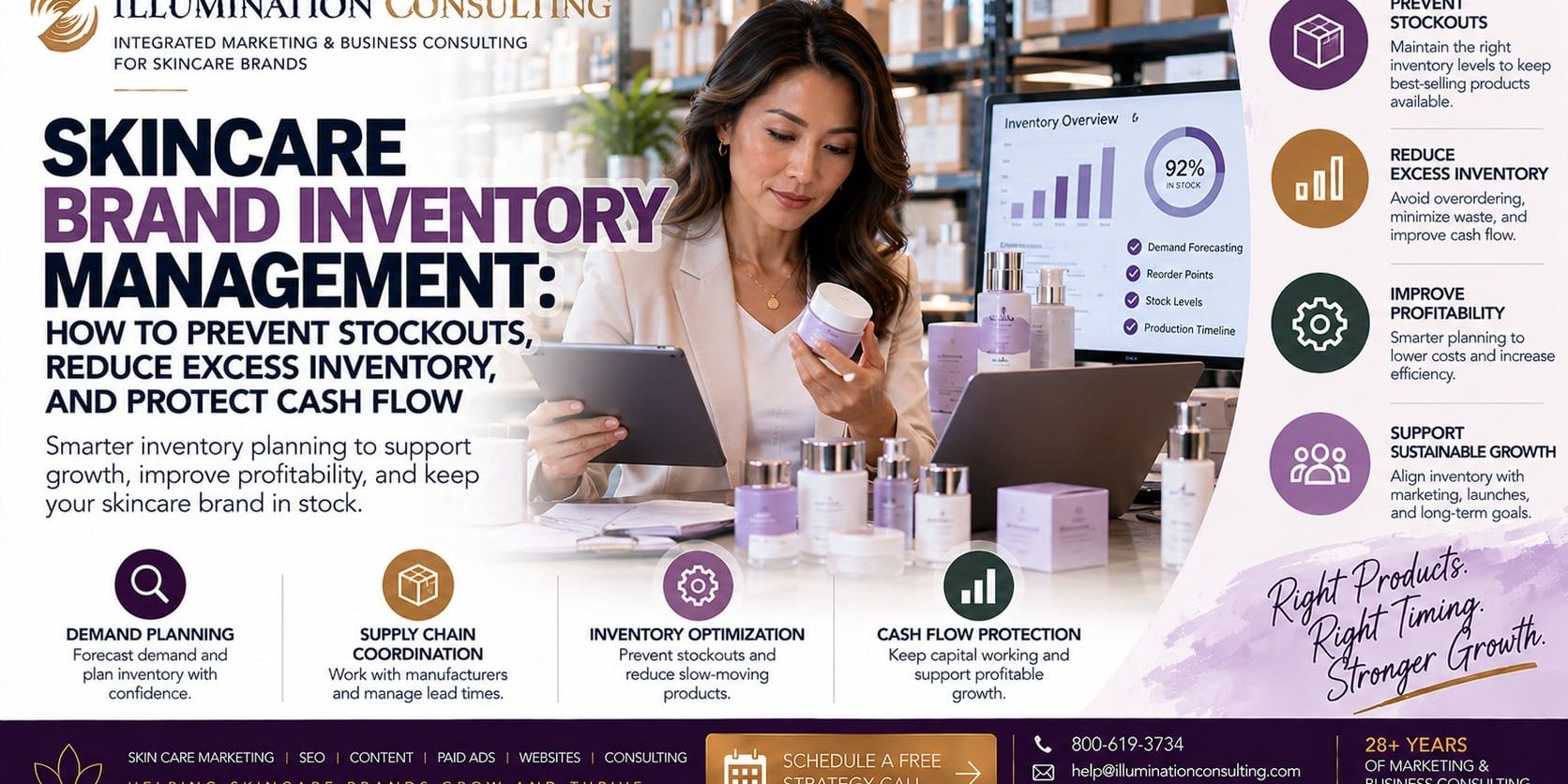
Launching and growing a skincare brand requires more than developing effective products and generating customer demand. Brands must also maintain sufficient inventory to fulfill orders, manage production schedules, control purchasing expenses, and protect working capital. Poor inventory decisions can create substantial financial pressure, particularly for emerging skincare companies operating with limited resources or working with contract manufacturers that require minimum order quantities.
Skincare brand inventory management involves coordinating product demand, manufacturing, purchasing, storage, and sales to maintain appropriate inventory levels. The objective is to prevent costly stockouts without tying up excessive capital in products that may expire, become outdated, or require heavy discounting. Effective inventory planning also helps brands coordinate marketing campaigns, product launches, and retail expansion with realistic production and fulfillment capabilities.
For skincare businesses investing in professional Skin Care Business Consulting, inventory management should be an important part of the growth strategy. A brand that understands its inventory requirements, product economics, and manufacturing timelines is better positioned to support consistent sales, maintain customer satisfaction, and build a financially sustainable business.
Why Inventory Management Is Critical for Skincare Brands
Skincare products present inventory challenges that differ from those of many other consumer goods. Formulations may have defined shelf lives, packaging components can require separate purchasing commitments, and manufacturing timelines may vary depending on ingredient availability, production capacity, and testing requirements. Certain products also require specific storage or shipping conditions to maintain quality.
For a growing skincare brand, inventory problems can quickly affect multiple areas of the business. Running out of a bestselling serum may interrupt revenue and waste advertising expenditure. Ordering too many units of an underperforming moisturizer can tie up cash that could otherwise support marketing, product development, or operations.
Inventory decisions also influence customer experience. Shoppers expect products to be available when advertised and orders to arrive within the communicated timeframe. Repeated stockouts, unexpected delays, or discontinued products can weaken customer confidence.
Effective inventory management connects operational planning with customer demand and financial performance.
Understand the Complete Skincare Inventory Lifecycle
Skincare inventory management begins before finished products arrive at a warehouse. Brands must coordinate several stages of production and distribution, each with its own costs, timelines, and potential risks.
The process typically begins with demand forecasting and purchase planning. The brand then coordinates ingredient sourcing, packaging procurement, manufacturing, quality control, finished goods delivery, storage, and order fulfillment. Inventory performance must be monitored throughout the product’s commercial life.
For private-label and contract-manufactured skincare brands, production scheduling may be controlled partly by external partners. This makes communication and realistic lead-time planning especially important.
Brands should understand the complete inventory lifecycle rather than treating inventory management as simply counting products available for sale.
Calculate Demand Before Placing Manufacturing Orders
One of the most common skincare inventory mistakes is placing production orders based on optimistic sales expectations rather than reliable demand information.
Emerging brands may order large quantities to reduce unit costs, while established brands may assume that recent growth will continue at the same rate. Both approaches can create financial problems when demand falls short of expectations.
Demand planning should consider historical sales, seasonality, product launch schedules, marketing expenditure, retail purchase orders, promotional activity, and anticipated changes in distribution.
For newer products with limited sales history, brands should use conservative assumptions and develop multiple demand scenarios.
Forecasting does not eliminate uncertainty, but it provides a more disciplined basis for purchasing decisions.
Use Sales Velocity to Estimate Inventory Requirements
Sales velocity measures how quickly a product sells during a defined period. It provides a practical starting point for estimating future inventory needs.
Average Daily Unit Sales = Units Sold During the Period / Number of Days in the Period
For example, if a skincare brand sells 600 units of a facial serum over 30 days, average daily sales velocity is 20 units.
If the brand expects demand to remain relatively stable, this information can help estimate inventory requirements for upcoming weeks or months.
However, average sales velocity should not be treated as a perfect forecast. Promotional campaigns, seasonal changes, retail orders, and stockouts can distort historical results.
Brands should regularly update sales velocity calculations and investigate meaningful changes.
Establish Appropriate Safety Stock Levels
Safety stock is additional inventory maintained to help protect against unexpected demand increases or supply delays.
Skincare brands may need safety stock when manufacturing lead times are long, packaging availability is uncertain, or sales demand fluctuates significantly.
The appropriate amount depends on demand variability, supplier reliability, product shelf life, and the financial cost of holding additional inventory.
Excessive safety stock can create the same problems as overordering, particularly for products with limited shelf lives.
Brands should therefore establish safety stock policies by product rather than applying one fixed quantity across the entire catalog.
Determine When to Reorder Skincare Products
A reorder point helps identify when additional inventory should be ordered to reduce the risk of running out before replenishment arrives.
A simple reorder calculation is:
Reorder Point = (Average Daily Unit Sales x Replenishment Lead Time in Days) + Safety Stock
Consider a serum selling an average of 20 units per day. If the replenishment lead time is 45 days and the brand maintains 200 units of safety stock, the reorder point would be:
(20 x 45) + 200 = 1,100 units
Under these assumptions, the brand should initiate replenishment when its relevant inventory position reaches approximately 1,100 units.
In practice, inventory position should account for available stock, outstanding purchase orders, and committed demand. The calculation should also be adjusted when sales patterns or supplier lead times change.
Understand Manufacturing Lead Times
Manufacturing lead time is the period required to replenish products after an order is initiated. For skincare brands, this may involve several separate stages.
Ingredients may need to be sourced before production begins. Packaging components may arrive from different suppliers. The manufacturer may require production scheduling, batch processing, filling, labeling, quality testing, and release procedures.
A brand that assumes replenishment takes only the time required for filling and packaging may underestimate its true lead time.
Manufacturing partners should provide realistic estimates for the entire process, including dependencies that could cause delays.
Brands should also understand whether repeat orders require the same lead time as initial production runs.
Manage Minimum Order Quantities Carefully
Minimum order quantities, commonly called MOQs, can significantly influence skincare inventory planning.
Contract manufacturers and packaging suppliers may require brands to purchase a minimum number of units or components. Larger production quantities may reduce unit costs, but they also increase upfront cash requirements and inventory exposure.
For example, a manufacturer may offer lower pricing for a 5,000-unit production run than for 1,000 units. However, the larger order may not be financially advantageous if the brand requires several months or years to sell the additional inventory.
Brands should evaluate MOQs using expected demand, shelf life, storage costs, available cash, and the risk of future formulation or packaging changes.
The lowest unit cost is not always the lowest total business cost.
Coordinate Packaging Inventory With Finished Goods Production
Skincare products often require several packaging components, including bottles, jars, pumps, caps, cartons, labels, and protective materials.
These components may have different suppliers, minimum order quantities, and delivery schedules.
A production run can be delayed when one critical packaging component is unavailable, even if the formulation and remaining materials are ready.
Brands should maintain accurate records of packaging inventory and coordinate component purchasing with manufacturing schedules.
Packaging changes should also be planned carefully. Introducing a new label, container, or carton design may leave existing components unusable.
Effective packaging inventory management reduces unnecessary production delays and waste.
Account for Skincare Product Shelf Life
Shelf life is a particularly important consideration in skincare inventory management. Finished products may have defined stability periods, expiration dates, or periods after opening that affect how they can be marketed and used.
Brands should maintain accurate product and batch information and follow applicable storage, labeling, quality, and regulatory requirements.
Inventory planning should consider the remaining usable life of products when they arrive from the manufacturer and the time required to distribute and sell them.
A large production run may appear economical based on unit cost but become expensive if substantial quantities remain unsold as their usable life approaches its end.
Shelf-life considerations should be incorporated into purchasing, fulfillment, and promotional planning.
Implement Batch Tracking and Inventory Rotation
Batch tracking helps skincare brands identify which production lots are in inventory and where those products have been distributed.
This information is important for quality management, traceability, and responding appropriately to potential product issues.
Brands should establish inventory rotation procedures that prioritize products according to applicable shelf-life and quality requirements.
First-expired, first-out inventory practices may be appropriate when expiration dates are relevant, while other products may require different controls based on their characteristics.
Inventory systems should make it possible to identify affected batches efficiently when quality concerns arise.
Prevent Stockouts on Bestselling Skincare Products
Stockouts can be particularly damaging when they affect products responsible for a large percentage of a brand’s revenue.
A bestselling cleanser, moisturizer, or serum may attract customers through advertising, search engines, and repeat purchasing. When the product becomes unavailable, the brand may lose immediate sales and interrupt established customer purchasing habits.
Brands should identify their most commercially important products and establish replenishment priorities accordingly.
Marketing teams should also receive timely information about inventory availability. Continuing to advertise unavailable products can waste marketing budgets and create frustration.
Where appropriate, brands may offer back-in-stock notifications, but availability dates should not be promised without reliable information.
Reduce Excess Inventory and Slow-Moving Products
Excess inventory ties up working capital and increases storage, handling, and potential write-off costs.
Skincare brands should regularly review products with declining sales velocity, high inventory coverage, or approaching shelf-life limitations.
Before discounting, management should investigate the underlying cause of weak sales. Problems may include insufficient visibility, unclear product positioning, inappropriate pricing, weak product-market fit, or excessive purchasing.
Some products may benefit from improved marketing or merchandising. Others may require controlled promotions, distribution changes, or reductions in future production quantities.
The objective is recovering financial value while avoiding repeated purchasing mistakes.
Use Product Portfolio Analysis to Improve Inventory Decisions
Not every skincare product deserves the same inventory investment.
Brands should evaluate products based on demand, contribution margin, sales consistency, inventory turnover, and strategic importance.
A core moisturizer with reliable repeat purchasing may justify different replenishment policies from a seasonal treatment or experimental product.
Portfolio analysis can also identify products that consume disproportionate amounts of working capital without generating sufficient contribution.
Our article on Skincare Product Portfolio Strategy explores how brands can evaluate which products deserve additional investment.
Inventory planning should reflect these priorities rather than treating every product as equally important.
Coordinate Inventory Planning With Marketing Campaigns
Marketing campaigns can create significant changes in product demand.
Paid advertising, influencer promotions, email campaigns, product launches, and seasonal sales may increase order volume beyond normal forecasts.
When marketing and inventory planning operate independently, brands may promote products that cannot be replenished quickly enough.
Before launching a major campaign, teams should review available inventory, expected demand, fulfillment capacity, and manufacturing timelines.
Campaign budgets and promotional schedules should be adjusted when inventory is insufficient to support the expected sales volume.
Professional Skin Care Marketing should connect demand generation with operational readiness.
Prepare Inventory for Skincare Product Launches
New product launches introduce additional uncertainty because brands have limited historical sales information.
Initial inventory decisions should consider realistic demand scenarios, marketing plans, distribution commitments, manufacturing constraints, and available cash.
A brand launching a new facial treatment may receive substantial early interest, but initial enthusiasm does not guarantee consistent long-term demand.
When possible, smaller initial production runs or staged replenishment may reduce financial exposure, although MOQs and manufacturing economics can limit flexibility.
Our article on Skincare Product Launch Strategy provides additional guidance on coordinating product development, marketing, and commercial execution.
Plan Inventory for Retail and Wholesale Expansion
Selling through retailers or wholesale distributors introduces different inventory requirements from direct-to-consumer ecommerce.
Retail partners may require specific packaging, case quantities, delivery schedules, product documentation, and minimum remaining shelf life.
Purchase orders can also create temporary demand spikes that differ from normal consumer purchasing patterns.
Brands should avoid treating potential retail distribution as guaranteed sales until commercial commitments are sufficiently established.
Wholesale expansion should be supported by realistic forecasts, production capacity, working capital planning, and clear communication with distribution partners.
Understand the Cash Flow Impact of Inventory
Inventory purchasing often requires cash long before the associated products generate revenue.
A skincare brand may pay deposits for ingredients, packaging, or manufacturing several months before finished goods are available for sale.
After production, additional expenses may include freight, storage, fulfillment, marketing, and customer service.
This creates a cash conversion challenge. The business must fund inventory and operating expenses while waiting for products to sell and payments to be collected.
Brands should develop cash flow forecasts that account for production deposits, final manufacturing payments, replenishment schedules, and expected sales receipts.
Strong revenue projections do not eliminate the need for sufficient working capital.
Calculate Inventory Turnover
Inventory turnover measures how frequently inventory is sold and replaced during a defined period.
Inventory Turnover = Cost of Goods Sold / Average Inventory Value
For example, if a skincare brand generates $240,000 in annual cost of goods sold and maintains an average inventory value of $60,000, inventory turnover is 4 times per year.
This measurement helps management evaluate how efficiently inventory investment supports sales.
However, turnover should be interpreted alongside product availability, shelf life, supplier lead times, and the risk of stockouts.
A very high turnover rate is not necessarily desirable if it results from consistently insufficient inventory.
Monitor Inventory Days on Hand
Inventory days on hand estimates how long current inventory may last under a defined consumption rate.
A simple unit-based calculation is:
Inventory Days on Hand = Available Inventory Units / Average Daily Unit Sales
If a brand has 1,500 units available and sells an average of 25 units per day, inventory coverage is approximately 60 days.
This measure can help determine whether replenishment is needed and whether existing inventory is excessive.
Brands should use consistent definitions and account for seasonality, committed orders, and expected changes in demand.
Days on hand is most useful when evaluated alongside manufacturing lead times and safety stock requirements.
Select Inventory Management Software That Fits the Business
Inventory software can help skincare brands track stock levels, purchase orders, product variants, warehouse locations, and sales activity.
The appropriate system depends on business size, distribution channels, operational complexity, and available resources.
An emerging direct-to-consumer brand may initially manage inventory through its ecommerce platform and straightforward reporting tools. A larger business selling through multiple channels may require more advanced inventory planning and integration capabilities.
Important features may include batch tracking, inventory synchronization, purchasing workflows, reporting, and connections to fulfillment partners.
Brands should avoid implementing unnecessarily complex software before their operational needs justify the investment.
Improve Coordination With Contract Manufacturers
Contract manufacturers are important operational partners for many skincare brands.
Clear communication about production schedules, lead times, component availability, quality requirements, and order quantities can reduce unexpected disruptions.
Brands should maintain written records of production commitments and clarify responsibilities for ingredient sourcing, packaging procurement, testing, and finished goods release.
It is also useful to understand how the manufacturer handles delays, production changes, and urgent replenishment requests.
A reliable manufacturing relationship can improve inventory predictability and support long-term growth.
Develop a 90-Day Skincare Inventory Improvement Plan
A structured improvement plan can help skincare brands strengthen inventory controls without introducing unnecessary complexity.
Days 1–30: Review Inventory and Demand
Begin by evaluating current inventory quantities, sales velocity, manufacturing lead times, shelf-life considerations, and product contribution.
Identify bestselling products, slow-moving inventory, and items at risk of stockouts.
Review outstanding purchase orders and confirm production timelines with manufacturing partners.
Establish baseline measurements for inventory turnover, days on hand, stock availability, and working capital exposure.
Days 31–60: Improve Forecasting and Replenishment
Develop updated demand forecasts and establish reorder points for priority products.
Review safety stock requirements and coordinate packaging purchasing with production schedules.
Improve communication between marketing, purchasing, manufacturing, and fulfillment.
Where appropriate, update inventory tracking procedures or software configurations.
Days 61–90: Measure Results and Refine
Evaluate changes in stock availability, inventory coverage, purchasing accuracy, and excess inventory.
Review whether replenishment decisions are aligned with actual demand and available cash.
Adjust forecasts, reorder points, and purchasing policies based on observed performance.
The 90-day framework provides a practical structure for implementation rather than a guarantee of specific financial improvements.
Common Skincare Inventory Management Mistakes
Skincare brands frequently encounter inventory problems that can be reduced through better planning and coordination.
Ordering based on optimistic forecasts. Overestimating demand can tie up substantial working capital in unsold products.
Ignoring complete manufacturing lead times. Brands may underestimate replenishment requirements when they overlook packaging, testing, or production scheduling.
Prioritizing low unit costs over inventory efficiency. Large production runs may create financial risk even when per-unit manufacturing costs are attractive.
Failing to track shelf life and batches. Inadequate traceability can complicate quality management and inventory rotation.
Launching marketing campaigns without inventory coordination. Increased demand can create stockouts and wasted advertising expenditure.
Treating every product equally. Products with different sales patterns and profitability require different inventory strategies.
Expanding wholesale distribution without working capital planning. Large purchase orders can create production and cash flow obligations before payments are received.
Avoiding these mistakes requires reliable information and consistent coordination across the business.
Build a Sustainable Skincare Inventory Management Strategy
Successful skincare brands need inventory systems that support customer demand without creating unnecessary financial exposure. This requires understanding sales velocity, manufacturing lead times, product shelf life, purchasing commitments, and the relationship between inventory and cash flow.
Effective skincare brand inventory management helps businesses maintain product availability, reduce excess stock, improve operational efficiency, and coordinate marketing with manufacturing capabilities. These improvements can support more predictable growth while protecting the financial resources needed for continued product development and customer acquisition.
Illumination Consulting helps skincare businesses connect Skin Care Business Consulting, Skin Care Marketing, ecommerce strategy, product launch planning, and business growth consulting into coordinated solutions. Our objective is to help skincare brands develop stronger operational foundations and build sustainable, profitable businesses.
Frequently Asked Questions
What is skincare brand inventory management?
Skincare brand inventory management involves planning, purchasing, tracking, storing, and replenishing skincare products and related materials. It helps brands maintain appropriate stock levels while controlling costs, reducing waste, and supporting customer demand.
How much inventory should a new skincare brand order?
Initial inventory quantities depend on expected demand, manufacturer minimum order quantities, product shelf life, available working capital, and launch plans. New brands should evaluate conservative demand scenarios rather than relying exclusively on optimistic sales projections.
How do skincare brands prevent stockouts?
Brands can reduce stockout risk by monitoring sales velocity, establishing reorder points, maintaining appropriate safety stock, understanding manufacturing lead times, and coordinating marketing activity with inventory availability.
Why is inventory management important for skincare cash flow?
Inventory often requires substantial upfront spending before products generate revenue. Excess stock ties up working capital, while insufficient inventory can interrupt sales. Effective planning helps balance product availability with financial resources.
What inventory metrics should skincare brands monitor?
Important measurements include sales velocity, inventory turnover, days on hand, stockout frequency, product contribution, manufacturing lead times, and aging inventory. These metrics help brands make more informed purchasing and replenishment decisions.