Small businesses invest considerable time and money attracting prospective customers through websites, search engines, paid advertising, social media, referrals, and other marketing channels. Yet generating traffic and inquiries does not automatically produce sales. Many businesses experience substantial losses between the initial customer interaction and the final purchasing decision because of unclear messaging, ineffective landing pages, slow responses, inconsistent follow-up, or unnecessary friction in the buying process.
Small business marketing funnel optimization focuses on improving how prospective customers move from initial awareness to inquiry, evaluation, and purchase. Instead of relying exclusively on additional advertising or larger marketing budgets, businesses examine where potential customers lose interest, what prevents them from moving forward, and which improvements can increase conversion. This approach helps companies generate greater value from existing marketing investments while creating a more predictable customer acquisition process.
For businesses working with experienced Marketing Services, funnel optimization connects customer acquisition with website performance, communication, sales processes, and measurable business outcomes. The objective is not simply generating more leads. It is creating an efficient, customer-focused system that converts qualified interest into sustainable revenue.
What Is a Small Business Marketing Funnel?
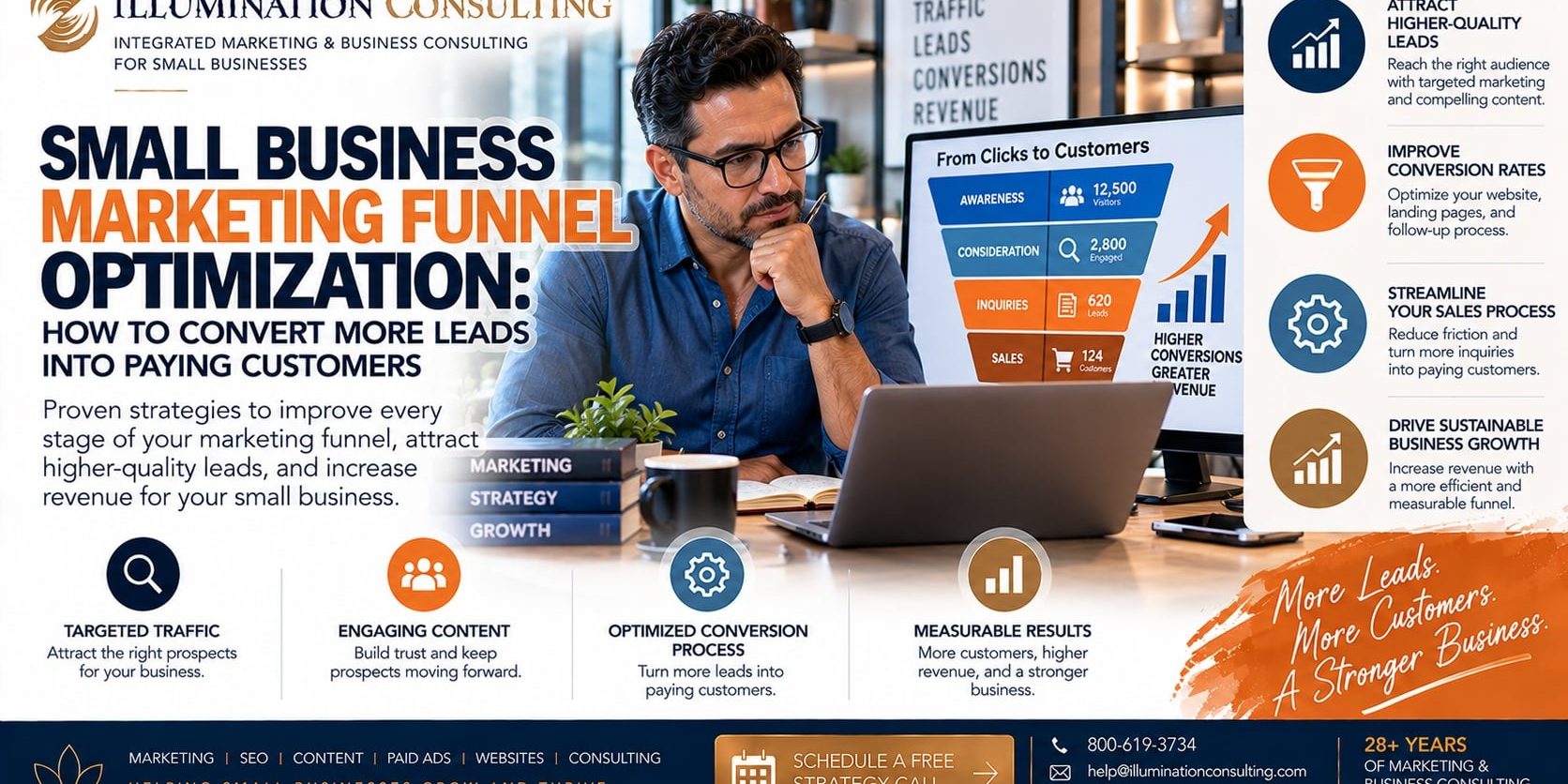
A marketing funnel represents the stages prospective customers move through as they become aware of a business, investigate its offerings, and decide whether to make a purchase. The exact stages vary depending on the industry, purchasing process, and complexity of the product or service.
For many small businesses, the funnel begins with awareness. Prospective customers discover the company through search results, advertising, social media, referrals, or other channels. During the consideration stage, they evaluate services, compare providers, read reviews, and investigate pricing or availability.
The next stage involves taking action, such as submitting an inquiry, requesting a quote, scheduling a consultation, or adding a product to a shopping cart. The final stage occurs when the customer completes a purchase, signs an agreement, or otherwise becomes a paying client.
A funnel helps management understand how effectively the business supports customers through these stages. It also reveals where marketing and sales processes may be creating unnecessary obstacles.
Why Marketing Funnel Optimization Matters for Small Businesses
Small businesses often operate with limited marketing resources. Increasing advertising expenditure may not be practical, especially when existing campaigns already generate inquiries that fail to become customers.
Funnel optimization helps identify opportunities to improve performance without necessarily increasing lead volume.
Consider a hypothetical service business that receives 200 qualified inquiries each month. If 20 become paying customers, its inquiry-to-customer conversion rate is 10%. Improving that rate to 15% would generate 30 customers from the same number of inquiries.
The business would acquire 10 additional customers without increasing its initial inquiry volume. Whether this improves profitability depends on acquisition costs, fulfillment capacity, customer value, and the expense of implementing changes.
The example illustrates why improving conversion efficiency can be as important as increasing traffic.
Identify the Stages of Your Existing Marketing Funnel
Before optimizing a funnel, businesses must understand how prospective customers currently discover and purchase their products or services.
A professional services company may rely on website inquiries, discovery calls, written proposals, and signed agreements. An ecommerce retailer may use product pages, shopping carts, checkout processes, and payment confirmation. A local service provider may depend on telephone inquiries, estimates, appointment scheduling, and completed services.
Management should document the actual customer journey rather than assuming that every prospect follows the same sequence.
This process should identify the primary marketing channels, conversion actions, communication methods, and decision points involved in acquiring customers.
Once the stages are clearly defined, the business can measure performance and identify where improvements are most likely to produce meaningful results.
Measure Conversion Rates at Each Funnel Stage
Overall conversion rate is useful, but it does not explain where prospective customers are being lost. Businesses should evaluate individual stages to identify specific problems.
A basic funnel conversion calculation is:
Stage Conversion Rate (%) = (Prospects Advancing to the Next Stage / Prospects Entering the Current Stage) x 100
For example, if 500 visitors reach a service landing page and 25 submit inquiries, the visitor-to-inquiry conversion rate is 5%.
If 10 of those inquiries become paying customers, the inquiry-to-customer conversion rate is 40%.
These measurements provide different insights. The first evaluates how effectively the website generates inquiries, while the second reflects downstream sales performance.
Businesses should use consistent reporting periods and definitions to ensure comparisons remain meaningful.
Evaluate the Quality of Marketing Traffic
Not all website visitors have the same level of purchasing intent. Some are researching general information, while others are actively comparing providers or preparing to buy.
A campaign that generates substantial traffic may produce few customers when visitors are not interested in the business’s actual offerings.
Traffic quality should therefore be evaluated through engagement, relevant conversion actions, qualified inquiries, and eventual customer acquisition.
For example, a business offering specialized consulting services may receive thousands of visitors from broad informational searches but relatively few inquiries. A smaller number of visitors searching for a specific consulting service may generate more qualified opportunities.
Professional SEO Services can help businesses align content and search visibility with relevant customer intent.
The goal is attracting visitors who are more likely to benefit from the company’s products or services.
Align Marketing Messages With Customer Intent
Marketing messages should reflect what prospective customers are trying to accomplish at each stage of the buying process.
Someone researching a problem may need educational information, while a prospective customer comparing providers may want pricing details, qualifications, service descriptions, and evidence of relevant experience.
Businesses frequently lose conversions when advertisements, search results, and landing pages communicate inconsistent messages.
For example, an advertisement promoting website development for small businesses should lead to a page that clearly explains the relevant service. Sending visitors to a generic homepage may require them to search for information they expected to find immediately.
Message consistency improves clarity and helps prospective customers determine whether the business meets their needs.
Improve Landing Page Conversion Performance
Landing pages play an important role in turning marketing traffic into inquiries and sales. Their effectiveness depends on how clearly they communicate value, address customer questions, and guide visitors toward appropriate next steps.
A strong landing page should explain the product or service, identify the intended audience, describe meaningful benefits, and provide a clear conversion opportunity.
Supporting information may include relevant qualifications, service details, customer testimonials when authorized, and frequently asked questions.
Professional Website Design Services can help businesses improve page structure, navigation, mobile usability, and conversion paths.
Landing pages should prioritize clarity over unnecessary design complexity. Visitors should quickly understand what the company offers and how to proceed.
Create Clear and Relevant Calls to Action
Calls to action help prospective customers understand what they should do next. However, vague or overly aggressive messaging can create confusion or hesitation.
A business offering consulting services may use a call to action such as “Schedule a Consultation,” while a local contractor may use “Request an Estimate.” An ecommerce company may direct shoppers toward product selection or checkout.
The appropriate action depends on the customer’s stage in the buying process.
Businesses should avoid presenting too many competing calls to action on the same page. When visitors face numerous unrelated options, they may struggle to identify the most relevant next step.
Clear calls to action should be supported by accurate expectations about what happens after the customer responds.
Reduce Friction in Lead Generation Forms
Lead generation forms can create unnecessary obstacles when they request excessive information or fail to explain why certain details are needed.
Small businesses should evaluate whether each form field is necessary at the initial inquiry stage.
For example, a service inquiry form may need a name, contact information, and a brief description of the requested service. Detailed project requirements can often be collected during a later conversation.
Forms should work reliably across desktop and mobile devices, provide clear confirmation messages, and route submissions to the appropriate team.
Businesses should also test forms regularly to identify technical problems that could prevent inquiries from reaching staff.
Improve Mobile Website Conversion
Many prospective customers research businesses using smartphones. A website that performs adequately on desktop may still create significant friction on mobile devices.
Common problems include difficult navigation, small text, poorly positioned buttons, slow-loading pages, and complicated forms.
Mobile optimization should focus on usability and the customer’s ability to complete important actions.
Telephone links, appointment scheduling, product information, and inquiry forms should be easy to access.
Businesses should test their primary conversion paths on actual mobile devices rather than relying exclusively on automated website reports.
Strengthen Trust Throughout the Customer Journey
Trust influences whether prospective customers continue evaluating a business or move to a competitor.
Small businesses can strengthen credibility by providing accurate service descriptions, transparent contact information, professional website design, relevant experience, and consistent communication.
Where available and authorized, genuine customer testimonials, case studies, and project examples can help prospective customers evaluate the business.
However, companies should avoid fabricated reviews, exaggerated results, and unsupported performance claims.
Trust develops when marketing promises align with the experience customers receive during subsequent interactions.
Make Pricing and Service Expectations Clearer
Uncertainty about pricing can prevent prospective customers from taking the next step.
Not every business can publish fixed prices, particularly when services require customized proposals. However, companies can often explain their pricing structure, minimum engagement requirements, service packages, or factors influencing cost.
For example, a consulting company may explain whether services are offered through hourly engagements, fixed-scope projects, or ongoing retainers.
Clear expectations help prospects determine whether the offering fits their needs and budget.
This can improve lead quality and reduce time spent pursuing opportunities that are unlikely to become suitable customers.
Improve Lead Response Times
When prospective customers submit inquiries, delayed responses can weaken their interest or encourage them to contact competing providers.
Businesses should establish reliable procedures for reviewing and responding to inquiries during normal operating hours.
Response expectations should reflect staffing capacity and customer needs. A business should not promise immediate responses unless it can consistently deliver them.
Automated acknowledgments may reassure prospects that their inquiry was received, but they should not replace appropriate human communication when the purchasing decision requires personal attention.
A consistent response process reduces the risk of qualified opportunities being overlooked.
Qualify Leads Without Creating Unnecessary Barriers
Lead qualification helps businesses determine whether prospective customers are appropriate for their products or services.
Useful qualification factors may include the requested service, project requirements, geographic eligibility, budget compatibility, timeline, and decision-making process.
However, excessive qualification requirements can discourage suitable prospects before the business understands their needs.
The objective is collecting enough information to determine the appropriate next step without making the initial interaction unnecessarily difficult.
Effective qualification also helps sales teams prioritize relevant opportunities and provide more useful responses.
Create a Consistent Sales Follow-Up Process
Prospective customers may not make purchasing decisions immediately after their first inquiry.
Some need additional information, internal approval, budget confirmation, or time to compare alternatives.
A structured follow-up process helps businesses remain responsive without relying on individual staff members to remember every opportunity.
Follow-up communications should address relevant questions, clarify next steps, and provide useful information.
Businesses should respect communication preferences and avoid excessive messages that create pressure rather than value.
A consistent process can improve opportunity management while supporting a professional customer experience.
Improve Proposal and Estimate Conversion
For service businesses, the proposal or estimate stage often represents an important conversion point.
Prospective customers may hesitate when proposals are difficult to understand, contain unclear pricing, or fail to explain deliverables and expectations.
A strong proposal should describe the relevant scope of work, expected deliverables, timeline, pricing, responsibilities, and applicable terms.
Businesses should also make the acceptance process straightforward.
Proposal conversion should be measured separately from initial lead conversion so management can identify whether problems originate in marketing, qualification, pricing, or the proposal process itself.
Use Customer Relationship Management Systems Effectively
Customer relationship management software can help businesses organize inquiries, track sales opportunities, document communication, and manage follow-up activities.
However, software alone does not create an effective funnel.
Businesses must establish clear sales stages, consistent data entry practices, and defined responsibilities for moving opportunities forward.
A simple CRM configured around the company’s actual purchasing process may be more useful than an expensive system with unnecessary features.
The goal is improving visibility and consistency so qualified opportunities receive appropriate attention.
Connect Marketing and Sales Reporting
Marketing and sales teams sometimes evaluate performance using different measurements.
Marketing may emphasize website traffic, inquiries, and advertising results, while sales focuses on proposals, closed deals, and collected revenue.
When these reports are disconnected, management may struggle to identify which marketing activities generate actual customers.
Businesses should establish a shared reporting process that connects acquisition channels with downstream sales outcomes.
This helps determine whether a campaign generates qualified opportunities, whether those opportunities progress through the funnel, and whether the resulting customers justify acquisition costs.
Measure Customer Acquisition Cost
Customer acquisition cost provides a useful financial perspective on funnel performance.
Customer Acquisition Cost = Total Defined Customer Acquisition Spending / Number of New Customers Acquired
For example, if a business spends $6,000 on defined acquisition activities and gains 12 new customers, the calculated acquisition cost is $500 per customer.
The appropriate acquisition cost depends on customer contribution, retention, fulfillment expenses, and the business model.
Improving funnel conversion can reduce acquisition cost when the same marketing expenditure produces more customers.
However, management should evaluate acquisition cost alongside customer quality and profitability rather than attempting to minimize it at any cost.
Evaluate Funnel Performance by Marketing Channel
Different marketing channels may generate customers with different levels of purchasing intent.
Organic search, paid advertising, social media, referrals, and email campaigns can each contribute to the customer journey.
A channel generating many inquiries may produce relatively few paying customers, while another with lower inquiry volume may generate stronger conversion.
Businesses should compare channels using qualified leads, sales progression, acquisition cost, and customer contribution.
Attribution limitations should also be considered, particularly when customers interact with multiple channels before purchasing.
The objective is making better marketing investment decisions using the most reliable information available.
Use Conversion Testing to Improve Results
Funnel optimization should be based on measured improvements rather than assumptions.
Businesses can test changes to landing page headlines, calls to action, form layouts, service descriptions, scheduling processes, and follow-up communications.
Testing should begin with a clear hypothesis.
For example, a business may believe that simplifying its inquiry form will increase qualified submissions. The company can implement the change and evaluate whether submission volume, lead quality, and downstream customer acquisition improve.
Where traffic volume supports it, controlled A/B testing may provide stronger evidence than simple before-and-after comparisons.
Businesses should avoid making numerous unrelated changes simultaneously when doing so would make results difficult to interpret.
Develop a 90-Day Small Business Marketing Funnel Optimization Plan
A structured improvement plan helps businesses prioritize changes and evaluate their financial impact.
Days 1–30: Audit the Existing Funnel
Document the customer journey from initial discovery through completed purchase.
Review website analytics, inquiry forms, response times, qualification procedures, proposal conversion, and customer acquisition costs.
Identify the stages where the largest losses occur and establish baseline performance metrics.
Days 31–60: Implement Priority Improvements
Improve landing pages, clarify calls to action, simplify unnecessary form fields, and address mobile usability problems.
Establish consistent inquiry response and follow-up procedures.
Update sales materials and CRM workflows where necessary.
Focus on changes that address clearly identified problems rather than redesigning the entire funnel without evidence.
Days 61–90: Measure and Refine
Compare conversion rates, lead quality, acquisition costs, and completed sales with the baseline.
Evaluate whether improvements generate additional qualified customers and meaningful financial value.
Expand successful changes and adjust initiatives that produce weak results.
The 90-day framework provides a practical implementation structure, although actual results will depend on business conditions and available data.
Common Small Business Marketing Funnel Mistakes
Businesses frequently lose potential customers through avoidable marketing and operational problems.
Focusing exclusively on traffic. More website visitors do not guarantee more qualified leads or paying customers.
Using generic landing pages. Visitors may leave when the page does not address the specific service or product they expected.
Creating complicated inquiry forms. Excessive information requirements can discourage prospective customers.
Responding inconsistently to leads. Delayed or missed communication can weaken otherwise promising opportunities.
Failing to track sales progression. Without stage-level reporting, management cannot reliably identify conversion problems.
Relying on aggressive follow-up. Excessive communication may damage trust rather than improve sales.
Measuring marketing without financial outcomes. Lead volume and conversion rates should be evaluated alongside customer acquisition costs and contribution.
Avoiding these mistakes requires coordination between marketing, website management, customer service, and sales operations.
Build a More Profitable Small Business Marketing Funnel
An effective marketing funnel helps businesses convert relevant customer interest into completed purchases through clear communication, useful information, reliable processes, and a professional customer experience.
Small business marketing funnel optimization is not simply about increasing conversion percentages. It involves identifying where customers encounter unnecessary obstacles, improving the quality of inquiries, supporting purchasing decisions, and connecting marketing performance with financial outcomes.
Businesses that consistently measure and refine their funnels can make better use of existing marketing investments and reduce unnecessary dependence on increased advertising expenditure.
Illumination Consulting helps small businesses connect Marketing Services, Website Design Services, SEO Services, Content Marketing, and business consulting into coordinated growth strategies. Our objective is to help companies attract qualified prospects, improve customer acquisition, and build sustainable business performance.
Frequently Asked Questions
What is small business marketing funnel optimization?
Small business marketing funnel optimization involves improving the stages that move prospective customers from initial awareness to inquiry, evaluation, and purchase. It focuses on reducing unnecessary friction and increasing the effectiveness of marketing and sales processes.
How can small businesses improve marketing funnel conversion rates?
Businesses can improve conversion by attracting more relevant traffic, strengthening landing pages, simplifying inquiry forms, responding consistently to leads, clarifying pricing, and improving sales follow-up procedures.
What is a good marketing funnel conversion rate for a small business?
There is no universal conversion rate that applies to every business. Results vary by industry, product or service, traffic source, pricing, and purchasing process. Companies should establish internal benchmarks and evaluate changes using consistent definitions.
Does marketing funnel optimization reduce customer acquisition costs?
It can reduce acquisition costs when existing marketing expenditure generates more paying customers. However, businesses should also evaluate customer quality, contribution, and the cost of implementing improvements.
Which marketing funnel stage should a small business optimize first?
Businesses should begin with the stage showing the largest meaningful performance problem. This may involve weak landing page conversion, poor lead qualification, slow response times, low proposal acceptance, or other issues identified through reporting.