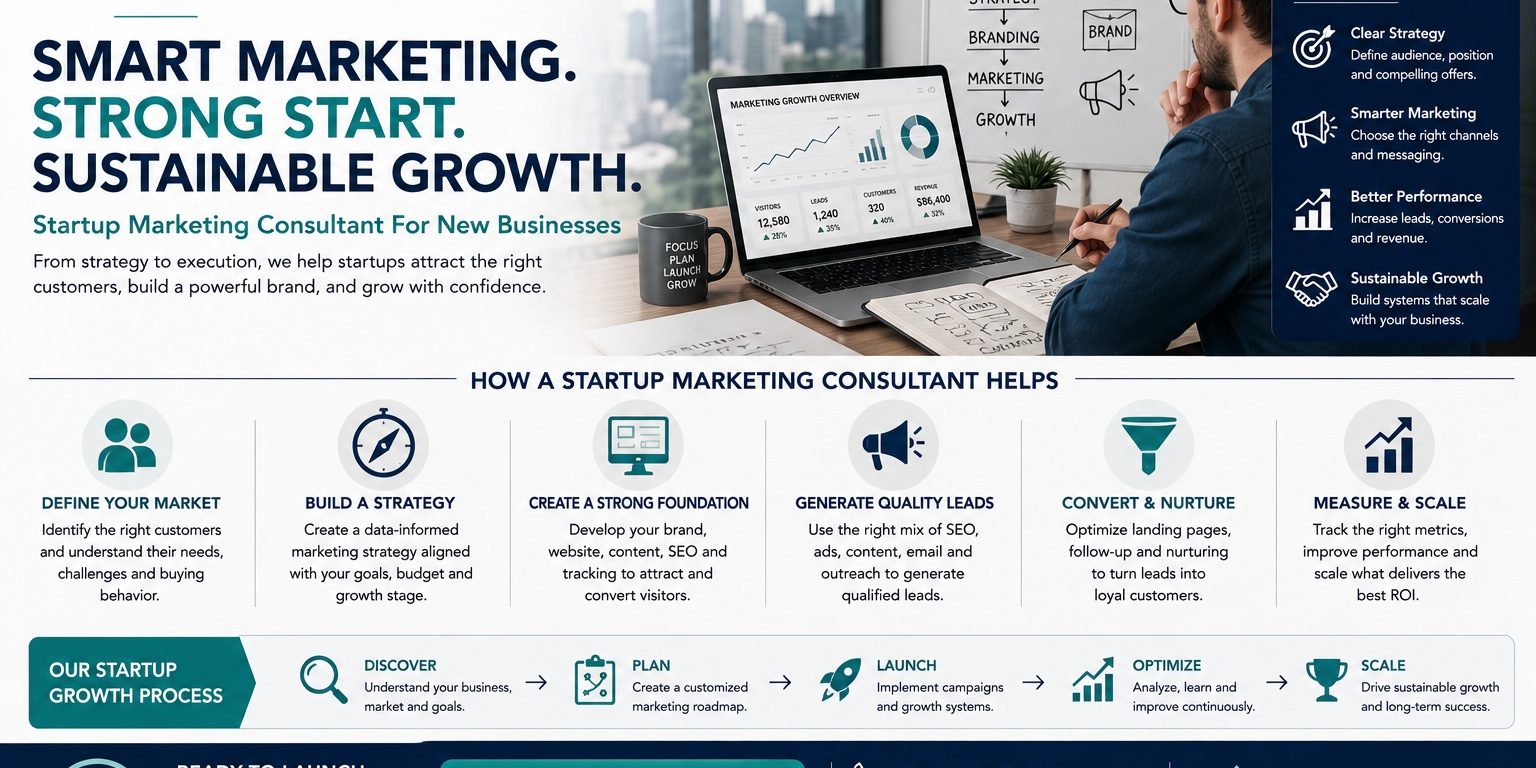
Starting a business requires more than developing a product or service. A new company must determine who it serves, how it should be positioned, why customers should choose it, where those customers can be reached, and how marketing activity will convert into revenue. Founders often attempt to answer these questions themselves while simultaneously managing operations, financing, vendors, product development, technology, and countless other startup responsibilities.
A startup marketing consultant can help turn these disconnected decisions into a structured customer acquisition strategy. The objective is not simply to produce advertisements, social media posts, or a website. Effective startup marketing establishes the positioning, infrastructure, channels, measurement systems, and execution priorities required to acquire customers efficiently.
For entrepreneurs already navigating the broader process of launching a company, professional business startup consulting can also connect marketing decisions with business planning, operations, technology, financial priorities, and the overall launch strategy.
What Does a Startup Marketing Consultant Do?
A startup marketing consultant helps founders determine how a new business will enter the market, attract customers, and create sustainable demand.
The exact role depends on the stage and needs of the company.
A consultant may assist with:
- market and competitor research
- target customer identification
- brand positioning
- value proposition development
- marketing strategy
- website planning
- search engine optimization
- content strategy
- lead generation
- paid advertising
- social media strategy
- email marketing
- conversion optimization
- marketing technology
- analytics and measurement
- launch planning
The strongest engagements begin with strategy rather than immediately selecting tactics.
Launching Google Ads, publishing articles, or posting on social media before establishing the target customer and market position can generate activity without creating a reliable path to revenue.
Why Startups Struggle With Marketing
Established companies usually have historical information.
They know something about their customers, sales cycles, profitable products, acquisition channels, conversion rates, and competitive position.
Startups often begin without those advantages.
A founder may have assumptions about the market, but assumptions are not the same as validated customer behavior.
This creates several common challenges.
Limited Marketing Data
A new company may not yet know which messages resonate, what customers are willing to pay, which channels perform best, or what objections prevent purchases.
Marketing therefore begins partly as a process of structured learning.
Limited Capital
Most startups cannot afford to test every possible channel.
Marketing resources need to be concentrated where the probability of generating useful information and revenue is highest.
Limited Brand Recognition
Established competitors may already have reviews, search rankings, social audiences, email databases, customer relationships, and market credibility.
A startup has to build those assets.
Limited Internal Resources
The founder may personally handle sales, operations, marketing, finance, product development, and customer service.
Even when the founder understands marketing, execution capacity can become the constraint.
When Should a Startup Hire a Marketing Consultant?
Not every new business needs outside marketing help immediately.
A founder still exploring an idea with no defined offer or customer may need additional business validation before building a sophisticated marketing system.
However, several situations make professional assistance particularly valuable.
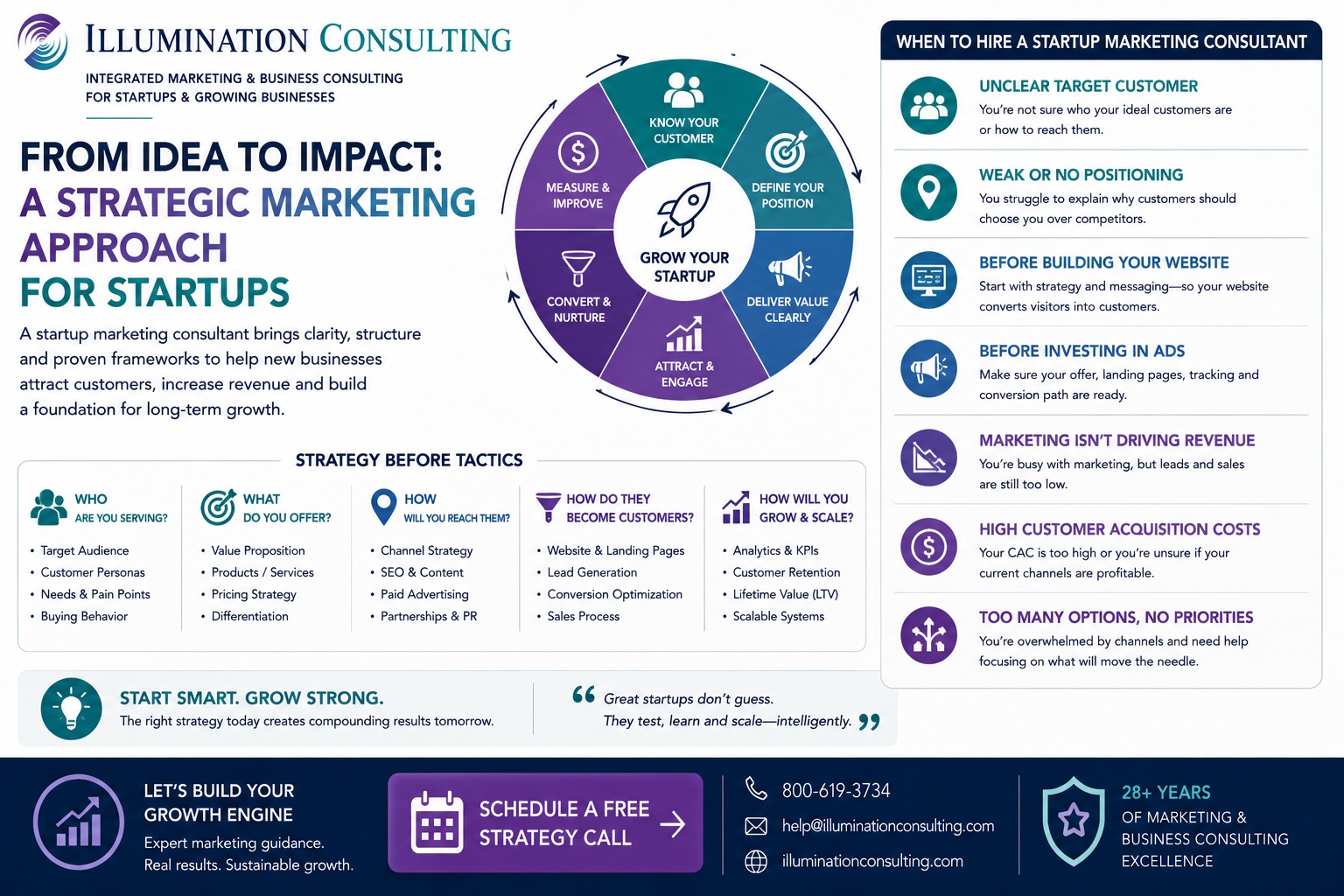
When the Founder Cannot Clearly Define the Target Customer
One of the earliest warning signs is an overly broad target market.
Statements such as:
“Everyone can use our product.”
or:
“We serve all small businesses.”
usually make marketing more difficult.
Effective marketing requires specificity.
A consultant can help define customer segments based on factors such as:
- needs
- problems
- purchasing behavior
- demographics
- business characteristics
- geography
- buying triggers
- objections
- economic value
A clearly defined audience makes positioning, messaging, advertising, content, and sales considerably easier to develop.
When the Business Lacks Clear Positioning
A startup needs an answer to a fundamental question:
Why should a customer choose this company instead of the available alternatives?
That answer becomes the foundation of positioning.
Weak positioning often leads companies to compete primarily on price or rely on vague claims such as better service, higher quality, or innovative solutions.
Strong positioning identifies a meaningful place in the customer’s mind.
It can be influenced by specialization, expertise, convenience, methodology, customer experience, technology, pricing model, product attributes, or another defensible advantage.
Marketing becomes substantially more effective when the market position is clear before campaigns begin.
Before Building the Website
Founders frequently treat the website as an early design project.
They select colors, images, layouts, and templates before determining what the website needs to accomplish.
The better sequence is strategic.
First determine:
Who is the visitor?
What problem are they trying to solve?
What should they understand about the company?
What objections need to be addressed?
What action should they take?
How will visitors reach the website?
Those answers should influence architecture, messaging, content, SEO, calls to action, and conversion pathways.
For startups, professional small business website design should therefore support customer acquisition rather than functioning merely as a digital brochure.
Before Spending Heavily on Advertising
Paid advertising can produce traffic quickly.
It can also consume startup capital quickly.
Advertising works best when the underlying business has sufficient clarity around:
- target customers
- offers
- positioning
- landing pages
- conversion
- tracking
- sales follow-up
- customer economics
Without these elements, increasing advertising spending may simply amplify weaknesses.
A startup marketing consultant can help establish the acquisition system before significant media budgets are deployed.
This does not mean every element must be perfect.
Startups need testing.
However, testing should answer deliberate questions rather than consist of random spending across multiple platforms.
When Marketing Activity Is Not Producing Revenue
Some startups are extremely busy with marketing.
They publish social content, write blogs, send emails, redesign websites, attend events, run ads, and experiment with new software.
Yet sales remain weak.
This is where founders need to distinguish marketing activity from marketing performance.
Useful questions include:
- Is the right audience being reached?
- Is the offer compelling?
- Is the positioning clear?
- Are visitors converting?
- Are leads qualified?
- Is sales follow-up effective?
- Is the customer acquisition cost sustainable?
- Are marketing channels appropriate for the buying journey?
A consultant should help diagnose the constraint rather than simply recommend additional activity.
When Customer Acquisition Costs Are Too High
Growth is not automatically healthy when acquiring customers costs more than the business can economically support.
A startup needs to understand the relationship between:
Customer acquisition cost
and
Customer lifetime value.
A simplified customer acquisition cost calculation is:
CAC = Sales and Marketing Acquisition Costs ÷ New Customers Acquired
Suppose a startup spends $12,000 on activities directly associated with customer acquisition and gains 40 new customers.
The simplified CAC would be:
$12,000 ÷ 40 = $300
Whether that is attractive depends on the economics of those customers.
A $300 CAC could be excellent for a high-margin recurring service and disastrous for a low-margin product with little repeat purchasing.
A consultant can help connect marketing performance to these business economics.
When the Startup Has Too Many Marketing Options
Modern founders face an enormous number of potential channels.
There is SEO.
Google Ads.
Meta advertising.
LinkedIn.
TikTok.
YouTube.
Email.
Influencers.
Affiliate marketing.
Partnerships.
Content.
PR.
Direct outreach.
Marketplaces.
Events.
The question is not whether these channels can work.
Many can.
The question is:
Which channels deserve the startup’s limited time and capital right now?
That is fundamentally a prioritization problem.
A strong startup marketing strategy should concentrate resources on the channels most appropriate for the target customer, offer, buying process, economics, and stage of the business.
Build a Startup Marketing Strategy Before a Channel Strategy
Founders frequently begin with statements such as:
“We need social media.”
“We should start SEO.”
“We need Google Ads.”
Those may eventually be correct.
But channels should follow strategy.
A startup marketing strategy should first define several core elements.
Target Market
Who specifically is the company trying to acquire?
Customer Problem
What meaningful problem, desire, or objective creates demand?
Value Proposition
Why should the customer choose this solution?
Positioning
How should the company be understood relative to alternatives?
Offer
What exactly is being sold, and under what conditions?
Acquisition Model
How will prospective customers discover the company?
Conversion Model
What steps move a prospect toward becoming a customer?
Retention Model
How will the business generate repeat purchases, renewals, referrals, or ongoing revenue?
Only after these questions become clearer should the channel mix be finalized.
Startup SEO Should Build Long-Term Visibility
Search engine optimization can be particularly valuable when potential customers actively search for the company’s products, services, or solutions.
However, startups need to be realistic about timing.
SEO is generally not an instant acquisition channel.
A new domain may need time to establish content, authority, relevance, and rankings.
That makes SEO a strategic asset rather than a substitute for immediate sales activity.
A startup SEO strategy can include:
- keyword research
- competitor analysis
- website architecture
- service or product pages
- local SEO
- technical optimization
- educational content
- internal linking
- authority development
- conversion optimization
Professional SEO services should align keyword opportunities with the startup’s commercial priorities rather than pursuing traffic for its own sake.
Content Should Support Customer Acquisition
Startups sometimes publish content because they have been told content marketing is important.
That is not enough.
Every significant piece of content should have a strategic purpose.
Content can:
- answer customer questions
- address objections
- demonstrate expertise
- explain products
- compare alternatives
- support SEO
- educate prospects
- build trust
- nurture leads
- strengthen sales conversations
A business-to-business startup with a complex sales process may require educational resources that help buyers evaluate the solution.
An ecommerce startup may benefit from buying guides, product education, comparisons, demonstrations, and post-purchase content.
The format should follow customer needs rather than a predetermined publishing schedule.
Establish Conversion Before Scaling Traffic
One of the most expensive startup mistakes is increasing traffic to an experience that does not convert.
Suppose a website receives 1,000 qualified visitors and generates ten inquiries.
Increasing traffic to 10,000 visitors may produce more inquiries, but the underlying conversion weakness remains.
Improving the conversion rate before aggressively scaling traffic can produce significantly better economics.
Startups should evaluate:
- value proposition clarity
- page messaging
- trust signals
- offers
- calls to action
- forms
- checkout processes
- pricing communication
- mobile usability
- page speed
- sales follow-up
Traffic and conversion should be improved together.
Marketing Technology Should Simplify the Business
Startups have access to thousands of marketing applications.
CRM platforms, analytics tools, automation systems, email software, AI applications, SEO platforms, social schedulers, chatbots, advertising tools, and countless other products promise better performance.
The temptation is to build an elaborate technology stack immediately.
That can become counterproductive.
Technology should solve actual operational or marketing problems.
A startup might initially need only:
Website → analytics → CRM → email → scheduling/payment → essential marketing tools
Additional systems can be introduced as complexity increases.
The objective is not owning sophisticated technology.
The objective is building an efficient acquisition and customer-management system.
How AI Changes Startup Marketing
Artificial intelligence gives small businesses capabilities that previously required larger teams.
AI can assist with:
- research
- content planning
- customer analysis
- personalization
- lead qualification
- marketing automation
- reporting
- SEO
- advertising analysis
- sales support
However, AI does not eliminate the need for strategy.
Automating a poorly defined process simply allows the company to execute the wrong process faster.
Startups should first establish what needs to happen, then determine where AI and automation can reduce cost, increase speed, improve consistency, or create better customer experiences.
What Should a Startup Marketing Consultant Cost?
There is no universal consulting fee because engagements vary substantially.
A founder may need a short strategic assessment, a launch plan, ongoing advisory support, or complete implementation involving multiple marketing disciplines.
Pricing may be structured as:
- hourly consulting
- fixed-fee projects
- monthly retainers
- strategy engagements
- implementation packages
- fractional marketing leadership
Rather than comparing hourly rates alone, founders should evaluate the scope and expected business value.
A lower-cost consultant providing generic advice can be expensive if months of execution are built around the wrong strategy.
Likewise, a startup should not purchase an elaborate marketing engagement that exceeds its actual needs or financial capacity.
The appropriate investment should reflect the company’s stage, complexity, available capital, and commercial opportunity.
Consultant, Agency, Employee, or Fractional CMO?
Startups have several options for obtaining marketing expertise.
Marketing Consultant
A consultant can be useful when the company needs diagnosis, strategy, prioritization, planning, or specialized expertise.
Marketing Agency
An agency may be appropriate when substantial execution is required across SEO, advertising, websites, content, or other disciplines.
Internal Marketing Employee
Hiring internally can make sense when the workload justifies a dedicated role and the company knows what expertise it requires.
Fractional Marketing Leadership
A fractional CMO or similar executive can help companies needing ongoing senior marketing leadership without hiring a full-time executive.
These models are not mutually exclusive.
A consultant may develop the strategy while specialists execute it. A fractional leader may manage agencies. An internal employee may coordinate outside partners.
The correct structure depends on what the startup actually needs.
Questions to Ask a Startup Marketing Consultant
Founders should evaluate consultants carefully.
Useful questions include:
- How do you determine which customers we should target?
- How will you evaluate our competitors?
- How do you approach positioning?
- How will marketing priorities be selected?
- Which metrics will determine success?
- How do you connect marketing with revenue?
- What work will you perform versus what must we execute?
- How will you evaluate customer acquisition cost?
- How will you determine which channels deserve investment?
- How do you approach testing?
- What happens if the initial assumptions prove incorrect?
- Who owns the marketing assets, accounts, and data?
A strong consultant should be comfortable discussing uncertainty.
Startups operate with incomplete information.
The objective is not pretending every answer is already known. It is creating an intelligent process for learning quickly while controlling risk.
Warning Signs When Hiring Marketing Help
Founders should be cautious when a consultant or agency:
- guarantees specific rankings
- guarantees immediate revenue
- recommends channels before understanding the business
- focuses primarily on vanity metrics
- cannot explain measurement
- pushes long contracts before defining scope
- uses the same strategy for every client
- avoids discussing customer economics
- cannot explain what the founder will actually receive
- prioritizes marketing activity over business objectives
Marketing always contains uncertainty.
Professional guidance should improve the quality of decisions, not disguise uncertainty with unrealistic promises.
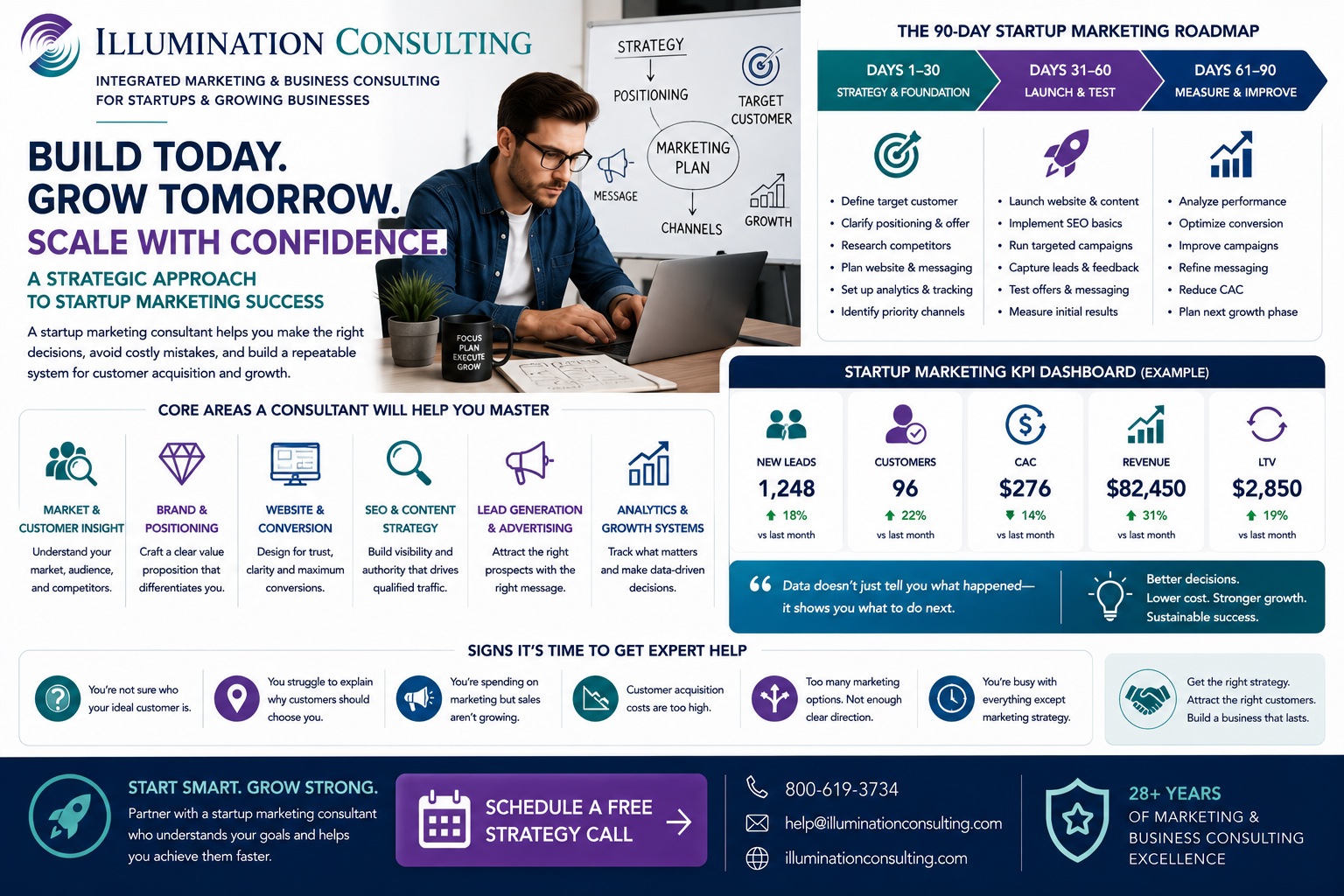
Create a 90-Day Startup Marketing Roadmap
A startup does not need to solve every marketing problem simultaneously.
A structured 90-day plan can establish priorities.
Days 1–30: Strategy and Foundation
Clarify:
- target customer
- positioning
- competitive environment
- value proposition
- offer
- pricing
- acquisition economics
- website requirements
- analytics
- priority channels
Identify the most important assumptions requiring validation.
Days 31–60: Launch and Testing
Begin controlled execution.
Depending on the business, this might involve:
- website launch or optimization
- SEO implementation
- content
- paid advertising
- outbound lead generation
- social media
- partnerships
Testing should be designed to produce useful information.
Days 61–90: Measure and Improve
Evaluate what happened.
Which channels generated qualified prospects?
Which messages performed?
Where did prospects abandon the process?
What did acquisition cost?
Which customers generated revenue?
Use those findings to determine the next investment cycle.
Know When the Startup Is Ready to Scale Marketing
More marketing spending does not fix a weak business model.
Scaling becomes more rational when the startup has evidence that:
- customers want the offer
- positioning resonates
- acquisition channels produce qualified demand
- conversion is measurable
- customer economics are viable
- fulfillment can support additional volume
- retention is acceptable
- tracking is reliable
At that point, additional marketing investment can amplify something that is already beginning to work.
Before that point, the priority may be validation and optimization.
The Right Marketing Help Should Improve Decisions
The value of a startup marketing consultant should not be measured by how many tactics are recommended.
It should be measured by the quality of the decisions the business makes.
A strong consultant helps founders determine what not to do as much as what to do.
That can prevent limited capital from being scattered across websites, software, advertising platforms, social channels, content programs, and other initiatives without a coherent acquisition strategy.
The goal is to establish a repeatable system:
Position → Attract → Convert → Measure → Improve → Scale
As the business learns, the system becomes more sophisticated.
Channels can expand. Automation can increase. Content can compound. SEO authority can grow. Advertising can scale. Customer data can improve targeting and retention.
But the foundation remains the same: understand the customer, solve a meaningful problem, communicate the value clearly, acquire customers economically, and measure what happens.
Illumination Consulting works with entrepreneurs and growing companies through business startup consulting and integrated marketing services. The objective is to help founders make stronger launch and growth decisions, establish the right marketing infrastructure, and focus limited resources on activities capable of creating customers and sustainable revenue.
Frequently Asked Questions
What does a startup marketing consultant do?
A startup marketing consultant helps founders develop customer acquisition strategies. Work may include market research, positioning, messaging, website strategy, SEO, content, advertising, lead generation, analytics, conversion optimization, marketing technology, and launch planning.
When should a startup hire a marketing consultant?
Outside help can be particularly useful when the business needs clearer positioning, does not know which marketing channels to prioritize, is preparing to launch, has weak customer acquisition, is spending heavily without adequate results, or lacks senior marketing expertise internally.
How much does a startup marketing consultant cost?
Costs vary according to the consultant’s expertise, engagement scope, duration, and required implementation. Pricing can include hourly consulting, fixed-fee projects, monthly retainers, strategy engagements, or fractional leadership. Startups should evaluate scope and expected value rather than price alone.
Should a startup hire a consultant or marketing agency?
A consultant is often appropriate for strategy, diagnosis, planning, and specialized guidance. An agency can be more suitable when substantial ongoing execution is required. Some startups use both, with strategic leadership coordinating specialized implementation.
Can a startup do its own marketing?
Yes. Many founders initially manage significant portions of marketing themselves. Outside expertise becomes more valuable when complexity increases, internal capacity becomes constrained, acquisition costs rise, or mistakes become more expensive than professional guidance.