
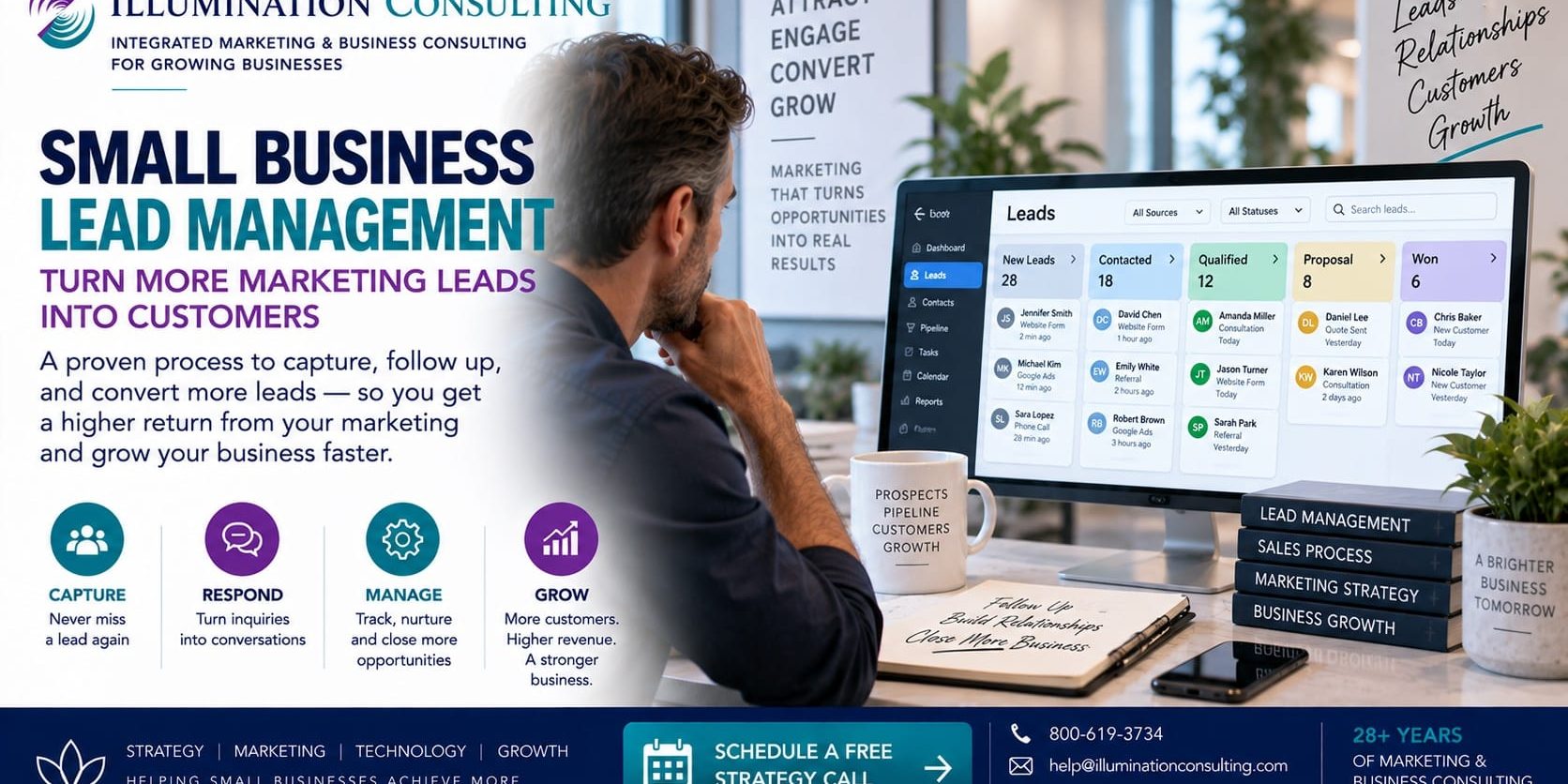
Small businesses invest considerable time, money, and effort into generating new customer opportunities. Website development, search engine optimization, paid advertising, content marketing, social media, referral programs, networking, and other marketing activities are all ultimately designed to accomplish the same commercial objective: attract qualified prospects and create opportunities for new business.
Generating the inquiry, however, is only the beginning. A company can improve its search rankings, increase website traffic, expand its advertising budget, and generate substantially more leads without producing proportional revenue if those opportunities are not handled effectively after they arrive. Slow responses, inconsistent follow-up, unclear responsibilities, poor qualification, scattered customer information, and inadequate tracking can allow valuable prospects to disappear before they ever become customers.
This is why small business lead management should be treated as an integral part of the customer acquisition system rather than simply an administrative sales function. Effective lead management connects marketing activity with sales outcomes by creating a defined process for capturing inquiries, responding to prospects, qualifying opportunities, managing follow-up, tracking progress, and measuring which leads ultimately generate revenue.
For businesses investing in professional marketing services, improving this process can increase the value of marketing already being performed. Instead of assuming that growth always requires more traffic or a larger advertising budget, companies should also examine how efficiently existing leads move from initial inquiry to paying customer.
What Is Small Business Lead Management?
Small business lead management is the process used to capture, organize, respond to, qualify, nurture, track, and convert prospective customers.
The process begins when someone expresses interest in the business and continues until the opportunity becomes a customer, is determined not to be a fit, or is appropriately moved into longer-term follow-up.
Depending on the company, lead management may include:
- capturing inquiries
- identifying lead sources
- assigning responsibility
- responding to prospects
- qualifying opportunities
- scheduling calls or appointments
- documenting conversations
- creating follow-up tasks
- sending proposals or estimates
- tracking sales stages
- nurturing longer-term opportunities
- recording wins and losses
- measuring conversion and revenue
Small businesses do not necessarily need complicated enterprise technology to accomplish this. What they do need is a consistent process that prevents qualified opportunities from being forgotten or mishandled.
Lead Generation and Lead Management Are Different
Lead generation creates opportunities. Lead management determines what happens to those opportunities.
That distinction matters because businesses frequently evaluate marketing based primarily on the number of inquiries generated.
Consider two hypothetical companies.
Company A generates 100 leads and acquires 10 customers, producing a 10% lead-to-customer conversion rate.
Company B generates 70 leads and acquires 14 customers, producing a 20% lead-to-customer conversion rate.
Company B generates fewer leads but acquires more customers because it converts opportunities more effectively.
The example illustrates an important principle:
More leads do not automatically mean more revenue.
Lead volume, lead quality, and lead conversion must be evaluated together.
Every Lead Represents a Marketing Investment
Even leads generated through organic channels are not truly free.
A business may have invested in:
- website design and development
- SEO
- content
- advertising
- marketing employees
- agencies or consultants
- software
- photography and video
- events
- sales collateral
- reputation development
When a qualified inquiry is poorly handled, some of the investment used to create that opportunity is effectively wasted.
This makes lead management particularly important for businesses investing in SEO services, advertising, content, and other customer acquisition strategies.
Marketing should not end when someone submits a form.
The complete customer acquisition path is closer to:
Visibility → Traffic → Inquiry → Response → Qualification → Sales Opportunity → Customer → Revenue
Every stage influences the return generated by the stages before it.
Map Every Way Prospects Contact the Business
The first practical step is identifying every possible lead entry point.
Depending on the business, inquiries might arrive through:
- website forms
- telephone calls
- online scheduling
- Google Business Profile
- social media messages
- advertising lead forms
- live chat
- text messages
- referrals
- networking
- events
- partner introductions
- walk-ins
Many businesses discover that leads are entering through more channels than management realizes.
The next question is critical:
Where does each inquiry go after it arrives?
If website leads go to one employee, social media messages are handled by another, telephone inquiries are recorded nowhere, and referrals remain inside someone’s email inbox, management does not have a unified view of its sales opportunities.
Centralize Lead Information
Lead information should ultimately reach a central system.
For a small company with limited lead volume, the initial system might be relatively simple. As the number of prospects increases, a customer relationship management platform or dedicated lead-management system becomes increasingly useful.
Useful lead records may include:
- prospect name
- company
- telephone number
- date received
- marketing source
- service or product interest
- assigned employee
- qualification status
- current sales stage
- previous contact
- next action
- notes
- estimated opportunity value
- final outcome
The objective is not creating unnecessary administrative work.
It is creating visibility and accountability.
Management should be able to determine what opportunities currently exist and what needs to happen next.
Define Who Owns Every Lead
Every new inquiry should have someone responsible for it.
If responsibility is unclear, prospects can easily fall between departments or employees.
A business should establish:
Who receives the inquiry? Who makes the initial response? Who qualifies the prospect? Who schedules the next step? Who follows up? Who records the outcome?
For a solo entrepreneur, one person may perform every function.
A larger small business might distribute these responsibilities among reception, customer service, sales, management, and marketing personnel.
Either structure can work. The important requirement is clear ownership.
Build a Consistent Lead Response Process
When someone contacts a company, that person is expressing active interest at that particular moment. The prospect may also be researching alternatives, comparing providers, reviewing pricing, or contacting competitors.
Businesses should therefore establish an internal process for responding to new inquiries consistently.
The appropriate response method and timing depend on the industry, operating hours, type of request, and customer expectations. A professional-services consultation request may require a different response from an ecommerce customer-service question.
The underlying principle remains the same: a qualified prospect should not enter an undefined process where nobody knows whether a response has occurred.
Use Automation to Support the Initial Response
Automation can help ensure that new inquiries are acknowledged and routed correctly.
For example, a website form might automatically:
- send confirmation to the prospect
- notify the appropriate employee
- create a CRM record
- capture the marketing source
- assign a follow-up task
This can improve operational consistency while reassuring the prospect that the inquiry was received.
Automation, however, should support human interaction rather than replace it when personal communication is appropriate.
An automated message stating that an inquiry has been received does not necessarily answer the prospect’s questions, establish a relationship, or advance the sale.
Match the Response to the Type of Lead
Not every inquiry should enter the same workflow.
A prospective customer requesting a quote may require immediate sales follow-up, while someone downloading educational information may still be in the early stages of research.
Useful lead classifications might include:
- consultation request
- quote request
- immediate sales inquiry
- product inquiry
- existing customer inquiry
- partnership inquiry
- informational request
- vendor inquiry
- employment inquiry
- spam
Classification allows businesses to prioritize and route opportunities more intelligently.
Define What a Qualified Lead Means
Businesses sometimes describe leads as “good” or “bad” without establishing objective criteria.
A stronger approach is to define what constitutes a qualified opportunity.
Depending on the business, qualification factors might include:
- service required
- geographic location
- project size
- budget
- purchasing timeline
- decision-making authority
- company size
- technical requirements
- product or service fit
The criteria should reflect the company’s actual business model.
Qualification helps determine where sales resources should be concentrated while also providing marketing with valuable information about the types of inquiries being generated.
Separate Sales-Ready Prospects From Earlier-Stage Leads
Some prospects are ready to speak with a company immediately.
Others are interested but still gathering information.
Treating both groups identically can create inefficient sales processes.
A sales-ready prospect may need direct personal contact, scheduling, pricing, or a consultation.
An earlier-stage prospect may benefit from:
- educational articles
- case studies
- email nurturing
- testimonials
- newsletters
- videos
- future follow-up
This is one area where a strong content marketing strategy can support lead management. Content can continue educating prospects who are interested in the company but are not yet ready to make a purchasing decision.
Create Clear Lead Stages
A simple sales pipeline makes opportunities easier to manage.
A service business might use:
New Lead → Contacted → Qualified → Consultation Scheduled → Proposal → Decision Pending → Won or Lost
Another company may require different stages.
The objective is not creating as many stages as the software permits. Each stage should represent a meaningful change in the customer’s progress toward a purchase.
A clear pipeline allows management to see where opportunities are accumulating or disappearing.
Always Establish the Next Action
One of the easiest ways to lose prospects is recording that someone was contacted without defining what should happen afterward.
Every active opportunity should have a next action.
Examples might include:
- call Thursday
- send pricing
- schedule consultation
- prepare estimate
- provide requested information
- send case study
- follow up after internal review
- reconnect next month
A prospect without a defined next step can quickly become a forgotten prospect.
This small operational discipline can substantially improve pipeline management.
Create a Structured Follow-Up Process
Not every customer makes a decision during the first conversation.
Prospects may need to:
- compare providers
- discuss the purchase internally
- secure financing
- evaluate pricing
- wait for a project to begin
- resolve another business issue
- obtain approval
- conduct additional research
A structured follow-up process allows legitimate opportunities to remain active without relying on someone’s memory.
Follow-up can combine telephone calls, email, CRM tasks, calendar reminders, text messaging where appropriate, and useful educational material.
The appropriate frequency depends on the value and complexity of the opportunity.
Make Follow-Up Useful
Repeated messages that simply ask whether the prospect has made a decision can become ineffective.
Whenever possible, follow-up should help move the decision forward.
A useful follow-up might:
- answer an unresolved question
- clarify scope
- provide relevant examples
- share a case study
- explain the process
- address an objection
- provide requested pricing
- clarify implementation
- confirm timing
The objective is not merely reminding the prospect that the company exists.
It is helping the prospect reach the next logical step.
Connect the Website Directly to Lead Management
A company’s website should not operate independently from the sales process.
Professional small business website design should consider what happens after a visitor responds to a call to action.
Forms can potentially capture information such as:
- contact information
- requested service
- originating page
- campaign
- referral source
- location
- other relevant qualification information
That data can then be passed into the company’s lead-management process.
Our article on small business website lead generation examines the preceding stage of this funnel: turning website visitors into inquiries.
Lead management begins where website conversion leaves off.
Track Lead Sources Consistently
A business should know where its opportunities originate.
Useful standardized source categories might include:
- Organic Search
- Paid Search
- Paid Social
- Organic Social
- Referral
- Partner
- Event
- Directory
- Direct
- Other
Consistency matters.
Allowing employees to enter descriptions such as “Google,” “website,” “internet,” “online,” and “search” interchangeably makes reporting difficult because those terms can describe different aspects of the customer journey.
Connect Marketing Sources to Sales Outcomes
Marketing reports often stop too early.
They show:
Clicks → Traffic → Leads
Management ultimately needs to understand:
Marketing Source → Leads → Qualified Leads → Opportunities → Customers → Revenue
Consider a hypothetical comparison.
A paid advertising campaign produces 50 leads, of which 15 are qualified and four become customers.
Organic search produces 30 leads, of which 20 are qualified and eight become customers.
If management looked only at lead volume, advertising would appear stronger.
Once lead quality and customer conversion are included, the interpretation changes.
This is why marketing attribution should extend as far into the sales process as reasonably possible.
Track Why Opportunities Are Lost
A lost opportunity can still provide useful business intelligence.
Whenever practical, record why the prospect did not become a customer.
Common reasons might include:
- price
- no response
- chose competitor
- timing
- budget unavailable
- service mismatch
- outside service area
- project canceled
- internal solution
- not qualified
- unknown
Patterns can reveal important problems.
If a large percentage of qualified opportunities disappear after proposals are submitted, the issue may involve pricing, proposal quality, positioning, competition, or follow-up.
If most inquiries are unqualified, marketing targeting may require attention.
Measure Lead-to-Customer Conversion
A basic lead-management metric is:
Lead-to-Customer Conversion Rate = Customers Acquired ÷ Leads Generated × 100
For example, suppose a business generates 80 leads and acquires 12 customers.
12 ÷ 80 × 100 = 15%
This is an illustrative example rather than an industry benchmark.
The metric becomes more useful when segmented by:
- marketing source
- service
- location
- campaign
- salesperson
- lead type
An overall conversion rate can hide substantial differences within the pipeline.
Measure Qualified-Lead Conversion
If a significant portion of inquiries is not relevant to the company, measuring all leads can distort sales performance.
The business can also calculate:
Qualified-Lead Conversion Rate = Customers Acquired ÷ Qualified Leads × 100
Using another illustrative example, suppose 80 inquiries produce 40 qualified opportunities and 12 customers.
The qualified-lead conversion rate is:
12 ÷ 40 × 100 = 30%
Management now has two separate insights.
Only half of incoming leads met qualification criteria, while 30% of qualified opportunities became customers.
Those findings point toward different potential improvements.
Measure the Sales Cycle
Businesses should also understand how long qualified prospects typically take to become customers.
For some companies, the sales cycle may be relatively short.
For others, particularly higher-value B2B and professional services, the process can take considerably longer.
Sales-cycle data helps businesses improve:
- revenue forecasting
- follow-up timing
- marketing attribution
- pipeline management
- staffing decisions
It also prevents companies from prematurely labeling newer leads as unsuccessful.
Calculate Customer Acquisition Cost
Once marketing and sales data are connected, the company can begin evaluating acquisition economics.
A simplified customer acquisition cost calculation is:
Customer Acquisition Cost = Relevant Acquisition Spending ÷ Customers Acquired
If a hypothetical campaign costs $8,000 and ultimately produces 16 customers:
$8,000 ÷ 16 = $500 CAC
Whether $500 represents strong performance depends on factors such as:
- customer value
- gross margin
- repeat purchases
- retention
- fulfillment costs
- additional sales expenses
Customer acquisition cost should therefore be interpreted within the economics of the business rather than evaluated as an isolated number.
Diagnose Where the Funnel Is Breaking
One of the greatest benefits of structured lead management is that it allows businesses to identify the specific stage limiting growth.
High Traffic but Few Leads
Investigate:
- website conversion
- traffic quality
- messaging
- offers
- calls to action
Many Leads but Few Qualified Opportunities
Investigate:
- advertising targeting
- keywords
- audience selection
- positioning
- marketing message
Qualified Leads but Few Meetings
Investigate:
- response process
- scheduling
- follow-up
- communication
Meetings but Few Proposals
Investigate:
- qualification
- sales discovery
- service fit
- sales process
Proposals but Few Customers
Investigate:
- pricing
- value proposition
- competition
- proposal quality
- objections
- follow-up
This diagnostic approach is far more useful than concluding broadly that “marketing isn’t working.”
Improve the Connection Between Marketing and Sales
In a small business, marketing and sales may not be separate departments.
The owner may perform both functions.
The underlying principle still matters.
Marketing should know:
Which leads actually become customers?
The sales process should know:
Where those prospects originated and what motivated them to respond?
This creates a feedback loop.
Marketing can then concentrate more resources on the channels, topics, audiences, and offers that produce commercially valuable opportunities.
That is also why effective SEO should ultimately be evaluated beyond rankings alone. Organic visibility becomes commercially valuable when it contributes to qualified traffic, inquiries, customers, and revenue.
Use CRM Automation Without Losing Human Interaction
Automation can make lead management more reliable.
Useful applications include:
- creating lead records
- assigning leads
- notifying employees
- creating follow-up tasks
- sending appointment reminders
- updating pipeline stages
- triggering nurture sequences
- producing reports
Automation becomes less useful when it substitutes generic communication for a conversation that requires human judgment.
High-value prospects should not spend weeks receiving automated messages while nobody actually speaks with them.
Technology should make personal follow-up easier and more consistent.
Reactivate Older Leads
Not every prospect that fails to purchase today is permanently lost.
A database may contain people who previously:
- delayed a project
- lacked sufficient budget
- stopped responding
- requested information
- considered a service
- chose to wait
- had a future purchasing timeline
Appropriate reactivation campaigns can bring some of these opportunities back into the sales pipeline.
This illustrates one of the long-term benefits of structured lead management: the company’s database itself becomes a business asset.
Without organized records, older opportunities are easily forgotten.
Improve Conversion Before Buying More Leads
Businesses often respond to disappointing sales by increasing marketing activity.
Sometimes that is appropriate.
But first examine whether existing opportunities are being converted effectively.
Consider a hypothetical company generating 100 qualified leads each month.
At a 10% conversion rate:
100 qualified leads → 10 customers
If improved lead management increases conversion to 15%:
100 qualified leads → 15 customers
The company acquires five additional customers without generating another lead.
No additional traffic was required.
No larger advertising budget was required.
The improvement occurred between inquiry and sale.
This is one reason conversion efficiency should be evaluated before simply spending more on acquisition.
Do Not Generate Leads Faster Than the Business Can Handle Them
Successful marketing can expose operational weaknesses.
If a company cannot adequately:
- answer telephone calls
- respond to forms
- schedule consultations
- prepare estimates
- send proposals
- follow up
- onboard customers
then generating substantially more leads may actually reduce overall performance.
Employees become overwhelmed.
Response quality deteriorates.
Prospects wait longer.
Conversion declines.
Before scaling acquisition, the business should confirm that it has sufficient capacity to manage the additional demand.
Build a Practical Lead Management Dashboard
Small businesses do not need hundreds of reports.
A useful dashboard can concentrate on metrics that help management make decisions.
| Metric | What It Helps Measure |
|---|---|
| New Leads | Overall demand generation |
| Lead Source | Where opportunities originate |
| Qualified Leads | Quality of incoming demand |
| Meetings/Appointments | Pipeline progression |
| Proposals/Estimates | Serious sales opportunities |
| Customers Won | Conversion |
| Conversion Rate | Sales efficiency |
| Lost Opportunities | Where business is being lost |
| Revenue by Source | Economic value of marketing channels |
| Customer Acquisition Cost | Cost of acquiring customers |
The purpose of the dashboard is not reporting for its own sake.
It is identifying where the business should take action.
Review the Pipeline Regularly
A simple recurring pipeline review can answer several important questions.
Which new leads arrived?
Which have received a response?
Which require follow-up?
Which opportunities have stalled?
Which proposals remain outstanding?
Which leads became customers?
Which opportunities were lost?
Why were they lost?
Which marketing sources are producing qualified opportunities?
Regular review creates accountability and prevents valuable prospects from quietly aging inside email inboxes, spreadsheets, or CRM systems.
Lead Management Makes Marketing More Valuable
Marketing is frequently blamed when revenue does not meet expectations.
Sometimes marketing is the problem.
In other situations, the company is already generating sufficient demand but converting too little of it.
That is why marketing performance should be evaluated across the complete customer acquisition system:
Visibility → Traffic → Lead → Qualified Opportunity → Sales Process → Customer → Revenue
SEO creates search visibility. Content helps attract and educate prospects. Advertising captures demand. Professional website design services help turn visitors into inquiries. Lead management then carries those opportunities through the sales process toward measurable business outcomes.
Improving one component can strengthen the value of every component before it.
Turn Marketing Leads Into Measurable Business Growth
The objective of lead generation is not accumulating names in a CRM or increasing the number displayed on a marketing report. It is creating legitimate opportunities for the company to acquire customers and generate profitable revenue.
A strong small business lead-management process creates clear ownership, consistent responses, useful qualification, disciplined follow-up, accurate tracking, and measurable outcomes. It also gives management better information about which marketing channels generate customers rather than merely inquiries.
Businesses that improve this part of the customer acquisition system may discover that they do not always need dramatically more leads. They may first need to capture more value from the opportunities they already have.
Illumination Consulting helps companies connect marketing services, SEO, content marketing, and website design into integrated growth strategies. The objective is to create a more complete customer acquisition system that attracts qualified prospects, converts opportunities, and supports measurable long-term business growth.
Frequently Asked Questions
What is small business lead management?
Small business lead management is the process of capturing, organizing, responding to, qualifying, following up with, and tracking prospective customers from their initial inquiry through the sales process.
Why is lead management important for small businesses?
Marketing generates opportunities, but those opportunities only create revenue when they are managed effectively. A consistent lead-management process can reduce missed inquiries, improve follow-up, increase accountability, and provide better information about marketing performance.
Does a small business need a CRM?
Not every small business requires a complex CRM. Every business should, however, have a reliable method for tracking prospects, lead sources, ownership, status, follow-up, next actions, and outcomes. CRM software becomes increasingly valuable as lead volume and sales complexity grow.
What information should a business track for each lead?
Useful information can include contact details, lead source, service interest, qualification status, assigned owner, current sales stage, previous communication, next action, estimated opportunity value, and final outcome.
How can a small business convert more leads without increasing advertising?
Businesses can examine response procedures, qualification, follow-up, scheduling, website-to-CRM integration, sales communication, proposals, and the stages where qualified prospects are currently being lost.
Should every lead receive the same follow-up?
No. Follow-up should reflect the prospect’s needs, qualification, buying stage, potential value, timing, and preferred communication method.
How does lead management improve marketing ROI?
Lead management helps businesses convert more qualified opportunities while revealing which marketing sources ultimately produce customers and revenue. That information can also be used to improve future marketing budget allocation.








1 Comment