
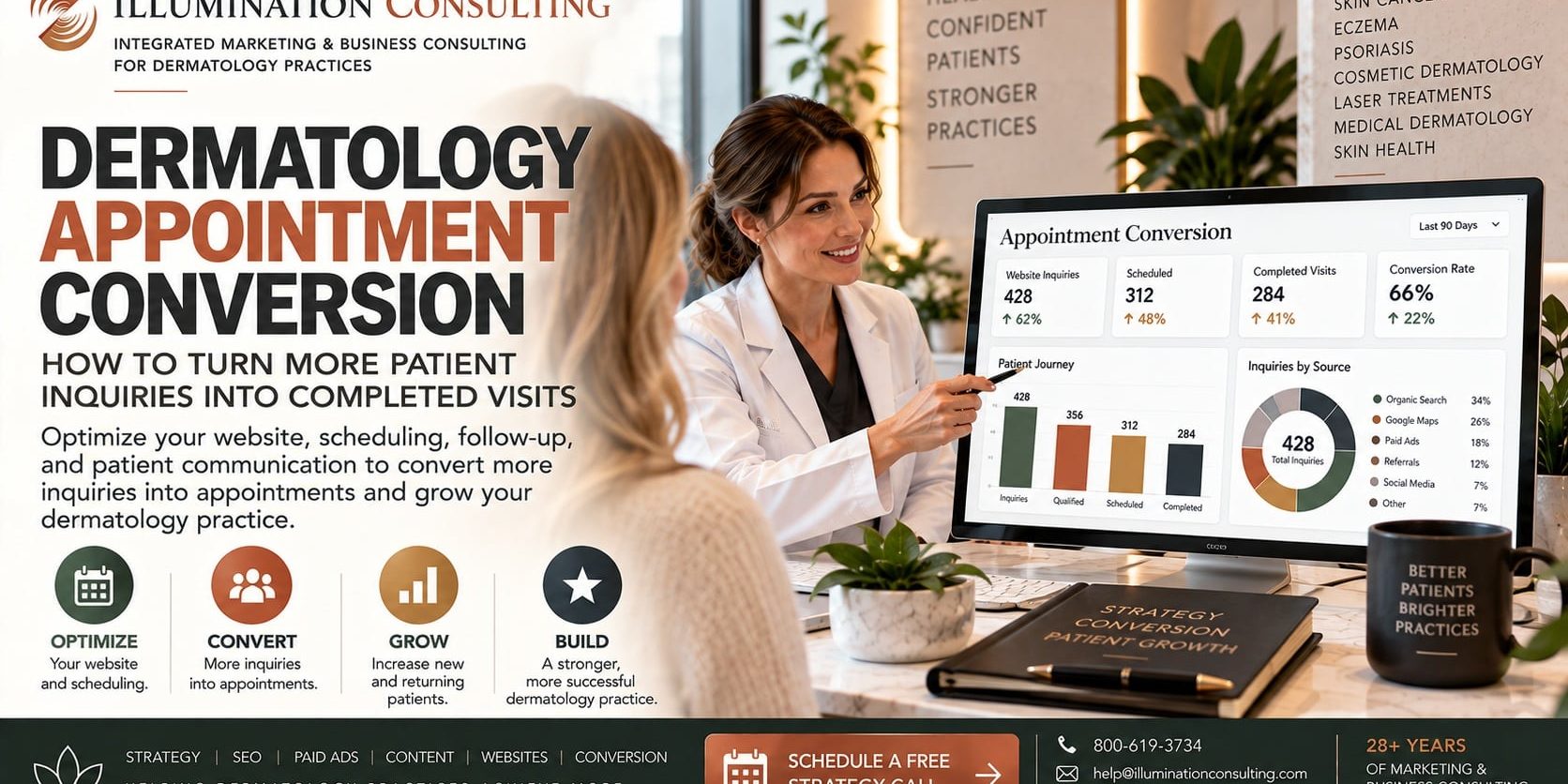
Dermatology practices can invest heavily in search engine optimization, Google visibility, paid advertising, content marketing, social media, referrals, and professional websites, yet still lose a meaningful portion of potential growth after prospective patients make contact. A phone call that goes unanswered, an online request that receives a slow response, limited appointment availability, confusing scheduling instructions, or inadequate follow-up can interrupt the patient journey before an appointment ever occurs.
This makes dermatology appointment conversion an important part of practice growth. Generating patient demand and converting that demand into completed visits are two different functions, and both must perform effectively. A practice can increase website traffic and patient inquiries without producing proportional growth if prospective patients encounter friction between initial interest and the actual appointment.
Professional Dermatology Marketing should therefore extend beyond visibility and lead generation. Marketing, website conversion, scheduling, patient communication, availability, and front-office processes should work together so that qualified prospective patients can move efficiently from discovery to scheduled and completed care.
Patient Acquisition Does Not End With the Inquiry
A marketing dashboard may report:
- website conversions
- phone calls
- appointment requests
- contact forms
- advertising leads
- consultation requests
These metrics indicate interest.
They do not necessarily indicate acquired patients.
The complete progression is closer to:
Marketing Exposure → Website Visit → Inquiry → Qualified Patient → Scheduled Appointment → Completed Appointment
For some cosmetic dermatology services, another stage may follow:
Consultation → Treatment
Every transition creates an opportunity for conversion loss.
That is why practices should measure the entire patient pathway rather than stopping at the inquiry.
Define What an Inquiry Actually Means
Not every inquiry should be counted equally.
Potential inquiries may include:
- new-patient phone calls
- online appointment requests
- direct online bookings
- cosmetic consultation requests
- contact forms
- referral inquiries
- social media messages
- responses to advertising
Some may represent qualified prospective patients.
Others may involve services the practice does not provide, insurance questions, existing patients, vendor calls, or unrelated requests.
Accurate measurement begins by defining what constitutes a relevant new-patient opportunity.
Otherwise, conversion rates become difficult to interpret.
Map Every Patient Entry Point
Before improving conversion, identify all the ways prospective patients can contact the practice.
Common entry points include:
Telephone
Website Forms
Online Scheduling
Google Business Profile
Paid Advertising Landing Pages
Physician Referrals
Directories
Social Media
The practice should understand where each pathway leads.
For example, a website form might enter a CRM or inbox.
A phone call might reach the front desk.
An online booking might enter the scheduling system directly.
A social media inquiry might be handled by marketing staff.
Fragmentation can create lost opportunities when ownership is unclear.
Establish Ownership of Every Inquiry
Every patient inquiry should have a defined destination and responsibility.
The practice should know:
Who receives it?
Who responds?
How quickly should it be reviewed?
Where is the outcome recorded?
What happens if the patient cannot immediately schedule?
Without ownership, inquiries can sit unanswered because everyone assumes someone else is handling them.
This is especially common when leads originate outside the traditional telephone channel.
Response Time Matters
A prospective patient may contact several practices while researching care.
The practice does not need to pressure the patient or create artificial urgency, but it should respond professionally within an appropriate operational timeframe.
Slow response can create unnecessary friction.
Practices should measure response performance across channels such as:
- telephone
- forms
- consultation requests
- advertising leads
The objective is establishing reliable service standards rather than allowing response times to depend entirely on how busy the office happens to be.
Answer the Telephone Effectively
For many dermatology practices, the telephone remains a major patient-conversion channel.
Marketing can generate the call.
What happens next is operational.
Potential problems include:
- unanswered calls
- excessive hold times
- rushed communication
- unclear answers
- unnecessary transfers
- poor documentation
- failure to offer next steps
Practices should periodically examine how new-patient calls are handled.
The front desk is not separate from marketing performance.
It is part of the conversion system.
Track Missed Calls
Missed calls deserve specific attention.
If a prospective patient calls after seeing the practice on Google or visiting the website and nobody answers, the marketing investment has succeeded in creating demand but the practice has not yet converted the opportunity.
Establish a process for:
- identifying missed calls
- distinguishing prospective-patient calls where possible
- returning calls
- documenting outcomes
A missed call should not automatically become a lost opportunity.
Make Online Appointment Requests Simple
Online forms should collect enough information to route the patient appropriately without creating unnecessary friction.
A new-patient form may need information such as:
- name
- contact information
- reason for visit
- preferred appointment timing
- relevant service interest
The exact fields depend on the practice and its systems.
The guiding principle is straightforward:
Do not ask for information at the inquiry stage unless it is useful.
Long forms can create unnecessary abandonment.
Clarify the Difference Between Requesting and Booking
A common source of confusion occurs when a website says:
Book an Appointment
but the patient is actually submitting a request that still requires staff confirmation.
If the appointment is not confirmed, say so clearly.
For example:
Request an Appointment
may be more accurate.
Clear expectations reduce confusion and prevent prospective patients from assuming they have an appointment when they do not.
Evaluate Direct Online Scheduling Carefully
Direct scheduling can reduce friction when the practice’s workflows support it.
Potential benefits include:
- 24-hour access
- reduced telephone dependency
- immediate appointment selection
- less administrative friction
But direct scheduling also requires appropriate controls.
The system must account for factors such as:
- visit type
- provider
- appointment duration
- new versus existing patient
- appropriate scheduling rules
- availability
Technology should simplify the patient journey without creating operational problems.
Separate Medical and Cosmetic Patient Pathways
Dermatology practices frequently serve substantially different patient needs.
A patient seeking evaluation of a medical skin concern may have a different scheduling journey from someone interested in an elective cosmetic procedure.
The website and intake process should reflect those differences.
For example:
Medical Dermatology
may emphasize appointment scheduling and appropriate clinical access.
Cosmetic Dermatology
may involve consultation requests, treatment education, pricing questions, or additional qualification.
Trying to force every patient through one identical conversion pathway can create unnecessary friction.
Align Website Calls to Action With Patient Intent
A website visitor researching acne treatment may not need the same CTA as someone evaluating cosmetic laser services.
Calls to action might include:
- Request an Appointment
- Schedule a Consultation
- Call the Practice
- Book Online
- Learn About Treatment Options
The CTA should correspond to the likely next step.
Professional website strategy should help visitors move naturally from information to action rather than forcing every page into the same conversion template.
Strengthen High-Traffic Service Pages
Some dermatology pages may receive substantially more relevant traffic than others.
These pages deserve careful conversion analysis.
Evaluate:
- CTA visibility
- mobile usability
- telephone access
- appointment links
- page speed
- provider information
- location information
- patient questions
- navigation
Professional SEO Services can increase visibility, but visibility creates business value only when relevant visitors can take the appropriate next step.
Use Content to Reduce Conversion Friction
Prospective patients frequently hesitate because they still have unanswered questions.
Strategic Content Marketing can address concerns before the patient contacts the practice.
Useful topics may include:
- what to expect during an appointment
- when to see a dermatologist
- treatment options
- preparation
- general recovery considerations
- differences between services
- frequently asked questions
Educational content can help prospective patients arrive at the inquiry stage better informed.
That can improve both patient experience and intake efficiency.
Measure Inquiry-to-Appointment Conversion
One useful metric is:
Inquiry-to-Appointment Conversion Rate = Scheduled New-Patient Appointments ÷ Qualified New-Patient Inquiries × 100
Suppose a hypothetical practice receives 100 qualified new-patient inquiries and 65 result in scheduled appointments.
The illustrative conversion rate would be:
65 ÷ 100 × 100 = 65%
This is not an industry benchmark.
Its purpose is to demonstrate the calculation.
The practice’s own historical performance is usually the most useful baseline for improvement.
Track Conversion by Inquiry Source
A blended conversion rate can conceal major differences.
For example:
| Source | Qualified Inquiries | Appointments |
|---|---|---|
| Organic Search | 40 | 30 |
| Google Maps | 30 | 24 |
| Paid Search | 35 | 18 |
| Referrals | 20 | 18 |
These numbers are entirely illustrative.
The analysis could reveal that certain sources produce inquiries that schedule at much stronger rates.
That information can improve marketing allocation.
Track Conversion by Service Line
Conversion can also differ substantially by service.
Medical dermatology, cosmetic dermatology, skin cancer services, acne care, injectables, laser services, and other areas may have different patient journeys.
Management may benefit from comparing:
Inquiry → Appointment
by service line.
This complements the existing Dermatology Service-Line Marketing strategy, which evaluates demand, patient acquisition, economics, and capacity across priority services.
Measure Appointment Show Rate
Scheduling an appointment does not complete the acquisition process.
The patient still needs to arrive.
A simplified calculation is:
Appointment Show Rate = Completed Appointments ÷ Scheduled Appointments × 100
If 100 appointments are scheduled and 88 are completed:
88 ÷ 100 × 100 = 88%
Again, this is illustrative rather than a dermatology benchmark.
Tracking show rate helps management distinguish between:
booking problems
and
attendance problems.
Those require different solutions.
Understand Why Patients Do Not Show
No-shows can occur for many reasons.
Potential factors include:
- appointment timing
- long booking lead times
- forgotten appointments
- transportation
- schedule changes
- unclear instructions
- patient circumstances
The practice should rely on its own data rather than assumptions.
Automated reminders and confirmation processes can help reduce avoidable communication failures, but policies and workflows should be appropriate for the practice and patient population.
Monitor Appointment Lead Time
How long must a new patient wait for an appointment?
This is an important operational metric.
If marketing creates substantial demand but the next appropriate appointment is far into the future, some prospective patients may continue looking elsewhere.
Track lead time by:
- provider
- service
- location
- appointment type
This can reveal capacity constraints that marketing reports alone cannot identify.
Marketing Cannot Fix a Capacity Problem
Suppose the practice generates 200 qualified inquiries for a service but has only 100 appropriate appointment slots available.
Increasing advertising may create more inquiries without creating more completed visits.
The constraint is capacity.
Possible operational questions then include:
- Can scheduling be improved?
- Is provider capacity available elsewhere?
- Can schedules be adjusted?
- Should marketing shift toward another service?
- Does the practice need additional resources?
The correct answer may not be more marketing.
Use Marketing to Balance Available Capacity
The opposite situation also occurs.
A provider may have open appointment capacity for a service the practice wants to grow.
Marketing can then intentionally support that capacity through:
- SEO
- paid advertising
- content
- local search
- social media
- website visibility
This creates a direct connection between marketing and operations.
Rather than generating generic patient volume, marketing helps fill strategically valuable capacity.
Measure Completed Appointments by Marketing Source
A stronger marketing dashboard should progress beyond inquiry counts.
Instead of:
Google Ads generated 75 leads
report:
Google Ads → 75 inquiries → 48 qualified → 35 appointments → 30 completed visits
Those figures are hypothetical.
The important part is the progression.
Management can now identify where conversion is being lost.
Connect Completed Visits to Patient Acquisition Cost
A campaign’s acquisition cost should ideally reflect actual acquired patients rather than merely inquiries.
A simplified calculation might be:
Cost per Completed New-Patient Visit = Acquisition Spending ÷ Completed New-Patient Visits
Suppose a hypothetical campaign costs $6,000 and ultimately produces 30 completed new-patient visits.
$6,000 ÷ 30 = $200
Again, this is an illustrative calculation.
Whether that represents attractive economics depends on the service, patient value, margin, retention, and broader practice economics.
Do Not Optimize for the Cheapest Inquiry
Marketing platforms often encourage optimization toward lower lead costs.
But inexpensive inquiries can be misleading if they rarely become patients.
Consider:
Campaign A
Cost per inquiry: $60
Appointment conversion: strong
Show rate: strong
Campaign B
Cost per inquiry: $35
Appointment conversion: weak
Show rate: weak
Campaign B looks better when judged solely by lead cost.
Campaign A may create stronger business performance.
The practice should optimize toward patient outcomes rather than the cheapest top-of-funnel metric.
Evaluate Paid Advertising Through the Full Funnel
Professional Paid Advertising should be evaluated from click through completed patient acquisition.
The funnel might look like:
Advertising Spend
↓
Clicks
↓
Inquiries
↓
Qualified Patients
↓
Appointments
↓
Completed Visits
This gives management a more meaningful view of advertising effectiveness.
A campaign producing fewer inquiries can outperform one producing many leads if the patients are more qualified and more likely to complete appointments.
Track Lost-Inquiry Reasons
When qualified patients do not schedule, record why whenever possible.
Potential categories might include:
- no appropriate availability
- insurance incompatibility
- service not offered
- patient not ready
- unable to reach
- pricing concern for elective services
- location inconvenience
- chose another provider
- requested timing unavailable
This information can reveal whether the problem belongs primarily to:
marketing
scheduling
capacity
positioning
or
operations.
Without lost-reason data, management may spend money trying to solve the wrong problem.
Improve Follow-Up Without Creating Pressure
Not every prospective patient schedules during the first interaction.
Appropriate follow-up can help when someone:
- submits a request
- leaves a voicemail
- asks for information
- begins scheduling but does not complete it
Follow-up should be professional and consistent.
The objective is helping the patient complete the next appropriate step, not pressuring someone into medical care.
Use Automation Where It Improves Reliability
Automation can reduce administrative gaps.
Depending on the practice’s systems and compliance requirements, automation may assist with:
- inquiry acknowledgments
- staff notifications
- appointment confirmations
- reminders
- follow-up tasks
- status tracking
Automation should support staff rather than create impersonal or inappropriate patient communication.
The practice remains responsible for designing workflows appropriate to healthcare communication and privacy requirements.
Protect Patient Privacy
Dermatology marketing and conversion systems operate within healthcare environments.
Practices should ensure that the technologies, forms, messaging systems, analytics implementations, and workflows they use are appropriate for applicable privacy and regulatory requirements.
Marketing convenience should never take precedence over responsible patient-data handling.
When compliance questions arise, practices should consult qualified legal, privacy, or compliance professionals.
Improve the Mobile Experience
Many prospective patients will interact with the practice from a smartphone.
Mobile conversion should therefore be tested directly.
Check:
- telephone buttons
- forms
- online scheduling
- navigation
- text size
- page speed
- location information
- appointment CTAs
A conversion path that works well on desktop but poorly on mobile can undermine otherwise successful marketing.
Make Location Information Easy to Find
For local healthcare decisions, practical information matters.
Prospective patients may need:
- address
- directions
- parking information
- office hours
- telephone number
- locations
- provider availability
Do not make people search through multiple pages for basic logistical information.
Convenience is part of the digital patient experience.
Strengthen Google Business Profile Conversion
Local search can bring patients very close to action.
Someone discovering the practice through Google Maps may:
- call
- visit the website
- request directions
- review photos
- read reviews
The Google Business Profile should therefore contain accurate and current business information.
Local visibility is not merely an SEO issue.
It is another patient-conversion pathway.
Reputation Influences Appointment Conversion
Prospective patients may discover the practice through marketing and then research its reputation before scheduling.
Reviews can influence confidence in areas such as:
- staff communication
- provider interaction
- scheduling
- wait times
- office experience
- overall care experience
The current Illumination Consulting dermatology strategy appropriately treats reputation as part of the patient-acquisition system rather than as a separate branding exercise.
Marketing creates awareness.
Reputation can influence whether that awareness becomes action.
Use Reviews as Operational Intelligence
Reviews should not be viewed solely as promotional assets.
Patterns can reveal operational issues.
Repeated comments about:
- telephone access
- scheduling
- waiting
- staff communication
- billing confusion
- office logistics
may identify friction affecting conversion or retention.
Practices can use appropriate feedback to improve the patient experience.
Connect Front-Office Teams With Marketing
Marketing teams frequently know how many inquiries campaigns generate.
Front-office teams know what happens when those inquiries arrive.
Those groups should exchange information.
Marketing should understand:
- common patient questions
- qualification problems
- scheduling constraints
- services with limited capacity
- services with open capacity
- frequent objections
The front office should understand:
- which campaigns are running
- which services are being promoted
- where inquiries originate
- what patients may have seen before contacting the practice
This creates a closed feedback loop.
Build a Dermatology Conversion Dashboard
A useful management dashboard does not need hundreds of metrics.
It might include:
| Metric | Management Question |
|---|---|
| Qualified New-Patient Inquiries | How much relevant demand exists? |
| Inquiry Source | Where does demand originate? |
| Appointment Conversion | Are inquiries scheduling? |
| Show Rate | Are scheduled patients arriving? |
| Response Time | Are we responding efficiently? |
| Missed Calls | Are opportunities being lost? |
| Appointment Lead Time | Can patients access care? |
| Conversion by Service | Which services convert best? |
| Conversion by Source | Which channels produce patients? |
| Cost per Completed Patient | What does acquisition actually cost? |
This creates a practical bridge between marketing and practice operations.
Diagnose the Conversion Constraint
When completed appointments are below expectations, determine where the funnel is breaking.
Traffic Is Low
The practice may need stronger SEO, local visibility, advertising, or content.
Traffic Is Strong but Inquiries Are Weak
Website messaging, usability, CTAs, or patient intent may require attention.
Inquiries Are Strong but Scheduling Is Weak
Response, availability, qualification, or front-office processes may be the constraint.
Appointments Are Strong but Show Rate Is Weak
Confirmation, reminders, booking lead time, or other attendance factors may deserve investigation.
Demand Exceeds Capacity
Marketing may already be working.
Operations are the constraint.
This diagnostic framework prevents unnecessary marketing spending against problems that marketing cannot solve.
Improve Conversion Before Buying More Traffic
Suppose a practice already generates substantial relevant website traffic and inquiries.
Before increasing advertising or expanding SEO aggressively, it may be more efficient to improve the percentage of those opportunities that become completed appointments.
Consider a purely illustrative example.
A practice receives:
200 qualified inquiries
and converts:
100 into completed appointments.
If operational improvements eventually allow 120 of the same 200 opportunities to become completed appointments, patient acquisition increases without requiring another 20% increase in inquiry volume.
This is why conversion optimization can multiply the value of existing marketing.
Conversion Improvement Can Benefit Every Channel
Improving the appointment pathway does not help only one campaign.
It can improve the value generated from:
- organic search
- Google Maps
- advertising
- referrals
- social media
- direct traffic
- content
That makes conversion infrastructure a particularly valuable marketing asset.
Better scheduling and follow-up can improve the economic output of several acquisition channels simultaneously.
Review Conversion by Provider and Location
Multi-provider or multi-location practices may find meaningful differences.
One location may convert more effectively because:
- appointments are available sooner
- telephone response is stronger
- scheduling is easier
- certain services have greater capacity
Similarly, providers may have different appointment lead times.
Understanding these differences can help management allocate marketing geographically and operationally.
Review Performance Regularly
Appointment conversion should not become a one-time project.
Patient demand, staffing, provider schedules, technology, marketing campaigns, and capacity all change.
Regular reviews can examine:
What generated inquiries?
How many were qualified?
How many scheduled?
How many completed appointments?
Where did opportunities drop out?
Why?
What can be improved?
That creates continuous optimization.
Build Growth Around Completed Patients, Not Vanity Metrics
Dermatology practices ultimately do not grow because website traffic increased.
They grow because appropriate patients find the practice, choose to make contact, successfully schedule, receive care, and—where clinically appropriate—continue a valuable relationship with the practice.
That requires marketing and operations to work together.
The complete growth system becomes:
Visibility → Relevant Traffic → Patient Inquiry → Qualification → Scheduling → Completed Appointment → Patient Experience → Retention
When practices measure the entire system, they can distinguish a traffic problem from a website problem, a scheduling problem from a marketing problem, and a capacity problem from an acquisition problem.
That produces better decisions.
Illumination Consulting helps dermatology practices connect Dermatology Marketing, SEO Services, Content Marketing, Paid Advertising, website strategy, patient acquisition, and conversion optimization into integrated growth systems. The objective is not simply to generate more clicks or inquiries, but to help practices create stronger pathways from patient demand to measurable practice growth.
Frequently Asked Questions
What is dermatology appointment conversion?
Dermatology appointment conversion measures how effectively prospective-patient demand becomes scheduled and ultimately completed appointments. It can include the progression from website or telephone inquiry through qualification, scheduling, confirmation, and attendance.
How do dermatology practices calculate inquiry-to-appointment conversion?
A simplified calculation divides scheduled appointments by qualified new-patient inquiries and multiplies the result by 100. Practices should define qualified inquiries consistently so the metric remains useful over time.
Why should completed appointments be measured instead of leads?
A lead indicates interest but does not necessarily represent an acquired patient. Measuring completed appointments provides a business outcome closer to actual patient acquisition.
How can dermatology practices improve appointment conversion?
Potential improvements include stronger website calls to action, reliable response processes, better telephone handling, simpler scheduling, appropriate online booking, follow-up procedures, appointment reminders, and closer alignment between marketing and available capacity.
Can marketing generate too many dermatology inquiries?
Yes. If provider or appointment capacity is constrained, additional demand may create longer wait times without substantially increasing completed visits. Practices should align marketing activity with operational capacity.
Should dermatology practices track conversion by marketing source?
Yes. Different channels can generate inquiries with different qualification, scheduling, and attendance patterns. Source-level measurement can provide better information for marketing allocation.
How does SEO affect appointment conversion?
SEO helps appropriate prospective patients discover the practice, while website and scheduling systems determine what happens after they arrive. Strong organic visibility and strong conversion infrastructure therefore work together.







1 Comment