Dermatology practices rarely have a demand problem that can be solved simply by generating more website traffic or increasing advertising.
The more important question is:
Which patients, services, and treatments should the practice actually be trying to grow?
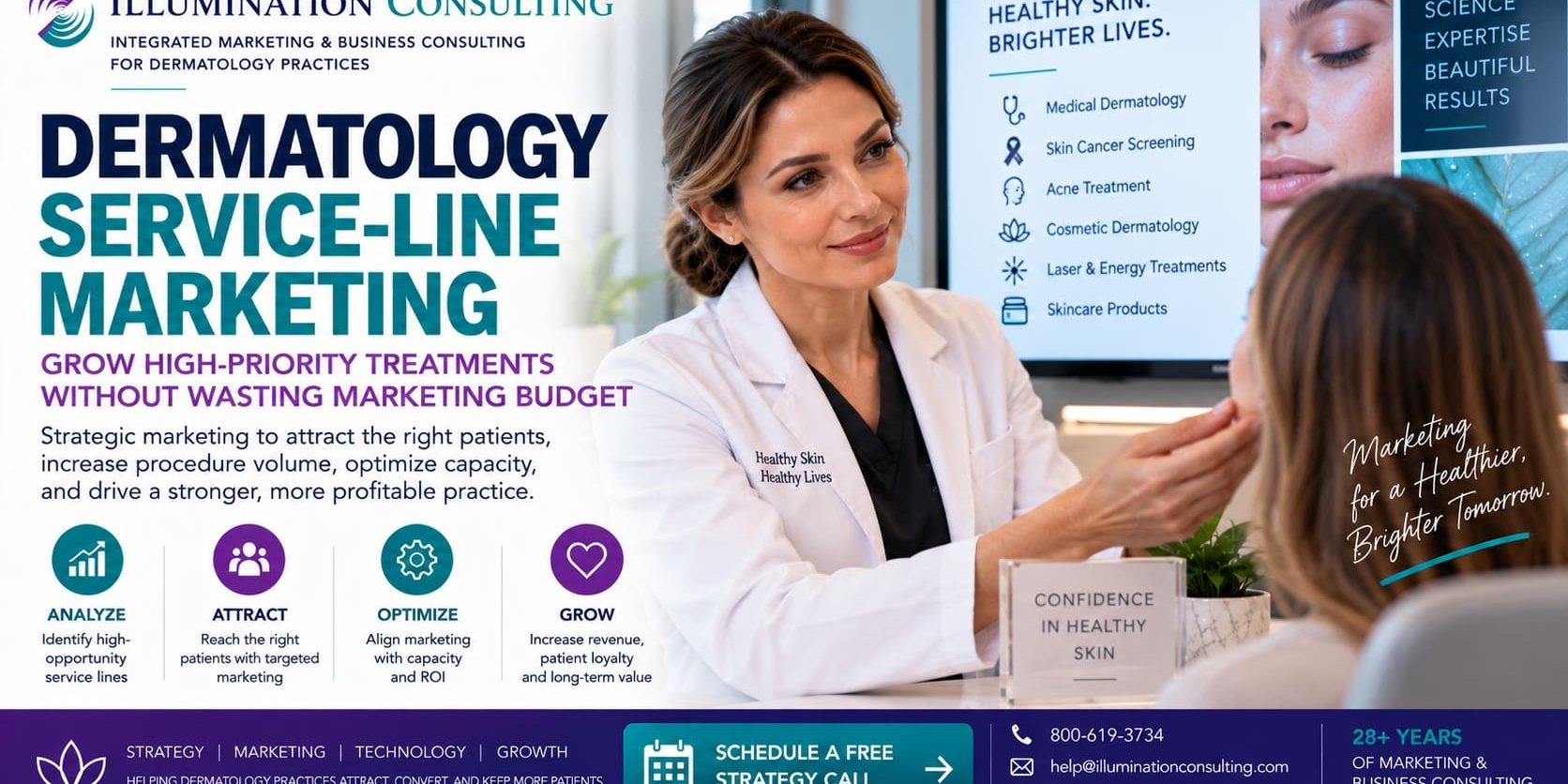
A dermatology practice may offer medical dermatology, skin cancer screening, acne treatment, psoriasis care, cosmetic dermatology, injectables, laser treatments, body treatments, skincare products, and numerous other services. Yet each service can have a different patient profile, search demand, competitive environment, treatment frequency, revenue potential, margin, staffing requirement, and impact on clinical capacity.
Marketing all of them equally can waste money.
Effective dermatology service-line marketing takes a more strategic approach. Instead of treating the practice as one broad marketing campaign, leadership identifies the services that deserve growth, determines where additional capacity exists, evaluates patient demand and economics, and allocates marketing resources accordingly.
For practices investing in dermatology marketing, this creates a direct connection between marketing activity and the actual business priorities of the practice.
What Is Dermatology Service-Line Marketing?
Service-line marketing organizes patient acquisition around specific areas of the practice rather than marketing the entire dermatology organization as one undifferentiated entity.
A simplified example might include:
Medical Dermatology
Acne, eczema, psoriasis, rashes, rosacea, skin conditions, and other medical concerns.
Skin Cancer and Preventive Dermatology
Skin checks, mole evaluation, screening, diagnosis, and related care.
Cosmetic Dermatology
Injectables, lasers, skin rejuvenation, pigmentation treatments, resurfacing, and other aesthetic services.
Professional Skincare
Products, treatment-support regimens, and ongoing skincare programs.
These categories should not automatically receive identical marketing budgets.
A practice might have strong organic demand for medical dermatology but unused capacity in cosmetic services.
Another might have substantial demand for cosmetic treatments but insufficient provider availability.
Another may want to build a particular high-priority service because it aligns with the expertise and long-term direction of the practice.
Marketing should reflect those realities.
Start With the Practice’s Business Objectives
Before researching keywords or launching advertisements, determine what the practice actually wants to grow.
That sounds obvious, but marketing decisions are frequently made in reverse.
A campaign begins because a competitor is advertising a particular procedure.
A new technology is purchased and suddenly needs promotion.
An agency notices high search volume and recommends targeting it.
None of these automatically means the service should become a major marketing priority.
Leadership should first ask:
- Which service lines have available capacity?
- Which services are strategically important?
- Which patient populations does the practice want to serve more effectively?
- Which providers need additional demand?
- Which services support long-term patient relationships?
- Which services complement existing areas of strength?
- Which areas are operationally prepared for growth?
- Which services have attractive economics?
- Which services differentiate the practice?
Marketing follows strategy.
It should not determine strategy by itself.
Evaluate Provider Capacity Before Generating More Demand
One of the fastest ways to waste marketing dollars is promoting a service that already has more demand than the practice can accommodate.
Suppose a dermatologist is booked several weeks in advance for a particular medical service.
Increasing paid advertising for that same service may create:
- longer wait times
- frustrated prospective patients
- additional front-desk workload
- abandoned appointment requests
- poor patient experience
The campaign could appear successful because it generated leads while creating little incremental value for the practice.
Instead, marketing investment might be more productive for a service line with available provider capacity.
Capacity analysis should therefore occur before budget allocation.
Understand the Economics of Each Service Line
Revenue alone does not determine the value of a service.
Practices should consider the broader economics.
Depending on the service, relevant considerations may include:
- average revenue
- treatment frequency
- provider time
- staffing requirements
- consumable costs
- equipment costs
- room utilization
- follow-up requirements
- insurance or reimbursement considerations
- patient acquisition cost
- cross-service opportunities
- longer-term patient value
Two services generating similar revenue can have very different economics.
Marketing decisions become stronger when leadership understands those differences.
Consider Patient Lifetime Value
Some services can create relationships extending far beyond the initial appointment.
For example, a patient initially entering the practice for one concern may later require ongoing dermatologic care, additional procedures, skincare products, preventive visits, or other appropriate services.
This means the economic value of a patient should not always be measured by the first transaction.
A simplified framework is:
Patient Lifetime Value = Average Patient Value × Expected Relationship Duration or Purchase Frequency
The exact calculation will differ substantially among practices.
More sophisticated models can incorporate contribution margin, retention, treatment mix, and acquisition cost.
The strategic point is that marketing should consider the relationship being acquired, not merely the first appointment.
Separate Medical and Cosmetic Patient Journeys
Medical dermatology and cosmetic dermatology frequently involve different patient motivations.
A medical patient may be searching because of:
- a persistent skin condition
- an unusual mole
- acne
- eczema
- psoriasis
- a rash
- a physician referral
- concern about skin cancer
The need may feel immediate.
A cosmetic patient may be researching:
- appearance goals
- treatment options
- providers
- expected outcomes
- recovery
- technology
- cost
- before-and-after examples
The decision process may be longer and more discretionary.
Trying to market these patients with identical messaging can reduce effectiveness.
Each service line should reflect the patient’s actual intent.
Build a Service-Line Opportunity Matrix
Practices can create a simple framework for prioritizing marketing opportunities.
Evaluate each important service according to:
Patient Demand
How much relevant demand exists?
Competitive Intensity
How difficult is it to acquire visibility?
Capacity
Can the practice accommodate additional patients?
Strategic Importance
Does leadership want this service line to grow?
Economics
Does growth contribute meaningfully to the business?
Patient Relationship Potential
Can the service create longer-term engagement?
Differentiation
Does the practice have a meaningful advantage?
Services that score strongly across several dimensions may deserve greater marketing attention.
Research Search Demand by Service
Search behavior provides useful insight into patient demand.
Rather than tracking only broad terms such as:
dermatologist near me
the practice can examine searches associated with individual conditions and treatments.
These may reveal different stages of intent.
For example:
Informational intent
“What causes adult acne?”
Problem-aware intent
“Treatment for adult acne”
Local commercial intent
“Acne dermatologist near me”
Provider intent
“Best dermatologist for acne”
These queries represent different points in the patient journey.
An effective SEO strategy can build visibility across relevant stages while directing commercially valuable searches toward appropriate service pages.
Create Dedicated Pages for Priority Services
A practice should not expect one generic dermatology page to rank effectively for every treatment it provides.
High-priority services generally deserve dedicated pages.
A strong service page can address:
- the condition or concern
- who may seek evaluation
- available treatment approaches
- the practice’s expertise
- what patients can expect
- frequently asked questions
- location
- provider information
- appropriate next steps
The goal is not producing hundreds of thin keyword pages.
Each page should genuinely help prospective patients understand the service.
Build Content Around the Service Line
Service pages capture commercial intent.
Educational content can build authority around the surrounding topic.
Suppose acne treatment is a strategic growth area.
The content ecosystem could include educational material addressing:
- types of acne
- adult acne
- acne scarring
- when to see a dermatologist
- treatment options
- skincare considerations
- common misconceptions
- treatment expectations
Those articles can internally support the primary acne service page.
This creates a topical cluster rather than a collection of disconnected blog posts.
Professional content marketing becomes more valuable when editorial decisions are tied directly to service-line priorities.
Use Local SEO to Capture High-Intent Patients
Dermatology is inherently local for most practices.
Patients usually need a provider within a practical travel area.
That makes local visibility particularly important.
Service-line local SEO can involve:
- Google Business Profile optimization
- consistent business information
- relevant service categories
- reviews
- localized website content
- service pages
- local authority signals
- structured data
- location pages where appropriate
The objective is to connect specific patient needs with a nearby practice capable of serving them.
Use Paid Search for Strategic Demand Capture
Paid search can be especially useful when the practice wants immediate visibility for a priority service.
But campaign structure should reflect the service line.
Instead of sending all advertising to the homepage, align:
Keyword → advertisement → service → landing page → appointment action
A prospective patient searching specifically for laser treatment should not have to navigate a general dermatology homepage to determine whether the practice offers it.
Message continuity improves relevance.
Avoid Measuring Paid Advertising Only by Cost per Lead
A low-cost dermatology lead is not necessarily a valuable lead.
Suppose:
Campaign A
- generates 100 inquiries
- produces 40 appointments
- results in 30 appropriate patients
Campaign B
- generates 50 inquiries
- produces 35 appointments
- results in 32 appropriate patients
Campaign A generated twice as many inquiries.
Campaign B ultimately produced more patients.
The example is hypothetical, but the principle is important.
Marketing should be evaluated through the patient funnel rather than solely at the inquiry stage.
Track Cost per Acquired Patient by Service Line
A simplified patient acquisition calculation is:
Patient Acquisition Cost = Marketing Cost ÷ New Patients Acquired
Suppose a campaign for a particular service costs $4,000 and results in 20 new patients.
The simplified acquisition cost is:
$4,000 ÷ 20 = $200 per patient
That number alone does not determine whether the campaign is successful.
Leadership should compare it with:
- patient value
- contribution margin
- treatment frequency
- longer-term relationship value
- available capacity
A $200 acquisition cost could be attractive for one service and unsustainable for another.
Measure Appointment Conversion
Traffic and inquiries need to become appointments.
A simplified calculation is:
Appointment Conversion Rate = Appointments Booked ÷ Qualified Inquiries × 100
If 80 qualified inquiries result in 40 appointments:
40 ÷ 80 × 100 = 50%
This is an illustrative example, not a benchmark.
Tracking the metric by service line can reveal important differences.
If one campaign produces qualified inquiries but very few appointments, investigate:
- messaging
- response time
- scheduling
- availability
- pricing questions
- staff handling
- patient expectations
The marketing campaign may not be the primary problem.
Measure Appointment Show Rate
Bookings alone are insufficient.
Track:
Show Rate = Completed Appointments ÷ Scheduled Appointments × 100
This helps distinguish patient acquisition from scheduling activity.
Low show rates may indicate issues with:
- lead quality
- wait times
- reminders
- appointment commitment
- scheduling process
- communication
Again, the appropriate response may be operational rather than simply changing the advertising.
Measure Revenue and Contribution by Service Line
Marketing becomes much more useful when it connects to financial performance.
For each priority service line, management can evaluate:
Marketing investment → acquired patients → service revenue → contribution → longer-term patient value
This helps identify situations where a high-volume service is less economically valuable than a lower-volume service.
It also helps prevent marketing budgets from being allocated simply according to which department requests the most promotion.
Use Cosmetic Dermatology Cross-Selling Carefully
Medical dermatology can sometimes introduce patients to cosmetic services, and cosmetic patients may eventually require medical dermatologic care.
However, cross-selling should remain appropriate and patient-centered.
A medical concern should never become merely a sales opportunity.
The stronger model is education.
Patients who already trust the practice can be made aware of other appropriate services without creating pressure.
When handled correctly, an integrated medical and cosmetic practice can benefit from stronger patient relationships across multiple areas of dermatologic care.
Market New Technology Strategically
Dermatology and aesthetic practices frequently invest in new devices.
Purchasing equipment does not automatically create demand.
Before heavily marketing a new technology, evaluate:
- which patient problem it addresses
- how much demand exists
- competing alternatives
- how the treatment differs
- pricing
- treatment frequency
- utilization required
- staff training
- provider capacity
- expected patient value
Marketing should communicate the patient benefit rather than relying entirely on the device’s brand name.
Patients generally care more about solving their problem than which machine the practice purchased.
Do Not Promote Every Service at the Same Time
Trying to market everything simultaneously can dilute resources.
A practice with twenty services may be better served by identifying three or four strategic growth priorities for a given period.
Resources can then concentrate around:
- SEO
- content
- paid advertising
- social media
- video
- landing pages
- conversion optimization
Once one service line has stronger infrastructure and visibility, additional priorities can be developed.
This produces depth instead of fragmented marketing.
Coordinate Marketing With Scheduling
Service-line campaigns should be connected to appointment availability.
If marketing generates demand for a treatment but patients cannot schedule within a reasonable timeframe, the practice may lose opportunities.
Management should regularly connect:
Marketing demand + provider schedules + room capacity + staffing + equipment availability
This allows campaigns to respond to actual operational conditions.
Use Marketing to Balance Capacity
This is where service-line marketing can become especially valuable.
Suppose one provider has underutilized capacity on certain days.
Or a particular treatment room is underused.
Or a newer service has capacity while another is fully booked.
Marketing can help direct demand toward areas where the practice is prepared to grow.
Instead of simply “getting more patients,” marketing becomes a mechanism for improving utilization.
Consider Seasonality
Some dermatology and cosmetic services experience seasonal changes in patient interest or treatment suitability.
Marketing calendars should anticipate these patterns.
Rather than reacting after appointment volume changes, practices can prepare campaigns in advance.
Content, SEO, email, advertising, and social media can build awareness before peak demand.
Historical practice data can help identify these patterns more accurately than assumptions alone.
Use Existing Patient Data
The patient database can reveal significant service-line opportunities.
Analyze:
- treatments received
- repeat visits
- product purchases
- inactive patients
- cross-service behavior
- appointment frequency
- patient geography
- referral sources
For example, the practice may discover that patients acquired through one service frequently purchase another.
Or patients from one geographic area may have substantially stronger retention.
Or a particular service may generate a high percentage of referrals.
These insights can improve marketing allocation.
Connect Service-Line Marketing With Patient Reactivation
Existing patients should also be considered when developing service-line growth strategies.
A practice may have hundreds or thousands of patients who previously received relevant care but have become inactive.
Rather than relying exclusively on new-patient acquisition, the practice can identify appropriate patients for re-engagement.
A structured med spa patient reactivation strategy illustrates the broader principle: existing patient databases can become active growth assets when segmentation, communication, timing, and measurement are managed systematically.
For dermatology practices, the exact approach should reflect the clinical context, patient relationship, privacy requirements, and appropriateness of communication.
Build a Service-Line Marketing Dashboard
Management should be able to see how priority services perform without digging through multiple reports.
A useful dashboard may include:
| Metric | Purpose |
|---|---|
| Marketing Spend | Investment by service |
| Website Traffic | Demand reaching the service pages |
| Qualified Inquiries | Relevant patient opportunities |
| Appointments | Scheduling performance |
| Show Rate | Actual patient attendance |
| New Patients | Acquisition outcome |
| Patient Acquisition Cost | Marketing efficiency |
| Revenue | Financial output |
| Capacity Utilization | Operational impact |
| Repeat Visits | Relationship development |
The exact metrics should reflect the practice model.
The dashboard should answer business questions rather than merely display marketing statistics.
Review Service Priorities Quarterly
Marketing priorities should not remain static indefinitely.
At least periodically, leadership should review:
- demand
- rankings
- advertising performance
- patient acquisition costs
- provider capacity
- new services
- competitive changes
- patient behavior
- financial performance
A service line that deserved aggressive growth six months ago may now be near capacity.
Another may have become a stronger opportunity.
Budget allocation should change accordingly.
Know When to Reduce Marketing
Growth strategy includes knowing what not to promote.
Reduce or redirect investment when:
- provider capacity is exhausted
- appointment delays are excessive
- acquisition cost becomes unattractive
- service economics deteriorate
- lead quality becomes poor
- another service offers a stronger opportunity
- operational limitations prevent appropriate growth
Spending more is not automatically the solution.
The goal is productive growth.
Marketing Budget Should Follow Opportunity
Instead of dividing the marketing budget evenly among services, consider allocating it according to opportunity.
A conceptual model could evaluate:
Demand × Capacity × Economics × Strategic Importance × Conversion Potential
This does not need to become an overly complicated mathematical formula.
The purpose is disciplined thinking.
A service with strong demand but no capacity may deserve less incremental marketing.
A service with capacity but virtually no market demand may also be a weak investment.
The strongest opportunities occur where multiple factors align.
Move From Practice Marketing to Portfolio Management
A multi-service dermatology practice can be viewed as a portfolio of patient-service relationships.
Each service line has:
- demand
- competition
- economics
- capacity
- growth potential
- patient value
- strategic importance
Marketing becomes more sophisticated when leadership stops asking:
“How do we get more dermatology patients?”
and starts asking:
“Which areas of the practice should grow, which patients should we reach, what capacity do we have, and where will the next marketing dollar create the greatest value?”
That is a fundamentally different approach.
Build Growth Around the Right Patients and Services
Successful dermatology marketing is not measured by generating the maximum number of leads.
It is measured by helping the practice attract appropriate patients for strategically important services while supporting clinical capacity, patient experience, and sustainable business performance.
The process becomes:
Identify priority services → evaluate demand → confirm capacity → understand economics → build visibility → acquire appropriate patients → measure results → reallocate resources
That creates a marketing system aligned with the business rather than a collection of disconnected campaigns.
Illumination Consulting helps dermatology practices develop integrated dermatology marketing strategies connecting SEO, content, advertising, website performance, patient acquisition, conversion, analytics, and business objectives. The goal is not simply generating more traffic or inquiries. It is helping practices allocate marketing resources toward the services and growth opportunities that matter most.
Frequently Asked Questions
What is dermatology service-line marketing?
Dermatology service-line marketing is the practice of developing marketing strategies around specific clinical or cosmetic service categories rather than promoting the entire practice uniformly. It connects patient demand, marketing investment, provider capacity, and business priorities.
Which dermatology services should a practice market most aggressively?
There is no universal answer. Practices should consider patient demand, provider capacity, competition, economics, strategic priorities, differentiation, and longer-term patient value before allocating additional marketing resources.
Should medical and cosmetic dermatology use the same marketing strategy?
Not necessarily. Medical and cosmetic patients can have different motivations, search behavior, decision processes, urgency, and expectations. Messaging, content, landing pages, and acquisition channels should reflect those differences.
How should dermatology practices measure marketing performance?
Useful measurements can include qualified inquiries, appointments, show rates, new patients, patient acquisition cost, revenue, capacity utilization, repeat visits, and longer-term patient value. Metrics should ideally be analyzed by service line rather than only at the overall practice level.
Should a dermatology practice advertise a service that is already fully booked?
Usually the practice should first evaluate whether additional demand creates meaningful value. If provider capacity is already constrained, increasing advertising may produce longer waits and poor patient experience rather than incremental growth.
How can SEO support individual dermatology services?
SEO can create dedicated service pages around commercially important treatments and support those pages with relevant educational content, local optimization, internal linking, technical optimization, and authority development.
How often should dermatology marketing priorities be reviewed?
Service-line performance should be monitored continuously, with more comprehensive strategic reviews periodically—often quarterly—so marketing investment can respond to changes in capacity, demand, competition, patient behavior, and financial performance.