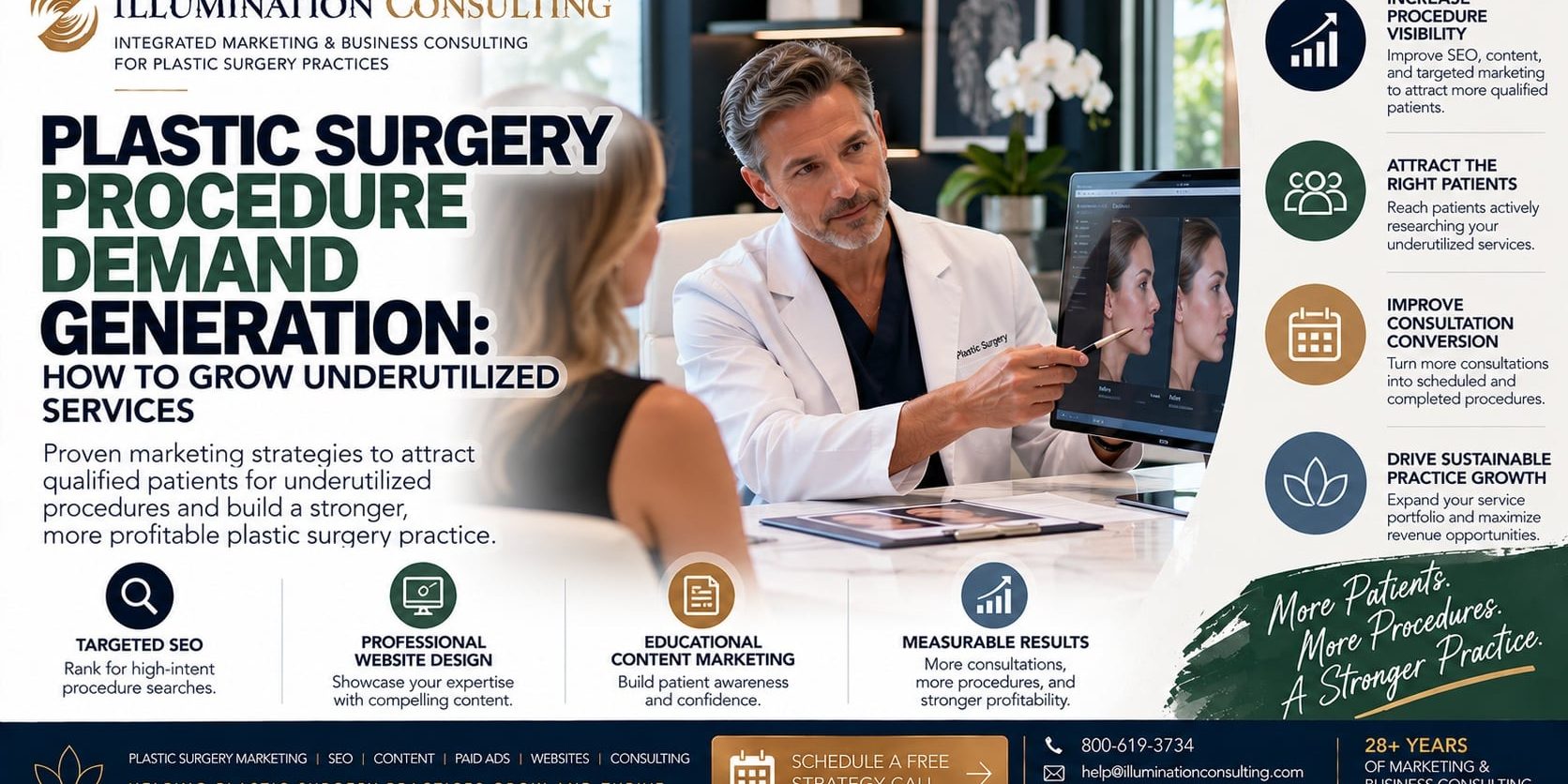
Plastic surgery practices often develop strong reputations around a limited number of procedures. A surgeon may become particularly well known for breast augmentation, facelifts, rhinoplasty, or body contouring, while other services receive relatively little attention from prospective patients. Although specialization can be a competitive advantage, relying heavily on a small number of procedures may leave additional clinical capacity and business opportunities underutilized.
Plastic surgery procedure demand generation involves identifying appropriate growth opportunities within a practice’s existing services and developing marketing strategies that attract qualified patients for those procedures. Rather than promoting every service equally, practices evaluate patient demand, surgeon expertise, procedure economics, local competition, and available capacity. Marketing resources can then be directed toward services that align with the practice’s clinical capabilities and long-term business objectives.
For practices investing in professional Plastic Surgery Marketing, generating demand for underutilized procedures requires a coordinated approach. Search engine optimization, patient education, website development, paid advertising, and reputation management must work together to improve visibility and build patient confidence. The objective is not simply increasing consultation volume, but attracting appropriate patients who understand their options and can make informed decisions about treatment.
Why Some Plastic Surgery Procedures Receive Less Patient Demand
A procedure may receive fewer inquiries for reasons unrelated to its clinical value or the surgeon’s expertise. In many practices, marketing activity naturally concentrates on the services that already generate the greatest revenue. Those procedures receive more website content, advertising investment, social media exposure, and patient testimonials, reinforcing their visibility while other services remain less prominent.
Local market conditions also influence demand. Certain procedures may be highly competitive, while others have limited search volume or require more patient education. A service may also be difficult to find on the practice website, poorly explained, or associated with unclear pricing and recovery expectations.
Practices should avoid assuming that low inquiry volume always indicates a marketing problem. Some procedures may have genuinely limited local demand, insufficient provider capacity, or economic characteristics that make aggressive promotion inappropriate.
The first step is determining whether a procedure represents a viable growth opportunity before investing in additional marketing.
Identify Procedures With Realistic Growth Potential
A plastic surgery practice should evaluate its procedure portfolio using clinical, operational, and commercial criteria. Revenue potential alone is not sufficient to justify increased promotion.
Important considerations include:
-
Surgeon qualifications and demonstrated expertise
-
Existing patient demand and inquiry trends
-
Local competition and search visibility
-
Procedure contribution and operating costs
-
Consultation and operating-room availability
-
Recovery and follow-up requirements
-
Patient satisfaction and outcomes
-
Alignment with the practice’s reputation and positioning
A procedure that generates attractive revenue but requires scarce operating-room capacity may not be the strongest opportunity. Another service may be appropriate for growth because the practice has relevant expertise, available capacity, and an underserved local patient population.
The objective is identifying services where additional qualified demand can be accommodated responsibly and sustainably.
Distinguish Low Visibility From Low Market Demand
One of the most important questions is whether patients are not interested in a procedure or simply cannot find the practice when researching it.
Low visibility can result from weak website content, limited local search rankings, insufficient educational resources, or inadequate promotion. These problems may be addressed through marketing improvements.
Low market demand is different. If relatively few prospective patients are searching for or considering a procedure in the practice’s service area, substantial advertising expenditure may produce limited results.
Practices should investigate local search trends, competitor offerings, historical inquiries, referral patterns, and patient questions before making assumptions.
Demand generation works best when marketing builds on a genuine patient need rather than attempting to manufacture interest in procedures that may not be appropriate or relevant.
Analyze Procedure-Level Marketing Performance
Many practices review marketing performance at the overall business level. They track website traffic, leads, consultations, and revenue without consistently identifying which procedures generate those outcomes.
Procedure-level reporting provides a more useful view of growth opportunities. Management can compare inquiries, consultation bookings, completed consultations, appropriate treatment decisions, completed procedures, and collected revenue across service categories.
For example, a practice may discover that one procedure receives substantial website traffic but few consultation requests. Another may receive relatively little traffic but produce a high percentage of qualified inquiries.
These differences help identify whether a procedure needs more visibility, better patient education, improved scheduling, or a different marketing approach.
Evaluate Procedure Profitability Before Increasing Promotion
Not all plastic surgery procedures have the same financial characteristics. Revenue per case can differ substantially, but so can operating-room expenses, anesthesia costs, staffing, supplies, facility fees, and postoperative requirements.
A practice should evaluate procedure contribution using consistent financial definitions.
Procedure Contribution = Collected Procedure Revenue – Relevant Variable Procedure Costs
Consider a hypothetical procedure generating $9,000 in collected revenue with $4,000 in relevant variable costs. The resulting contribution before fixed overhead and patient acquisition is $5,000.
This is an illustrative calculation, not an industry benchmark. Actual economics vary by procedure, practice structure, and provider arrangements.
Understanding contribution helps management establish appropriate marketing budgets and evaluate whether additional procedure demand supports financial objectives.
Build Dedicated Website Pages for Priority Procedures
A practice website should provide meaningful information about the procedures it offers. Underutilized services are sometimes represented by brief descriptions or buried within broad service-category pages.
Dedicated procedure pages can improve search visibility while helping prospective patients understand their options.
An effective page should explain the procedure’s general purpose, potential indications, surgeon qualifications, consultation requirements, recovery considerations, and relevant risks. It should also provide clear scheduling information and appropriate links to related educational resources.
Professional Website Design Services can help practices organize procedure information around patient needs and search intent.
The goal is creating useful, clinically accurate resources rather than producing numerous repetitive pages solely to target keywords.
Develop Procedure-Specific SEO Strategies
Search engine optimization can help plastic surgery practices reach patients researching particular procedures. Different searches reflect different stages of the decision process.
Some prospective patients are seeking basic information about a procedure. Others are comparing surgeons, researching recovery, evaluating costs, or preparing to schedule consultations.
A procedure-specific SEO strategy should address these stages through relevant service pages, educational articles, provider information, and local search optimization.
Professional SEO Services can support the technical and content requirements necessary to improve visibility.
However, practices should avoid creating multiple pages with substantially identical content targeting the same procedure and geographic area. Each page should serve a distinct purpose and provide genuine value.
Use Educational Content to Develop Patient Interest
Some plastic surgery procedures require more education because prospective patients may not understand their indications, limitations, or differences from other treatments.
Educational content can help address these questions.
Useful topics may include:
-
What the procedure is designed to address
-
General candidacy considerations
-
Differences between related procedures
-
Consultation expectations
-
Recovery and downtime
-
Potential risks and limitations
-
Factors affecting procedure costs
-
Questions to ask a qualified surgeon
Content should be medically reviewed where appropriate and avoid promises of specific outcomes.
The objective is helping prospective patients make informed decisions while establishing the practice as a credible source of information.
Differentiate Similar Procedures Clearly
Plastic surgery patients may compare several procedures that address related concerns. Confusion can arise when websites use similar descriptions without explaining meaningful differences.
For example, patients researching facial rejuvenation may encounter surgical and nonsurgical options with different indications, recovery requirements, and expected outcomes.
Clear comparisons can help patients understand why procedures are not interchangeable and why individualized assessment is necessary.
Practices should avoid presenting one procedure as universally superior. Treatment suitability depends on clinical circumstances, patient goals, and professional evaluation.
Accurate differentiation can improve the quality of inquiries and reduce misunderstandings during consultations.
Strengthen Surgeon Authority for Underutilized Procedures
Prospective patients often evaluate the surgeon as carefully as the procedure itself. Credentials, relevant experience, professional background, and communication style influence confidence.
If a practice wants to increase demand for a particular service, its website and marketing materials should clearly establish the qualifications of the surgeon who performs it.
This may include an accurate provider biography, educational videos, professional affiliations where relevant, and detailed explanations of the surgeon’s approach.
Marketing should avoid unsupported claims of exceptional outcomes or superiority over competing surgeons.
Professional authority is built through credible information, relevant expertise, and transparent communication.
Use Video Marketing to Explain Procedures
Video can help prospective patients understand procedures that are difficult to explain through text alone.
A surgeon may discuss the consultation process, common patient questions, recovery considerations, or differences between treatment options.
Short educational videos can support website content, social media, and appropriate advertising campaigns. Longer videos may address complex topics for patients who are conducting more detailed research.
Video should be professionally presented, clinically accurate, and compliant with patient privacy requirements.
Rather than relying on dramatic transformations, practices can use video to communicate expertise and help patients develop realistic expectations.
Use Before-and-After Photography Responsibly
Before-and-after photography may help patients understand the range of possible surgical outcomes. However, it must be used carefully.
Practices should obtain appropriate patient authorization, protect privacy, and present authentic images without misleading alterations.
Photography should use consistent conditions where practical, and marketing materials should not imply that every patient will achieve similar results.
For underutilized procedures, a limited portfolio of appropriately authorized photographs may be more valuable than a large collection of poorly contextualized images.
The objective is supporting informed patient understanding rather than creating unrealistic expectations.
Build Procedure-Specific Paid Advertising Campaigns
Paid advertising can help increase visibility for selected procedures when a practice has appropriate clinical expertise, capacity, and financial justification.
Campaigns should target relevant patient intent and direct visitors to useful procedure-specific landing pages.
A campaign promoting rhinoplasty, for example, should not automatically send visitors to a general plastic surgery homepage. A dedicated page can provide information about the procedure, surgeon qualifications, consultation requirements, and scheduling.
Advertising must comply with applicable platform policies and healthcare advertising requirements.
Practices should measure qualified consultations and completed procedures rather than relying exclusively on clicks or lead volume.
Establish Marketing Budgets Based on Procedure Economics
Advertising budgets should reflect the economic contribution and realistic demand potential of the procedure being promoted.
A practice may calculate acquisition cost using the following formula:
Cost per Acquired Procedure Patient = Relevant Marketing Spend / Completed Procedures Attributed to Marketing
For example, if a hypothetical campaign spends $6,000 and generates three completed procedures, the attributed marketing cost per completed procedure is $2,000.
Whether that expenditure is financially acceptable depends on procedure contribution, attribution accuracy, patient acquisition objectives, and the broader business model.
Marketing budgets should be reviewed as actual performance data becomes available rather than relying on assumptions about expected conversion rates.
Improve Consultation Quality for Priority Procedures
Generating more inquiries is only useful when prospective patients receive appropriate consultations and understand their treatment options.
Consultations should include relevant clinical assessment, discussion of patient goals, realistic expectations, risks, recovery requirements, and transparent financial information.
Practices should not treat consultation conversion as a reason to pressure patients into surgery.
A successful consultation may result in treatment, a different recommendation, additional evaluation, or a decision not to proceed.
Marketing performance should therefore be evaluated alongside patient experience and clinical suitability.
Make Procedure Pricing Easier to Understand
Cost is an important consideration for many elective surgery patients. Uncertainty about pricing may discourage qualified individuals from scheduling consultations.
Practices can improve transparency by explaining what influences procedure costs and what may be included in a quoted price.
Depending on the practice and procedure, relevant components may include surgeon fees, anesthesia, facility charges, postoperative care, and other services.
Published ranges or starting prices may be appropriate when clearly qualified, but practices should avoid implying that every patient will receive the same final quote.
Transparent communication helps patients understand the potential financial commitment before making treatment decisions.
Explain Financing Without Creating Pressure
Some patients may consider financing options for elective procedures. Practices can provide accurate information about available payment arrangements and third-party financing programs.
However, financing should not be presented as a substitute for appropriate clinical assessment or responsible financial decision-making.
Patients should understand relevant financing terms and obligations before entering an agreement.
The goal is providing clear information about payment options while preserving patient autonomy.
Develop Ethical Referral Relationships
Professional referrals may help generate appropriate demand for selected plastic surgery procedures.
Depending on the procedure and market, referral relationships may involve other qualified healthcare professionals or complementary medical practices.
However, arrangements must comply with applicable professional, privacy, anti-kickback, and referral regulations.
Practices should focus on professional credibility, patient education, and continuity of care rather than financial incentives for patient referrals.
Ethical relationships can support awareness of relevant expertise while maintaining patient trust.
Use Existing Patient Relationships Appropriately
Established plastic surgery practices may have patients who are interested in additional information about other services.
Educational newsletters, website resources, and general practice communications can help patients understand the range of procedures offered.
However, communications must respect privacy, consent, and applicable marketing requirements.
Existing patients should not be pressured to consider unnecessary procedures. Clinical recommendations should remain individualized and based on appropriate assessment.
The purpose of cross-service education is awareness, not indiscriminate upselling.
Coordinate Marketing With Surgeon Capacity
Increasing demand for underutilized procedures requires understanding available clinical and operational capacity.
Some procedures require specialized equipment, operating-room availability, anesthesia resources, or substantial postoperative follow-up.
A practice may have unused consultation slots but limited operating-room capacity. Alternatively, a surgeon may have sufficient operating availability but limited patient demand.
Marketing should address the actual constraint.
Coordinating demand generation with scheduling and resource planning helps practices avoid creating bottlenecks or promoting services they cannot deliver efficiently.
Measure Procedure Demand Generation Performance
A useful performance dashboard should connect marketing activity with patient and financial outcomes.
Important measurements include:
-
Procedure-specific organic search visibility
-
Relevant website traffic
-
Qualified patient inquiries
-
Consultation booking rate
-
Completed consultations
-
Appropriate treatment bookings
-
Completed procedures
-
Collected procedure revenue
-
Marketing acquisition cost
-
Contribution after acquisition
-
Surgeon and operating-room utilization
These metrics should be interpreted together.
For example, increasing website traffic without improving qualified inquiries may indicate that the content is attracting the wrong audience. More consultations without additional completed procedures may suggest that patients require better information or that demand assumptions need reassessment.
Consistent measurement helps practices make informed decisions about where to invest marketing resources.
Develop a 90-Day Procedure Demand Generation Plan
A structured implementation plan can help practices evaluate opportunities before committing substantial marketing expenditure.
Days 1–30: Identify and Evaluate Growth Opportunities
Review procedure-level demand, historical inquiries, marketing performance, clinical capacity, and contribution economics.
Identify one or two procedures with credible growth potential and sufficient provider expertise.
Evaluate the existing website, local competition, educational content, and patient questions. Establish baseline performance metrics before making changes.
Days 31–60: Improve Visibility and Patient Education
Develop or improve dedicated procedure pages, update surgeon information, and create educational content that addresses relevant patient questions.
Strengthen internal linking, local SEO, and consultation scheduling information.
Prepare targeted advertising where appropriate, ensuring that campaign messages are accurate and supported by the practice’s capabilities.
Days 61–90: Launch and Measure Demand
Evaluate changes in qualified inquiries, completed consultations, treatment decisions, and procedure bookings.
Review acquisition costs and contribution alongside clinical capacity and patient feedback.
Expand initiatives that demonstrate appropriate demand and sustainable financial performance. Adjust or discontinue activities that generate poorly qualified inquiries or weak economic results.
The timeline is a planning framework rather than a guarantee of increased procedure volume.
Common Plastic Surgery Demand Generation Mistakes
Practices can weaken growth initiatives through several recurring mistakes.
Promoting procedures without evaluating demand. Low utilization does not necessarily mean a procedure has sufficient local market potential.
Prioritizing revenue over contribution. High procedure prices do not automatically indicate strong profitability.
Using generic website content. Brief or repetitive procedure descriptions may not address patient questions or search intent.
Advertising without adequate patient education. Campaigns can generate poorly qualified inquiries when expectations are unclear.
Overstating results. Exaggerated claims and misleading imagery can damage trust and create compliance risks.
Ignoring provider capacity. Additional inquiries may not translate into completed procedures when scheduling or clinical resources are constrained.
Measuring leads instead of completed procedures. Inquiry volume alone does not establish financial performance.
Treating every consultation as a sales opportunity. Surgical decisions must remain grounded in clinical appropriateness and informed consent.
Avoiding these mistakes requires coordination between clinical leadership, marketing, patient coordination, and business management.
Build Sustainable Demand Across the Plastic Surgery Procedure Portfolio
A successful plastic surgery practice does not need to promote every procedure equally. Growth depends on identifying services that align with surgeon expertise, patient demand, available capacity, and the financial objectives of the business.
Procedure demand generation should begin with careful evaluation and continue through accurate patient education, search visibility, targeted advertising, consultation quality, and performance measurement. This approach helps practices develop a more balanced procedure portfolio without relying exclusively on their most established services.
Illumination Consulting helps plastic surgery practices connect Plastic Surgery Marketing, SEO Services, Content Marketing, website development, patient acquisition, and business growth planning into coordinated strategies. Our objective is to help practices attract qualified patients, strengthen procedure visibility, and support sustainable growth.
Frequently Asked Questions
What is plastic surgery procedure demand generation?
Plastic surgery procedure demand generation involves increasing awareness and qualified patient interest in specific procedures through SEO, educational content, advertising, surgeon positioning, and other appropriate marketing activities.
How can a plastic surgery practice promote underutilized procedures?
Practices can evaluate local demand, improve procedure-specific website pages, strengthen surgeon information, publish educational content, and use targeted advertising when financially and clinically appropriate.
Which plastic surgery procedures should receive more marketing investment?
Procedures with credible patient demand, qualified surgeon expertise, available capacity, and sustainable contribution may deserve additional marketing support. Practices should evaluate each opportunity rather than promoting services solely because they generate high revenue.
How does SEO help generate demand for plastic surgery procedures?
SEO improves the visibility of relevant procedure pages and educational resources when prospective patients search for information, surgeons, recovery expectations, and consultation options.
Should plastic surgery practices advertise procedures with low inquiry volume?
Low inquiry volume may indicate limited visibility or limited market demand. Practices should investigate the cause before investing in advertising and test campaigns carefully when a credible opportunity exists.
How should practices measure procedure-specific marketing performance?
Useful measurements include qualified inquiries, completed consultations, appropriate treatment bookings, completed procedures, acquisition costs, collected revenue, and contribution after relevant expenses.
Can educational content increase interest in lesser-known procedures?
Educational content can help prospective patients understand treatment options, limitations, recovery, and consultation requirements. It is most effective when it addresses genuine patient questions and supports informed decision-making.