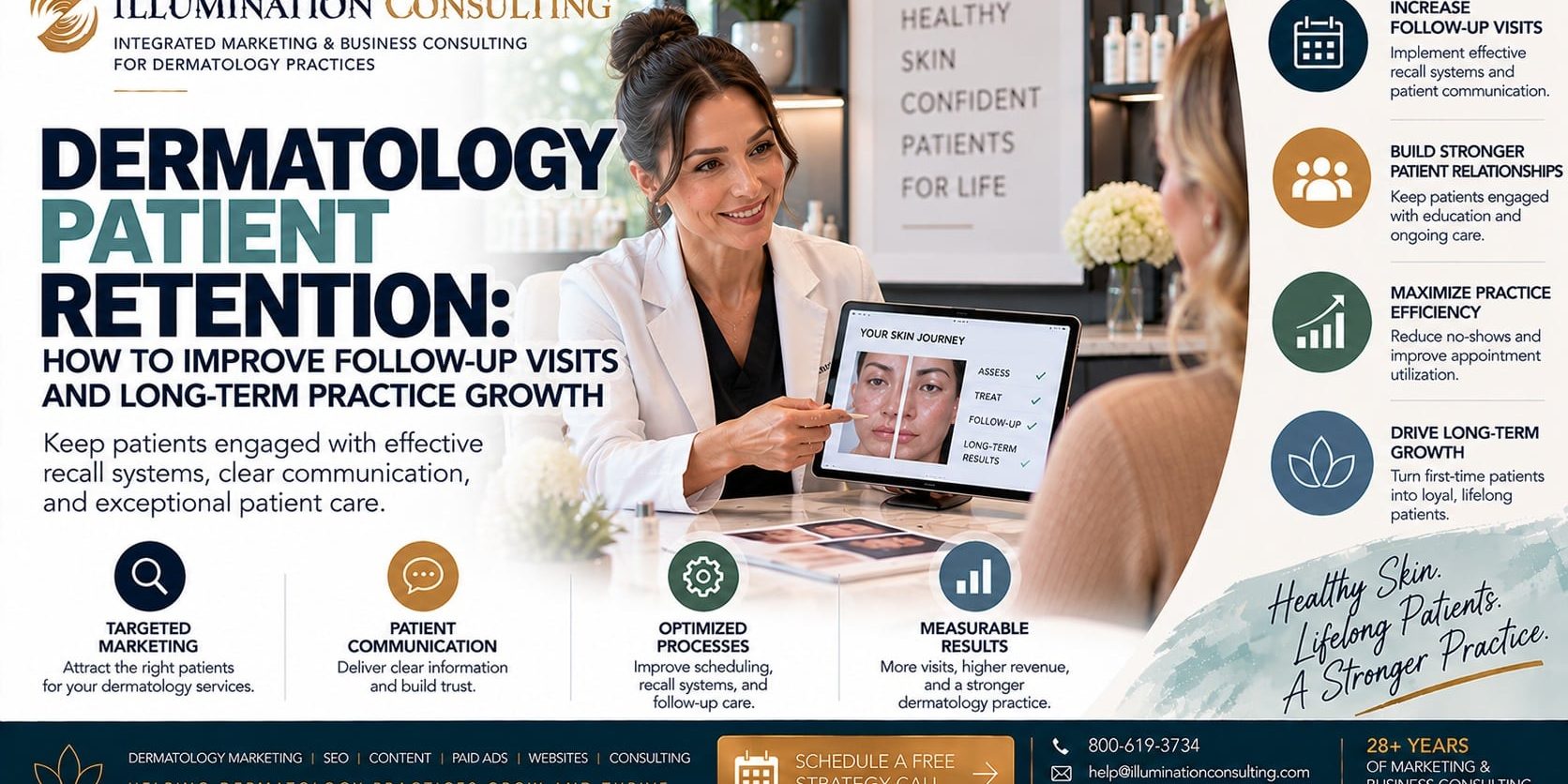
Attracting new patients is essential for dermatology practice growth, but acquiring patients is only one part of building a sustainable medical business. Dermatology practices also need effective systems for maintaining patient relationships, supporting appropriate follow-up care, and helping patients return when additional evaluation or treatment is clinically necessary. Without these systems, practices may experience missed follow-up opportunities, inconsistent appointment scheduling, and unnecessary dependence on new patient acquisition.
Dermatology patient retention involves creating a reliable patient experience that encourages continuity of care, supports medically appropriate return visits, and strengthens long-term relationships. Unlike conventional customer retention strategies, healthcare retention must remain grounded in clinical needs, patient autonomy, and professional judgment. The objective is not encouraging unnecessary appointments or treatments, but ensuring patients receive appropriate information, timely communication, and convenient access to ongoing dermatologic care.
For practices investing in professional Dermatology Marketing, patient retention should complement acquisition efforts. A coordinated approach to patient communication, follow-up scheduling, digital accessibility, and practice operations can improve continuity while helping dermatology businesses make better use of existing patient relationships.
Why Patient Retention Matters for Dermatology Practices
Dermatology practices often invest heavily in attracting new patients through search engine optimization, advertising, physician referrals, and local reputation development. These investments help introduce the practice to individuals seeking care, but the long-term patient relationship may depend on what happens after the initial appointment.
Patients with chronic dermatologic conditions may require ongoing monitoring or management. Other patients may need postoperative assessments, medication follow-up, or future evaluations based on individual risk factors. Some patients may not require additional care for extended periods.
A successful retention strategy respects these differences while making it easier for patients to follow clinically recommended care plans.
From a business perspective, reliable follow-up processes can improve appointment planning, reduce administrative friction, and support continuity of appropriate services. Retention should therefore be evaluated through both patient-care outcomes and operational performance.
Understand the Difference Between Retention and Repeat Visits
Patient retention is sometimes measured simply by counting how many patients return within a particular period. However, this approach can be misleading in dermatology because appropriate visit frequency varies considerably.
A patient receiving ongoing treatment for a chronic skin condition may need multiple appointments during a year. Another patient who receives evaluation for a minor, resolved concern may not need to return unless new symptoms develop.
A practice should not interpret every patient who does not return as lost business.
Instead, management should distinguish between patients with recommended follow-up care, patients who require ongoing management, and patients whose episode of care is complete.
This distinction supports more meaningful performance measurement and prevents retention goals from interfering with clinical judgment.
Identify Patients Who Need Ongoing Follow-Up
An effective dermatology retention system begins with appropriate patient segmentation.
Practices may have different follow-up workflows for patients receiving chronic condition management, postoperative care, medication monitoring, skin cancer surveillance, or elective cosmetic services.
These groups should not automatically receive identical reminders or scheduling recommendations.
The practice’s clinical team should establish follow-up requirements based on diagnosis, treatment, individual circumstances, and applicable care standards.
Administrative systems can then support those recommendations by making appointments easier to schedule and helping patients understand their next steps.
Establish Clear Follow-Up Recommendations
Patients are more likely to understand their ongoing care when the practice explains why a follow-up appointment may be necessary.
At the end of a visit, patients should receive clear information about the recommended next steps, including the purpose of follow-up, the suggested timeframe, and any relevant preparation instructions.
When appropriate, these recommendations should also be documented in the patient’s after-visit materials.
A patient who understands the reason for returning is better equipped to participate in the decision and follow the care plan.
Clear communication can also reduce unnecessary phone calls and confusion after the appointment.
Schedule Appropriate Follow-Up Before Patients Leave
One practical way to reduce scheduling friction is to offer follow-up appointment scheduling before the patient leaves the practice.
When a clinician has recommended another visit, front-desk staff can help identify available appointment times and explain the scheduling process.
This approach may be particularly useful for patients who require ongoing treatment or monitoring.
However, the practice should avoid automatically scheduling repeat visits that have not been clinically recommended.
The goal is improving access to appropriate care, not maximizing appointment volume regardless of medical necessity.
Develop a Reliable Dermatology Recall System
A patient recall system helps practices identify individuals who are due for recommended follow-up appointments and communicate with them appropriately.
Depending on the practice’s systems, recall workflows may be supported by an electronic health record, practice management software, or another authorized communication platform.
A recall process should distinguish between patients who already have appointments, those who need scheduling assistance, and those who have declined or deferred further care.
Practices should also ensure that reminders are consistent with patient communication preferences, privacy requirements, and applicable consent rules.
A reliable recall system reduces dependence on staff remembering individual follow-up needs and supports more consistent continuity of care.
Use Appointment Reminders to Reduce Missed Visits
Appointment reminders can help patients remember scheduled visits and prepare for their appointments.
Depending on the practice and patient preferences, reminders may be delivered through text messages, email, patient portals, or telephone calls.
Useful reminders may include the appointment date, time, location, arrival instructions, and appropriate rescheduling information.
Practices should avoid including unnecessary sensitive medical details in communications.
Reminder timing and frequency should be evaluated based on patient response and operational performance rather than assuming that more messages always produce better results.
Make Rescheduling Easy
Patients may need to change appointments because of work, transportation, family responsibilities, illness, or other circumstances.
A complicated rescheduling process can create frustration and lead to missed follow-up care.
Dermatology practices should provide clear instructions for changing appointments and make available options reasonably accessible.
Online scheduling or rescheduling may be helpful where supported by the practice’s systems and clinical requirements.
Efficient rescheduling can also help staff make better use of available appointment capacity.
Improve the Patient Experience at Every Visit
Patient retention is influenced by more than clinical treatment alone.
Scheduling convenience, communication quality, office organization, wait times, billing clarity, and staff professionalism all contribute to the overall experience.
A practice may provide excellent medical care but still create avoidable frustration through confusing administrative processes.
Management should regularly evaluate the patient journey, from appointment scheduling through check-in, consultation, checkout, and follow-up.
Improving these touchpoints can strengthen patient confidence and make returning for appropriate care easier.
Train Front-Desk Teams on Patient Communication
Front-desk staff frequently serve as the first and last point of contact during a dermatology visit.
Their communication can influence whether patients understand follow-up instructions, know how to obtain additional information, and feel comfortable contacting the practice again.
Staff should receive training on scheduling procedures, communication standards, administrative policies, and appropriate handling of patient questions.
Clinical questions should be directed to qualified healthcare professionals rather than answered beyond the staff member’s role.
Consistent administrative communication helps patients navigate their care without unnecessary confusion.
Improve Patient Education Between Appointments
Educational content can support patient understanding and reinforce appropriate care instructions.
Dermatology practices may provide general educational resources about common skin conditions, treatment processes, medication use, skin protection, or follow-up expectations.
Content should be accurate, appropriately reviewed, and clearly distinguished from individualized medical advice.
Professional Content Marketing can help organize useful educational resources for websites, patient portals, and authorized communication channels.
The objective is supporting patient understanding and trust rather than turning every communication into a promotional message.
Use Email Communications Responsibly
Email can be useful for general practice updates, educational information, and certain patient communications when properly authorized.
However, dermatology practices must distinguish between general marketing communications and messages containing protected health information.
Practices should evaluate applicable privacy requirements, consent, communication preferences, and the capabilities of their email platforms before sending patient-specific messages.
Marketing emails should not reveal sensitive medical information or assume that all patients want to receive promotional content.
Responsible communication helps preserve patient trust while supporting appropriate ongoing engagement.
Strengthen the Dermatology Website for Returning Patients
A dermatology website should serve existing patients as well as prospective patients.
Returning patients may visit the website to find office hours, contact information, appointment instructions, patient portal access, provider details, or general preparation guidance.
These resources should be easy to locate, particularly on mobile devices.
Professional Website Design Services can help improve navigation, accessibility, and the overall patient experience.
A website that makes routine administrative tasks easier can support retention without relying on additional promotional campaigns.
Support Continuity Across Multiple Providers
Dermatology practices with several clinicians may face additional challenges maintaining continuity of care.
Patients may see different providers for medical dermatology, surgical procedures, or cosmetic services.
Clear documentation, appropriate internal communication, and consistent scheduling processes help ensure that patients receive coordinated care.
The practice should explain provider roles and make it easy for patients to understand who is responsible for follow-up.
Continuity should not depend entirely on one staff member or individual provider remembering the patient’s history.
Use Patient Feedback to Identify Retention Problems
Patient feedback can reveal operational issues that traditional marketing reports do not capture.
For example, patients may report difficulty reaching the office, unclear billing explanations, inconvenient appointment availability, or inconsistent follow-up communication.
Practices can collect feedback through appropriate surveys, direct communication, and reviews of administrative complaints.
Management should evaluate recurring patterns rather than overreacting to isolated comments.
Feedback should also be considered alongside clinical quality and operational performance.
Respond Professionally to Online Reviews
Online reviews can influence both new patient acquisition and existing patient perceptions.
Practices should respond professionally and avoid disclosing or confirming protected patient information in public replies.
Negative feedback may reveal opportunities to improve scheduling, communication, or administrative processes.
However, public reviews do not provide a complete measure of clinical quality or patient satisfaction.
A thoughtful reputation management strategy should focus on service improvement, appropriate communication, and compliance with privacy requirements.
Measure Dermatology Patient Retention Accurately
Retention measurement should reflect the practice’s clinical model.
A simple return-visit rate may be useful for certain patient groups, but it should not be treated as a universal performance benchmark.
For patients with documented follow-up recommendations, one useful measure is:
Recommended Follow-Up Completion Rate (%) = (Patients Completing Recommended Follow-Up / Patients Due for Recommended Follow-Up) x 100
For example, if 200 patients were due for recommended follow-up during a defined period and 160 completed those visits, the follow-up completion rate would be 80%.
This calculation is illustrative and does not represent an industry benchmark.
The practice should account for patients who transferred care, declined further visits, experienced changes in clinical recommendations, or had other documented circumstances affecting follow-up.
Track Patient Retention by Care Category
Different dermatology services involve different follow-up patterns.
A practice may need separate reporting for chronic medical conditions, postoperative care, surveillance appointments, and elective aesthetic treatments.
Comparing all patients using one retention metric can obscure meaningful differences.
Category-specific reporting helps management evaluate whether patients are receiving recommended care and whether administrative processes support appropriate scheduling.
It can also identify service areas where follow-up communication or appointment availability needs improvement.
Evaluate Patient Retention Alongside Appointment Capacity
Retention systems should be coordinated with provider availability and scheduling capacity.
A practice that improves recall communication but lacks sufficient appointment availability may create frustration for patients.
Management should review appointment lead times, provider schedules, treatment requirements, and the distribution of follow-up visits.
Where appropriate, scheduling improvements may help balance new patient appointments with ongoing care needs.
The objective is supporting access and continuity without creating unnecessary operational bottlenecks.
Understand the Financial Value of Patient Relationships
Existing patient relationships can contribute to the financial stability of a dermatology practice, particularly when patients require appropriate ongoing care.
However, financial value should not determine whether a patient needs additional treatment.
For business planning, management may evaluate collected revenue, contribution, visit frequency, and administrative costs across defined patient populations.
These measurements can help forecast staffing, appointment demand, and operational resources.
They should not be used to encourage unnecessary visits or override clinical decisions.
Connect Patient Retention With New Patient Acquisition
Patient acquisition and retention are related but distinct business activities.
Acquisition marketing introduces the practice to prospective patients. Retention systems help established patients navigate ongoing care when appropriate.
A practice with strong acquisition but weak follow-up processes may experience unnecessary operational inefficiency. Conversely, a practice with effective retention systems may still need marketing to reach new patients and support long-term growth.
Professional Dermatology Marketing should account for both stages.
The goal is building a balanced practice growth strategy rather than treating every business challenge as a need for more advertising.
Develop a 90-Day Dermatology Patient Retention Improvement Plan
A structured improvement plan can help dermatology practices evaluate existing systems and implement changes without disrupting clinical operations.
Days 1–30: Review Follow-Up and Patient Experience
Begin by examining current follow-up recommendations, recall workflows, appointment reminders, and scheduling procedures.
Identify patients who are due for recommended care, review missed appointment patterns, and evaluate patient feedback.
Establish baseline measurements for follow-up completion, appointment access, and administrative communication.
Days 31–60: Improve Communication and Scheduling
Update administrative workflows to make recommended follow-up scheduling more consistent.
Review reminder templates, rescheduling procedures, and patient-facing website information.
Provide staff training where communication or process inconsistencies have been identified.
Ensure that clinical recommendations remain under the direction of qualified professionals.
Days 61–90: Measure Results and Refine
Compare follow-up completion, missed appointments, patient feedback, and scheduling performance with the original baseline.
Identify improvements that support continuity of care and reduce unnecessary administrative friction.
Adjust workflows that create confusion or additional work without meaningful patient benefit.
The 90-day framework is a planning structure rather than a guarantee of specific performance improvements.
Common Dermatology Patient Retention Mistakes
Dermatology practices can weaken patient relationships through several recurring operational problems.
Treating every patient as a candidate for repeat visits. Follow-up recommendations should reflect individual clinical needs rather than revenue objectives.
Failing to explain follow-up requirements. Patients may not understand why another appointment is necessary when instructions are unclear.
Relying on manual recall processes. Inconsistent tracking can cause recommended follow-up opportunities to be overlooked.
Making scheduling unnecessarily difficult. Complicated appointment procedures can discourage patients from obtaining appropriate care.
Sending excessive or inappropriate communications. Reminder and marketing programs must respect privacy, consent, and patient preferences.
Ignoring patient feedback. Recurring administrative complaints can reveal problems that affect patient confidence.
Measuring retention without clinical context. A single repeat-visit rate cannot accurately describe every dermatology patient population.
Avoiding these mistakes requires coordination between clinical leadership, administrative teams, and practice management.
Build a Sustainable Dermatology Patient Retention Strategy
Dermatology patient retention is most effective when it supports continuity of care, patient understanding, and a consistent practice experience. Patients should receive clear follow-up recommendations, convenient scheduling options, appropriate reminders, and access to reliable information.
For dermatology practices, these improvements can also support operational efficiency and long-term business stability. Better communication and scheduling processes may reduce missed appointments, strengthen patient relationships, and help providers deliver appropriate care more consistently.
Illumination Consulting helps dermatology practices connect Dermatology Marketing, SEO Services, Content Marketing, website development, and business growth planning into coordinated strategies. Our objective is to help practices attract appropriate patients, improve the patient experience, and support sustainable long-term growth.
Frequently Asked Questions
What is dermatology patient retention?
Dermatology patient retention refers to maintaining ongoing patient relationships and supporting appropriate return visits, follow-up care, and continuity of treatment when clinically indicated.
How can dermatology practices improve patient retention?
Practices can improve retention through clear follow-up recommendations, reliable recall systems, convenient scheduling, appointment reminders, patient education, and consistent administrative communication.
What is a good dermatology patient retention rate?
There is no universal rate that applies to every dermatology practice. Appropriate return-visit frequency depends on diagnosis, treatment, patient needs, and the services provided. Practices should establish benchmarks for relevant patient groups rather than relying on one overall percentage.
How do appointment reminders affect dermatology retention?
Appointment reminders can help patients remember scheduled visits and understand relevant appointment instructions. They may also support rescheduling when patients cannot attend.
Should dermatology practices use email marketing for existing patients?
Email may be useful for authorized educational and general practice communications. Practices must evaluate privacy requirements, consent, patient preferences, and whether the platform is appropriate for the information being shared.
How should dermatology practices measure follow-up performance?
One useful measure is the percentage of patients who complete clinically recommended follow-up visits within a defined period. Results should account for clinical circumstances and documented changes to care plans.
Can patient retention improve dermatology practice profitability?
Effective continuity and scheduling processes may support operational efficiency and practice stability. However, additional visits should occur only when appropriate for the patient’s care, not solely to increase revenue.