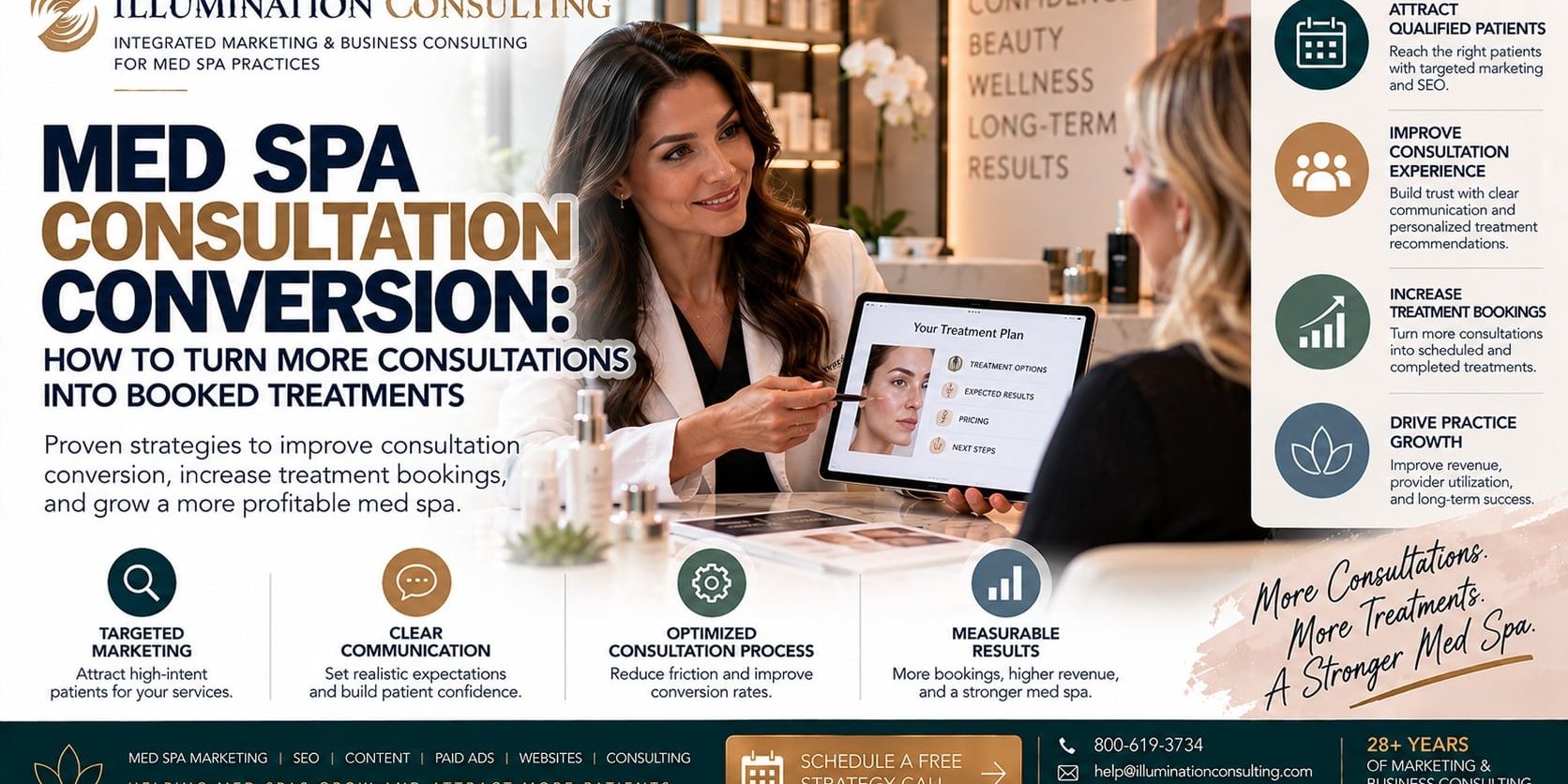
Attracting new patients is an important part of growing a medical spa, but generating inquiries and booking consultations does not automatically translate into treatment revenue. Many med spas invest in search engine optimization, paid advertising, social media, and website development to increase patient interest. However, when prospective patients attend consultations but do not move forward with appropriate treatments, the business may struggle to achieve a satisfactory return on its marketing investment.
Med spa consultation conversion focuses on improving the experience and processes that help prospective patients make informed treatment decisions. This includes how consultations are scheduled, how patients are prepared, how treatment options are explained, how pricing is communicated, and how follow-up is handled. A successful conversion strategy does not depend on pressuring patients into purchasing services. It emphasizes professional communication, realistic expectations, patient trust, and an efficient process that makes appropriate treatment decisions easier.
For medical spas investing in professional Med Spa Marketing, consultation performance should be an essential part of the overall growth strategy. Improving the percentage of qualified consultations that become completed treatments can strengthen marketing efficiency, support provider utilization, and increase revenue without necessarily requiring a proportional increase in advertising expenditure.
Why Consultation Conversion Matters for Med Spa Growth
Medical spas frequently measure marketing success through website traffic, lead volume, appointment requests, and consultation bookings. These indicators are useful, but they represent intermediate stages of the patient acquisition process rather than the final business outcome.
A practice may generate substantial interest in cosmetic injectables, laser treatments, skin rejuvenation, or other aesthetic services while experiencing relatively few completed treatments. The problem may not be insufficient marketing demand. It could involve unclear pricing, scheduling friction, inadequate patient preparation, inconsistent consultation experiences, or poor follow-up.
Consider a hypothetical med spa that completes 100 consultations during a month. If 35 of those consultations result in booked treatments, the consultation-to-treatment booking rate is 35%. If the practice improves that rate to 45%, it generates 10 additional treatment bookings from the same number of completed consultations.
Whether those bookings ultimately increase profitability depends on treatment suitability, attendance, revenue collected, service costs, and available capacity. Nevertheless, the example demonstrates why consultation conversion deserves management attention alongside lead generation.
Understand the Med Spa Patient Journey
Consultation conversion begins before a patient enters the treatment room. The patient’s experience with advertising, the website, scheduling, and initial communication shapes expectations about the practice.
A typical journey includes discovering the med spa, researching treatments, submitting an inquiry, scheduling a consultation, attending the appointment, evaluating recommendations, and deciding whether to proceed.
Each stage can influence the next. A website that exaggerates results may generate inquiries from patients with unrealistic expectations. A scheduling process that provides little information may lead to consultations with patients who do not understand the potential costs. Inconsistent front-desk communication can create confusion before the provider has an opportunity to establish trust.
Effective consultation conversion therefore requires coordination between marketing, administrative staff, patient coordinators, and qualified clinical professionals.
Attract Patients Who Are Appropriate for the Services Offered
Improving consultation conversion starts with attracting relevant patient demand. High inquiry volume is not necessarily beneficial when many prospective patients are interested in treatments the practice does not offer, cannot afford, or cannot appropriately provide.
Marketing should communicate the med spa’s actual services, provider qualifications, location, general pricing position, and consultation requirements. Treatment pages should answer common questions without suggesting that every visitor is a suitable candidate.
For example, a campaign promoting laser skin rejuvenation should clearly identify the treatment category and provide realistic information about the consultation process. Broad advertising that promises dramatic results without context may attract attention but create difficulties during clinical evaluation.
Professional SEO Services and targeted advertising can help practices reach patients actively researching relevant treatments. The objective is generating qualified interest rather than maximizing the number of leads regardless of suitability.
Build Treatment Pages That Prepare Patients for Consultations
A med spa website should do more than display attractive photographs and encourage visitors to book appointments. It should provide enough information for prospective patients to understand what a service involves and why a consultation may be necessary.
Effective treatment pages typically explain the general purpose of the service, the concerns it may address, who performs the procedure, and what patients can expect during the appointment process. Depending on the treatment, they may also address preparation, recovery considerations, potential risks, and factors affecting price.
Clear information helps patients arrive with more realistic expectations. It can also reduce repetitive administrative questions and improve the quality of consultation discussions.
Professional Website Design Services can support a clearer path from treatment research to consultation scheduling, particularly when the website serves multiple providers or treatment categories.
Make Consultation Scheduling Simple and Transparent
Scheduling friction can weaken conversion before the consultation occurs. Patients may abandon booking attempts when appointment options are unclear, forms are unnecessarily complicated, or they cannot determine whether a consultation requires a fee.
Med spas should provide clear instructions for scheduling, including available contact methods, consultation duration where appropriate, cancellation policies, and any relevant financial requirements.
Online booking may improve convenience, but it should be configured carefully. Certain treatments require clinical screening or staff review before an appointment can be scheduled appropriately.
A reliable scheduling process should make the next step easy while preserving necessary patient screening and administrative safeguards.
Prepare Patients Before Their Appointments
Pre-consultation communication helps patients understand what to expect and can reduce avoidable confusion. Depending on the service, practices may provide appointment confirmations, general preparation instructions, directions, parking information, and reminders about relevant consultation policies.
Administrative communications should be clear and timely. Clinical preparation instructions should come from appropriately qualified professionals and reflect the specific treatment under consideration.
Patients may also benefit from knowing whether they should bring relevant medical information, arrive without certain cosmetic products when instructed, or allow additional time for paperwork.
Preparation improves the consultation experience by allowing more attention to be devoted to clinical assessment and patient questions.
Establish a Consistent Consultation Experience
Consistency is important when multiple providers or patient coordinators participate in consultations. Patients should receive a professional experience regardless of which qualified team member they meet.
A consultation framework may include discussing the patient’s concerns and goals, obtaining relevant medical information, assessing treatment suitability, explaining appropriate options, reviewing risks and expected outcomes, and communicating pricing.
The framework should not become a rigid sales script. Individual clinical circumstances require professional judgment, and patients may need additional time or information before making decisions.
A consistent structure helps the practice provide reliable information while allowing providers to personalize the clinical discussion.
Focus on Patient Goals Before Recommending Treatments
Prospective patients may arrive with a particular procedure in mind, but their underlying concerns can differ from the treatment they initially request.
For example, a patient may ask about a specific injectable treatment when their primary concern involves skin texture or another issue that requires a different assessment. The provider should evaluate the patient’s goals and clinical circumstances before recommending an appropriate course of action.
Listening carefully also helps identify expectations that may be unrealistic or inconsistent with what a treatment can reasonably accomplish.
Consultations are more effective when patients feel heard and understand why a recommendation is being made. This supports informed decision-making and can strengthen long-term trust.
Communicate Treatment Benefits and Limitations Clearly
Aesthetic patients often research procedures through social media, promotional videos, online reviews, and before-and-after images. These sources can influence expectations, sometimes without providing sufficient information about risks, variability, or individual suitability.
Qualified providers should explain the realistic benefits and limitations of proposed treatments. Depending on the procedure, this may include expected recovery, the possibility of additional sessions, maintenance considerations, and potential adverse effects.
Marketing and consultation materials should avoid guaranteed outcomes or misleading representations of results.
Clear communication may lead some patients to decide against treatment. That is an appropriate outcome when the service does not fit their needs, expectations, or circumstances.
Build Trust Through Provider Qualifications and Expertise
Patients considering aesthetic treatments often evaluate the qualifications and experience of the professionals who will provide their care.
Med spas should communicate provider credentials accurately through biographies, treatment pages, and consultation materials. Patients should be able to understand who performs procedures and what qualifications are relevant to those services.
Educational content can further demonstrate professional knowledge by addressing common questions, explaining treatment processes, and discussing realistic expectations.
Trust should be established through accurate information, respectful communication, and appropriate clinical care rather than unsupported claims of superiority.
Improve Pricing Transparency During Consultations
Unclear pricing is a common source of uncertainty in elective aesthetic services. Patients may understand the general purpose of a treatment but hesitate because they do not know the likely financial commitment.
A transparent consultation process should explain the proposed treatment price, relevant fees, potential additional sessions, and any ongoing maintenance considerations.
When final pricing depends on individual assessment, the practice should communicate the factors involved rather than implying that every patient will receive the same treatment plan.
Patients should also understand what is included in a quoted price and whether optional products or services involve additional costs.
Transparent financial communication helps patients evaluate affordability and reduces misunderstandings after the consultation.
Avoid Relying on Discounts to Close Treatment Bookings
Discounts can generate interest, but they should not become the primary method of encouraging patients to proceed with treatment.
A practice that routinely reduces prices during consultations may weaken patient trust and create expectations that initial prices are negotiable. Discounts can also reduce contribution, particularly for treatments involving expensive supplies or substantial provider time.
Instead, med spas should emphasize accurate treatment information, qualified providers, clear pricing, and a professional patient experience.
Promotional offers may still have a role when appropriately structured, financially justified, and compliant with applicable rules. However, they should not replace a strong consultation process.
Explain Financing Options Responsibly
Some elective aesthetic treatments involve costs that patients prefer to manage over time. Third-party financing may be available for eligible patients and can provide an additional payment option.
Practices should communicate financing arrangements accurately, including relevant terms, eligibility requirements, and the distinction between financing approval and clinical treatment suitability.
Financing should never be presented as a reason to undergo unnecessary treatment or assume an unaffordable financial obligation.
The purpose of discussing payment options is to support informed financial decisions, not create pressure to proceed.
Train Patient Coordinators to Support the Consultation Process
Patient coordinators can play an important role in helping prospective patients understand scheduling, pricing, treatment logistics, and next steps.
Staff should receive consistent training on the services offered, administrative policies, consultation requirements, and available payment methods. They should also know when to refer clinical questions to qualified providers.
Effective coordinators listen to patient concerns, provide accurate information, and help patients navigate the decision process without making clinical promises.
Training should emphasize professional communication and appropriate follow-up rather than aggressive closing techniques.
Create a Respectful Consultation Follow-Up Process
Not every patient will decide to schedule treatment immediately after a consultation. Some may need time to consider the recommendation, review financial options, discuss personal circumstances, or seek additional medical information.
A structured follow-up process can help patients obtain answers and understand their next steps.
Where appropriate and authorized, the practice may send a consultation summary, provide requested educational materials, clarify administrative questions, or offer assistance with scheduling.
Follow-up frequency should respect patient preferences and applicable privacy and communication requirements. Repeated sales pressure can damage trust and should be avoided.
The goal is ensuring patients have the information needed to make appropriate decisions.
Measure Med Spa Consultation Conversion Accurately
Practices should define consultation conversion consistently before evaluating performance.
One useful metric is the consultation-to-treatment booking rate.
Consultation-to-Treatment Booking Rate (%) = (Consultations Resulting in Treatment Bookings / Completed Eligible Consultations) x 100
For example, if a med spa completes 80 eligible consultations and 32 result in booked treatments, the booking rate is 40%.
The practice should define what qualifies as an eligible consultation and how long after the consultation a booking may be attributed to it. Patients who are clinically unsuitable or appropriately decline treatment should not be treated as sales failures.
Management should also distinguish treatment bookings from completed treatments. A booking that is subsequently canceled does not produce the same business outcome as a completed service.
Track Completed Treatment Conversion
Completed treatment conversion provides another perspective on consultation performance.
Completed Treatment Conversion Rate (%) = (Consultations Resulting in Completed Treatments / Completed Eligible Consultations) x 100
For meaningful reporting, the practice should use a defined follow-up period and account for the time between consultation and treatment.
For example, a consultation completed near the end of a reporting month may lead to treatment during the following month. Measuring only same-month activity could understate conversion.
Tracking completed treatments helps management connect consultations with realized service activity rather than relying exclusively on scheduled appointments.
Evaluate Revenue and Contribution per Consultation
Conversion rates are useful, but they do not describe the complete economic value of consultations.
A practice should also evaluate collected treatment revenue and contribution associated with completed consultations.
Revenue per Completed Consultation = Attributed Collected Treatment Revenue / Completed Consultations
Contribution per Completed Consultation = Attributed Treatment Contribution / Completed Consultations
These calculations require consistent attribution periods and cost definitions.
For example, a med spa may improve its consultation booking rate while generating more low-contribution treatments. The increase in bookings may not produce the expected improvement in profitability.
Revenue and contribution metrics help management understand whether consultation improvements are translating into sustainable business results.
Identify Where Consultation Conversion Breaks Down
A low conversion rate does not automatically indicate poor provider performance. The underlying problem may occur at several stages of the patient journey.
If patients arrive with unrealistic expectations, marketing messages may need improvement. If patients frequently express surprise about pricing, website content or pre-consultation communication may be insufficient. If patients agree to treatment but do not schedule, administrative processes may require attention.
Practices should review patterns across treatment categories, providers, lead sources, and consultation types while avoiding simplistic comparisons.
The objective is identifying specific operational problems that can be improved without compromising clinical judgment or patient autonomy.
Connect Consultation Conversion With Marketing Attribution
Marketing channels can generate different types of patient interest.
A search campaign targeting a specific treatment may attract patients who have already completed substantial research. A social media campaign may generate earlier-stage awareness among people who are not ready to schedule treatment.
These differences can influence consultation behavior.
Med spas should evaluate lead sources using qualified consultations, completed appointments, appropriate treatment bookings, and collected revenue rather than inquiry volume alone.
Professional Med Spa Marketing should connect acquisition reporting with downstream patient outcomes so advertising budgets can be allocated more effectively.
Improve Provider Utilization Through Better Conversion
Consultation conversion can affect how efficiently a med spa uses its available treatment capacity.
When providers have open appointment slots, improving the progression from appropriate consultations to completed treatments may increase utilization without requiring additional lead volume.
However, practices should evaluate scheduling capacity before attempting to increase treatment bookings. Certain services require specific providers, equipment, treatment rooms, or follow-up resources.
A treatment booking is beneficial only when the practice can deliver the service appropriately and efficiently.
Marketing, patient coordination, and clinical scheduling should work together to balance demand with available capacity.
Use Patient Feedback to Improve the Consultation Experience
Patient feedback can provide valuable information about consultation quality and decision-making.
Practices may ask patients whether information was clear, whether their concerns were addressed, and whether they understood the proposed next steps.
Feedback should be collected respectfully and without pressuring patients to provide positive reviews or proceed with treatment.
Patterns may reveal opportunities to improve communication, scheduling, pricing explanations, or educational materials.
A patient who chooses not to undergo treatment may still have received an excellent consultation. Measuring satisfaction independently from treatment conversion helps maintain that distinction.
Develop a 90-Day Med Spa Consultation Conversion Improvement Plan
A structured improvement plan allows practices to identify conversion problems, implement targeted changes, and evaluate results.
Days 1–30: Evaluate Current Consultation Performance
Review completed consultations, treatment bookings, completed treatments, and the time between consultation and treatment. Examine performance by treatment category and lead source where sufficient data exists.
Assess website information, consultation scheduling, pricing communication, and follow-up procedures. Gather appropriate patient feedback to identify recurring sources of confusion.
Establish baseline conversion and contribution metrics before introducing changes.
Days 31–60: Improve Communication and Processes
Update treatment pages and pre-consultation materials to provide clearer information. Standardize relevant administrative procedures and improve staff training.
Review how pricing is explained, how clinical questions are routed, and how patients receive follow-up information.
Changes should support informed patient decisions rather than encourage unnecessary procedures.
Days 61–90: Measure Results and Refine
Compare conversion, completed treatments, patient feedback, and contribution with the baseline. Review whether improvements differ by service category or acquisition channel.
Expand changes that improve patient experience and appropriate treatment completion. Reassess initiatives that create additional administrative work without meaningful benefits.
The 90-day framework is a planning approach, not a guarantee of increased bookings or revenue.
Common Med Spa Consultation Conversion Mistakes
Several recurring mistakes can reduce consultation effectiveness and create unnecessary friction for prospective patients.
Attracting poorly qualified inquiries. Broad marketing messages may generate interest from patients whose needs do not match available services.
Providing insufficient treatment information. Patients may arrive with unrealistic expectations or uncertainty about the consultation process.
Making pricing difficult to understand. Unexpected costs can undermine trust and complicate decision-making.
Using high-pressure sales tactics. Patients should have sufficient information and freedom to make appropriate treatment decisions.
Failing to train administrative staff. Inconsistent answers about scheduling, pricing, or treatment logistics can create confusion.
Neglecting appropriate follow-up. Patients may need additional information before making a decision.
Measuring bookings without tracking completed treatments. Scheduled appointments do not necessarily translate into delivered services or collected revenue.
Ignoring patient satisfaction. A higher booking rate does not justify a poor consultation experience.
Addressing these issues requires coordination between clinical leadership, marketing, administration, and patient-facing staff.
Build a Sustainable Med Spa Consultation Conversion Strategy
Improving consultation conversion is not simply about increasing the percentage of patients who agree to purchase treatments. It is about creating a reliable process that attracts appropriate patients, provides accurate information, supports informed decisions, and makes scheduling and treatment delivery more efficient.
Med spas that understand the relationship between marketing, consultation quality, pricing transparency, follow-up, and provider capacity are better positioned to improve their overall business performance. They can identify whether growth challenges originate in lead generation, patient communication, scheduling, or service delivery rather than automatically increasing advertising expenditure.
Illumination Consulting helps aesthetic practices connect Med Spa Marketing, Med Spa Business Consulting, SEO Services, website development, patient acquisition, and operational growth planning into coordinated strategies. Our objective is to help med spas generate qualified patient demand, improve the consultation experience, and build sustainable practice growth.
Frequently Asked Questions
What is med spa consultation conversion?
Med spa consultation conversion measures how effectively completed consultations lead to appropriate treatment bookings or completed treatments. It helps practices evaluate the relationship between patient acquisition, consultation quality, and treatment demand.
How can a med spa improve consultation conversion rates?
Practices can improve consultation performance through clearer treatment information, transparent pricing, convenient scheduling, consistent staff training, appropriate clinical consultations, and respectful patient follow-up.
What is a good med spa consultation conversion rate?
There is no universal conversion rate that applies to every med spa. Results vary by treatment, patient population, consultation type, pricing, and lead source. Practices should establish reliable internal benchmarks and evaluate changes alongside patient satisfaction and clinical suitability.
How do you calculate consultation-to-treatment booking rate?
Divide the number of eligible consultations that result in treatment bookings by the total number of completed eligible consultations, then multiply by 100. Use a consistent attribution period and reporting definition.
Why do patients attend med spa consultations without booking treatments?
Patients may decide not to proceed because of cost, treatment suitability, recovery considerations, expectations, timing, or personal preferences. Practices should identify recurring communication or operational issues without treating every decision not to undergo treatment as a failure.
Should med spas offer discounts to improve consultation conversion?
Discounts may be appropriate in selected circumstances, but they should not replace clear treatment information, professional care, and transparent pricing. Practices should evaluate the financial impact and avoid pressuring patients into unnecessary services.
How does consultation conversion affect med spa marketing ROI?
Improving the progression from qualified consultations to completed treatments can increase the economic value generated by existing marketing activity. Practices should measure completed treatments, collected revenue, and contribution rather than relying exclusively on inquiry or booking volume.