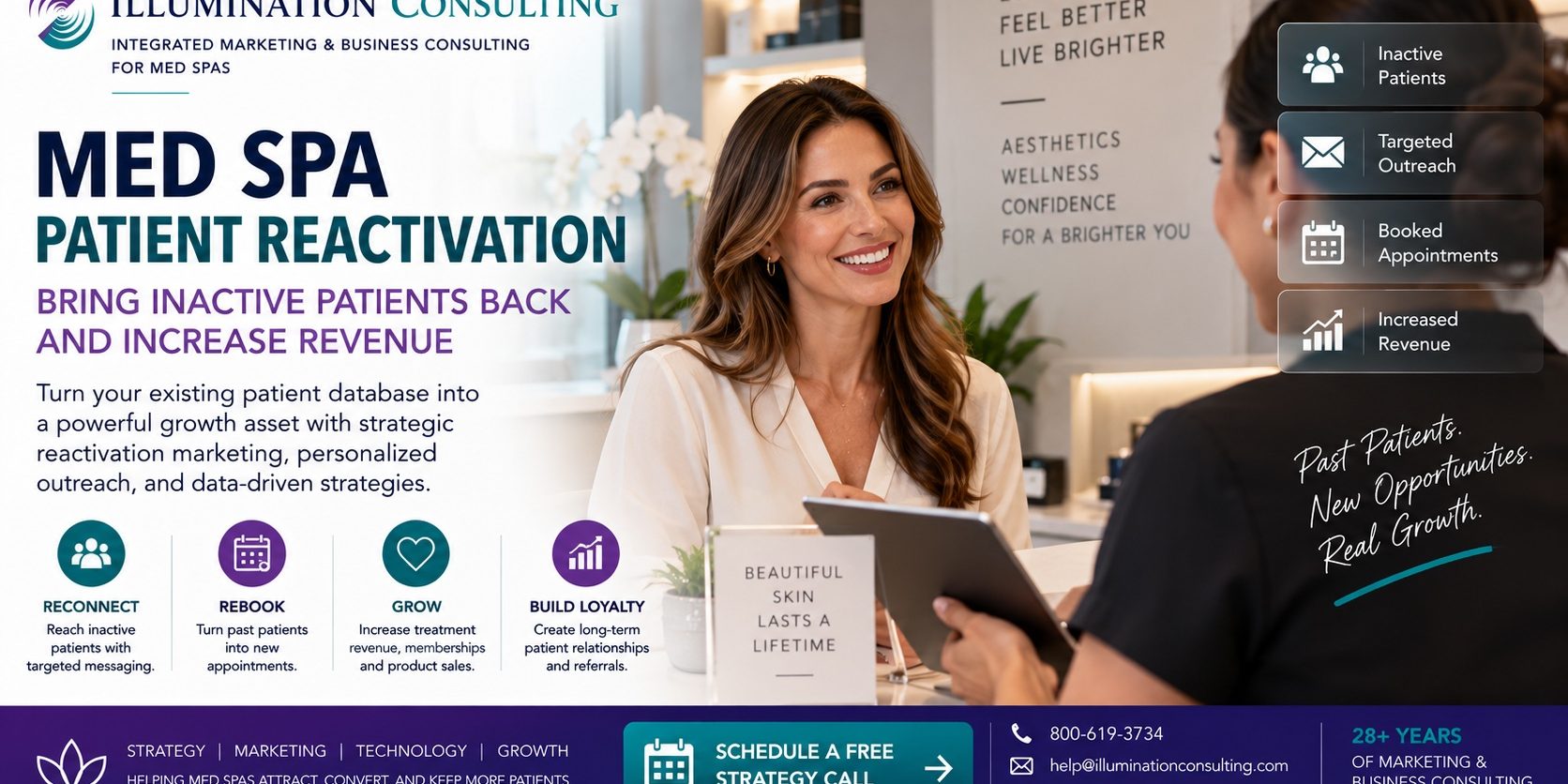
Acquiring a new med spa patient can require significant investments in advertising, search engine optimization, social media, content, promotions, staff time, and sales follow-up. Yet many aesthetic practices concentrate heavily on generating new leads while overlooking one of their most valuable existing assets: patients who have already purchased from the practice.
Every established med spa eventually develops a database of patients who have not returned.
Some completed a treatment series and never scheduled another service. Others intended to return but became busy. Some stopped receiving effective follow-up. Others may simply have forgotten that it is time for another treatment.
These inactive patients represent a different growth opportunity than cold prospects. They already know the practice. They have experienced its services. The business may already have contact information, treatment history, preferences, and an established relationship with them.
A structured med spa patient reactivation strategy can help turn that dormant database into consultations, appointments, recurring treatments, memberships, product purchases, and renewed patient relationships.
For practices investing heavily in med spa marketing, reactivation should be considered part of the overall patient acquisition and retention system—not an occasional promotional email sent when the appointment calendar becomes slow.
What Is Med Spa Patient Reactivation?
Patient reactivation is the process of identifying previous patients who have become inactive and systematically encouraging appropriate patients to return to the practice.
The definition of “inactive” should depend on the treatment and patient relationship.
A patient who received a treatment normally repeated several times per year may become a reactivation candidate much sooner than someone who purchased a treatment intended to produce longer-lasting results.
This distinction matters.
An effective reactivation program should not simply target everyone who has not visited in six months. It should consider:
- previous treatments
- expected treatment intervals
- last appointment date
- treatment plans
- product purchases
- membership history
- consultation history
- patient preferences
- previous engagement
- consent and communication preferences
The objective is to make outreach relevant rather than indiscriminately marketing to the entire database.
Why Patient Reactivation Matters for Med Spa Growth
Most med spas understand the importance of generating leads.
Fewer treat their patient database as a measurable revenue channel.
Consider what happens when a practice continually acquires new patients but allows a significant portion of them to disappear after one or two transactions.
Marketing must continually replace those patients before the practice can generate meaningful net growth.
The business effectively operates with a leaking bucket.
A stronger model combines:
New patient acquisition + conversion + retention + reactivation + referrals
This creates multiple paths to revenue instead of relying almost entirely on new leads.
Patient reactivation can also improve the economics of marketing because the original cost of acquiring the patient has already been incurred.
That does not make reactivation free. There are still technology, staff, promotional, and communication costs. But the practice is working with an audience that already has experience with the business.
Reactivation Is Different From Retention
Retention and reactivation are related but not identical.
Patient retention focuses on keeping active patients engaged so they continue purchasing treatments and products.
Patient reactivation focuses on patients whose relationship with the practice has already weakened or stopped.
The distinction changes the messaging.
An active patient may need:
- appointment reminders
- treatment-plan communication
- membership benefits
- educational content
- product replenishment reminders
- treatment recommendations
An inactive patient may require something different:
- a reason to reconnect
- an update about new treatments
- a reminder of previous results
- a personalized treatment opportunity
- a consultation invitation
- reassurance after a long absence
The longer the patient has been inactive, the more the relationship may need to be rebuilt.
Start by Defining an Inactive Patient
Before launching a campaign, establish clear reactivation criteria.
Avoid defining inactivity with a single arbitrary time period across every service.
Instead, practices can segment patients according to expected treatment behavior.
For example:
Treatment-Based Inactivity
Identify patients whose expected treatment window has passed based on the service they previously received.
General Practice Inactivity
Identify patients who have not made any purchase or appointment within a defined period.
Lapsed Membership Patients
Separate patients who previously belonged to memberships or recurring programs but canceled or stopped participating.
Consultation-Only Prospects
Patients who completed a consultation but never purchased can form another valuable segment.
Technically, these may be unconverted leads rather than inactive patients, but they can still benefit from structured re-engagement.
Product-Only Customers
Patients who purchased skincare products but have not returned for services may represent cross-selling opportunities.
The important principle is segmentation.
A patient who previously purchased injectables should not necessarily receive the same message as someone who completed laser treatments or bought professional skincare products.
Audit the Patient Database
A reactivation strategy is only as useful as the underlying data.
Before launching campaigns, review the practice’s CRM, scheduling platform, patient-management system, and other relevant records.
Look for information such as:
- patient name
- last appointment
- treatments received
- purchase history
- provider
- total historical spend
- membership status
- previous inquiries
- communication preferences
- available contact information
- appointment cancellations
- no-shows
The purpose is not merely creating a large list.
It is identifying which patients are appropriate to contact, when they should be contacted, and what communication is likely to be relevant.
Practices should also ensure patient communications and use of patient information follow applicable privacy, consent, healthcare, advertising, and communications requirements.
Segment Patients by Reactivation Opportunity
Once the database has been cleaned and organized, create practical segments.
One useful framework is:
Recently Inactive
These patients have only recently passed the expected return window.
They may require little more than a timely reminder.
Moderately Inactive
These patients have been absent longer and may need stronger education or a compelling reason to return.
Long-Term Inactive
The practice relationship may need to be re-established.
Messaging should acknowledge the passage of time naturally rather than behaving as though the patient visited recently.
High-Value Inactive Patients
Patients with substantial historical treatment activity or spending may justify more personalized outreach from staff.
Former Members
These patients already demonstrated willingness to participate in a recurring relationship.
Understanding why they stopped can be particularly valuable.
Treatment-Specific Segments
Segment according to prior services so outreach can be relevant to likely future needs.
This structure enables more personalized marketing without requiring every communication to be individually created.
Prioritize Patients Instead of Treating Everyone Equally
Not every inactive patient represents the same opportunity.
Practices can develop a simple prioritization model based on factors such as:
Recency — How long has it been since the patient’s last visit?
Frequency — How often did the patient previously visit?
Historical value — How much business has the relationship generated?
Treatment relevance — Is the patient approaching a logical treatment window?
Engagement — Does the patient still open emails, click messages, visit the website, or respond to communications?
Relationship strength — Did the patient have a preferred provider or membership?
The highest-priority patients may deserve personal outreach rather than another automated campaign.
Use Email for Patient Reactivation
Email can support scalable reactivation because different messages can be created for different patient groups.
Possible email themes include:
- treatment reminders
- seasonal treatment planning
- new services
- new technology
- provider updates
- educational information
- skincare recommendations
- membership opportunities
- consultation invitations
- practice news
The strongest reactivation emails generally have a clear purpose.
Avoid overwhelming the patient with every service the practice offers.
A focused message gives the patient one understandable reason to return.
Professional content marketing can also support these campaigns by giving inactive patients useful educational material rather than relying entirely on promotional messaging.
Use SMS Strategically
Text messaging can be highly useful for time-sensitive communication and appointment-related engagement when the practice has the appropriate permission to communicate through that channel.
SMS may be useful for:
- appointment opportunities
- treatment reminders
- scheduling prompts
- relevant practice updates
- limited promotions
- consultation invitations
The advantage of SMS can also become its weakness.
Because text messages are immediate and personal, excessive or irrelevant communication can quickly become irritating.
Relevance and frequency control matter.
Personal Outreach Can Be Extremely Valuable
Automation should not replace human contact where the economics justify personal attention.
For selected high-value patients, a staff member can reach out directly.
The message does not need to sound like a sales script.
A simple check-in from someone the patient knows can be much more appropriate.
Personal outreach is particularly relevant for:
- high-value treatment patients
- former members
- patients with unfinished treatment plans
- long-standing patients who unexpectedly disappeared
- patients with a strong provider relationship
This is where CRM data and staff knowledge should work together.
Give Patients a Relevant Reason to Return
“Come back and see us” is not a particularly compelling strategy.
Reactivation becomes stronger when there is a meaningful reason to reconnect.
That reason might be:
- it is time to evaluate another treatment
- a new service has become available
- the practice introduced new technology
- seasonal timing makes a treatment relevant
- a provider recommends a follow-up
- the patient’s skincare regimen may need reassessment
- the practice launched a membership
- the patient has an unused benefit or credit where applicable
- a consultation would help evaluate changing goals
The objective is relevance.
A med spa should not manufacture urgency where none exists.
Do You Need a Discount to Reactivate Patients?
No.
Discounting is one possible tactic, but it should not automatically become the foundation of patient reactivation.
Constant discounts can train patients to wait for promotions.
They can also weaken premium positioning.
Alternative reactivation incentives might include:
- complimentary consultations
- treatment-plan reviews
- membership introductions
- bundled value
- loyalty benefits
- educational events
- priority scheduling
- product or service enhancements where economically appropriate
If an offer is used, the practice should understand its economics.
Revenue generated is not the same as profit generated.
Use Treatment Education as a Reactivation Tool
Many patients do not return simply because they do not understand what should happen next.
They may not know:
- how often a treatment is typically considered
- what complementary services exist
- how different treatments work together
- what maintenance may involve
- how skincare products support treatment goals
- when a consultation should be repeated
Educational reactivation can therefore be more effective than purely promotional messaging.
It also reinforces professional positioning.
The practice becomes a source of guidance rather than a business continually pushing specials.
Build Reactivation Into the Patient Journey
The strongest reactivation strategy begins before the patient becomes inactive.
During the active relationship, the practice should establish expectations around:
- next appointments
- treatment plans
- maintenance
- follow-up
- skincare
- memberships
- future consultations
This creates continuity.
Instead of waiting until the patient disappears and then trying to recover the relationship, the practice builds future engagement into the patient experience.
This is one reason med spa business consulting should consider marketing, operations, patient experience, and revenue systems together rather than treating them as unrelated functions.
Reduce Friction in the Return Process
A reactivation campaign can generate interest and still fail if returning is difficult.
The patient should be able to understand what to do next.
Depending on the practice, that may mean:
- calling
- texting
- submitting a form
- booking online
- requesting a consultation
- responding directly to the message
Review the entire process from the patient’s perspective.
If an email encourages a patient to schedule but the website makes booking difficult, marketing and operations are working against each other.
Train the Front Desk for Reactivation Campaigns
Marketing should not surprise the people answering the phone.
Before a campaign launches, staff should know:
- which patients are being contacted
- what message they received
- what services are being promoted
- whether an offer exists
- how eligibility works
- how appointments should be handled
- what questions patients may ask
Otherwise, a patient can respond to a carefully designed campaign and encounter confusion at the front desk.
The campaign is not complete until the operational handoff works.
Track Reactivation as Its Own Revenue Channel
One of the biggest mistakes is running reactivation campaigns without measuring them separately.
Create a reactivation dashboard.
Important metrics can include:
Patients Contacted
How many appropriate inactive patients entered the campaign?
Response Rate
How many responded to the communication?
Reactivation Booking Rate
How many scheduled an appointment?
A simplified formula is:
Reactivation Booking Rate = Reactivation Bookings ÷ Patients Contacted × 100
Show Rate
How many reactivated patients actually attended?
Revenue per Reactivated Patient
How much revenue did returning patients generate during the measurement period?
Reactivation Cost
Include technology, staff time, creative costs, offers, and other campaign expenses where appropriate.
Reactivation ROI
A simplified framework is:
Reactivation ROI = (Return Attributable to Reactivation − Reactivation Cost) ÷ Reactivation Cost × 100
Practices should use profit or contribution margin rather than gross revenue where they want a more economically meaningful measure.
Measure What Happens After the First Return
The first appointment is only part of the opportunity.
Ask:
Did the patient return once because of a promotion and disappear again?
Or:
Did reactivation restore an ongoing patient relationship?
Track subsequent:
- appointments
- treatments
- memberships
- product purchases
- referrals
- revenue
This provides a much better understanding of the value created by the campaign.
Example of Reactivation Economics
Consider a hypothetical med spa with 2,000 appropriate inactive patients.
The practice launches a segmented reactivation program.
Suppose:
- 2,000 patients are contacted
- 160 schedule
- 120 attend
- those 120 patients generate $60,000 in attributable initial revenue
The initial revenue per attending reactivated patient would be:
$60,000 ÷ 120 = $500
These numbers are purely illustrative.
The important point is how the practice evaluates the opportunity.
Management should then ask:
- What did the campaign cost?
- What was the contribution margin?
- Which segments performed best?
- Which treatments generated the strongest response?
- How many patients returned again?
- How much additional revenue occurred over the following months?
That transforms reactivation from a promotion into a measurable business system.
Identify Why Patients Become Inactive
Reactivation data can expose broader operational problems.
If a large percentage of patients continually become inactive, the business should investigate why.
Possible causes include:
- weak follow-up
- inconsistent patient experience
- pricing concerns
- poor treatment expectations
- scheduling difficulties
- staff turnover
- provider relationships
- inadequate treatment planning
- lack of membership options
- weak communication
- aggressive promotions from competitors
The goal should not merely be getting inactive patients back.
It should also be reducing unnecessary patient loss.
Use Feedback From Lost Patients
Some patients will tell the practice why they stopped returning.
That information is valuable.
Consider gathering feedback through appropriate:
- surveys
- personal conversations
- cancellation feedback
- membership exit questions
- customer-service follow-up
Patterns can reveal issues that marketing alone cannot fix.
If patients consistently leave because appointment availability is poor, spending more on advertising will not solve the underlying problem.
If patients leave because communication disappears after treatment, the follow-up system needs improvement.
Connect Reactivation With Membership Strategy
Memberships can provide an important bridge between reactivation and long-term retention.
An inactive patient who previously purchased treatments individually may benefit from learning about a membership if the structure genuinely fits their needs.
Memberships can support:
- recurring engagement
- predictable visits
- recurring revenue
- loyalty
- treatment planning
- product purchases
- stronger patient relationships
However, memberships should be economically sustainable and operationally manageable.
The objective is not simply signing up members.
It is creating a relationship that works for both the patient and the practice.
Coordinate Reactivation With New Patient Marketing
Reactivation should not replace acquisition.
A growing med spa still needs new patients.
The stronger strategy uses both.
Acquisition creates new relationships.
SEO, paid advertising, social media, referrals, content, and local visibility introduce new people to the practice.
Retention develops those relationships.
Patient experience, communication, treatment planning, memberships, and follow-up encourage continued engagement.
Reactivation recovers appropriate lost relationships.
CRM segmentation, email, SMS, personal outreach, and targeted campaigns bring some inactive patients back.
Together, these systems improve the productivity of the entire marketing investment.
Build an Automated Reactivation System
Once the practice understands which campaigns work, much of the process can become systematic.
For example:
Patient completes treatment
↓
Treatment and communication data enter CRM
↓
Follow-up communication occurs
↓
Expected return window approaches
↓
Reminder sequence begins
↓
Patient schedules
or
↓
Patient enters an appropriate reactivation workflow
The exact workflow will differ by practice, treatment, technology stack, and applicable communication requirements.
But the strategic principle remains the same:
Do not depend on staff remembering every patient manually.
Use systems to identify opportunities and humans where personal communication adds value.
Patient Reactivation Should Be an Ongoing Growth System
A one-time database blast may produce appointments.
It does not create a reactivation strategy.
A mature program operates continuously.
Each month, the practice can identify patients who have crossed appropriate inactivity thresholds and place them into relevant workflows.
Management can review:
- number of inactive patients
- patients entering reactivation
- appointments recovered
- revenue recovered
- performance by segment
- performance by treatment
- campaign costs
- repeat behavior after reactivation
This turns dormant patient data into an actively managed business asset.
Stop Treating the Patient Database Like an Archive
A med spa’s patient database represents years of accumulated relationships, marketing investment, treatment history, and potential future demand.
It should not sit inside scheduling software as a historical record.
It should support decision-making.
The most successful growth model is not simply:
Generate more leads.
It is:
Acquire the right patients → convert them → deliver an excellent experience → retain them → identify disengagement → reactivate appropriate patients → build long-term relationships.
That creates a much stronger economic engine.
Illumination Consulting works with aesthetic businesses through integrated med spa marketing and med spa business consulting. Rather than treating marketing as isolated campaigns, the objective is to connect patient acquisition, conversion, retention, operations, reactivation, and measurement into a growth system that produces measurable business results.
Frequently Asked Questions
What is med spa patient reactivation?
Med spa patient reactivation is the process of identifying previous patients who have become inactive and using relevant communication, education, reminders, offers, or personal outreach to encourage appropriate patients to return.
How long before a med spa patient should be considered inactive?
There is no universal period. The appropriate timeframe depends on the patient’s previous treatment, expected treatment cycle, membership status, purchase history, and relationship with the practice. Treatment-specific segmentation is generally more useful than applying one inactivity threshold to every patient.
Should med spas offer discounts to inactive patients?
Not necessarily. Discounts can work in some situations, but reactivation can also use consultations, treatment reviews, educational communication, new-service announcements, memberships, loyalty benefits, or personalized recommendations. Excessive discounting can negatively affect positioning and margins.
What is the best way to reactivate med spa patients?
There is no single channel that works for every practice. A coordinated approach may include email, SMS where appropriately authorized, CRM automation, treatment reminders, personalized staff outreach, educational content, and easy scheduling.
How should a med spa measure patient reactivation?
Track patients contacted, responses, appointments booked, show rates, revenue generated, campaign cost, profitability, subsequent appointments, and longer-term patient behavior. Reactivation should ultimately be evaluated based on economic results rather than message opens alone.
Can patient reactivation reduce med spa marketing costs?
It can improve overall marketing efficiency because the practice is engaging people with an existing relationship rather than relying exclusively on acquiring new prospects. However, reactivation still has costs and should be measured independently.