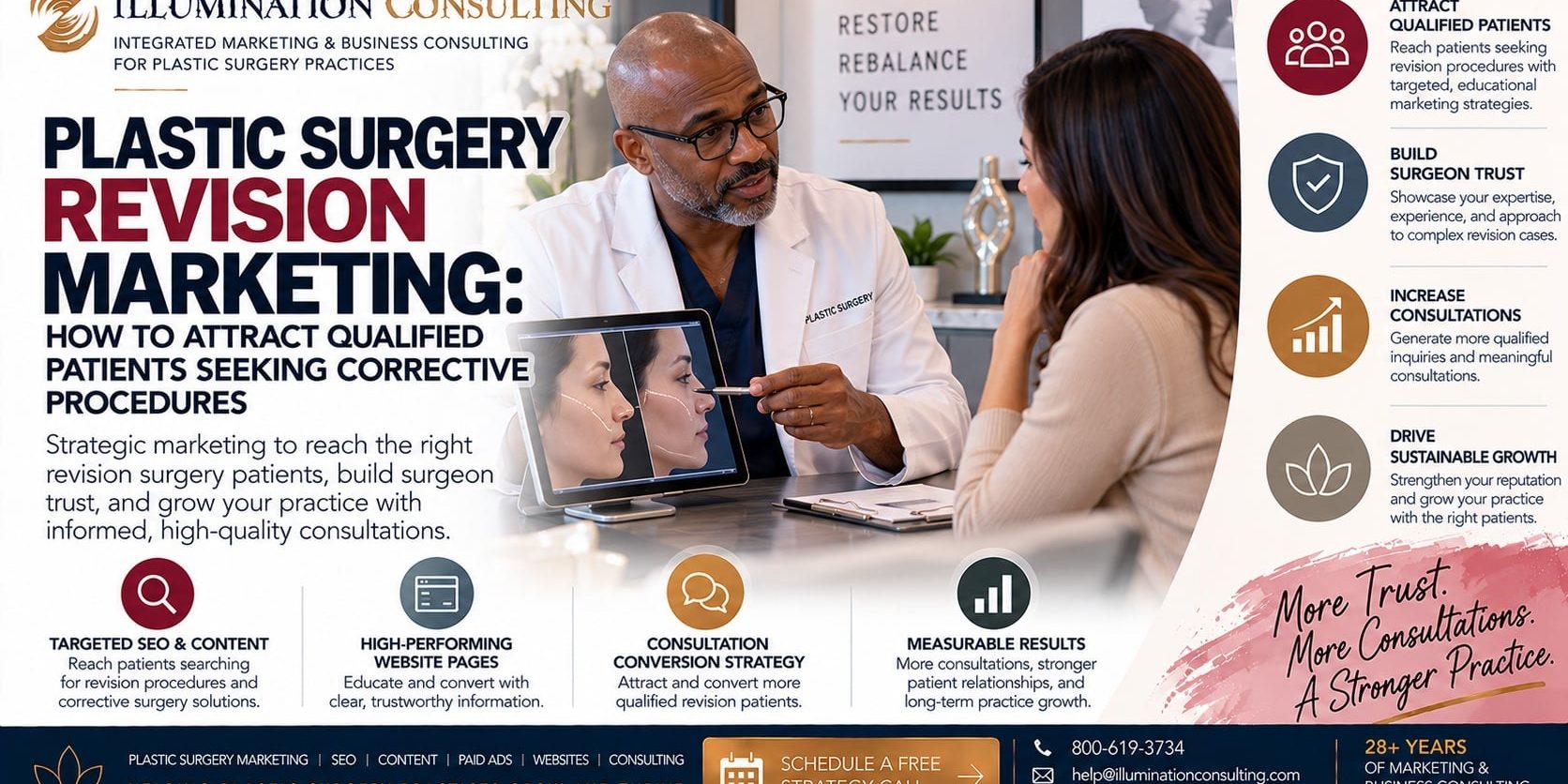
Plastic surgery practices serve patients with a wide range of aesthetic goals, including individuals seeking corrective or revision procedures after previous surgery. These patients may have concerns about an earlier result, experience changes over time, or require additional evaluation because of complications or functional problems. Their decision-making process can be more complex than that of patients considering an initial cosmetic procedure, making accurate information, professional credibility, and realistic expectations especially important.
Plastic surgery revision marketing involves helping qualified prospective patients discover surgeons who have relevant experience evaluating and performing corrective procedures. Unlike general cosmetic surgery promotion, revision marketing must recognize that not every concern requires another operation and not every patient is an appropriate surgical candidate. Effective strategies focus on surgeon expertise, patient education, transparent consultation processes, and careful communication about the limitations and risks of additional surgery.
For practices investing in professional Plastic Surgery Marketing, revision procedures can represent a specialized service category with distinct search intent and patient information needs. Developing relevant website content, educational resources, and appropriate patient acquisition campaigns can improve visibility while supporting informed decisions and responsible practice growth.
Why Revision Surgery Requires a Different Marketing Strategy
Revision surgery patients often arrive with concerns shaped by a previous surgical experience. Some may be dissatisfied with an aesthetic result, while others may be experiencing functional issues, healing complications, or changes that occurred after their original procedure.
These circumstances can influence how patients research surgeons and evaluate their options. They may spend more time reviewing qualifications, examining relevant experience, and asking questions about potential outcomes.
Marketing that relies primarily on dramatic before-and-after imagery or promotional pricing may be poorly suited to this audience. Patients considering revision surgery often need detailed explanations of clinical complexity, possible limitations, and the importance of individualized assessment.
A successful marketing strategy should communicate relevant expertise without suggesting that corrective surgery is simple, universally appropriate, or guaranteed to produce a particular result.
Understand the Different Categories of Revision Procedures
Revision surgery encompasses several types of procedures, each with distinct patient concerns and clinical considerations.
Revision rhinoplasty may involve aesthetic or functional concerns following previous nasal surgery. Breast revision procedures may address implant-related issues, changes in breast appearance, or other circumstances requiring specialist evaluation. Other patients may seek revision of body contouring, facial procedures, or surgical scars.
These categories should not be marketed as interchangeable services. Each involves different anatomical considerations, potential risks, recovery expectations, and surgical planning requirements.
Practices should evaluate which revision procedures align with their surgeons’ qualifications and experience before developing dedicated marketing campaigns.
The objective is promoting services the practice can appropriately assess and provide rather than attempting to attract every patient seeking corrective surgery.
Evaluate Surgeon Expertise Before Promoting Revision Services
Revision procedures may require additional technical expertise because previous surgery can alter anatomy, tissue characteristics, and surgical options.
Practices should accurately communicate the qualifications and relevant experience of surgeons offering revision services. This may include appropriate board certification, professional training, procedure-specific experience, and a clear explanation of the surgeon’s approach to evaluation.
Marketing should avoid unsupported claims such as being the best revision surgeon or guaranteeing correction of previous results.
A surgeon’s ability to perform a procedure should be assessed through appropriate professional qualifications and clinical judgment rather than promotional language.
Credible positioning helps prospective patients understand whether the practice may be suitable for their needs.
Research Revision Surgery Patient Search Intent
Patients researching revision procedures often use search terms that differ from those associated with primary cosmetic surgery.
A person considering initial rhinoplasty may search for general procedure information, recovery expectations, or local surgeons. Someone considering revision rhinoplasty may search for information about persistent concerns, secondary surgery, surgical limitations, or specialists with relevant experience.
These searches reflect different information needs and stages of decision-making.
Practices should research relevant procedure-specific queries, local search patterns, and common patient questions before developing content.
Search intent analysis helps determine whether the website should provide a dedicated revision service page, an educational article, a consultation resource, or another form of content.
Create Dedicated Revision Procedure Pages
Plastic surgery websites often include comprehensive pages for primary procedures but provide limited information about revision services.
Dedicated revision pages can help prospective patients understand the purpose of corrective evaluation and the circumstances that may lead someone to consider additional surgery.
An effective revision procedure page should explain the general nature of the service, relevant surgeon qualifications, consultation requirements, potential limitations, and the importance of individualized assessment.
For example, a revision rhinoplasty page should address secondary nasal surgery specifically rather than repeating the content of the practice’s primary rhinoplasty page.
Professional Website Design Services can help organize revision services within a clear website structure that supports both usability and search visibility.
Develop Procedure-Specific Revision SEO Content
Search engine optimization can help practices reach prospective patients researching corrective procedures.
A revision SEO strategy should focus on relevant patient questions, accurate medical information, surgeon expertise, and local service availability.
Potential content themes include the differences between primary and revision procedures, consultation preparation, general recovery considerations, and factors influencing surgical planning.
Professional SEO Services can support the technical and content requirements needed to improve visibility.
However, practices should avoid creating multiple nearly identical pages targeting minor keyword variations. Each page should address a meaningful topic and provide information that differs from existing procedure content.
Differentiate Revision Surgery From Primary Procedures
Prospective patients may assume that revision surgery follows the same process as their initial operation.
Educational content should explain why previous surgery can affect future treatment options. Changes in tissue, scarring, anatomy, healing, and other individual factors may influence surgical planning.
The practice should avoid presenting revision surgery as a straightforward repeat of the original procedure.
Clear differentiation helps patients understand why a specialist evaluation may be necessary and why outcomes can vary.
This information also supports more qualified consultations by addressing important questions before patients contact the practice.
Build Surgeon Authority Through Educational Content
Surgeon credibility is particularly important when marketing revision procedures.
Educational articles, professional biographies, videos, and detailed service information can help patients understand a surgeon’s qualifications and approach.
Content may discuss how revision consultations are conducted, why some cases require additional assessment, and what factors influence treatment recommendations.
Information should be clinically accurate and reviewed by appropriately qualified professionals.
The goal is demonstrating relevant knowledge through useful information rather than relying on exaggerated marketing claims.
Use Video to Explain Revision Surgery Considerations
Video can help surgeons communicate complex topics in an accessible format.
A surgeon may explain why revision procedures require individualized planning, what patients should bring to a consultation, or why additional surgery may not always be recommended.
Educational videos can support dedicated procedure pages, social media, and appropriate advertising campaigns.
The tone should be professional, empathetic, and realistic. Patients who have experienced disappointing outcomes may be particularly sensitive to promises of improvement.
Video marketing should build understanding and trust rather than create unrealistic expectations.
Present Revision Surgery Photography Responsibly
Before-and-after photography may help patients understand the range of outcomes associated with selected revision procedures.
However, revision cases can vary substantially in complexity, and images should not imply that similar results are achievable for every patient.
Practices should obtain appropriate patient authorization and present authentic photographs without misleading alterations.
Images should also be accompanied by suitable context where appropriate, including the fact that individual outcomes vary.
Marketing should avoid portraying another surgeon’s work negatively or using patient dissatisfaction as a sensational promotional device.
Professional presentation supports credibility while respecting patients and other healthcare professionals.
Communicate the Limits of Corrective Surgery
One of the most important responsibilities in revision surgery marketing is setting realistic expectations.
Additional surgery may improve certain concerns, but it may also involve limitations or risks that differ from those of the original procedure.
Not every desired change is technically feasible or clinically advisable.
Marketing materials should avoid guarantees, claims of perfect correction, or suggestions that revision surgery can reliably restore a patient’s preferred appearance.
Accurate information helps prospective patients approach consultations with a more informed understanding of the decision.
Improve Revision Surgery Consultation Preparation
Revision surgery consultations may require more detailed preparation than routine aesthetic inquiries.
Depending on the circumstances, the practice may request relevant surgical history, prior operative records, information about implants or materials used, and details about postoperative complications.
Administrative staff should explain what information may be helpful without attempting to make clinical assessments.
Patients should also understand the purpose of the consultation and whether additional evaluation may be required before treatment recommendations can be made.
Clear preparation can improve the efficiency and usefulness of the appointment.
Create a Professional Revision Consultation Experience
Patients considering revision surgery may have concerns about trust, disappointment, or the possibility of another unsatisfactory outcome.
A professional consultation should provide sufficient time for discussion, appropriate clinical evaluation, and clear explanations of potential options.
Surgeons should assess individual circumstances and determine whether additional surgery is appropriate.
Practices should not measure consultation success solely by whether a patient schedules another operation.
An appropriate recommendation against surgery can represent a successful clinical consultation when it serves the patient’s interests.
Make Revision Surgery Pricing More Transparent
Revision procedures may involve pricing considerations that differ from primary surgery.
Costs can depend on case complexity, operating time, anesthesia, facility requirements, and other clinical factors.
Practices should explain that final pricing may require an individualized evaluation.
Where appropriate, websites can describe the components of surgical pricing and provide general information about the consultation and quotation process.
Patients should understand what is included in a proposed fee and whether additional services or postoperative care involve separate costs.
Transparent financial communication helps reduce uncertainty without oversimplifying complex procedures.
Use Paid Advertising for Qualified Revision Inquiries
Paid advertising may help practices reach prospective patients actively researching revision services.
Campaigns should use accurate, procedure-specific messaging and direct visitors to relevant educational landing pages.
For example, a revision rhinoplasty campaign should provide information about secondary nasal surgery rather than directing visitors to a generic plastic surgery homepage.
Advertising must comply with applicable platform policies and healthcare advertising requirements, including restrictions that may apply to sensitive personal attributes or medical conditions.
Practices should evaluate campaign performance using qualified inquiries and appropriate consultations rather than click volume alone.
Avoid Sensational or Fear-Based Advertising
Revision surgery marketing can become problematic when it relies on fear, embarrassment, or negative portrayals of previous surgical outcomes.
Practices should avoid messaging that suggests prospective patients have been harmed or disfigured without knowing their individual circumstances.
Advertisements should not imply that a person requires corrective surgery based on appearance alone.
Professional messaging can explain the availability of revision consultations without exploiting patient dissatisfaction.
This approach supports trust and helps distinguish a qualified medical practice from aggressive promotional campaigns.
Develop Ethical Professional Referral Relationships
Revision surgery patients may be referred by other healthcare professionals when specialized evaluation is appropriate.
Practices can support professional awareness through educational communication, accurate information about surgeon qualifications, and appropriate collaboration.
Referral relationships must comply with applicable professional standards and laws governing patient referrals, financial arrangements, and privacy.
The objective is helping patients access appropriate expertise rather than creating incentives for unnecessary surgery.
A strong professional reputation can support referrals over time, although referral volume should never be treated as a substitute for clinical quality.
Strengthen Local Search Visibility for Revision Services
Patients frequently consider geographic convenience when researching surgeons, but some may be willing to travel for specialized evaluation.
Practices should ensure that their websites and business profiles accurately communicate their location, contact information, services, and consultation procedures.
Local SEO efforts should reflect the practice’s actual service area and avoid misleading location pages or unsupported claims of local presence.
Relevant revision procedure pages can support local search visibility when they provide useful information for patients researching available services.
Accurate business information also makes it easier for prospective patients to contact the practice and understand appointment logistics.
Build Trust Through Accurate Online Reputation Management
Online reviews can influence how patients evaluate plastic surgery practices, particularly when considering complex or corrective procedures.
Practices should monitor feedback and respond professionally without revealing protected patient information.
Reviews may provide insight into administrative communication, consultation experiences, and patient service.
However, online ratings alone cannot establish clinical expertise or predict surgical outcomes.
Marketing should avoid selectively presenting reviews in ways that create misleading impressions.
A responsible reputation strategy focuses on accurate representation, professional communication, and continuous improvement.
Measure Revision Surgery Marketing Performance
Revision surgery campaigns should be evaluated through a combination of marketing, operational, and financial metrics.
Useful measurements include:
-
Revision procedure search visibility
-
Relevant website traffic
-
Qualified revision inquiries
-
Consultation booking rate
-
Completed consultations
-
Clinically appropriate surgical recommendations
-
Completed revision procedures
-
Collected procedure revenue
-
Patient acquisition cost
-
Procedure contribution
These metrics should be interpreted carefully because revision surgery cases can vary substantially in complexity.
A practice should not treat a lower surgical booking rate as a failure when consultations appropriately identify patients who should not undergo additional surgery.
Calculate Revision Surgery Patient Acquisition Cost
Patient acquisition cost helps practices understand the marketing expenditure associated with completed revision procedures.
Revision Patient Acquisition Cost = Defined Revision Marketing Spending / Completed Revision Procedures Attributed to Marketing
For example, if a hypothetical practice spends $8,000 on revision-related marketing and attributes four completed procedures to those activities, the calculated acquisition cost is $2,000 per completed procedure.
This calculation is illustrative and does not represent an industry benchmark.
The financial acceptability of acquisition cost depends on collected revenue, relevant procedure costs, attribution accuracy, and the practice’s broader business objectives.
Marketing performance should be evaluated alongside patient suitability and clinical outcomes.
Coordinate Revision Marketing With Surgeon Capacity
Revision procedures may require different scheduling and resource commitments from primary cosmetic surgery.
Some cases involve longer consultations, additional planning, specialized operating requirements, or more extensive postoperative care.
Practices should evaluate available capacity before increasing marketing investment.
A campaign that generates substantial interest may not produce sustainable growth if the surgeon lacks sufficient time to evaluate and manage cases appropriately.
Marketing should therefore be coordinated with clinical leadership, scheduling, and financial planning.
Develop a 90-Day Plastic Surgery Revision Marketing Plan
A structured implementation plan can help practices establish revision surgery visibility while maintaining appropriate clinical and operational safeguards.
Days 1–30: Evaluate Revision Service Opportunities
Review the practice’s existing revision services, surgeon qualifications, consultation demand, and operational capacity.
Assess current website content, local search visibility, patient questions, and relevant competition.
Identify the revision procedures that align with the surgeon’s expertise and the practice’s business objectives.
Establish baseline marketing and consultation performance measurements.
Days 31–60: Improve Website Content and Positioning
Develop or improve dedicated revision procedure pages with clinically accurate information.
Update surgeon biographies and create educational content addressing common patient questions.
Improve internal linking, local search information, and consultation scheduling instructions.
Prepare appropriate advertising materials where justified by demand and available capacity.
Days 61–90: Launch and Evaluate Marketing Activities
Introduce targeted marketing initiatives and monitor qualified inquiries, completed consultations, and appropriate treatment decisions.
Evaluate acquisition costs, patient feedback, and scheduling capacity.
Refine content and campaigns based on actual performance rather than inquiry volume alone.
The 90-day framework provides a planning structure and does not guarantee a particular number of patients or completed procedures.
Common Plastic Surgery Revision Marketing Mistakes
Practices should avoid several recurring mistakes when promoting corrective procedures.
Using generic primary surgery content. Revision patients often need different information about surgical complexity, limitations, and consultation requirements.
Making unrealistic outcome promises. Corrective surgery cannot guarantee a particular aesthetic or functional result.
Relying on sensational imagery. Dramatic marketing can undermine trust and create misleading expectations.
Promoting procedures beyond demonstrated expertise. Marketing should reflect actual surgeon qualifications and clinical capabilities.
Failing to explain consultation requirements. Patients may need to provide additional records or undergo more detailed evaluation.
Using aggressive sales tactics. Patients considering revision surgery should have sufficient time and information to make appropriate decisions.
Measuring success solely by surgical bookings. Clinical suitability and patient autonomy must remain central to the consultation process.
Avoiding these mistakes helps practices maintain professional credibility while developing relevant patient demand.
Build a Sustainable Plastic Surgery Revision Marketing Strategy
Revision surgery marketing requires a careful balance between business growth and professional responsibility. Patients researching corrective procedures often need detailed information, credible surgeon qualifications, and realistic explanations of what additional surgery may involve.
Plastic surgery practices can improve their visibility through dedicated procedure pages, educational content, accurate surgeon positioning, local search optimization, and appropriate advertising. These activities should be supported by a professional consultation process that prioritizes individualized assessment and informed decision-making.
Illumination Consulting helps plastic surgery practices connect Plastic Surgery Marketing, SEO Services, Content Marketing, website development, and practice growth consulting into coordinated strategies. Our objective is to help practices attract qualified patients, strengthen professional visibility, and develop sustainable business growth.
Frequently Asked Questions
What is plastic surgery revision marketing?
Plastic surgery revision marketing involves promoting specialized corrective surgery consultations and services through educational content, search visibility, surgeon positioning, and appropriate patient acquisition campaigns.
How can surgeons attract qualified revision surgery patients?
Surgeons can improve visibility through dedicated revision procedure pages, accurate professional biographies, educational articles, local SEO, and targeted advertising. Marketing should emphasize relevant qualifications and realistic expectations.
Is revision surgery marketing different from primary plastic surgery marketing?
Yes. Revision patients may have previous surgical experiences, more complex concerns, and additional questions about risks and limitations. Marketing should address these needs rather than simply repeating primary procedure messaging.
What content should a revision surgery website page include?
A revision page should explain the procedure category, relevant surgeon expertise, consultation requirements, general risks and limitations, and how prospective patients can request an evaluation.
How should plastic surgery practices measure revision marketing results?
Practices should track qualified inquiries, completed consultations, appropriate surgical recommendations, completed procedures, acquisition costs, and patient experience. Marketing performance should be interpreted alongside clinical suitability.