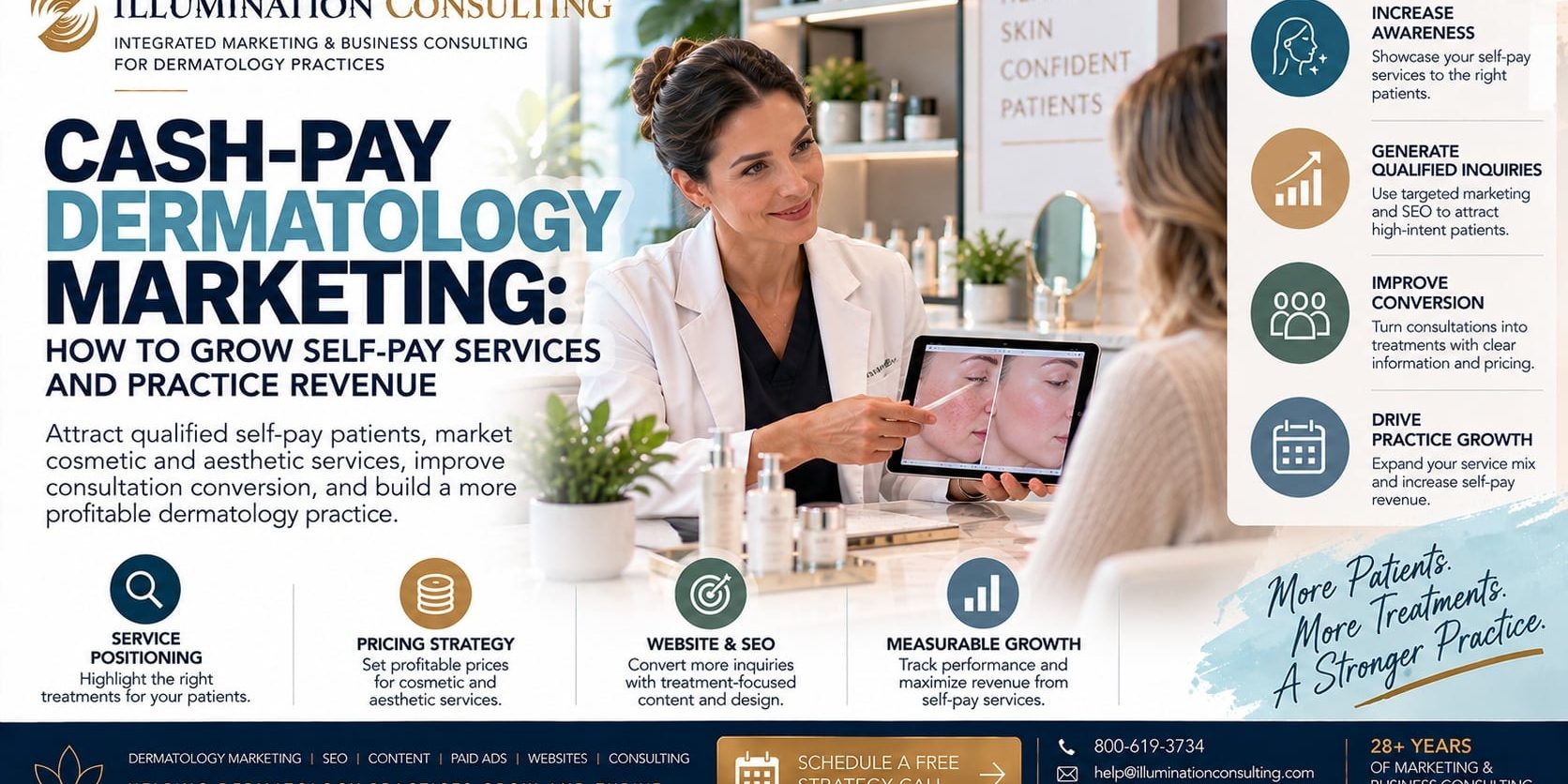
Dermatology practices operate at the intersection of medical care, patient demand, and business management. Many practices provide insurance-based medical dermatology services while also offering treatments and procedures that patients pay for directly. These self-pay services can create opportunities to diversify revenue, expand treatment offerings, and strengthen patient relationships. However, introducing cash-pay services or increasing their visibility requires more than adding a price list to the website or advertising cosmetic procedures.
A successful cash-pay dermatology marketing strategy connects clinical capabilities with patient education, transparent pricing, appropriate consultation processes, and a sustainable operating model. Practices must understand which services are suitable for self-pay arrangements, how patients evaluate those services, what information influences booking decisions, and how marketing can generate qualified demand without creating misleading expectations. They must also distinguish elective cosmetic treatments from medically necessary services that may be subject to insurance coverage, payer contracts, and other requirements.
For dermatology practices investing in professional Dermatology Marketing, cash-pay growth should be approached as a coordinated business initiative. Marketing can increase awareness and inquiries, but long-term success depends on appropriate clinical care, accurate communication, efficient scheduling, patient experience, and the economics of each service.
What Is Cash-Pay Dermatology?
Cash-pay dermatology generally refers to services for which patients pay the practice directly rather than having the practice seek reimbursement from a health insurance plan for that service.
The term cash-pay does not necessarily mean the patient pays with physical cash. Payment may occur through credit cards, debit cards, financing arrangements, or other accepted methods.
Self-pay arrangements can arise in different circumstances. Some patients purchase elective cosmetic services that are not generally covered by insurance. Others may pay directly for medical services because they are uninsured, choose not to use insurance, or are receiving a service that is not covered under their plan.
These situations should not be treated as legally or operationally identical. Practices must evaluate payer agreements, applicable laws, billing obligations, patient disclosures, and other requirements before establishing or advertising self-pay arrangements.
Why Dermatology Practices Consider Cash-Pay Services
Insurance-based dermatology can provide an important foundation for a practice, but reimbursement structures, administrative requirements, and appointment availability influence operating decisions.
Cash-pay services may offer additional opportunities to serve patient needs while diversifying the practice’s revenue sources.
Potential benefits include greater flexibility in certain elective service offerings, more direct visibility into the price paid for a service, and opportunities to develop treatment programs that complement existing clinical capabilities.
However, self-pay revenue is not automatically more profitable than insurance-based revenue. Practices must account for provider time, equipment, supplies, staffing, marketing, follow-up, and other operating requirements.
The business case should be established through service-level analysis rather than assumptions about payment methods.
Distinguish Medical Dermatology From Cosmetic Dermatology
One of the most important marketing considerations is accurately distinguishing medical services from elective cosmetic treatments.
Medical dermatology may involve evaluation, diagnosis, and treatment of skin conditions. Cosmetic dermatology generally focuses on elective aesthetic concerns and procedures.
Some treatments can have both medical and cosmetic applications, depending on the patient’s condition and the clinical purpose.
Marketing should not imply that all dermatology services are elective or that a service is never covered by insurance. Coverage can vary by diagnosis, plan, medical necessity, and payer rules.
Clear distinctions help patients understand their options and reduce confusion during scheduling.
Identify Which Services Fit the Practice’s Cash-Pay Strategy
The right self-pay service mix depends on the practice’s providers, clinical expertise, equipment, patient population, and business objectives.
Potential categories may include:
-
Cosmetic injectables, when offered by appropriately qualified professionals
-
Certain laser and energy-based aesthetic treatments
-
Cosmetic skin rejuvenation
-
Elective aesthetic consultations
-
Cosmetic lesion treatment when clinically appropriate
-
Professional skincare products
-
Other elective services within the practice’s scope
Some medical dermatology services may also be offered on a self-pay basis where legally and contractually permitted.
The practice should evaluate each service independently rather than grouping every non-insurance transaction into one business category.
Evaluate Patient Demand Before Expanding Services
A treatment may appear commercially attractive but still lack sufficient demand in the practice’s market.
Management should investigate:
Existing patient inquiries: What services do patients already ask about?
Local search behavior: Which relevant treatments are patients researching?
Competitive availability: What services are offered by nearby practices?
Patient characteristics: Which concerns are common among the population the practice serves?
Provider capabilities: Can the practice deliver the service safely and appropriately?
Demand research should inform investment decisions before the practice purchases equipment, expands staffing, or commits substantial marketing resources.
Understand the Economics of Cash-Pay Services
Revenue alone does not determine whether a self-pay service is financially attractive.
A dermatology practice should evaluate:
-
Collected revenue per completed service
-
Consumables and product costs
-
Provider compensation
-
Treatment duration
-
Equipment expenses
-
Room utilization
-
Follow-up requirements
-
Marketing acquisition costs
-
Administrative expenses
A service with a high selling price may generate less contribution than expected if it requires substantial provider time or expensive supplies.
Conversely, a lower-priced service may support a viable business model when it fits efficiently into the practice’s operating structure.
Calculate Service-Level Contribution
Consider a hypothetical cosmetic dermatology treatment:
| Component | Illustrative Amount |
|---|---|
| Collected treatment revenue | $450 |
| Consumables and supplies | ($90) |
| Variable provider compensation | ($100) |
| Other avoidable variable expenses | ($20) |
| Contribution before fixed costs and acquisition | $240 |
The figures are hypothetical and do not represent industry averages.
This example illustrates why management should evaluate the contribution remaining after relevant variable costs.
The practice must still account for fixed operating expenses, equipment investment, and marketing costs before determining overall profitability.
Evaluate Provider and Treatment-Room Capacity
Cash-pay expansion may require additional provider time or specialized equipment.
A practice should determine whether new services can be delivered within existing capacity or whether expansion would displace other appointments.
Relevant questions include:
How long does the treatment require?
Which provider qualifications are necessary?
Does the service require specialized equipment?
How much preparation and follow-up are involved?
What other services could use the same appointment time?
These questions help determine the opportunity cost of introducing or promoting a particular treatment.
Establish a Clear Service Positioning Strategy
Cash-pay dermatology marketing should explain the purpose and appropriate benefits of each service without exaggeration.
Patients may evaluate cosmetic treatments based on expected outcomes, safety considerations, provider qualifications, recovery requirements, and cost.
A strong service presentation should answer these questions clearly.
The practice should avoid generic promises such as guaranteed transformation or universally superior results.
Accurate positioning supports informed decisions and long-term credibility.
Create Dedicated Service Pages
A well-designed dermatology website should provide meaningful information about individual self-pay services.
Depending on the treatment, a page may include:
-
General treatment overview
-
Appropriate indications
-
Provider qualifications
-
Consultation requirements
-
General preparation information
-
Expected appointment process
-
Recovery considerations
-
Pricing information or pricing explanation
-
Frequently asked questions
-
Consultation scheduling
Professional Website Design Services can help organize these pages around patient needs and conversion.
The objective is to reduce uncertainty while encouraging appropriate consultations.
Use SEO to Capture Relevant Treatment Demand
Search engine optimization can help dermatology practices become visible when prospective patients research particular services.
Relevant search intent may include:
Treatment Information: Patients want to understand how a service works.
Provider Research: Patients are evaluating local dermatologists or practices.
Pricing Research: Patients want to understand potential costs.
Consultation Intent: Patients are ready to discuss treatment options.
Professional SEO Services can connect these search journeys through appropriate service pages, educational content, local information, and internal links.
The practice should avoid creating multiple nearly identical pages targeting the same treatment and location.
Build a Search Strategy Around Patient Questions
A useful content strategy begins with the questions patients actually ask.
For example:
-
What does the treatment involve?
-
Who may be an appropriate candidate?
-
What factors influence the price?
-
How many appointments might be needed?
-
What are the potential risks?
-
What is the expected recovery process?
-
How should patients prepare?
Educational content should provide accurate general information while making clear that individual treatment recommendations require appropriate clinical evaluation.
This approach supports both search visibility and patient confidence.
Improve Pricing Transparency
Cost uncertainty can prevent patients from scheduling consultations.
Practices should provide clear information about pricing where practical and appropriate.
Depending on the service, this may involve:
Published Starting Prices
Price Ranges
Per-Session Pricing
Package Information
Consultation Fees
Factors That Affect Final Cost
A price range should not be presented as a guaranteed final charge when individual assessment can materially change the treatment plan.
Clear communication reduces unnecessary inquiries and helps patients evaluate affordability before scheduling.
Explain What Is Included in the Price
Patients may compare prices across practices without understanding differences in what is included.
For example, a quoted treatment price may or may not include consultation fees, follow-up appointments, additional sessions, or related products.
The practice should communicate these details accurately.
Transparent pricing does not require reducing every treatment to a commodity. It helps patients make informed comparisons.
Avoid Competing Exclusively on Price
Aggressive discounting can attract attention, but it may also weaken positioning and contribution.
Dermatology patients often consider professional qualifications, treatment suitability, safety, convenience, and trust alongside cost.
A practice should communicate its legitimate differentiators rather than relying entirely on lower prices.
Potential differentiators include:
-
Relevant physician expertise
-
Comprehensive consultations
-
Appropriate treatment options
-
Clear patient education
-
Continuity of care
-
Professional facilities
-
Convenient scheduling
Claims should be factual and substantiated.
Use Paid Search for High-Intent Services
Paid search may be appropriate for selected self-pay services with clear patient demand and sufficient economic contribution.
Campaigns can target relevant treatment inquiries and direct users to dedicated service pages.
However, advertising budgets should reflect the service’s economics and available capacity.
The practice should measure more than clicks and form submissions.
Important outcomes include qualified consultations, completed appointments, appropriate treatment bookings, and contribution generated from acquired patients.
Evaluate Cost per Completed Treatment
A campaign may generate many inquiries without producing meaningful revenue.
A simplified performance metric is:
This metric requires consistent attribution and an appropriate measurement period.
For example, if a hypothetical campaign spends $2,400 and generates 12 completed treatments, marketing cost per completed treatment is $200.
Whether that cost is acceptable depends on treatment contribution, repeat behavior, and the practice’s broader financial objectives.
Use Social Media to Educate Rather Than Overpromise
Social media can support awareness of self-pay dermatology services.
Useful content may include:
-
Provider introductions
-
General treatment education
-
Common patient questions
-
Appropriate preparation guidance
-
Service explanations
-
Clinic information
Visual content can be valuable, but practices must ensure that images, testimonials, and outcome descriptions are authentic and compliant with applicable requirements.
Marketing should not imply guaranteed results or minimize potential risks.
Use Before-and-After Photography Responsibly
Before-and-after images may help explain the range of possible aesthetic outcomes.
However, they require careful handling.
Practices should obtain appropriate authorization, protect patient privacy, use accurate photography, and avoid misleading editing or selective presentation.
Images should not imply that every patient will achieve the same result.
Before-and-after content should support informed understanding rather than unrealistic expectations.
Build Patient Trust Through Provider Expertise
For elective dermatology services, patients may spend considerable time evaluating who will perform the treatment.
Provider biographies, credentials, relevant experience, and educational content can help establish confidence.
The website should clearly identify who performs particular procedures and communicate qualifications accurately.
A professional introduction can be more valuable than generic statements about advanced technology or exceptional results.
Connect Medical Dermatology With Appropriate Cosmetic Education
An established medical dermatology practice may already have strong patient relationships.
Some patients may be interested in elective aesthetic services that the practice offers.
However, medical appointments should not become inappropriate sales opportunities.
When relevant, clinicians can provide accurate information about available options while respecting the patient’s medical needs and preferences.
Marketing communications involving existing patients must comply with applicable privacy, consent, and professional requirements.
Develop Ethical Cross-Service Awareness
Cross-service awareness can be appropriate when it helps patients understand legitimate treatment options.
For example, a practice may provide educational materials about cosmetic services in its waiting area or website.
The goal is informing patients, not pressuring them.
Clinical recommendations should remain grounded in individual needs rather than revenue objectives.
Build a Consultation Conversion Process
Self-pay services often require patients to make a financial decision after learning about the treatment.
The consultation process should provide:
Appropriate Clinical Assessment
Clear Treatment Explanation
Realistic Expectations
Transparent Cost Information
Relevant Risks and Alternatives
Time for Patient Questions
Clear Next Steps
A consistent process can reduce confusion without turning a medical consultation into a high-pressure sales interaction.
Our article on Dermatology Appointment Conversion explores how practices can improve the movement from patient inquiry to completed appointments.
Train Patient Coordinators on Service Information
Front-desk and patient coordination teams should understand the administrative details of promoted services.
They should be able to explain:
-
Consultation scheduling
-
General pricing structures
-
Appointment duration
-
Provider availability
-
Payment methods
-
Cancellation policies
-
Where patients can obtain clinical answers
Staff should not make diagnoses, promise treatment results, or determine clinical eligibility outside their qualifications.
Improve Inquiry Follow-Up
A prospective patient may contact several practices before scheduling.
Delayed responses, unclear pricing explanations, and inconsistent follow-up can reduce booking opportunities.
A reliable process should record inquiries, assign responsibility, respond promptly, and provide appropriate next steps.
The objective is helping patients obtain information and schedule suitable consultations.
Track Inquiry-to-Appointment Conversion
A basic conversion measure is:
The practice should define what qualifies as an inquiry and avoid counting duplicates as separate prospects.
This metric can help identify whether marketing is generating appropriate interest and whether the scheduling process is effective.
Measure Completed Appointments, Not Just Bookings
A full calendar does not guarantee that appointments will be completed.
Cancellations and no-shows can reduce realized capacity.
Practices should track completed visits and treatment outcomes alongside bookings.
This is especially important when paid campaigns generate appointment requests that may not ultimately convert into completed services.
Evaluate Treatment Packages Carefully
Packages may make sense for services that appropriately involve multiple sessions.
However, practices should evaluate:
-
Clinical suitability
-
Package pricing
-
Contribution
-
Refund terms
-
Scheduling capacity
-
Applicable laws
-
Patient expectations
A package should not encourage patients to purchase unnecessary treatment.
The terms should be clear before payment.
Consider Membership Models
Some dermatology and aesthetic practices offer memberships that include certain benefits or services.
A membership can create recurring revenue, but it also creates ongoing obligations.
Management should evaluate:
Included Benefits
Expected Utilization
Provider Capacity
Recurring Billing
Cancellation Terms
Contribution
Patient Value
Memberships should be structured transparently and reviewed for applicable legal and regulatory considerations.
Recurring revenue is not automatically profitable if the included benefits cost more to deliver than the membership generates.
Evaluate Financing Options Responsibly
Some elective dermatology services involve costs that patients prefer to pay over time.
Third-party financing may be available for eligible patients.
However, practices should communicate financing terms accurately and avoid presenting credit as a substitute for careful treatment decisions.
Patients should understand that financing creates a financial obligation separate from the clinical service.
Build Retention Through Appropriate Follow-Up
Some cosmetic dermatology services involve recurring appointments or ongoing treatment plans.
Patient retention should be based on appropriate clinical needs, satisfaction, and informed choice.
Useful retention activities may include:
-
Follow-up scheduling
-
Treatment education
-
Appointment reminders
-
Appropriate maintenance information
-
Patient feedback
-
General skincare guidance
The practice should avoid automatically promoting additional treatments simply because a patient previously purchased a service.
Measure Repeat Patient Value
Repeat patients can contribute to practice stability, but the economic value of a patient relationship should be calculated carefully.
A simplified contribution-based lifetime value approach is:
A practical model may account for expected visit frequency, treatment mix, retention, and relevant variable expenses.
Historical revenue alone should not be confused with future profitability.
Integrate Skincare Product Sales Where Appropriate
Some dermatology practices offer professional skincare products.
Retail products can complement patient education and appropriate care when recommendations are grounded in patient needs.
Management should evaluate:
-
Product margins
-
Inventory requirements
-
Staff training
-
Patient demand
-
Replenishment patterns
-
Returns and expiration risk
Retail should be treated as its own operating activity rather than assuming that every product sale creates meaningful profit.
Coordinate Marketing With Service Capacity
A dermatology practice should not aggressively promote services it cannot deliver within a reasonable scheduling window.
Before increasing advertising, management should evaluate provider availability, treatment-room capacity, equipment requirements, and staff readiness.
If consultations are fully booked but treatment conversion is weak, additional marketing may not solve the underlying problem.
Growth planning should identify the actual constraint.
Measure Cash-Pay Service Profitability
A practical dashboard can include:
| Metric | Management Question |
|---|---|
| Qualified Inquiries | Is marketing attracting appropriate interest? |
| Consultations Booked | Are inquiries becoming appointments? |
| Consultations Completed | Are patients attending? |
| Treatment Conversion | Are appropriate consultations leading to services? |
| Collected Revenue | What revenue is actually received? |
| Contribution per Treatment | What remains after relevant variable costs? |
| Marketing Acquisition Cost | What does generating completed treatment demand cost? |
| Provider Utilization | Is available clinical capacity being used appropriately? |
| Repeat Patient Contribution | What value comes from ongoing patient relationships? |
| Patient Feedback | Is the experience supporting satisfaction and trust? |
The dashboard should help management evaluate the full business model rather than relying exclusively on revenue growth.
Compare Cash-Pay Services With Other Practice Activities
A self-pay service should not be considered successful simply because it generates a high selling price.
The practice should evaluate the contribution generated relative to provider time, equipment, and other scarce resources.
For example, management may compare contribution per provider hour across appropriate services.
However, such comparisons should not override clinical priorities, patient needs, payer obligations, or professional judgment.
Financial analysis informs capacity planning; it does not determine what care an individual patient should receive.
Develop a 90-Day Cash-Pay Dermatology Growth Plan
A phased plan can help practices improve execution without expanding too quickly.
01–30
Days
Evaluate services and economics
Review current cash-pay offerings, demand, provider capacity, contribution, pricing transparency, and existing marketing performance. Identify the most commercially and clinically appropriate opportunities.
31–60
Days
Improve patient-facing marketing
Update service pages, clarify pricing information, strengthen educational content, improve scheduling workflows, and prepare focused campaigns for selected services.
61–90
Days
Launch, measure, and optimize
Evaluate qualified inquiries, completed consultations, treatment conversion, contribution, and patient experience. Adjust marketing based on economic performance and available capacity.
The 90-day structure is a planning framework, not a guarantee of revenue growth.
Avoid Common Cash-Pay Dermatology Marketing Mistakes
Several mistakes can undermine otherwise promising services.
Promoting treatments without understanding profitability. A service may generate revenue while consuming too much provider time or marketing expenditure.
Providing unclear pricing. Patients may hesitate when they cannot understand likely costs.
Creating unrealistic expectations. Exaggerated claims can damage trust and create compliance risks.
Treating every inquiry as qualified. High lead volume does not guarantee appropriate patient demand.
Ignoring scheduling capacity. Advertising can generate demand that the practice cannot serve efficiently.
Overusing discounts. Frequent promotions may weaken contribution and patient expectations.
Failing to distinguish medical and cosmetic services. Confusing coverage or billing information can create patient dissatisfaction and compliance problems.
Measuring bookings instead of completed treatments. Appointment activity does not necessarily reflect realized revenue.
Avoiding these mistakes requires coordination between clinical leadership, marketing, administration, and financial management.
Build a Repeatable Cash-Pay Growth System
A sustainable approach connects each stage of the patient and business journey:
Evaluate Clinical Capabilities and Demand
↓
Select Appropriate Services
↓
Model Pricing and Contribution
↓
Develop Accurate Patient Education
↓
Generate Qualified Inquiries
↓
Provide Appropriate Consultations
↓
Deliver Suitable Treatment
↓
Support Follow-Up and Retention
↓
Measure Patient Experience and Profitability
↓
Optimize the Service Mix
This structure helps dermatology practices make growth decisions based on evidence rather than promotional activity alone.
From Self-Pay Demand to Sustainable Dermatology Practice Growth
Cash-pay dermatology can create opportunities to diversify revenue, expand services, and meet patient demand for elective and appropriately structured self-pay care. However, the business opportunity depends on much more than the prices charged or the number of treatments advertised.
Successful practices understand the clinical purpose of their services, the needs of their patients, the economics of their treatment offerings, and the operational requirements of delivering consistent care. They provide accurate information, maintain transparent financial communication, and measure the progression from qualified inquiries to completed services.
Illumination Consulting helps dermatology practices connect Dermatology Marketing, SEO Services, Content Marketing, website development, patient acquisition, consultation conversion, and business growth planning into integrated strategies. The objective is not simply increasing self-pay transactions, but helping practices develop sustainable services that support patient care and long-term financial performance.
Frequently Asked Questions
What is cash-pay dermatology?
Cash-pay dermatology refers to dermatology services patients pay for directly rather than having the practice seek insurance reimbursement for those services. This can include elective cosmetic treatments and certain medical services, depending on coverage, contractual obligations, and applicable regulations.
How can dermatology practices attract more self-pay patients?
Practices can improve visibility through treatment-specific SEO, clear service pages, educational content, appropriate paid advertising, transparent pricing, professional reputation development, and accessible consultation scheduling.
Are cash-pay dermatology services more profitable than insurance-based services?
Not necessarily. Profitability depends on collected revenue, provider time, consumables, equipment, staffing, acquisition costs, and operating requirements. Each service should be evaluated on its actual economics.
Should dermatology practices publish cosmetic treatment prices?
Clear pricing information can help patients evaluate affordability and reduce uncertainty. Practices may publish fixed prices, starting prices, or ranges when appropriate, while explaining factors that can change the final treatment cost.
What is the best marketing channel for cosmetic dermatology services?
The strongest channel depends on the treatment, local competition, patient demand, practice reputation, and available capacity. SEO, paid search, educational content, and existing patient communications may each contribute to a coordinated strategy.
Can medical dermatology practices market cosmetic services to existing patients?
Practices may inform patients about appropriate services while respecting clinical judgment, patient privacy, communication preferences, and applicable marketing requirements. Patients should never be pressured into unnecessary treatment.
How should dermatology practices measure cash-pay marketing performance?
Useful metrics include qualified inquiries, completed consultations, treatment conversion, collected revenue, marketing cost per completed treatment, service contribution, provider utilization, and patient satisfaction.