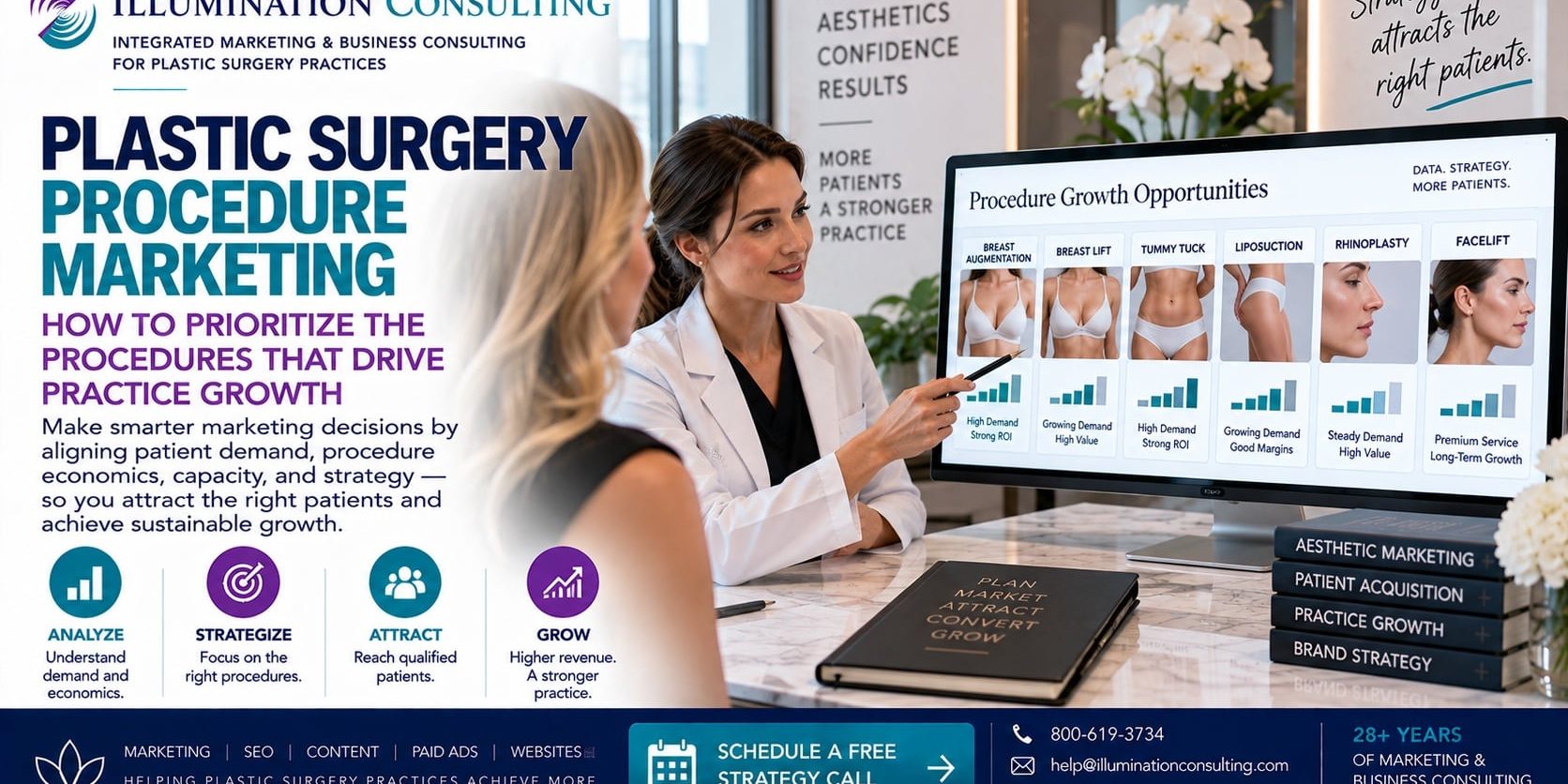
Plastic surgery practices rarely have unlimited marketing budgets, surgeon capacity, operating-room availability, or staff resources. Yet many practices market a long list of procedures with relatively little distinction between the services that should drive growth and those that simply need to remain visible. Breast procedures, facial surgery, body contouring, rhinoplasty, eyelid surgery, and other procedures may all appear throughout the website and marketing campaigns, but they do not necessarily represent equal business opportunities.
A more strategic approach to plastic surgery procedure marketing begins by determining which procedures the practice actually wants to grow and why. Patient demand matters, but so do procedure economics, surgeon specialization, consultation conversion, operating capacity, competitive positioning, patient acquisition cost, and the long-term direction of the practice. Marketing becomes more effective when these business considerations determine where resources are concentrated.
For practices investing in professional Plastic Surgery Marketing, the objective should therefore extend beyond generating more inquiries. Marketing should help attract appropriate prospective patients for priority procedures while supporting the practice’s clinical positioning, capacity, financial objectives, and sustainable growth.
Not Every Procedure Should Receive the Same Marketing Investment
A plastic surgery website may contain pages for dozens of procedures.
That does not mean every procedure deserves an equal share of:
- SEO investment
- advertising
- content
- video
- social media
- landing pages
- conversion optimization
- remarketing
- creative production
Equal allocation can actually reduce marketing effectiveness.
Some procedures may represent major growth opportunities.
Others may already have sufficient demand.
Some may have limited surgeon capacity.
Others may be strategically important despite relatively modest search volume.
The first task is therefore identifying the role each procedure plays within the practice.
Start With the Practice’s Growth Objectives
Marketing priorities should follow business strategy.
Leadership should first determine what it wants the practice to look like over the next one to three years.
Questions might include:
Which procedures do we want to perform more frequently?
Which procedures best reflect the surgeon’s expertise?
Where do we have available capacity?
Which services contribute strongly to the practice?
Which procedures attract the type of patient relationship we want?
Are there procedures we intentionally do not want to expand?
Do we want to become better known for a particular surgical category?
Without these answers, marketing can generate demand that does not support the practice’s actual objectives.
Categorize Procedures by Strategic Role
One useful exercise is grouping procedures according to their role within the practice.
For example:
| Procedure Role | Strategic Purpose |
|---|---|
| Growth Procedure | Practice wants significantly more volume |
| Signature Procedure | Closely associated with surgeon expertise |
| High-Contribution Procedure | Economically important to the practice |
| Capacity Opportunity | Additional procedure volume can be accommodated |
| Competitive Procedure | Important in the local market |
| Supporting Procedure | Complements other surgical services |
| Maintenance Procedure | Should remain visible but does not require aggressive growth |
These classifications do not need to be permanent.
They provide a framework for allocating resources intentionally.
Understand Procedure-Level Economics
Procedure revenue alone does not determine marketing value.
Two procedures generating similar revenue may have substantially different economics.
Relevant factors can include:
- surgeon time
- operating-room requirements
- anesthesia
- implants
- supplies
- clinical staffing
- facility costs
- postoperative care
- financing expenses
- marketing acquisition costs
The appropriate financial analysis should be completed using the practice’s own accounting and financial information.
From a marketing perspective, the important principle is simple:
A procedure’s advertised price or revenue is not the same as its economic contribution.
Estimate Procedure Contribution
A simplified conceptual framework is:
Procedure Contribution = Procedure Revenue − Direct Procedure Costs
Suppose a hypothetical procedure generates $12,000 in revenue and incurs $5,000 in directly attributable costs.
The simplified contribution would be:
$12,000 − $5,000 = $7,000
This is an illustrative example, not an industry benchmark or recommendation.
The actual financial analysis may need to include additional expenses and overhead.
However, even a simplified contribution model can improve marketing decisions compared with evaluating procedures solely according to top-line revenue.
Include Patient Acquisition Cost
Marketing cost should then be connected to procedure economics.
A simplified calculation is:
Procedure CAC = Marketing Acquisition Cost ÷ New Patients Acquired for That Procedure
Suppose a hypothetical rhinoplasty campaign requires $10,000 in attributable marketing investment and generates five new surgical patients.
The simplified acquisition cost would be:
$10,000 ÷ 5 = $2,000 per acquired patient
Whether that represents attractive performance depends on the economics of the procedure and the practice.
There is no universal plastic-surgery patient acquisition cost that applies to every surgeon, procedure, geographic market, or practice.
Measure Beyond Cost per Lead
Cost per lead can be useful for diagnosing advertising performance, but it does not tell management what it costs to acquire a surgical patient.
Consider two hypothetical campaigns.
Campaign A
50 inquiries
20 qualified inquiries
10 consultations
3 procedures
Campaign B
30 inquiries
18 qualified inquiries
12 consultations
6 procedures
Campaign A generates considerably more inquiries.
Campaign B generates twice as many procedures.
If management evaluates marketing primarily by lead volume, it could favor the weaker business outcome.
This is why the existing Plastic Surgery Marketing Attribution framework becomes important.
Marketing measurement should continue from:
Source → Inquiry → Qualified Lead → Consultation → Procedure → Revenue
Measure Consultation Conversion by Procedure
Blended consultation conversion can hide meaningful differences.
Suppose the practice converts consultations strongly for one procedure but poorly for another.
Management needs to understand why.
Track:
Procedure Consultation Conversion = Procedures Booked ÷ Completed Consultations × 100
This should be evaluated separately for important procedure categories.
Our previous article on Plastic Surgery Consultation Conversion addresses the broader consultation-to-procedure process.
Procedure-level measurement adds another layer.
It helps reveal whether a particular marketing initiative is producing commercially meaningful opportunities.
Consider Surgeon Capacity
A procedure can have excellent marketing economics and still be the wrong place for additional investment.
Why?
Capacity.
Suppose a surgeon is already performing as many facelifts as the schedule can comfortably accommodate.
Increasing facelift advertising may create:
- longer consultation waits
- scheduling delays
- additional administrative workload
- frustrated prospective patients
The incremental marketing budget may create greater value elsewhere.
Marketing allocation should therefore consider:
Demand + Economics + Capacity
rather than demand alone.
Consider Operating-Room Capacity
Surgeon availability is only one constraint.
Surgical volume may also depend on:
- operating-room access
- anesthesia availability
- nursing
- recovery capacity
- equipment
- postoperative scheduling
- administrative support
A practice should understand these constraints before aggressively increasing demand for a procedure.
Marketing can create demand much faster than operational capacity can sometimes expand.
Consider Consultation Capacity
Consultations themselves can become a bottleneck.
If the practice generates significantly more qualified demand but cannot offer consultations within a reasonable timeframe, marketing efficiency may deteriorate.
Prospective patients can continue researching competitors while waiting.
Practices should monitor:
- consultation availability
- booking delays
- consultation show rate
- consultation capacity
- surgeon consultation time
Increasing marketing spend without sufficient consultation capacity may simply move the bottleneck downstream.
Analyze Search Demand by Procedure
Once the practice identifies strategically important procedures, search data can help quantify market demand.
Research might examine:
- procedure keywords
- local search demand
- related questions
- geographic modifiers
- informational searches
- competitor visibility
- search trends
Professional SEO Services can then build visibility around procedures that align with practice priorities.
The important distinction is that search volume should inform strategy rather than dictate it.
A high-volume keyword does not automatically represent the best business opportunity.
Consider Search Intent
Someone searching:
What is recovery like after a facelift?
is at a different stage from someone searching:
facelift surgeon near me
Both searches can be valuable.
The first may represent research.
The second may indicate stronger immediate provider-selection intent.
A complete procedure SEO strategy can address multiple stages of the patient journey while directing authority toward the main procedure page.
Build Strong Procedure Pages
Priority procedures deserve stronger digital infrastructure.
A high-quality procedure page can help prospective patients understand:
- what the procedure addresses
- who may be an appropriate candidate
- what consultation involves
- general recovery considerations
- frequently asked questions
- surgeon expertise
- next steps
Clinical information must remain accurate and appropriate.
Marketing should not exaggerate outcomes or make promises that cannot responsibly be made.
The objective is informed decision support and appropriate patient acquisition.
Create Supporting Content Clusters
One procedure page cannot answer every question prospective patients have.
Supporting content can address subjects such as:
- recovery
- preparation
- procedure comparisons
- consultation questions
- general candidacy considerations
- postoperative planning
- common misconceptions
Strategic Content Marketing can strengthen the procedure’s organic search ecosystem while educating prospective patients.
Internal links can then connect supporting articles to the primary procedure page.
Avoid Creating Multiple Pages for the Same Search Intent
Procedure SEO can become fragmented when practices create numerous pages targeting nearly identical searches.
For example, separate pages built around minor variations of the same procedure keyword may compete with one another.
Before creating new content, determine:
Does this search deserve its own page?
or:
Should it strengthen an existing procedure page?
This reduces unnecessary keyword cannibalization and creates clearer topical architecture.
Use Geographic SEO Strategically
Plastic surgery is geographically sensitive, but the appropriate market can vary substantially by practice.
Some surgeons primarily serve local patients.
Others attract patients regionally, nationally, or internationally.
The SEO strategy should reflect actual patient behavior and the practice’s operational capabilities.
Local visibility can include:
- location relevance
- Google Business Profile
- local citations
- reviews
- localized procedure content where appropriate
Practices attracting traveling patients may require a broader content and conversion strategy.
Match Paid Search to Priority Procedures
Paid search can capture prospective patients actively researching procedures.
But not every procedure needs its own large advertising budget.
Start with the business opportunity.
For each priority procedure, monitor:
Advertising Spend → Leads → Qualified Leads → Consultations → Procedures
This allows management to compare actual acquisition economics.
A campaign with a higher cost per click may still outperform a cheaper campaign if it generates substantially stronger procedure conversion.
Build Procedure-Specific Landing Pages When Appropriate
Advertising traffic should arrive somewhere relevant.
Sending every prospective patient to the homepage can create unnecessary friction.
A procedure-specific landing experience can align:
Search Intent → Advertising Message → Procedure Information → Consultation CTA
This creates continuity.
The visitor should immediately understand that they have reached the right place.
Use Social Media to Build Procedure Familiarity
Plastic surgery decisions can involve extended consideration periods.
Prospective patients may follow a surgeon for months before contacting the practice.
Social media can therefore support procedure marketing through:
- educational videos
- surgeon explanations
- FAQs
- appropriate before-and-after content
- recovery discussions
- practice environment
- patient stories where permitted
- myth clarification
- procedure comparisons
Social media may influence a decision even when it does not receive the final attribution credit.
Use Video for Complex Procedures
Video can be particularly useful when prospective patients need substantial education.
A surgeon can explain:
- procedure objectives
- general process
- consultation considerations
- recovery
- common questions
- differences among options
This helps prospective patients become more informed before contacting the practice.
It can also strengthen trust by allowing patients to become familiar with the surgeon’s communication style.
Understand Competitive Positioning
Procedure marketing occurs within a competitive market.
Before expanding a procedure, evaluate:
- competing surgeons
- search visibility
- advertising activity
- positioning
- reviews
- website quality
- content depth
- social presence
- geographic competition
The objective is not imitating competitors.
It is understanding what prospective patients see when comparing options.
Differentiate Through Expertise Rather Than Claims
Strong plastic surgery positioning should not rely on exaggerated claims such as:
the best surgeon
or:
guaranteed results
Instead, differentiation can be built around factual characteristics such as:
- training
- credentials
- procedure focus
- experience
- philosophy
- patient education
- technology
- practice environment
- consultation process
Credible differentiation is more sustainable than unsupported promotional language.
Reputation Matters at the Procedure Level
Reviews often influence prospective patients evaluating surgeons.
Practices should monitor what patients actually discuss.
Reviews may reference:
- consultation experience
- staff
- communication
- recovery support
- facility
- surgeon interaction
- overall experience
Patterns can reveal strengths and operational weaknesses.
Reputation management should therefore be viewed as both a marketing function and a source of business intelligence.
Consider the Entire Patient Journey
Procedure marketing does not stop when a lead form is submitted.
The full journey may include:
Search or Discovery
↓
Website
↓
Inquiry
↓
Staff Response
↓
Qualification
↓
Consultation
↓
Follow-Up
↓
Procedure Decision
↓
Scheduling
↓
Procedure
↓
Postoperative Experience
Every stage can affect marketing performance.
A strong advertising campaign cannot compensate indefinitely for weak intake or follow-up.
Measure Lead Response
For high-value procedures, every qualified inquiry represents meaningful potential economic value.
Practices should establish:
- lead ownership
- response procedures
- CRM tracking
- follow-up standards
- status definitions
The purpose is not applying inappropriate pressure to prospective patients.
It is ensuring that legitimate inquiries receive professional and timely assistance.
Track Why Prospective Patients Do Not Proceed
Lost-opportunity data can improve marketing and operations.
Possible reasons might include:
- not clinically appropriate
- timing
- financial considerations
- chose another provider
- not ready
- unable to reach
- consultation not scheduled
- procedure preference changed
Tracking actual reasons is better than assuming why conversion did not occur.
Patterns may reveal opportunities to improve marketing qualification, patient education, intake, or follow-up.
Measure Procedure Revenue by Marketing Source
Once attribution is established, practices can examine which channels produce which procedures.
A simplified dashboard might look like this:
| Channel | Qualified Leads | Consultations | Procedures | Procedure Revenue |
|---|---|---|---|---|
| Organic Search | 30 | 18 | 8 | $96,000 |
| Paid Search | 40 | 20 | 7 | $84,000 |
| Social Media | 20 | 12 | 5 | $60,000 |
| Referrals | 15 | 12 | 8 | $100,000 |
These figures are entirely illustrative.
The point is not the specific numbers.
It is the progression from marketing source to actual business outcome.
Add Procedure Economics to the Dashboard
Revenue provides only part of the picture.
Where appropriate, management can also examine:
- acquisition cost
- procedure contribution
- surgeon time
- OR requirements
- conversion
- capacity
- cancellation rates
This creates a more complete view of the opportunity.
A procedure generating significant revenue may still deserve less incremental marketing if capacity is constrained or acquisition economics are deteriorating.
Evaluate Marginal Marketing Performance
Marketing efficiency can change as spending increases.
Suppose the first level of paid search spending captures the highest-intent demand.
Additional spending may require broader keywords, expanded geography, or less-qualified audiences.
As a result:
the next marketing dollar may not perform like the previous marketing dollar.
Practices should therefore monitor marginal performance when scaling.
Do not assume a campaign can simply double its budget and double its procedures.
Build a Procedure Opportunity Matrix
Leadership can organize major procedures according to several dimensions.
For example:
| Factor | Question |
|---|---|
| Demand | Are prospective patients actively seeking it? |
| Economics | Does the procedure contribute appropriately? |
| Capacity | Can we perform more of it? |
| Conversion | Do consultations become procedures? |
| CAC | Can patients be acquired sustainably? |
| Competition | How difficult is the market? |
| Expertise | Does it align with surgeon positioning? |
| Strategic Value | Does it support the future practice? |
This makes marketing allocation substantially more disciplined.
Identify High-Priority Opportunities
A particularly attractive procedure-marketing opportunity might combine:
Strong Demand
Strong Economics
Available Capacity
Strong Consultation Conversion
Competitive Differentiation
That does not guarantee success.
But it provides a rational reason to investigate additional marketing investment.
Identify Procedures That Need Optimization Before More Marketing
Another procedure might have:
Strong Demand
High Lead Volume
Weak Consultation Conversion
In that case, buying additional traffic may not be the first priority.
The better investment may be improving:
- qualification
- procedure-page information
- consultation experience
- follow-up
- positioning
Growth does not always require more lead generation.
Sometimes it requires extracting more value from demand the practice already has.
Identify Capacity-Constrained Procedures
A third procedure might have:
Strong Demand
Strong Conversion
No Additional Capacity
Aggressive marketing may not be necessary.
Instead, management could consider whether:
- pricing
- scheduling
- operations
- staffing
- capacity expansion
deserve attention.
Again, marketing strategy follows business reality.
Allocate the Budget by Strategic Opportunity
Once procedures have been evaluated, the marketing budget can be distributed more intentionally.
Instead of:
20% to social media
30% to SEO
40% to advertising
leadership can begin one level higher:
Which procedures should we grow?
Then determine:
Which channels are best suited to creating that growth?
This changes marketing allocation from channel-first thinking to business-first thinking.
Review Procedure Priorities Quarterly
Procedure priorities should not be static.
Markets change.
Search behavior changes.
Competition changes.
Capacity changes.
New technology enters the practice.
Surgeons develop new areas of emphasis.
Marketing economics change.
A quarterly procedure-growth review can evaluate:
- demand
- lead volume
- consultations
- conversion
- procedures
- acquisition costs
- revenue
- capacity
- competitive activity
Marketing allocation can then adjust accordingly.
Do Not Let Trends Dictate the Entire Strategy
A procedure can become popular on social media without necessarily representing the right opportunity for a particular practice.
Trends can create demand, but management should still evaluate:
- clinical alignment
- surgeon expertise
- economics
- capacity
- durability of demand
- brand positioning
The practice should not constantly rebuild its strategy around whatever treatment or procedure happens to be receiving attention online.
Build Authority Around the Procedures You Want to Own
Over time, consistent procedure-focused marketing can create stronger market positioning.
A practice that wants to become especially well known for a particular surgical category should reinforce that positioning through:
- website architecture
- SEO
- content
- video
- surgeon education
- social media
- reputation
- patient experience
- public relations where appropriate
Authority is usually cumulative.
It is built through consistent signals rather than a single campaign.
Connect Procedure Marketing to Practice Growth
The strongest plastic surgery marketing strategies ultimately connect several disciplines:
Business Strategy
↓
Procedure Prioritization
↓
Market Demand
↓
SEO + Advertising + Content + Social
↓
Qualified Patient Acquisition
↓
Consultation Conversion
↓
Procedure Revenue
↓
Economic Contribution
↓
Capacity Planning
This is substantially more powerful than treating marketing as a collection of campaigns.
From More Leads to Better Practice Growth
Plastic surgery practices do not necessarily need more leads for every procedure.
They need the appropriate demand for the procedures they strategically want to grow.
That requires understanding:
What should we market?
Why should we grow it?
Is there sufficient demand?
Can we accommodate more procedures?
What does patient acquisition cost?
How effectively do consultations convert?
What economic contribution does the procedure create?
Does it strengthen the long-term position of the practice?
Once those questions guide marketing decisions, procedure promotion becomes part of practice strategy rather than simply advertising.
Illumination Consulting helps plastic surgery practices connect Plastic Surgery Marketing, SEO Services, Content Marketing, website strategy, patient acquisition, conversion systems, attribution, and growth consulting. The objective is to help practices focus marketing resources on the procedures and opportunities that support stronger, more measurable, and more sustainable growth.
Frequently Asked Questions
What is plastic surgery procedure marketing?
Plastic surgery procedure marketing is the strategic promotion of individual surgical services using channels such as SEO, paid advertising, content, social media, video, website optimization, and reputation management. A strong strategy prioritizes procedures according to practice objectives rather than promoting every service equally.
How should a plastic surgery practice decide which procedures to market?
Practices can evaluate patient demand, procedure economics, surgeon expertise, consultation conversion, patient acquisition cost, competitive conditions, available capacity, and long-term strategic value.
Should the highest-revenue procedure receive the most marketing?
Not necessarily. Revenue is only one factor. Direct procedure costs, surgeon time, capacity, acquisition cost, conversion, competition, and contribution to the practice should also be considered.
Why should patient acquisition cost be measured by procedure?
Different procedures can have substantially different lead costs, consultation conversion, patient acquisition costs, and economics. A blended practice-wide CAC can conceal these differences.
How does SEO support priority procedures?
SEO can increase organic visibility through strong procedure pages, supporting educational content, internal linking, local relevance, technical optimization, and search-intent alignment.
Should plastic surgeons market procedures that are already booked heavily?
Additional marketing may provide limited value when surgeon, consultation, or operating-room capacity is already constrained. The practice should evaluate whether incremental demand can actually be accommodated.
How often should procedure-marketing priorities be reviewed?
Quarterly review provides a practical framework for many practices, although high-spend campaigns may require more frequent performance analysis. Priorities should change when demand, economics, capacity, competition, or practice strategy changes.