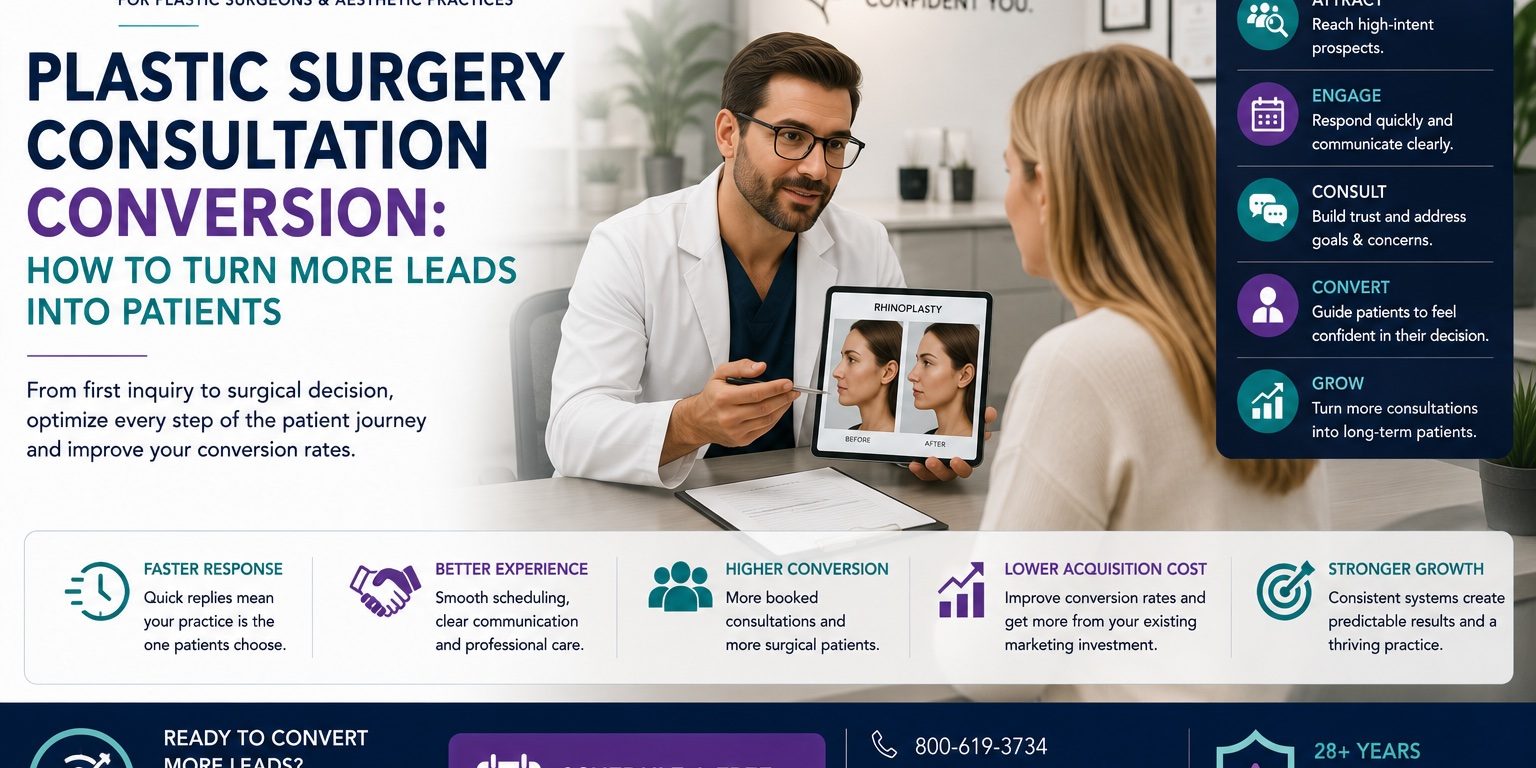
Plastic surgery practices can invest substantial resources in SEO, paid advertising, social media, websites, content, referrals, and reputation development to generate prospective patient inquiries. Yet generating interest is only the beginning of patient acquisition. Revenue is created when qualified prospects move from inquiry to consultation and ultimately decide to proceed with an appropriate procedure.
Plastic surgery consultation conversion measures how effectively a practice moves prospective patients through that process. Improving conversion does not mean applying more sales pressure. It means reducing unnecessary friction, strengthening trust, improving communication, responding effectively to patient concerns, and creating a professional experience that helps qualified prospects make informed decisions.
For practices investing in plastic surgery marketing, conversion deserves the same attention as traffic and lead generation. Increasing qualified inquiries while allowing prospective patients to disappear during follow-up or consultation can significantly reduce the return on the entire marketing investment.
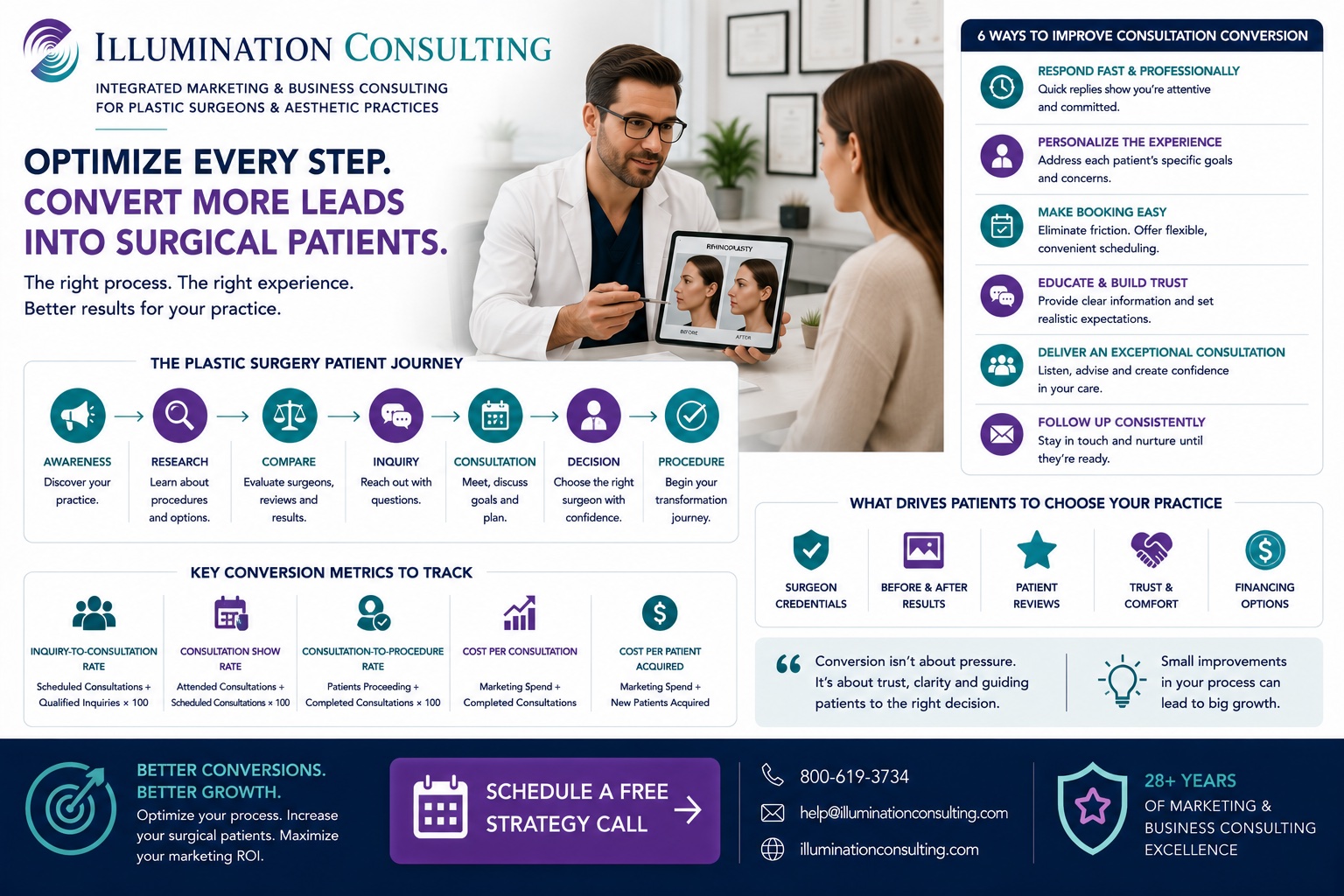
Understand the Plastic Surgery Patient Journey
Plastic surgery generally involves a more complex buying decision than many ordinary consumer purchases.
Prospective patients may spend considerable time researching a procedure before contacting a surgeon. They can compare physicians, review credentials, examine before-and-after galleries, read patient reviews, investigate recovery, consider financing, and evaluate multiple practices.
A simplified journey may look like:
Awareness → research → practice comparison → inquiry → consultation → decision → procedure → follow-up
Marketing influences multiple stages.
SEO may introduce the practice during procedure research. Social media can build familiarity. Reviews strengthen trust. Before-and-after photographs can help prospective patients evaluate results. The website provides additional information. Staff communication influences whether an inquiry becomes a consultation.
The consultation then becomes one of the most important moments in the entire journey.
What Is Plastic Surgery Consultation Conversion?
Consultation conversion can refer to several related measurements.
Inquiry-to-Consultation Conversion
This measures how many qualified prospective patient inquiries result in scheduled consultations.
The simplified formula is:
Inquiry-to-Consultation Rate = Scheduled Consultations ÷ Qualified Inquiries × 100
Consultation Show Rate
This measures how many scheduled prospects actually attend.
Consultation Show Rate = Attended Consultations ÷ Scheduled Consultations × 100
Consultation-to-Procedure Conversion
This measures how many completed consultations eventually result in patients proceeding with a procedure.
Consultation-to-Procedure Rate = Patients Proceeding With Treatment ÷ Completed Consultations × 100
Practices should ideally measure all three.
A single overall conversion rate can hide where prospective patients are actually being lost.
Lead Quality Comes Before Conversion
Not every inquiry should become a surgical patient.
That distinction is particularly important in healthcare.
Marketing should generate qualified prospective patients, not simply the largest possible number of leads.
An inquiry may not be appropriate because of treatment expectations, geographic limitations, financial considerations, timing, procedure interest, or other factors. Clinical candidacy itself must be determined by appropriately qualified medical professionals.
Therefore, the objective should never be maximizing conversion at any cost.
The objective is creating an efficient process that helps appropriate prospective patients reach the right clinical conversation.
This distinction protects both patient experience and marketing economics.
Respond Effectively to New Patient Inquiries
The conversion process begins before the consultation.
Someone who contacts a plastic surgery practice may also be evaluating other surgeons.
A delayed, confusing, impersonal, or poorly informed response can weaken confidence before the prospect ever meets the physician.
Practices should establish clear processes for:
- incoming phone calls
- missed calls
- website forms
- email inquiries
- online appointment requests
- social media inquiries where appropriate
- after-hours inquiries
Response speed matters, but speed alone is insufficient.
The quality of the interaction matters too.
Make the Initial Conversation Useful
Prospective patients frequently have basic questions before they are willing to schedule a consultation.
They may want to know:
- whether the surgeon performs the procedure
- where the practice is located
- how consultations work
- whether virtual consultations are available
- general scheduling availability
- consultation fees
- financing options
- what information they should prepare
Staff should be able to answer appropriate administrative and non-clinical questions accurately.
Clinical questions should be directed to qualified medical personnel rather than answered beyond the staff member’s role.
A strong initial interaction gives the prospect confidence that the practice is organized, knowledgeable, and attentive.
Reduce Friction in Consultation Scheduling
Once a prospective patient decides to schedule, the process should be straightforward.
Unnecessary friction can include:
- repeated transfers
- complicated forms before basic scheduling
- unclear consultation fees
- limited communication options
- delayed callbacks
- confusing instructions
- poor mobile booking experiences
- unclear appointment confirmation
Every additional obstacle creates another opportunity for the prospect to abandon the process.
Review the scheduling experience from the patient’s perspective rather than only from the practice’s operational perspective.
Set Appropriate Expectations Before the Consultation
Patients should understand what the consultation involves.
Clear pre-consultation communication can explain:
- appointment length
- location or virtual process
- required forms
- consultation fees
- what to bring
- whether photographs may be required
- who they will meet
- what generally happens during the consultation
- relevant office policies
Setting expectations reduces uncertainty.
It can also improve the quality of the consultation because the patient arrives better prepared.
Build Trust Before the Patient Arrives
Trust does not begin when the surgeon enters the consultation room.
It begins with the first exposure to the practice.
Prospective patients may evaluate:
The website
Does it appear professional, current, informative, and credible?
Surgeon credentials
Can visitors easily understand the surgeon’s training and experience?
Procedure information
Does the website answer meaningful patient questions?
Reviews
What experiences do previous patients describe?
Before-and-after galleries
Can prospects evaluate relevant examples where appropriately presented?
Staff communication
Does the practice appear organized and responsive?
Professional plastic surgery website design should therefore support both patient education and conversion rather than functioning merely as an attractive online brochure.
Improve Procedure Pages Before Buying More Traffic
A prospective patient may arrive directly on a procedure page from Google, advertising, or another referral source.
That page may be the patient’s first meaningful interaction with the practice.
Strong procedure pages should clearly communicate:
- what the procedure addresses
- who may consider it
- how the procedure generally works
- surgeon expertise
- recovery considerations
- frequently asked questions
- relevant supporting information
- how to request a consultation
The page should educate rather than make unrealistic promises.
If high-intent traffic is reaching weak procedure pages, increasing advertising or SEO investment may amplify an existing conversion problem.
Use Before-and-After Galleries Strategically
Before-and-after galleries can be particularly influential in aesthetic medicine because prospective patients want to understand the surgeon’s work.
However, galleries should be organized for usability rather than simply accumulating images.
Where appropriate, practices can categorize examples by:
- procedure
- treatment area
- patient characteristics
- surgical technique
- related procedures
Prospective patients should be able to locate relevant examples without navigating through an overwhelming collection.
Photography should also be consistent and professionally presented.
A high-quality gallery can help prospective patients develop realistic expectations while evaluating whether the surgeon’s aesthetic approach aligns with their goals.
Reviews Influence Consultation Decisions
Patient reviews provide another layer of social proof.
Prospects may pay attention to comments involving:
- surgeon communication
- staff professionalism
- consultation experience
- results
- recovery support
- responsiveness
- facility experience
- overall patient care
Reviews can influence whether someone contacts the practice and whether they remain confident after scheduling.
Practices should monitor reputation consistently and establish appropriate processes for requesting patient feedback.
Reputation management should never be reduced to accumulating stars.
Review patterns can reveal operational strengths and weaknesses that affect conversion.
The Consultation Is an Educational Experience
A plastic surgery consultation should help the prospective patient understand their options and make an informed decision.
The patient may arrive with assumptions created by online research, social media, other providers, friends, or previous procedures.
The consultation provides an opportunity to clarify those assumptions.
Depending on the procedure and clinical circumstances, the discussion may address:
- patient goals
- treatment options
- candidacy
- expected outcomes
- limitations
- risks
- recovery
- procedure planning
- costs
- next steps
Clinical guidance must remain with qualified medical professionals.
From a conversion perspective, the important principle is that clarity and trust reduce uncertainty.
Listen Before Presenting Solutions
Prospective patients want to feel understood.
A consultation that moves immediately into presenting procedures without adequately understanding the patient’s goals can feel transactional.
Listening helps the practice understand:
- what the patient wants to change
- why they are considering surgery
- what outcome they expect
- what concerns they have
- what research they have already completed
- what factors influence their decision
This information improves communication.
It also helps identify situations where expectations may not align with what can appropriately be achieved.
Avoid High-Pressure Conversion Tactics
Plastic surgery is an elective healthcare decision, not an ordinary retail transaction.
Aggressive closing tactics can undermine trust and create an inappropriate patient experience.
The practice can still operate an organized conversion process.
There is an important difference between:
making the next step easy
and
pressuring someone to make a medical decision.
Patients should have the information necessary to make an informed choice.
A professional follow-up process can remain available without manufacturing unnecessary urgency.
Address Financial Questions Clearly
Cost is naturally part of many plastic surgery decisions.
Practices should establish a consistent process for communicating financial information.
Depending on the practice, this may include:
- surgeon fees
- facility-related costs
- anesthesia-related costs
- consultation fees
- deposits
- payment policies
- financing options
- cancellation policies
Unexpected or confusing financial information can create friction late in the decision process.
Clarity helps prospective patients understand the commitment before proceeding.
Follow Up After the Consultation
Not every qualified patient will decide immediately.
Someone may need time to consider the procedure, arrange financing, coordinate work schedules, organize recovery support, or simply think through the decision.
Post-consultation follow-up can provide a professional way to remain available.
Follow-up might include:
- thanking the patient for visiting
- answering unresolved administrative questions
- providing appropriate information discussed during the consultation
- explaining next steps
- helping with scheduling when the patient is ready
The purpose is not repeated pressure.
It is ensuring that a qualified patient does not disappear simply because the practice failed to maintain communication.
Separate Short-Term Follow-Up From Long-Term Nurturing
Some prospects may not be ready for surgery for months.
That does not necessarily mean the marketing investment was wasted.
With appropriate permissions and communication practices, prospective patients can remain connected to the practice through:
- educational email content
- procedure information
- practice news
- physician content
- social media
- educational videos
This is where content marketing can continue supporting the patient decision journey after the initial inquiry or consultation.
High-consideration procedures often require more than one interaction.
Track Why Patients Do Not Proceed
Practices should avoid assuming they know why prospective patients fail to convert.
Track the reasons when they can reasonably be identified.
Examples might include:
- not clinically appropriate
- timing
- cost
- financing
- recovery requirements
- selected another provider
- stopped responding
- decided against the procedure
- expectations did not align
- scheduling constraints
These categories can reveal patterns.
If many qualified prospects choose competitors, positioning or consultation experience may require investigation.
If financial concerns dominate, communication or financing options may need review.
If prospects frequently disappear before consultations, the issue may exist earlier in the funnel.
Measure Conversion by Procedure
Aggregate conversion rates can hide substantial differences.
A practice may perform well with one procedure while struggling with another.
Measure conversion for priority procedures such as:
- breast augmentation
- facelift
- rhinoplasty
- liposuction
- tummy tuck
- eyelid surgery
- body contouring
- other procedures offered by the practice
Different procedures can have different decision cycles, economics, competition, and patient concerns.
Procedure-level measurement gives management better information for marketing decisions.
Measure Conversion by Lead Source
The same principle applies to acquisition channels.
Track prospective patients from sources such as:
- organic search
- Google Ads
- social advertising
- organic social media
- referrals
- physician referrals
- directories
- direct traffic
A channel producing many consultations may not necessarily generate the most procedures.
Another channel may produce fewer leads but significantly stronger patients.
This is why plastic surgery SEO and paid acquisition should ultimately be evaluated against patient outcomes rather than traffic alone.
Calculate Cost per Consultation
Cost per lead is useful, but cost per consultation gets closer to the business outcome.
A simplified calculation is:
Cost per Consultation = Acquisition Spend ÷ Consultations Generated
Suppose a campaign costs $6,000 and generates 30 completed consultations.
The simplified cost per consultation is:
$6,000 ÷ 30 = $200
This example is illustrative rather than an industry benchmark.
Management can then continue following those consultations through actual procedures and revenue.
Calculate Cost per Acquired Patient
The next step is:
Patient Acquisition Cost = Acquisition Spend ÷ New Patients Acquired
Suppose the same $6,000 campaign eventually generates 10 new surgical patients.
The simplified acquisition cost becomes:
$6,000 ÷ 10 = $600 per patient
Whether that is economically attractive depends on procedure revenue, margins, operational costs, and other factors.
This measurement is much more useful than evaluating marketing based only on clicks or leads.
Improve Conversion Before Increasing Marketing Spend
Consider two hypothetical practices.
Both generate 100 qualified inquiries.
Practice A converts 10 into surgical patients.
Practice B converts 20.
Practice B can acquire twice as many patients from the same lead volume.
This illustrates an important growth principle:
Increasing conversion can create additional revenue without requiring an equivalent increase in traffic.
Before increasing advertising budgets, practices should therefore examine whether existing opportunities are being converted efficiently.
Build a Plastic Surgery Conversion Dashboard
Management does not need dozens of reports.
A focused dashboard can include:
- qualified inquiries
- lead source
- response time
- consultation booking rate
- consultation show rate
- consultation-to-procedure rate
- cost per consultation
- patient acquisition cost
- procedure revenue
- conversion by procedure
- reasons patients do not proceed
This allows leadership to identify the actual bottleneck.
Marketing may need improvement.
Or the primary constraint may be follow-up, scheduling, consultation attendance, patient communication, or another part of the process.
Train Staff Around the Entire Patient Experience
Conversion is not exclusively the surgeon’s responsibility.
Every patient-facing interaction contributes to the experience.
Staff should understand:
- practice positioning
- surgeon credentials
- procedures offered
- administrative information
- communication standards
- follow-up responsibilities
- scheduling processes
- appropriate escalation of clinical questions
- CRM or lead-management procedures
Consistency matters.
A sophisticated marketing campaign can generate excellent prospects while an inconsistent intake experience damages confidence.
Use CRM and Automation to Support the Process
Technology can improve consistency by helping practices manage:
- lead capture
- source attribution
- staff notifications
- follow-up tasks
- appointment confirmations
- reminders
- lead status
- consultation outcomes
- reporting
Automation can support administrative processes, but it should not make communication feel impersonal.
Plastic surgery decisions can involve significant emotional, financial, and medical considerations.
Technology should help staff provide a better experience rather than remove appropriate human interaction.
Conversion Optimization Strengthens Marketing ROI
Plastic surgery marketing is often discussed in terms of acquiring more traffic.
But patient acquisition is a system.
Search visibility creates discovery.
The website builds credibility.
Content provides education.
Reviews reinforce trust.
Lead follow-up creates contact.
Scheduling creates consultations.
The consultation helps qualified patients make informed decisions.
Follow-up maintains communication.
Each stage influences the next.
Practices that measure the entire journey can identify where marketing investment is producing value and where potential revenue is being lost.
Turn More Qualified Opportunities Into Patients
A plastic surgery practice does not necessarily need more leads to generate more procedures.
Sometimes it needs to convert existing qualified opportunities more effectively.
That begins by understanding the patient journey from initial research through consultation and decision.
Responsive communication, strong procedure pages, professional website design, useful content, reputation, straightforward scheduling, appropriate consultation experiences, organized follow-up, and accurate measurement all contribute to conversion.
The objective is not maximizing the number of people persuaded to proceed with surgery.
It is creating an effective system that allows appropriate, qualified prospective patients to make informed decisions with confidence.
Illumination Consulting helps plastic surgery practices connect marketing services with SEO, website performance, patient acquisition, conversion, and growth strategy. By measuring the entire acquisition funnel, practices can identify where qualified prospects are being lost and improve the return generated by their existing marketing investments.
Frequently Asked Questions
What is plastic surgery consultation conversion?
Plastic surgery consultation conversion measures how effectively prospective patients move through stages such as inquiry, consultation booking, consultation attendance, and ultimately proceeding with an appropriate procedure.
How can a plastic surgery practice increase consultation bookings?
Practices can improve response processes, make scheduling easier, communicate clearly, strengthen website credibility, answer appropriate pre-consultation questions, follow up consistently, and measure where prospective patients abandon the process.
Why do plastic surgery patients not convert after consultations?
Reasons vary and can include clinical appropriateness, timing, cost, financing, recovery considerations, expectations, choosing another surgeon, or deciding not to proceed. Tracking actual reasons provides better information than relying on assumptions.
Should plastic surgeons follow up after consultations?
Professional follow-up can help patients who need additional time or have unresolved administrative questions. Follow-up should provide clarity and assistance without creating inappropriate pressure around an elective medical decision.
What plastic surgery marketing metrics should practices track?
Useful metrics include qualified inquiries, response time, consultation booking rate, consultation show rate, consultation-to-procedure conversion, cost per consultation, patient acquisition cost, lead source, procedure-level conversion, and revenue attributable to marketing.