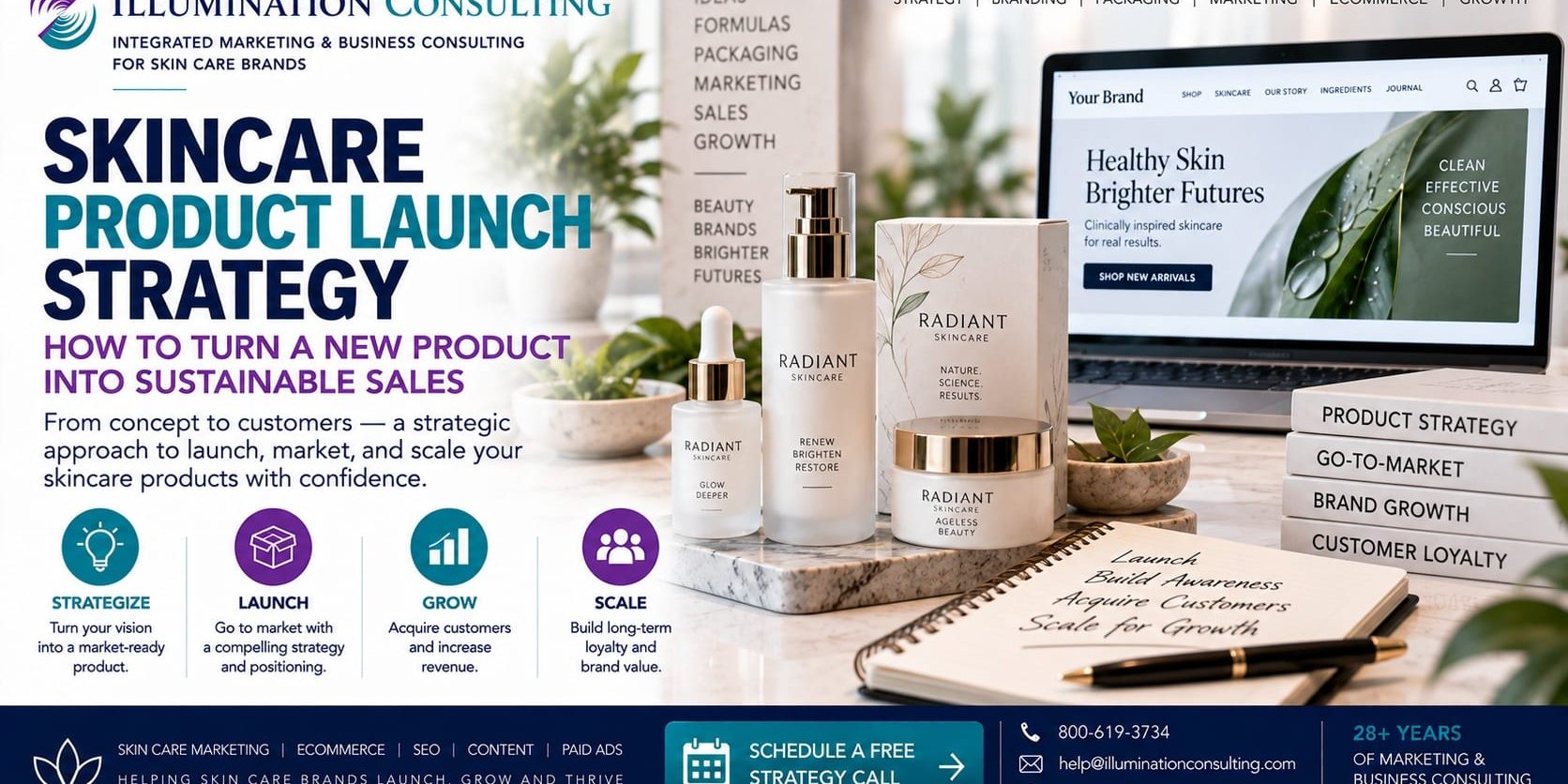
Launching a new skincare product is much more than introducing another SKU to an ecommerce store. A successful launch requires the brand to coordinate positioning, pricing, packaging, inventory, website merchandising, content, search visibility, advertising, email, social media, customer acquisition, and retention around one commercial objective. When those elements are disconnected, even an excellent formulation can enter the market without enough visibility, differentiation, or demand to produce meaningful sales.
A strong skincare product launch strategy begins well before launch day and continues long after the initial announcement. The objective is not simply to create a temporary spike in orders. It is to establish the product within the brand’s portfolio, acquire the right customers at sustainable economics, generate repeat demand, and determine whether the product deserves additional marketing and inventory investment.
For skincare companies working with Skin Care Business Consulting, this means treating a product launch as a coordinated business initiative rather than an isolated marketing campaign. Product economics, customer demand, ecommerce performance, acquisition strategy, operational readiness, and long-term brand positioning all need to support one another.
Start With the Business Case for the Product
Before developing the campaign, establish why the product should exist.
A new skincare product may be designed to:
- address an unmet customer need
- enter a growing category
- expand an existing routine
- increase average order value
- attract a new customer segment
- create replenishment revenue
- strengthen a hero-product line
- support retail expansion
- improve customer retention
- fill a gap in the current portfolio
These are different objectives.
A product designed primarily to acquire new customers may require a different launch strategy from one designed to increase purchases among existing customers.
The strategic question is therefore not merely:
How do we launch this product?
It is:
What role should this product play in the growth of the brand?
Define the Target Customer Precisely
“People interested in skincare” is not a useful target market.
The launch should identify the specific consumer the product is intended to serve.
Depending on the product, this might involve characteristics such as:
- skin concern
- desired outcome
- existing routine
- age range
- product sophistication
- price sensitivity
- lifestyle
- ingredient preferences
- purchase behavior
- current alternatives
The objective is not creating an unnecessarily narrow customer profile.
It is making the product’s relevance clear.
A customer should be able to understand:
Is this product for someone like me?
Define the Problem Before Promoting the Product
Consumers generally do not purchase a skincare product because the company needs another SKU.
They purchase because they want something.
That might be:
- hydration
- smoother-looking skin
- a simpler routine
- improved appearance
- product compatibility
- convenience
- premium experience
- ingredient preferences
Marketing should begin with the customer’s need and then explain how the product fits into that need.
This creates stronger communication than leading exclusively with technical product specifications.
Establish Clear Product Positioning
Positioning answers a fundamental question:
Why should someone choose this product instead of the alternatives available to them?
That answer can involve:
- formulation
- ingredient philosophy
- product format
- routine compatibility
- brand expertise
- convenience
- premium positioning
- packaging
- customer experience
- price-value relationship
Strong positioning does not require attacking competitors.
It requires making the brand’s own value proposition understandable.
If the company cannot clearly articulate why the product deserves attention, advertising will not solve the positioning problem.
Understand the Competitive Environment
Before launch, evaluate the products already competing for the customer’s attention.
Research can include:
- competing product types
- pricing
- package sizes
- positioning
- ingredient communication
- reviews
- product-page presentation
- bundles
- subscriptions
- promotions
- retail presence
- search visibility
The purpose is not copying competitors.
It is understanding the context in which the customer will evaluate the new product.
A product does not enter an empty marketplace.
It enters an existing set of choices.
Build the Unit Economics Before Scaling Marketing
A launch should have a basic economic model.
Management should understand:
Selling Price
minus
Product Cost
minus
Packaging
minus
Fulfillment
minus
Payment Costs
minus
Discounts and Promotions
minus
Customer Acquisition Cost
The exact financial model will vary by company, but the principle is critical.
A product can generate strong revenue and still produce weak economics.
This becomes particularly important when paid acquisition is involved.
Determine the Contribution per Order
A simplified contribution calculation might be:
Order Contribution = Net Revenue − Variable Order Costs
Suppose a hypothetical product generates $80 of net revenue from an order and has $30 of variable costs before marketing.
The simplified pre-acquisition contribution is:
$80 − $30 = $50
This example is illustrative.
If acquiring that customer costs $55, the first transaction would not recover the acquisition expense.
That does not automatically mean the economics are poor.
The customer may purchase repeatedly.
But the brand needs to know that.
Model Customer Acquisition Cost Before Launch
Do not wait until substantial advertising has been spent to ask what the brand can afford to pay for a customer.
Establish acquisition thresholds beforehand.
The brand should understand the relationship among:
- product contribution
- average order value
- repeat purchase behavior
- customer lifetime value
- gross margin
- acquisition cost
- payback period
This is where our previous article on skincare customer acquisition cost becomes especially relevant.
The objective is not simply achieving a low CAC.
It is acquiring customers at economics the business can sustain.
Decide Whether the Product Should Stand Alone or Enter a Routine
Skincare products frequently exist within routines.
That creates an important merchandising decision.
Should the launch primarily promote:
The individual product
or
The routine in which the product belongs?
A standalone approach may make the offer simpler.
A routine-based approach may:
- educate the customer
- increase average order value
- create cross-selling opportunities
- clarify product usage
- strengthen retention
The correct approach depends on the product and customer.
Develop the Offer Architecture
The launch offer is not limited to the price of one item.
The brand might consider:
- single-product purchase
- multipack
- starter kit
- routine bundle
- complementary-product bundle
- subscription
- gift with purchase
- limited introductory offer
Every option should be evaluated economically.
Bundles should create logical customer value rather than simply combining unrelated inventory.
Use Pricing to Support Positioning
Pricing communicates something about the product.
A premium product presented at a heavily discounted introductory price can create tension between brand positioning and promotional strategy.
Conversely, a new brand entering a competitive category may need to provide customers with enough perceived value to justify trying an unfamiliar product.
Pricing should reflect:
- product economics
- competitive context
- positioning
- perceived value
- customer expectations
- channel strategy
- margin requirements
Do not determine launch pricing solely by looking at what competitors charge.
Prepare Inventory Around Realistic Demand
One of the most difficult launch decisions is inventory.
Too little inventory can produce stockouts and interrupt momentum.
Too much can trap working capital in unsold product.
Forecasting should consider:
- existing customer base
- email audience
- historical product performance
- advertising plans
- influencer activity
- retail commitments
- preorder demand
- seasonality
- expected conversion
Forecasts should include scenarios rather than one assumed outcome.
For example:
Conservative
Expected
High Demand
This helps management prepare for different results.
Build the Product Page Before Sending Traffic
A product launch should not rely on advertising to compensate for a weak ecommerce experience.
The product page should clearly communicate:
- what the product is
- who it is for
- how it fits into a routine
- key features
- appropriate ingredient information
- usage
- size
- pricing
- shipping information
- relevant FAQs
- supporting imagery
- social proof when available
Professional Retail Ecommerce Website Design should connect brand presentation with conversion.
The objective is not merely making the page attractive.
It is helping customers make an informed purchasing decision.
Create a Strong Visual Launch System
Skincare is highly visual.
The launch may require:
- product photography
- packaging photography
- lifestyle imagery
- ingredient visuals
- routine imagery
- demonstrations
- video
- social assets
- advertising creative
- email graphics
- retailer materials
These assets should feel like parts of one launch rather than unrelated pieces created by different channels.
Consistency strengthens recognition.
Develop Educational Content Before Launch
Customers may need information before they are ready to purchase.
Useful content might explain:
- the product category
- how the product fits into a routine
- relevant ingredients
- usage
- differences between product types
- frequently asked questions
- common customer concerns
Strategic Content Marketing can create demand while also supporting organic search visibility.
This is especially valuable when customers actively research the problem before choosing a product.
Build Search Visibility Early
SEO should not begin after launch.
Search engines require time to discover, crawl, understand, and rank content.
Before launch, brands can prepare:
- optimized product pages
- collection pages
- supporting articles
- FAQs
- internal links
- metadata
- structured information
- image optimization
Professional SEO Services can help connect the new product to the search demand surrounding its category and customer problem.
The goal should not be stuffing the product name into pages.
The goal is building relevant search architecture around the product.
Use Existing Customers as the First Audience
A brand’s existing customers can be one of its most valuable launch assets.
They already know the company.
They may already trust its products.
The launch can be introduced through:
- SMS where appropriate
- loyalty programs
- early access
- customer communities
- social channels
- inserts in existing orders
Existing customers can also provide valuable early feedback.
This does not mean every existing customer is appropriate for every new product.
Segmentation matters.
Segment the Launch Audience
A customer who previously purchased a related product may be more relevant than someone who bought an unrelated item once several years ago.
Useful segments might include:
- recent customers
- repeat customers
- high-value customers
- customers purchasing complementary products
- inactive customers
- subscribers
- email prospects who have not purchased
- previous buyers of the category
Segmentation allows the message to reflect the relationship.
Build a Pre-Launch Period
Launch day should not necessarily be the first time customers hear about the product.
A pre-launch period can build awareness.
Possible activities include:
- teaser content
- educational articles
- behind-the-scenes content
- founder messaging
- waitlists
- email previews
- product education
- early access
The objective is not manufacturing artificial hype.
It is giving interested customers time to understand why the product matters.
Use Waitlists as a Demand Signal
A pre-launch waitlist can help estimate interest.
Useful measurements include:
- landing-page visits
- signup rate
- email engagement
- segment composition
- eventual purchase rate
A large waitlist does not guarantee strong sales.
Signing up requires much less commitment than purchasing.
Still, it provides another demand signal before launch.
Coordinate Email With the Customer Journey
A product launch email campaign should usually involve more than one announcement.
The sequence might include:
Introduction
Explain the problem and product.
Education
Help customers understand usage and relevance.
Launch
Announce availability.
Product Detail
Address questions and explain the offer.
Social Proof
Share appropriate customer feedback when available.
Reminder
Reconnect with interested customers who have not purchased.
The exact sequence depends on the audience and launch duration.
Use Social Media for More Than Announcements
Repeatedly posting a product image with “Now Available” leaves much of social media’s potential unused.
Launch content can include:
- product story
- demonstrations
- routine education
- packaging
- founder perspective
- ingredient education
- FAQs
- behind-the-scenes material
- customer content
- product comparisons where appropriate
Different content formats help the brand communicate the product from multiple angles.
Approach Influencer Marketing Strategically
Influencer activity can support awareness, content creation, social proof, and customer acquisition.
But follower count alone should not determine partnerships.
Brands should consider:
- audience relevance
- content quality
- engagement quality
- brand alignment
- previous partnerships
- creative fit
- economics
- measurable outcomes
Product seeding can generate exposure, but it should not be assumed that every gifted product will produce meaningful content or sales.
Build Paid Advertising in Stages
A new product rarely needs maximum advertising spend on the first day.
A staged approach can provide better information.
Stage 1: Test
Evaluate:
- audiences
- messages
- creative
- landing-page performance
- offers
Stage 2: Validate
Determine whether the product can acquire customers at acceptable economics.
Stage 3: Scale
Increase spending where performance remains attractive.
This reduces the risk of committing substantial capital before the product’s acquisition economics are understood.
Do Not Optimize Paid Media Only for Clicks
Clicks are not the business outcome.
Track the progression:
Ad Impression → Click → Product View → Add to Cart → Checkout → Purchase → Repeat Purchase
Each stage helps diagnose a different problem.
High click-through with weak purchasing may indicate that the advertisement is attracting attention without attracting the right customer.
Strong add-to-cart activity with weak checkout completion may indicate a different problem.
Monitor Conversion Rate
A simplified ecommerce conversion calculation is:
Conversion Rate = Orders ÷ Relevant Website Visits × 100
Suppose a launch receives 10,000 relevant visits and generates 300 orders.
300 ÷ 10,000 × 100 = 3%
This is purely an illustrative example, not an industry benchmark.
Conversion should be segmented where possible by:
- traffic source
- device
- new versus returning customer
- campaign
- landing page
A blended sitewide rate can hide meaningful differences.
Track Average Order Value
Average order value helps determine how much revenue the average transaction generates.
AOV = Revenue ÷ Orders
If a hypothetical launch generates $30,000 from 400 orders:
$30,000 ÷ 400 = $75 AOV
Bundles, complementary products, multipacks, and other merchandising strategies can influence AOV.
But increasing order value should not create unnecessary purchase friction.
Track New Versus Existing Customers
A launch can succeed in different ways.
It might:
- acquire new customers
- increase spending from existing customers
- reactivate inactive customers
- accomplish all three
Track these groups separately.
If almost all launch revenue comes from existing customers, the product may be succeeding as a portfolio expansion while doing relatively little customer acquisition.
That is not necessarily a problem.
It simply tells management what role the product is actually playing.
Measure Repeat Purchase
The launch is not fully understood when the first order arrives.
For products with replenishment potential, track whether customers purchase again.
Questions include:
- Do they reorder the product?
- How long until the second purchase?
- Do they purchase complementary products?
- Do they subscribe?
- Do they remain active customers?
This information can substantially change the economics of the launch.
Track Product-Level CAC
Brand-wide customer acquisition cost can conceal important differences.
A new product may initially require more marketing investment than established products.
Track:
Product Acquisition Spending ÷ New Customers Acquired Through the Product
Then compare that with:
- contribution
- AOV
- repeat purchasing
- retention
- lifetime value
The purpose is to understand whether acquisition can eventually scale sustainably.
Measure Contribution, Not Just Revenue
Launch dashboards frequently celebrate gross sales.
Revenue matters.
Contribution tells management more.
A simplified framework can compare:
Revenue
minus:
- discounts
- product costs
- packaging
- fulfillment
- transaction costs
- acquisition costs
The result provides a stronger understanding of the economic performance of the launch.
The exact accounting treatment should be determined by the company and its financial professionals.
Watch the Payback Period
A brand may intentionally accept weak or negative economics on the first order if repeat purchasing is sufficiently strong.
That strategy requires understanding the payback period.
If customer acquisition costs $50 and the first order contributes $30 after relevant variable expenses, the brand has not yet recovered the acquisition investment.
Future purchases need to close that gap.
If customers rarely repurchase, the model becomes problematic.
If they consistently repurchase profitably, the economics may be attractive.
Do not assume future retention.
Measure it.
Use Customer Feedback After Launch
Early customer feedback can reveal issues that analytics cannot.
Look for patterns involving:
- packaging
- product understanding
- instructions
- expectations
- shipping
- website information
- routine compatibility
- questions
- objections
Feedback can improve:
- product-page copy
- FAQs
- advertising
- content
- packaging instructions
- customer service
A launch should become more informed as real customers interact with the product.
Monitor Returns and Customer Service
Revenue alone can make a launch appear stronger than it really is.
Track:
- returns
- refunds
- customer-service inquiries
- shipping issues
- damaged products
- common questions
These signals can identify operational problems early.
A successful marketing campaign that creates a poor post-purchase experience is not a successful growth system.
Protect the Brand While Chasing Growth
Launch pressure can tempt companies toward excessive discounting, exaggerated urgency, or messaging that does not fit the brand.
Short-term sales should not unnecessarily damage long-term positioning.
Premium brands in particular should consider how:
- pricing
- promotions
- influencer partnerships
- creative
- packaging
- advertising
affect perceived value.
The launch should strengthen the brand, not merely move inventory.
Review Performance at Defined Milestones
Instead of reacting emotionally to daily sales fluctuations, establish review points.
For example:
Launch Week
Evaluate operational execution and immediate response.
30 Days
Review acquisition, conversion, AOV, customer mix, and inventory.
60–90 Days
Evaluate repeat behavior, CAC trends, channel performance, and product momentum.
Longer Term
Evaluate retention, customer value, contribution, and the product’s role in the portfolio.
The precise periods should reflect the brand’s purchase cycle.
Decide Whether to Scale, Optimize, Maintain, or Reduce
After sufficient data exists, management can classify the product.
Scale
Demand and economics support additional investment.
Optimize
Demand exists, but conversion, acquisition cost, merchandising, or messaging requires improvement.
Maintain
The product performs appropriately within the portfolio but does not require aggressive expansion.
Reduce or Reposition
Demand or economics do not justify the current level of investment.
Not every product needs to become a hero product.
A disciplined brand recognizes this.
Product Launches Should Improve the Entire Brand
A successful launch can create benefits beyond direct product revenue.
It can:
- acquire new customers
- reactivate existing customers
- increase average order value
- strengthen brand authority
- create new content
- increase email engagement
- expand search visibility
- support retail conversations
- generate customer insights
This is why launches should be integrated with the broader Skin Care Marketing strategy rather than managed as temporary promotional events.
Build a Repeatable Skincare Launch System
The greatest long-term value may come from what the company learns.
After each launch, document:
What generated demand?
Which audiences converted?
Which creative performed?
Which channels acquired valuable customers?
What did acquisition cost?
Which bundles worked?
What objections appeared?
How accurate was inventory forecasting?
Did customers repurchase?
What should change next time?
The next launch should begin with more knowledge than the previous one.
That is how product launches become a repeatable growth capability rather than recurring experiments.
Turn Product Launches Into Sustainable Brand Growth
The strongest skincare launches connect product strategy with marketing, ecommerce, customer acquisition, retention, and financial discipline. They do not rely on launch-day excitement alone.
The complete system looks more like:
Product Opportunity → Positioning → Economics → Audience → Ecommerce → Demand Generation → Customer Acquisition → Conversion → Retention → Optimization → Scale
Every stage affects the others.
A strong formulation with weak positioning can struggle.
Excellent advertising with poor unit economics can destroy profitability.
Strong first-month sales without retention can produce temporary growth.
A coordinated launch strategy helps the brand understand not only whether people purchased the product, but whether the product can become a sustainable contributor to the business.
Illumination Consulting helps skincare companies connect Skin Care Business Consulting, Skin Care Marketing, Retail Ecommerce Website Design, SEO, and Content Marketing into integrated growth strategies. The objective is to help brands launch products with stronger positioning, better digital infrastructure, measurable customer acquisition, and a clearer path toward sustainable sales.
Frequently Asked Questions
What should a skincare product launch strategy include?
A comprehensive launch strategy can include product positioning, target audience, pricing, unit economics, packaging, inventory, ecommerce preparation, content, SEO, email, social media, advertising, influencer activity, acquisition measurement, and post-launch retention.
How early should skincare brands start marketing a new product?
The appropriate timeline depends on the product and company, but planning should begin well before the product becomes available. Ecommerce assets, content, photography, positioning, inventory, email, and acquisition campaigns all require preparation.
Should a skincare brand discount a new product at launch?
Not necessarily. Introductory promotions can stimulate trial, but discounting affects contribution margin and brand positioning. Brands should evaluate the economics and strategic purpose of any launch promotion before using it.
What metrics should skincare brands track during a launch?
Useful metrics can include traffic, conversion rate, average order value, customer acquisition cost, new versus existing customers, contribution, channel performance, returns, repeat purchases, inventory, and customer feedback.
How does SEO support a skincare product launch?
SEO can build visibility around the product category, customer concern, ingredients, routines, and relevant searches through optimized product pages, collections, educational content, internal linking, and technical optimization.
Should brands advertise heavily immediately after launching?
Not automatically. Testing audiences, creative, messaging, landing pages, and acquisition economics before aggressively scaling can reduce financial risk and provide better information for budget decisions.
How do skincare brands know if a launch was successful?
Success should be measured against the product’s original business objective. Sales matter, but management should also evaluate customer acquisition, contribution, retention, repeat purchasing, inventory performance, customer feedback, and the product’s strategic role within the brand.