
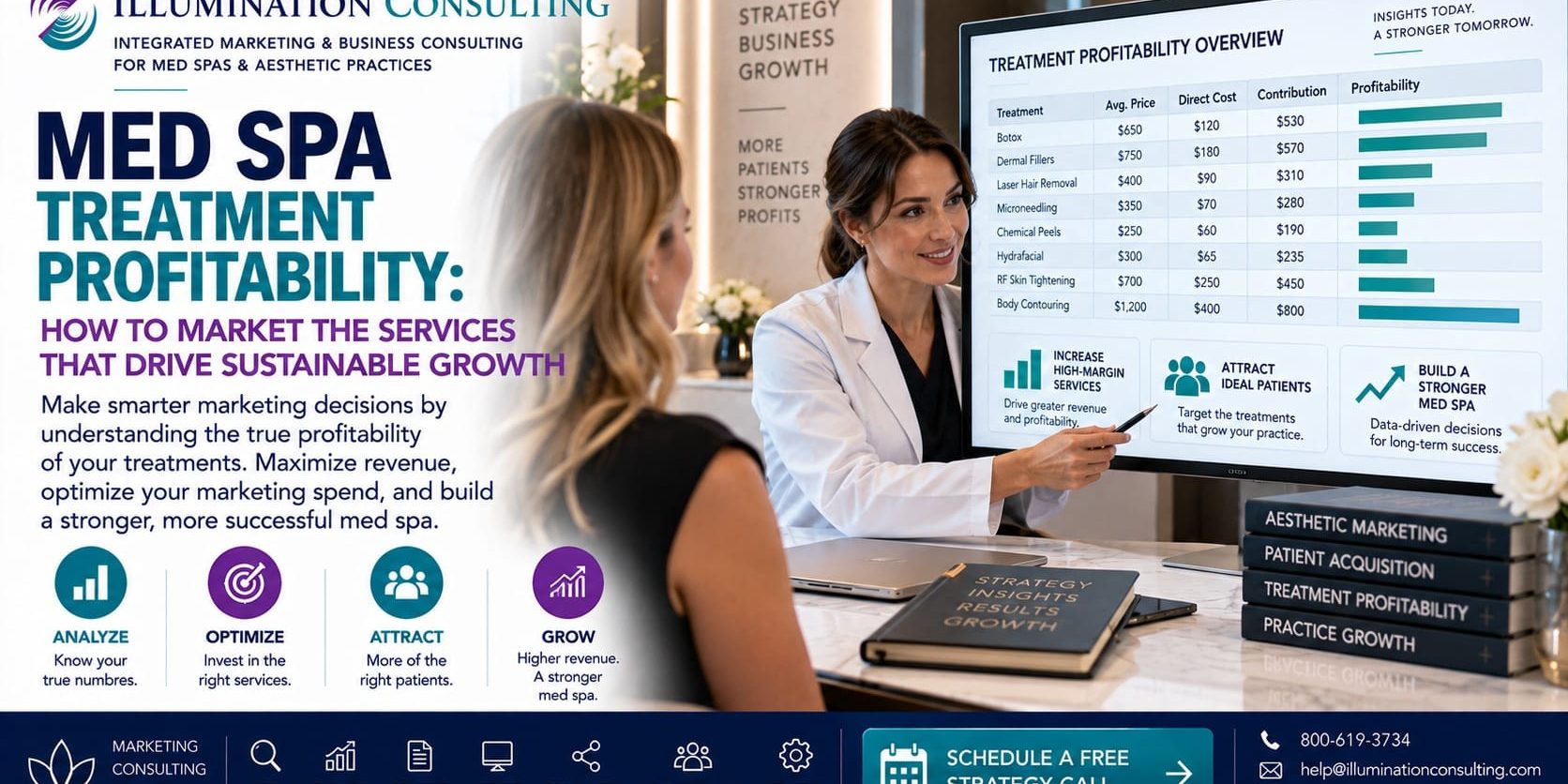
Med spas often market their businesses as if every treatment contributes equally to growth. Websites give similar prominence to dozens of services, advertising budgets are divided according to what happens to be popular at the moment, and promotional campaigns frequently focus on generating appointments without considering what those appointments are economically worth to the practice. The result can be a busy marketing program that produces activity without necessarily producing the strongest possible business performance.
A more strategic approach begins with med spa treatment profitability. Before deciding which treatments deserve additional advertising, SEO, content, promotions, or website visibility, owners should understand the economics behind individual service lines. Treatment revenue matters, but so do direct costs, provider time, equipment utilization, repeat-treatment potential, patient retention, cross-selling opportunities, acquisition costs, and operational capacity.
This does not mean med spas should promote only their highest-margin treatment. Sustainable growth usually requires a portfolio of services serving different patient needs and stages of the relationship. It does mean that med spa marketing becomes considerably more effective when marketing priorities are connected to the economics of the practice.
Revenue Alone Does Not Determine the Value of a Treatment
A high-priced treatment can appear extremely attractive from a marketing perspective.
But price is only one variable.
Suppose Treatment A generates substantially more revenue per appointment than Treatment B. Treatment A might also require:
- expensive consumables
- significant provider time
- costly equipment
- financing expenses
- greater administrative support
- longer appointment blocks
- lower repeat frequency
Treatment B may generate less revenue per visit but involve lower direct costs, shorter appointments, stronger repeat behavior, or opportunities to introduce patients to additional services.
Looking exclusively at treatment revenue can therefore produce poor marketing decisions.
The better question is:
How much economic value does this treatment contribute to the practice and the patient relationship?
Understand Contribution Margin by Treatment
A useful starting point is estimating the contribution generated by individual treatments.
A simplified calculation is:
Treatment Contribution = Treatment Revenue − Direct Treatment Costs
Direct costs might include:
- product or consumable costs
- provider compensation tied directly to the service
- device-related consumables
- payment processing
- other treatment-specific variable expenses
Suppose a hypothetical treatment sells for $1,000 and incurs $350 in directly attributable costs.
The simplified contribution would be:
$1,000 − $350 = $650
This is an illustrative example, not a profitability benchmark.
The calculation does not necessarily represent final profit because the business still has fixed expenses such as rent, administration, insurance, technology, marketing, equipment, and overhead.
But it provides a more useful starting point than revenue alone.
Include Provider Time in the Analysis
Treatment economics should also account for time.
A service generating $700 of contribution over a two-hour appointment is economically different from one producing the same contribution in 30 minutes.
Practices can examine metrics such as:
Contribution per Treatment Hour
This helps management understand how efficiently different services use limited provider capacity.
Capacity becomes particularly important when the schedule begins filling.
If a practice has abundant appointment availability, the immediate objective may be increasing utilization.
When providers are close to capacity, the objective may shift toward improving the economic productivity of available appointment hours.
Marketing strategy should change accordingly.
Evaluate Equipment Utilization
Many med spa services require significant capital investment.
Devices can represent substantial fixed costs regardless of whether they are being used.
When evaluating a device-based service, management should understand:
- equipment purchase or lease cost
- financing
- maintenance
- service agreements
- consumables
- training
- treatment pricing
- treatment volume
- available capacity
A device sitting unused is not creating economic value.
But promoting a treatment merely because equipment needs utilization is also not automatically the answer.
There must still be sufficient patient demand, appropriate pricing, competitive positioning, and clinical fit.
This is where business analysis and med spa business consulting can complement marketing decisions.
Consider Repeat-Treatment Potential
Some treatments create primarily one-time revenue.
Others naturally support recurring patient relationships.
That distinction can dramatically affect long-term economics.
A treatment may lead to:
- scheduled maintenance
- recurring procedures
- skincare purchases
- memberships
- complementary treatments
- annual treatment plans
The initial transaction therefore may not represent the complete economic value of acquiring the patient.
Marketing should consider both:
Immediate treatment economics
and
Long-term patient economics
Calculate Patient Acquisition Cost by Treatment
Overall patient acquisition cost can hide important differences between service lines.
A simplified treatment-level calculation is:
Treatment CAC = Marketing Cost Attributed to Treatment Campaign ÷ New Patients Acquired
Suppose a hypothetical campaign spends $6,000 promoting a particular service and generates 20 new patients.
$6,000 ÷ 20 = $300 acquisition cost per new patient
Whether that is attractive cannot be determined from the $300 figure alone.
Management needs to compare it with:
- treatment contribution
- repeat-treatment behavior
- additional services purchased
- retention
- long-term patient value
A $300 acquisition cost could be unsustainable for one treatment and highly attractive for another.
Do Not Confuse Cost per Lead With Patient Acquisition Cost
This distinction is particularly important in aesthetic marketing.
A campaign might generate inexpensive leads without generating inexpensive patients.
Consider an illustrative campaign:
Advertising Spend: $5,000
Leads: 100
Cost per Lead: $50
Consultations: 30
New Patients: 10
The actual advertising cost per acquired patient is:
$5,000 ÷ 10 = $500
The $50 lead looks inexpensive.
But the business outcome costs $500.
That is why campaign reporting should extend beyond lead generation whenever possible.
Our broader article on med spa marketing metrics addresses the measurement framework surrounding CAC, patient value, ROI, and growth.
Measure Consultation-to-Treatment Conversion
For services requiring consultations, another critical metric is how effectively consultations become treatment revenue.
A simplified calculation is:
Consultation Conversion Rate = Patients Purchasing Treatment ÷ Consultations Completed × 100
If 40 consultations produce 16 treatment purchases:
16 ÷ 40 × 100 = 40%
This example is illustrative.
Low conversion does not automatically mean the sales team is performing poorly.
Potential causes might include:
- poor lead quality
- pricing
- financing limitations
- weak treatment fit
- unrealistic expectations
- competitive alternatives
- insufficient trust
- poor consultation experience
- ineffective follow-up
Marketing should therefore be evaluated together with what happens after the inquiry.
Calculate Revenue per Consultation
Another useful metric is revenue generated relative to consultation volume.
For example:
Revenue per Consultation = Treatment Revenue Generated ÷ Consultations Completed
This can help practices compare the economic productivity of consultation-based service lines.
Again, the analysis becomes stronger when revenue is combined with contribution margin rather than evaluated alone.
Look Beyond the First Treatment
A patient acquired for one treatment may eventually purchase several others.
Suppose someone initially enters the practice for a facial treatment but later purchases:
- professional skincare
- injectables
- laser treatments
- membership
- maintenance services
The initial service effectively acted as an entry point into a broader relationship.
This creates an important concept for med spa marketing:
The most valuable treatment to advertise may not always be the treatment producing the highest immediate transaction.
Some services can function as highly effective patient-acquisition gateways.
Identify Gateway Treatments
A gateway treatment attracts new patients who can potentially develop into broader relationships with the practice.
Characteristics might include:
- relatively accessible price
- strong consumer awareness
- lower perceived commitment
- clear patient need
- opportunity for repeat visits
- logical connection to other services
The practice should measure whether these patients actually progress into other treatments.
Do not assume they will.
Data should confirm the relationship.
Identify Retention Treatments
Other services may play a stronger role in keeping existing patients engaged.
These treatments might support:
- regular maintenance
- recurring appointments
- membership participation
- skincare replenishment
- treatment plans
Retention-oriented services may deserve marketing support even when they are not the strongest new-patient acquisition offer.
They serve a different strategic purpose.
Identify High-Contribution Treatments
Practices should also understand which treatments contribute strongly to financial performance.
These may deserve increased visibility when:
- demand exists
- sufficient capacity is available
- acquisition economics are attractive
- the service fits the practice’s positioning
- providers can deliver it effectively
This is different from simply identifying the most expensive item on the menu.
Price and contribution are not the same.
Build a Treatment Portfolio
Rather than classifying treatments as simply “good” or “bad,” management can evaluate them according to their role.
For example:
| Treatment Role | Strategic Purpose |
|---|---|
| Acquisition | Introduces new patients |
| Contribution | Generates strong economic contribution |
| Retention | Encourages repeat visits |
| Gateway | Leads patients into additional services |
| Premium | Supports higher-value positioning |
| Capacity Filler | Uses available provider/device capacity |
| Retail Connector | Supports skincare/product sales |
One treatment may serve multiple roles.
The purpose of the framework is to understand why the practice is marketing each service.
Prioritize Treatments Using Multiple Variables
Treatment prioritization should consider several dimensions simultaneously.
A useful scorecard might examine:
- patient demand
- treatment contribution
- provider capacity
- equipment capacity
- competitive intensity
- acquisition cost
- conversion rate
- repeat potential
- patient lifetime value
- strategic importance
The practice can then decide where incremental marketing resources are most likely to create meaningful growth.
This is considerably more disciplined than simply advertising whichever treatment is currently popular on social media.
Match SEO Strategy to Priority Services
Once high-priority treatments have been identified, organic search strategy can support them.
This can include:
- optimized treatment pages
- location relevance
- educational content
- FAQs
- internal linking
- before-and-after content where appropriate
- supporting articles
- technical SEO
- structured information
Professional SEO services can help practices build search visibility around strategically valuable treatments rather than chasing search traffic indiscriminately.
Search volume alone should not determine SEO priorities.
A lower-volume treatment search can be commercially valuable if it reflects strong patient intent and attractive treatment economics.
Build Content Around Patient Questions
Patients rarely begin by thinking in terms of the med spa’s internal profitability.
They think about their concerns.
Content should therefore answer questions such as:
- What does the treatment do?
- Who is it appropriate for?
- What should patients expect?
- How does it compare with alternatives?
- What is recovery like?
- How many treatments may be involved?
- What questions should be discussed during consultation?
Strategic content marketing can support treatment pages while building patient understanding and organic search relevance.
Content should educate rather than simply repeat promotional claims.
Match Paid Advertising to Treatment Economics
Paid advertising makes treatment profitability especially important because acquisition costs are immediate and visible.
Before scaling a treatment campaign, management should understand:
Cost per lead
Cost per consultation
Cost per acquired patient
Treatment contribution
Repeat behavior
Patient value
A campaign producing large lead volume may still be economically weak if few prospects ultimately purchase.
Conversely, a more expensive lead source may be attractive if it produces higher-quality patients.
Avoid Discount-Led Growth Without Economic Analysis
Discounting can generate demand.
It can also reduce contribution and attract customers whose primary motivation is price.
Before launching aggressive promotions, evaluate:
- reduced treatment contribution
- acquisition cost
- expected conversion
- repeat behavior
- upsell assumptions
- retention
- brand positioning
The assumption that discounted first-time patients will automatically become high-value long-term patients should be tested against actual practice data.
Use Packages Strategically
Treatment packages can improve economics when they create genuine value for the patient and support an appropriate treatment plan.
Potential benefits can include:
- increased commitment
- improved retention
- more predictable revenue
- scheduled future visits
- reduced reacquisition needs
But packages should not simply disguise discounting.
The financial structure should still make sense after considering treatment costs and fulfillment obligations.
Evaluate Membership Economics
Membership programs can support recurring revenue and patient retention, but they should also be modeled carefully.
Management should understand:
- membership price
- included services
- utilization
- discounts
- incremental purchases
- retention
- administrative costs
A growing membership count is not sufficient by itself.
The membership should contribute positively to the overall patient relationship and practice economics.
Connect Retail Skincare With Treatment Economics
Professional skincare can also contribute to patient value.
A patient receiving treatment may benefit from appropriate products that support the treatment plan or ongoing skincare routine.
From a business perspective, retail can potentially:
- increase revenue per patient
- extend the relationship beyond appointments
- support replenishment purchases
- reinforce professional recommendations
The objective should be clinically and commercially appropriate integration rather than indiscriminate product selling.
Consider Provider Capacity Before Increasing Demand
Marketing should never be separated from operational capacity.
Suppose a treatment already has a three-week appointment backlog.
Increasing advertising might generate additional inquiries without meaningfully increasing treatment volume.
It may instead:
- lengthen wait times
- reduce conversion
- frustrate patients
- overwhelm staff
In that situation, marketing resources might produce better results when directed toward another treatment with available capacity.
This is why capacity data should influence marketing allocation.
Consider Device Capacity Too
The same principle applies to equipment.
A practice might have:
Treatment A: strong demand, limited appointment availability.
Treatment B: adequate demand, significant unused device capacity.
If Treatment B also has attractive economics, incremental marketing may create greater financial impact there.
Marketing allocation should respond to operational reality.
Analyze Performance by Provider
Treatment economics can also vary according to provider.
Differences may involve:
- appointment duration
- conversion
- scheduling availability
- compensation structure
- patient retention
- cross-treatment recommendations
The purpose is not reducing clinical work to financial metrics.
It is understanding how staffing and capacity affect business performance.
Build a Treatment-Level Dashboard
A useful management dashboard might include:
| Metric | Why It Matters |
|---|---|
| Treatment Revenue | Measures sales volume |
| Direct Treatment Cost | Shows variable cost |
| Contribution | Estimates economic contribution |
| Appointments | Measures demand |
| Provider Time | Measures capacity use |
| Leads | Measures marketing response |
| Consultations | Shows progression |
| New Patients | Measures acquisition |
| CAC | Measures acquisition efficiency |
| Repeat Rate | Indicates retention |
| Additional Services | Reveals cross-service value |
The exact metrics should reflect the practice’s available data.
Perfect information is not required to begin improving decisions.
Compare Trends Over Time
A single month may not represent normal treatment performance.
Seasonality, promotions, staffing, weather, holidays, and other variables can influence demand.
Look at trends.
Questions might include:
- Is demand increasing?
- Is CAC rising?
- Is conversion declining?
- Is treatment contribution changing?
- Are patients returning?
- Is provider capacity tightening?
- Are certain services becoming more competitive?
This creates a stronger basis for marketing decisions than reacting to individual weeks.
Use Cohort Analysis for New Patients
Practices with sufficient data can also evaluate patients according to when or how they were acquired.
For example:
Patients acquired through Treatment A during Q1
could be followed over subsequent months.
Management could examine:
- repeat visits
- additional treatments
- skincare purchases
- membership enrollment
- total revenue
This helps determine whether a treatment actually creates the long-term value initially assumed.
Measure Treatment-Level Marketing ROI
Once acquisition and treatment economics are connected, practices can begin estimating marketing return by service line.
The conceptual model becomes:
Marketing Investment → Leads → Consultations → New Patients → Treatment Contribution → Repeat Value
This provides a substantially stronger picture than:
Marketing Investment → Leads
It also makes budget allocation more rational.
Do Not Over-Market One Treatment
A treatment performing exceptionally well can tempt management to direct increasingly large portions of the marketing budget toward it.
Eventually, however, the opportunity can encounter limits:
- market saturation
- increasing advertising costs
- provider capacity
- device capacity
- competitive pressure
- diminishing incremental demand
Practices should monitor marginal performance as spending increases.
The first $5,000 invested in a campaign may perform differently from the next $5,000.
Scaling should be based on economics, not momentum alone.
Allocate Marketing Capital by Opportunity
A more disciplined budgeting process evaluates where the next dollar can produce the strongest strategic return.
The practice might choose among:
- expanding a profitable treatment
- building demand for underutilized capacity
- increasing patient retention
- improving website conversion
- strengthening SEO
- developing content
- reactivating inactive patients
- improving lead follow-up
This makes marketing allocation a management decision rather than a collection of disconnected campaigns.
Treatment Profitability Can Reveal Marketing Problems
Treatment-level analysis can also reveal issues that initially appear unrelated.
For example:
High lead volume + low consultation rate
may indicate lead quality or follow-up problems.
High consultation volume + low treatment conversion
may indicate pricing, positioning, expectations, or consultation issues.
Strong new-patient volume + weak repeat behavior
may indicate retention or treatment-experience problems.
Strong demand + limited revenue growth
may indicate capacity constraints.
Marketing data becomes much more valuable when interpreted alongside operational and financial data.
Treatment Profitability Can Reveal Business Opportunities
The same analysis can identify growth opportunities.
A practice may discover that a particular service has:
- attractive patient demand
- strong contribution
- available provider capacity
- high conversion
- repeat potential
- strong patient satisfaction
Yet it receives little website visibility or marketing support.
That is a potentially actionable growth opportunity.
Another treatment may receive substantial advertising despite weak economics.
That deserves investigation.
Marketing Should Follow Business Strategy
A med spa marketing plan should not begin with:
What should we advertise this month?
It should begin with questions such as:
What are our business objectives?
Which services should grow?
Where do we have capacity?
Which treatments create attractive patient economics?
Where is demand strongest?
What constraints are preventing growth?
Only then should management determine which marketing channels and campaigns are appropriate.
This is where integrated med spa marketing and business strategy become considerably more powerful than isolated promotional tactics.
Build a More Profitable Med Spa Growth System
Sustainable med spa growth is not simply about generating more appointments. It is about attracting the right patients for the right services while using provider capacity, equipment, marketing capital, and patient relationships effectively.
Treatment-level profitability gives owners a better framework for making those decisions.
Instead of asking only:
How many leads did marketing generate?
management can ask:
Which treatments generated demand?
Which leads became patients?
What did acquiring those patients cost?
What contribution did the treatment generate?
Did patients return?
Did they purchase additional services?
Where should we invest next?
That changes marketing from a promotional activity into a measurable growth discipline.
Illumination Consulting helps aesthetic practices connect med spa marketing, med spa business consulting, SEO, content marketing, website strategy, and customer acquisition into integrated growth systems. The objective is not merely to create more marketing activity, but to align marketing investment with the services, patients, and opportunities that can support sustainable practice growth.
Frequently Asked Questions
What is med spa treatment profitability?
Med spa treatment profitability examines the economic performance of individual services by considering revenue together with factors such as direct costs, provider time, equipment utilization, acquisition costs, repeat treatment potential, and patient value.
Should med spas market their most profitable treatment the most?
Not necessarily. Marketing priorities should also consider patient demand, available capacity, acquisition cost, conversion, retention, competitive conditions, and the strategic role a treatment plays within the patient relationship.
How can a med spa calculate patient acquisition cost by treatment?
A simplified approach divides the marketing investment attributed to a treatment campaign by the number of new patients acquired from that campaign. Practices should then compare acquisition cost with treatment contribution and longer-term patient value.
Why is cost per lead not enough for med spa marketing?
A lead does not necessarily become a consultation or paying patient. Cost per lead can therefore look attractive even when actual patient acquisition costs are high. Practices should track prospects farther through the conversion process.
What is a gateway treatment?
A gateway treatment is a service that can introduce new patients to the practice and potentially lead to repeat visits, complementary services, skincare purchases, or longer-term patient relationships.
How does provider capacity affect marketing?
If providers are already operating near capacity for a particular treatment, generating more demand may not meaningfully increase revenue. Marketing resources may create more value when directed toward services with available capacity and attractive economics.
How should med spas decide which treatments to promote?
Practices can evaluate patient demand, contribution, acquisition cost, conversion, provider and device capacity, repeat potential, patient value, competitive conditions, and strategic importance before allocating additional marketing resources.







1 Comment