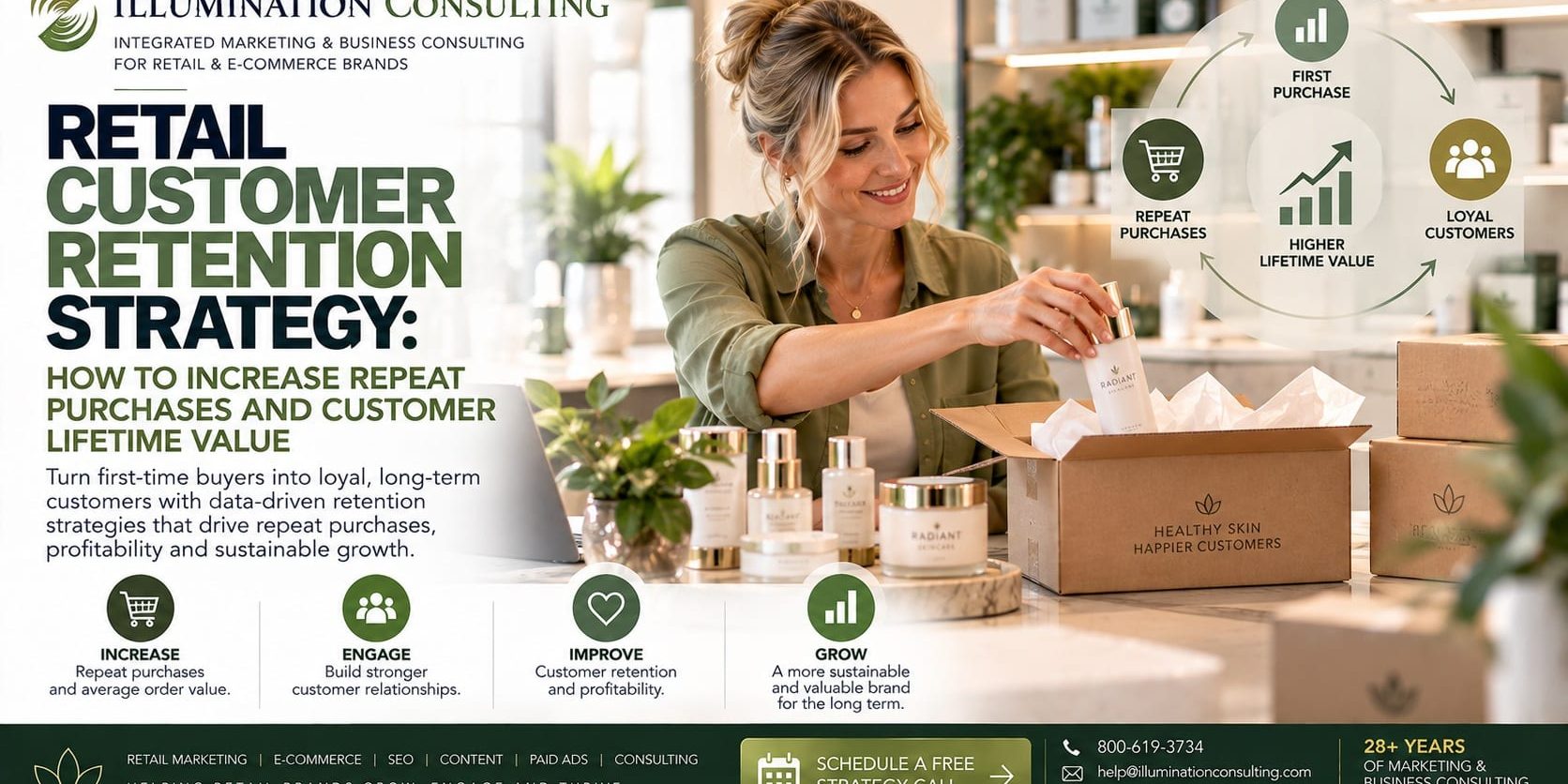
Retail businesses invest considerable resources into attracting new customers through search engine optimization, paid advertising, social media, influencer partnerships, email marketing, content creation, and ecommerce website development. Yet acquiring a customer is only the beginning of the commercial relationship. When a retailer focuses almost exclusively on first-time purchases, it can become dependent on continuously increasing acquisition spending to sustain revenue, even when its existing customer base contains substantial untapped growth opportunities.
A stronger retail customer retention strategy treats every completed purchase as the beginning of a measurable customer lifecycle. The objective is to understand why customers return, which products encourage repeat purchasing, how frequently customers buy, what influences their next order, and whether the economic value of those relationships justifies the investment required to maintain them. Effective retention is not simply sending more promotional emails or introducing a loyalty program. It requires coordinating merchandising, customer experience, product quality, communication, data analysis, and profitability.
For retailers investing in professional Retail Marketing, retention should be integrated with customer acquisition rather than managed as an unrelated activity. When acquisition, conversion, average order value, repeat purchasing, and customer lifetime value work together, retailers can create a more sustainable growth model that relies less heavily on constantly replacing customers.
What Is a Retail Customer Retention Strategy?
A retail customer retention strategy is a coordinated approach to encouraging existing customers to make additional purchases and maintain a valuable relationship with the brand over time.
It can involve:
-
Customer segmentation and lifecycle analysis
-
Post-purchase communication
-
Personalized product recommendations
-
Email and SMS marketing
-
Loyalty and rewards programs
-
Replenishment reminders
-
Subscription options
-
Customer service improvements
-
Ecommerce merchandising
-
Product quality and availability
-
Customer feedback and retention measurement
The objective is not simply maximizing purchase frequency. It is creating reasons for customers to return when they have a genuine need for the retailer’s products.
A successful strategy improves the value of the customer relationship while maintaining attractive business economics.
Why Customer Retention Matters to Retail Profitability
Customer acquisition requires investment. Depending on the business, that investment may include advertising, search optimization, content, website development, promotional incentives, and creative production.
A first purchase may recover those costs immediately, or the customer relationship may require additional purchases before becoming economically attractive.
Retention therefore affects the financial performance of acquisition.
When customers return without requiring the same level of acquisition expenditure, their subsequent purchases can contribute additional economic value.
However, repeat purchases are not automatically profitable. Discounts, shipping subsidies, loyalty rewards, fulfillment costs, and retention marketing expenses must also be considered.
The objective is profitable repeat purchasing, not repeat transactions at any cost.
Understand the Difference Between Retention and Loyalty
Retention and loyalty are related but distinct.
Customer retention describes whether customers continue purchasing from the retailer.
Customer loyalty describes the strength of their preference or relationship with the retailer.
A customer may repeatedly purchase because a retailer offers the lowest price, not because they feel loyal to the brand.
Another customer may strongly prefer a brand but purchase infrequently because the products last a long time.
Retailers should therefore avoid treating every repeat purchase as proof of loyalty.
Both purchasing behavior and customer attitudes can provide useful insight.
Start by Measuring Repeat Purchase Rate
Repeat purchase rate is one of the most accessible retention metrics for ecommerce retailers.
A simplified calculation is:
Suppose a hypothetical retailer has 1,000 purchasing customers during a defined analysis period, and 280 of them have placed at least two orders.
The illustrative repeat purchase rate would be:
This is a mathematical example, not a retail industry benchmark.
The measurement period and customer population must be clearly defined. A new customer acquired last week has had much less opportunity to reorder than someone acquired a year earlier.
That is why repeat purchase rate should eventually be complemented by cohort analysis.
Measure Time Between Purchases
Purchase frequency differs significantly across retail categories.
A customer purchasing skincare may need to replenish products periodically. Someone purchasing furniture may not return for years.
Retailers should analyze how long customers typically wait between orders.
Useful questions include:
How long after the first order does the second purchase occur?
Does that interval differ by product category?
Do repeat customers purchase more frequently over time?
When does the probability of another purchase begin to decline?
Understanding purchase intervals helps the retailer communicate at appropriate moments instead of relying on arbitrary promotional schedules.
Segment Customers by Purchase History
A single retention campaign rarely serves every customer equally well.
Retailers can create segments such as:
First-Time Customers
Customers who have completed their first purchase but have not yet returned.
Second-Purchase Customers
Customers who have demonstrated repeat purchasing behavior but may not yet have established a consistent relationship.
Established Repeat Customers
Customers who have purchased multiple times over an extended period.
High-Value Customers
Customers who contribute substantial economic value relative to the resources required to serve them.
At-Risk Customers
Customers whose purchasing activity has declined relative to their expected behavior.
Inactive Customers
Customers who have not purchased within a relevant period.
Each segment may require a different retention strategy.
The Second Purchase Is an Important Milestone
The first purchase demonstrates that the retailer successfully converted a prospective customer.
The second purchase provides additional evidence that the customer found enough value to return.
This makes the transition from first to second purchase an important area of analysis.
Retailers should examine whether the first-order experience supports another transaction.
Potential factors include:
-
Product quality
-
Delivery experience
-
Packaging
-
Product instructions
-
Customer service
-
Product recommendations
-
Post-purchase communication
-
Returns and exchanges
If first-time customers rarely return, the problem may not be insufficient email marketing. It may involve the underlying customer experience or product-market fit.
Improve the Post-Purchase Experience
Retention begins immediately after the initial transaction.
The customer should receive clear information about the order, including relevant confirmations, shipping updates, and support resources.
After delivery, the retailer can provide useful information about the product.
For example, skincare brands may offer usage guidance, while apparel retailers may provide care instructions.
The purpose is helping the customer receive the value they expected when purchasing.
A positive ownership experience can create the foundation for future purchases.
Build a Post-Purchase Email Sequence
A structured post-purchase email sequence can support the customer relationship without immediately introducing another sales pitch.
Depending on the product, the sequence might include:
Order Confirmation
↓
Shipping and Delivery Information
↓
Product Education
↓
Customer Support and Feedback
↓
Relevant Complementary Products
↓
Appropriate Replenishment or Reengagement
The timing should reflect the product category and customer needs.
Professional Content Marketing can support these communications by providing useful educational material that continues delivering value after the sale.
Avoid Excessive Promotional Communication
Retailers sometimes respond to weak retention by increasing email frequency.
More communication does not necessarily produce stronger customer relationships.
Excessive promotional messaging can create:
-
Unsubscribes
-
Lower engagement
-
Discount dependence
-
Customer fatigue
-
Reduced brand perception
A better approach focuses on relevance.
Customers should receive communication connected to their interests, purchases, and likely needs.
Use Purchase-Based Personalization
Purchase history provides useful information about customer preferences.
A retailer can use that information to recommend complementary products.
For example, a customer who purchases a particular product category may be interested in related accessories, refills, or maintenance items.
Recommendations should reflect genuine product relationships rather than simply promoting whichever SKU the retailer wants to move.
Effective personalization improves product discovery and makes future purchases easier.
Connect Retention With Ecommerce Merchandising
Merchandising influences whether customers find additional products worth purchasing.
A retailer may have excellent retention campaigns but still lose repeat business if customers struggle to navigate the catalog.
Strong Retail Ecommerce Website Design can support retention through:
-
Clear product categories
-
Relevant recommendations
-
Convenient account access
-
Easy reordering
-
Product comparison
-
Bundles
-
Personalized collections
-
Mobile usability
-
Reliable checkout
Retention is therefore partly a website experience problem.
Make Reordering Convenient
For replenishable products, repeat purchasing should require minimal effort.
Customers may benefit from:
-
Previous-order access
-
Reorder functionality
-
Saved preferences
-
Appropriate reminders
-
Subscription options
Reducing unnecessary friction can improve repeat purchasing without requiring larger discounts.
The objective is convenience rather than pressure.
Use Replenishment Marketing When Appropriate
Replenishment marketing works best when a product has a reasonably predictable consumption cycle.
Examples may include certain skincare products, personal-care products, supplements, and household consumables.
Retailers should use actual customer purchasing behavior where possible rather than assuming everyone uses a product at the same rate.
A replenishment reminder can be useful when it arrives near the time a customer may genuinely need another purchase.
Poorly timed reminders can feel irrelevant.
Evaluate Subscription Opportunities
Subscriptions can create recurring revenue, but not every retail product is suitable.
A subscription model may work when customers:
-
Purchase regularly
-
Consume products predictably
-
Value convenience
-
Want dependable delivery
Retailers should evaluate:
Subscription retention
Cancellation rate
Contribution per shipment
Fulfillment cost
Customer satisfaction
Inventory reliability
Recurring orders are valuable only when the subscription remains attractive to customers and economically sustainable for the business.
Build Loyalty Programs Around Customer Value
Loyalty programs can encourage repeat purchasing, but their structure matters.
Common approaches include:
-
Points
-
Purchase rewards
-
Tiered benefits
-
Exclusive access
-
Member experiences
-
Personalized benefits
The most effective program is not necessarily the one offering the largest discount.
Retailers should consider whether rewards strengthen the customer relationship or simply reduce margin on purchases customers would have made anyway.
Measure Loyalty Program Incrementality
A loyalty program may report impressive participation while creating little additional business value.
For example, existing repeat customers may enroll and receive rewards without changing their purchasing behavior.
Management should investigate whether the program actually improves:
-
Purchase frequency
-
Customer retention
-
Average order value
-
Customer engagement
-
Economic contribution
The objective is measuring incremental value rather than simply counting memberships.
Protect Profitability From Discount Dependence
Discounts can generate repeat purchases quickly.
However, frequent promotions may train customers to delay purchasing until another offer appears.
This can weaken contribution margins and create volatile demand.
Retailers should explore alternatives such as:
-
Better product recommendations
-
Improved convenience
-
Relevant educational content
-
Exclusive product access
-
Customer service benefits
-
Thoughtful bundles
Discounting should be a deliberate economic decision rather than the default retention strategy.
Measure Customer Lifetime Value
Customer lifetime value helps retailers understand the economic importance of customer relationships.
There are several valid approaches to calculating LTV, depending on data availability and accounting methodology.
A simple revenue-based model may estimate:
Average Order Value × Purchase Frequency × Customer Relationship Duration
However, this estimates revenue rather than profit.
A more useful financial analysis considers contribution generated across the customer relationship, including relevant acquisition and retention expenses.
Retailers should distinguish revenue LTV from contribution-based customer value when making investment decisions.
Compare Customer Lifetime Value With Acquisition Cost
Retention and acquisition economics should be evaluated together.
Suppose a retailer acquires customers through paid advertising.
If those customers rarely return, the business may need the first transaction to recover most or all of the acquisition investment.
If customers make multiple profitable purchases, the acquisition economics may be different.
This creates a critical management question:
How much can the retailer responsibly invest in acquiring a customer based on the economic value that customer is likely to generate?
The answer depends on actual cohort behavior, contribution margins, payback requirements, and cash flow.
Avoid Using Average LTV Alone
Blended averages can hide important differences.
Customers acquired through different channels may behave differently.
For example:
-
Organic search customers
-
Paid search customers
-
Social advertising customers
-
Referral customers
-
Email subscribers
These groups may have different purchase frequencies, product preferences, and retention patterns.
The retailer should investigate customer value by acquisition source when sufficient data exists.
This helps determine which channels generate valuable long-term customers rather than simply inexpensive first purchases.
Use Cohort Analysis to Understand Retention
Cohort analysis groups customers according to a shared starting point, such as their first purchase month.
The retailer then tracks their behavior over time.
An illustrative cohort framework might look like this:
| Customer Cohort | First Purchase | Second Purchase | Later Repeat Purchases |
|---|---|---|---|
| January Customers | Track | Track | Track |
| February Customers | Track | Track | Track |
| March Customers | Track | Track | Track |
| April Customers | Track | Track | Track |
This allows management to compare customer groups at similar stages of their relationship.
Cohort analysis can reveal whether retention is improving, declining, or changing because of acquisition mix.
Measure Retention by Product Category
Customers purchasing different products may exhibit different behavior.
A skincare customer may return regularly for replenishment.
A furniture customer may purchase infrequently but generate substantial value when they do.
A retailer should not apply identical retention expectations to every category.
Segment performance by:
Product Category
First Product Purchased
Order Value
Customer Type
Acquisition Channel
This creates a more realistic view of retention opportunities.
Identify Products That Create Repeat Customers
Some products may function as customer-acquisition gateways.
Others may encourage regular replenishment.
Still others may generate strong cross-selling.
Retailers should analyze which first-purchase products lead to valuable future relationships.
This information can influence:
-
Advertising
-
SEO
-
Product positioning
-
Bundling
-
Merchandising
-
Inventory planning
Retention intelligence should influence what the retailer promotes to new customers.
Use SEO to Support Customer Retention
SEO Services are commonly associated with acquiring new customers, but organic search can also support retention.
Existing customers may search for:
-
Product usage instructions
-
Replacement products
-
Complementary items
-
Product comparisons
-
Troubleshooting information
-
Brand-specific questions
Helpful content can bring customers back to the retailer’s website throughout the ownership lifecycle.
SEO therefore supports both discovery and ongoing customer engagement.
Build Content for Existing Customers
Content should not focus exclusively on people who have never purchased.
Retailers can publish:
-
Product care guides
-
Tutorials
-
Styling guides
-
Routine recommendations
-
Product compatibility information
-
Seasonal usage guidance
-
Frequently asked questions
This content can reduce customer-service friction while encouraging appropriate additional purchases.
It also strengthens the perceived usefulness of the brand.
Improve Customer Service as a Retention Channel
Customer service has a direct influence on repeat purchasing.
A customer who encounters a problem may still remain loyal if the issue is resolved professionally.
Conversely, poor communication can permanently damage the relationship.
Retailers should examine:
Response time
Resolution quality
Return experience
Customer satisfaction
Recurring complaints
Retention marketing cannot compensate indefinitely for a weak customer-service experience.
Analyze Returns and Refunds
Returns can reveal important information about customer expectations.
High return rates may indicate:
-
Inaccurate product descriptions
-
Sizing issues
-
Quality concerns
-
Shipping damage
-
Misleading photography
-
Product mismatch
Reducing preventable returns can improve both profitability and customer confidence.
A customer who receives what they expected is more likely to consider purchasing again.
Use Customer Feedback to Improve Products
Customer feedback should influence more than marketing copy.
It can inform:
-
Product development
-
Packaging
-
Instructions
-
Assortment
-
Quality control
-
Customer support
-
Merchandising
Retention improves when the underlying products and experiences improve.
This is especially important for retailers selling their own brands.
Identify At-Risk Customers
An at-risk customer is someone whose purchasing behavior suggests declining engagement.
The definition should reflect the product category.
For a frequently replenished product, a missed expected purchase may be meaningful.
For an infrequently purchased product, several months without an order may be entirely normal.
Retailers should use category-specific purchasing patterns to determine when reengagement is appropriate.
Create Customer Win-Back Campaigns
Win-back campaigns target customers who have become inactive.
Potential approaches include:
-
Relevant product updates
-
New collection announcements
-
Personalized recommendations
-
Educational content
-
Customer feedback requests
-
Selective promotional offers
The message should provide a reason to return.
Repeated generic discounts may create short-term sales without rebuilding the relationship.
Measure Win-Back Profitability
A successful win-back campaign should be evaluated beyond the number of orders generated.
Track:
Reactivated Customers
Revenue
Contribution
Campaign Cost
Subsequent Purchases
If customers return only for a heavily discounted transaction and disappear again, the long-term value may be limited.
Reactivation should ideally restore an economically useful customer relationship.
Coordinate Email and SMS Marketing
Email and SMS can both support retention, but they should not simply duplicate the same messages.
Email is often useful for:
-
Product education
-
Longer-form content
-
Recommendations
-
Account updates
-
Brand storytelling
SMS may be useful for timely, concise communications when customers have provided appropriate consent.
Retailers must respect applicable consent, privacy, and messaging requirements.
A coordinated communication strategy reduces duplication and customer fatigue.
Use Automation Without Losing Relevance
Automation can make retention programs scalable.
Examples include:
Post-Purchase Education
Replenishment Reminders
Product Recommendations
Loyalty Updates
Customer Reengagement
However, automation should not be treated as a substitute for strategy.
Poorly designed automation simply distributes irrelevant messages more efficiently.
Connect Retention With Inventory Availability
Retention campaigns can fail when promoted products are unavailable.
A customer receiving a replenishment reminder may become frustrated if the item is out of stock.
Marketing should therefore coordinate with inventory planning.
Before launching retention campaigns, confirm:
-
Product availability
-
Replenishment timing
-
Fulfillment capacity
-
Relevant substitutions
Reliable availability is part of the customer experience.
Avoid Creating Demand the Business Cannot Fulfill
An aggressive retention campaign may generate a short-term sales spike.
If the retailer cannot fulfill those orders effectively, the resulting delays can weaken customer trust.
Marketing calendars should therefore reflect operational readiness.
Retention should create sustainable demand rather than temporary order volume that damages the experience.
Understand Customer Retention by Channel
A retailer selling through multiple channels may have different levels of access to customer data.
Direct ecommerce can provide substantial insight into customer behavior.
Marketplaces, wholesale relationships, and physical retail may offer different levels of visibility.
The retention strategy should reflect the data and customer relationships actually available in each channel.
Retailers should not assume they can communicate directly with every end customer.
Connect Physical Retail With Digital Retention
For omnichannel retailers, customer relationships may move between physical stores and ecommerce.
A customer might discover a product in-store and reorder online.
Another may research online before purchasing in person.
Where appropriate and permitted, retailers can create consistent experiences across channels through:
-
Unified customer accounts
-
Loyalty programs
-
Relevant communication
-
Product availability information
-
Consistent merchandising
The objective is recognizing the customer relationship rather than treating every channel as a separate business.
Build a Retail Retention Dashboard
A useful dashboard should connect customer behavior with financial performance.
| Metric | Management Question |
|---|---|
| Repeat Purchase Rate | How many customers return? |
| Time to Second Purchase | How quickly do new customers buy again? |
| Purchase Frequency | How often do customers purchase? |
| Average Order Value | How much does each order generate? |
| Customer Lifetime Value | What is the long-term economic value? |
| Customer Acquisition Cost | What does acquiring customers cost? |
| Contribution per Customer | How much value remains after relevant costs? |
| Cohort Retention | Is customer behavior improving over time? |
| Win-Back Rate | Are inactive customers returning? |
| Loyalty Incrementality | Are rewards changing behavior profitably? |
Management should avoid collecting metrics that do not support decisions.
The dashboard should reveal where the business can improve.
Establish a Retention Review Process
A monthly review can examine:
Are more first-time customers making a second purchase?
Which products generate the strongest repeat behavior?
Are customer acquisition costs being recovered?
Are retention campaigns generating profitable incremental sales?
Are customer complaints or returns increasing?
Which cohorts are performing better or worse?
Should marketing resources shift between acquisition and retention?
The purpose is making adjustments based on evidence.
Balance Acquisition and Retention Spending
Retailers sometimes treat acquisition and retention as competing priorities.
In reality, they are interconnected.
Acquisition introduces customers to the brand.
Retention determines how much value those relationships create.
If the retailer has excellent retention but insufficient new customers, acquisition may deserve additional investment.
If the retailer acquires many customers but few return, improving the post-purchase experience may create greater value than simply increasing advertising.
Marketing allocation should respond to the business’s actual constraint.
Understand Incremental Retention Value
One of the most important questions in retention marketing is whether a campaign creates additional purchases that would not otherwise have occurred.
Suppose a retailer sends a promotional email to established repeat customers.
Some recipients may purchase because of the message.
Others may have purchased anyway.
If the retailer discounts every order, part of the campaign expense may subsidize existing demand rather than create new demand.
Controlled testing, appropriate customer comparisons, and contribution analysis can help estimate incremental performance.
Do Not Optimize Retention for Revenue Alone
A campaign can increase repeat-order revenue while weakening profitability.
Potential causes include:
-
Excessive discounts
-
High shipping subsidies
-
Costly loyalty rewards
-
Expensive retention technology
-
Low-contribution product mix
Retention performance should ultimately connect to economic contribution.
The strongest retention strategy creates more valuable customer relationships, not simply more transactions.
Build Retention Into the Business Model
Customer retention should influence decisions throughout the company.
Product teams should understand which products generate repeat demand.
Merchandising teams should understand which products work well together.
Marketing teams should understand customer lifecycle behavior.
Operations should support reliable fulfillment.
Customer service should identify recurring friction.
Management should connect these functions through shared performance measurements.
Retention is not simply an email marketing responsibility.
It is a business-wide growth capability.
From First Purchase to Long-Term Customer Value
A sustainable retail growth system can be represented as:
Customer Acquisition
↓
First Purchase
↓
Positive Product Experience
↓
Relevant Post-Purchase Communication
↓
Second Purchase
↓
Ongoing Product Discovery
↓
Repeat Purchasing
↓
Customer Lifetime Value
↓
Retention and Acquisition Optimization
The cycle becomes stronger as the retailer learns which products, channels, and experiences create valuable customer relationships.
The objective is not making customers purchase more frequently than they need to. It is becoming the retailer they choose when another relevant purchase opportunity arises.
Retail Retention as a Sustainable Growth Advantage
Retailers that understand customer retention can make better decisions about advertising, SEO, merchandising, inventory, loyalty programs, product development, and customer service.
Instead of evaluating marketing solely by the number of new customers acquired, management can examine the complete economic relationship.
Which customers return?
What causes them to return?
Which products create valuable relationships?
What does retention cost?
How much contribution do repeat purchases generate?
Which acquisition channels attract the strongest long-term customers?
These questions turn retention from a collection of promotional tactics into a measurable growth strategy.
Illumination Consulting helps retailers connect Retail Marketing, Retail Ecommerce Website Design, SEO Services, Content Marketing, customer acquisition, conversion optimization, merchandising, and customer retention into integrated business growth systems. The objective is not simply generating more first-time orders. It is helping retail businesses create profitable customer relationships capable of supporting sustainable long-term growth.
Frequently Asked Questions
What is a retail customer retention strategy?
A retail customer retention strategy is a coordinated approach to encouraging existing customers to make additional purchases through improved customer experience, relevant marketing, product recommendations, loyalty benefits, and convenient purchasing.
How can retailers increase repeat purchase rates?
Retailers can improve repeat purchasing through post-purchase education, personalized recommendations, replenishment reminders, reliable fulfillment, excellent customer service, and loyalty programs that provide meaningful value.
What is the difference between customer retention and customer loyalty?
Customer retention measures whether customers continue purchasing, while customer loyalty reflects their preference for a retailer. Customers can make repeat purchases without having a strong emotional attachment to the brand.
How does customer retention affect customer lifetime value?
Profitable repeat purchases can increase the total economic contribution a customer generates over time. Retailers should account for product costs, discounts, fulfillment, acquisition spending, and retention expenses when evaluating lifetime value.
Should retailers prioritize acquisition or retention?
The appropriate balance depends on the business. A retailer with strong repeat purchasing but limited new-customer growth may need more acquisition investment. A retailer acquiring many customers who never return may benefit more from improving retention.
Are loyalty programs necessary for retail customer retention?
No. Loyalty programs can help, but product quality, convenience, customer experience, relevant communication, and customer service can also create strong repeat purchasing without formal rewards.
How often should retailers measure customer retention?
Monthly performance reviews can help identify changes, while cohort analysis over longer periods provides a more reliable understanding of customer behavior. The appropriate time horizon depends on natural product purchasing cycles.