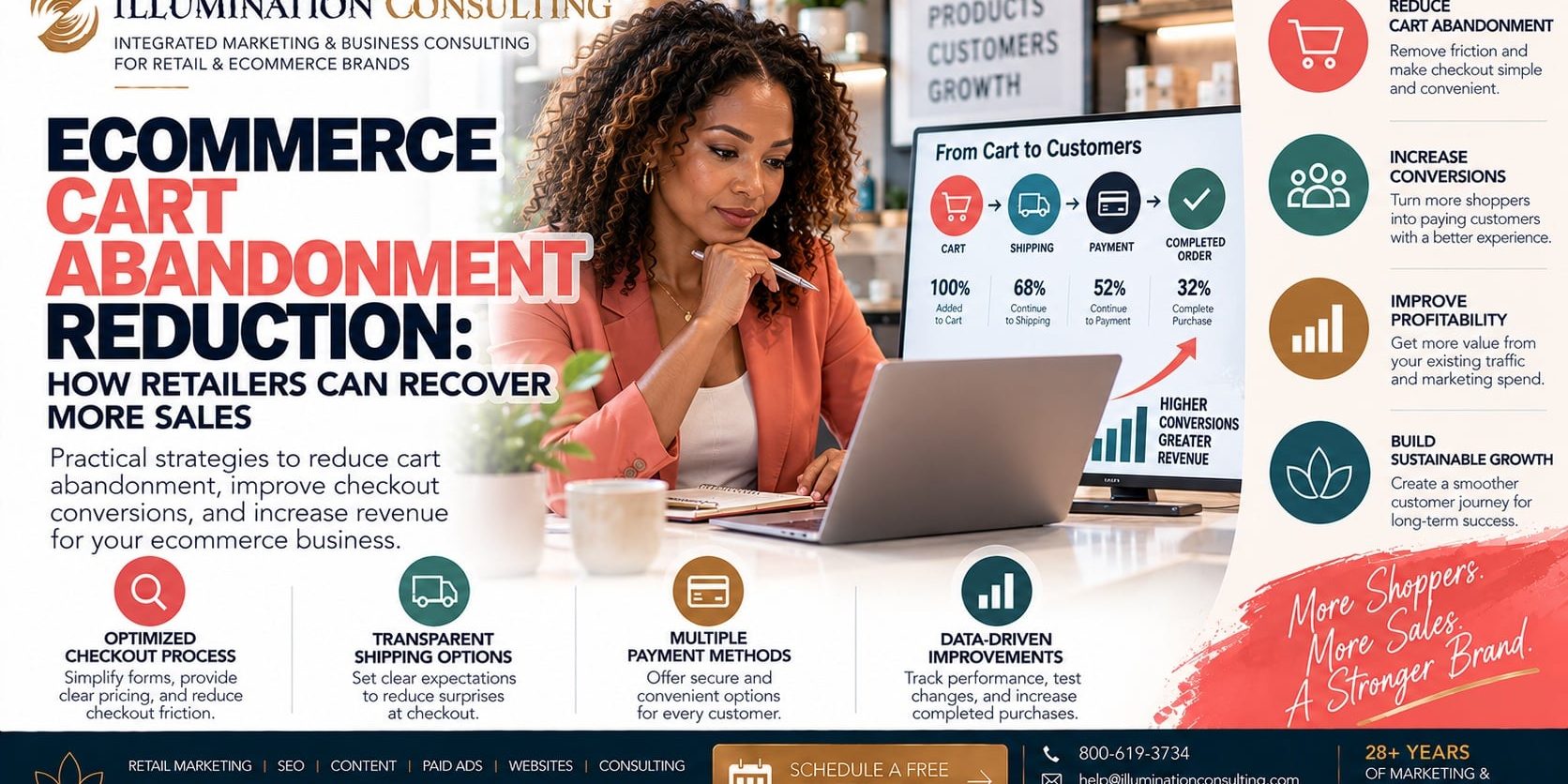
Retail businesses invest significant resources attracting customers to their ecommerce websites. Search engine optimization, paid advertising, social media, email marketing, and content development help generate traffic and introduce products to potential buyers. However, attracting visitors and encouraging them to add products to their shopping carts does not guarantee completed purchases. Many shoppers leave before finishing checkout, creating lost sales opportunities and reducing the financial return on customer acquisition investments.
Ecommerce cart abandonment reduction focuses on identifying why shoppers leave without purchasing and improving the shopping experience to remove unnecessary obstacles. These improvements may involve checkout usability, shipping transparency, payment options, website performance, customer trust, and appropriately structured recovery communications. Rather than relying exclusively on additional advertising expenditure, retailers can improve the efficiency of their existing traffic by making the purchasing process clearer, faster, and more convenient.
For retailers investing in professional Retail Marketing, reducing cart abandonment should be part of a broader ecommerce growth strategy. When businesses coordinate marketing, website development, merchandising, and customer experience, they can create a more effective purchasing journey while protecting profitability.
What Is Ecommerce Cart Abandonment?
Ecommerce cart abandonment occurs when a shopper adds one or more products to an online shopping cart but leaves without completing a purchase. This may happen before checkout begins or during the checkout process itself.
Cart abandonment should be distinguished from checkout abandonment. Cart abandonment measures purchasing activity that does not result in an order after items have been added to a cart. Checkout abandonment focuses more specifically on shoppers who begin checkout but do not finish.
These measurements help retailers understand different stages of the purchasing process. A shopper who adds a product to compare prices may behave differently from someone who reaches the payment page but encounters an error.
Understanding these distinctions is important because each situation may require a different improvement strategy.
Why Cart Abandonment Matters for Retail Profitability
Abandoned carts represent potential purchasing opportunities that did not become completed transactions. However, not every abandoned cart represents a sale that would otherwise have occurred. Some shoppers use carts to save products, compare alternatives, calculate shipping costs, or conduct preliminary research.
Retailers should therefore evaluate abandonment as a conversion performance indicator rather than treating the total value of abandoned carts as guaranteed lost revenue.
Consider a hypothetical ecommerce retailer that records 2,000 shopping carts during a month and receives 600 completed orders from those carts. Its cart abandonment rate would be 70%, assuming the carts and orders are measured consistently.
If improvements increase completed orders to 700 from the same number of carts, the retailer generates 100 additional transactions. Whether these transactions improve profitability depends on order contribution, fulfillment costs, discounts, and other relevant expenses.
This illustrates why cart abandonment reduction can be valuable when it produces additional profitable purchases rather than simply increasing order volume.
Calculate Your Ecommerce Cart Abandonment Rate
Retailers should establish a reliable baseline before making changes to their checkout processes.
A commonly used calculation is:
Cart Abandonment Rate (%) = (1 – (Completed Orders / Shopping Carts Created)) x 100
For example, if 1,000 shopping carts are created and 300 result in completed orders, the cart abandonment rate is 70%.
This calculation assumes that completed orders can be consistently attributed to the carts being measured. Retailers should account for tracking limitations, returning shoppers, cross-device activity, and differences in how ecommerce platforms define carts.
Businesses should also track checkout abandonment separately when their analytics systems support that measurement.
Consistent definitions are more useful than comparing figures generated through incompatible reporting methods.
Identify Why Customers Abandon Shopping Carts
Cart abandonment can result from several factors, and the underlying causes vary by retailer, product category, and customer audience.
Unexpected shipping costs, complicated checkout forms, limited payment methods, account creation requirements, unclear delivery estimates, and concerns about website security can create unnecessary friction. Other shoppers may leave because they are not ready to purchase, want to compare prices, or are waiting for a more convenient time.
Retailers should investigate abandonment patterns using ecommerce analytics, customer feedback, usability testing, and checkout error reports.
The objective is identifying actual purchasing obstacles rather than assuming every abandoned cart can be recovered through discounts or reminder emails.
Make Shipping Costs Transparent Before Checkout
Unexpected shipping charges can create frustration when shoppers discover additional costs late in the purchasing process. A customer who believes a product costs $75 may reconsider the purchase when shipping and other charges increase the final amount substantially.
Retailers should communicate shipping policies clearly and provide accurate cost estimates as early as practical.
Product pages, cart summaries, and shipping information pages should explain available delivery methods, relevant fees, and any applicable free-shipping thresholds.
Transparency helps customers make informed decisions before investing time in checkout.
Retailers should also evaluate the financial implications of shipping incentives. Offering free shipping may improve conversion, but the additional order contribution must justify the shipping expense.
Simplify the Ecommerce Checkout Process
Checkout complexity can discourage shoppers who are otherwise prepared to purchase.
Retailers should review the number of steps, required fields, navigation elements, and decisions involved in completing an order. Unnecessary form fields and confusing instructions can increase friction.
A streamlined checkout should collect the information required to process the transaction while minimizing avoidable effort.
Address autocomplete, clear error messages, appropriate field formatting, and logical page organization can improve usability.
Professional Retail Ecommerce Website Design can help retailers evaluate checkout usability and identify technical or design problems affecting conversions.
The objective is making purchasing straightforward without compromising transaction security or necessary business requirements.
Offer Guest Checkout When Appropriate
Requiring shoppers to create accounts before purchasing may introduce unnecessary friction.
Some customers prefer to complete a transaction without establishing a permanent relationship with the retailer. Others may be comfortable creating an account after experiencing a successful purchase.
Guest checkout can provide flexibility while allowing retailers to offer optional account creation.
Businesses should evaluate their ecommerce platform capabilities and determine whether account requirements serve a legitimate operational purpose.
When customer accounts are useful for order tracking, loyalty benefits, or repeat purchasing, retailers can explain those advantages without making registration an unnecessary obstacle.
Improve Mobile Checkout Performance
Mobile shopping experiences deserve particular attention because smartphones introduce different usability challenges from desktop computers.
Small input fields, difficult navigation, excessive scrolling, slow page loading, and poorly positioned buttons can interfere with checkout completion.
Retailers should test the entire purchasing process on actual mobile devices, including product selection, cart review, shipping information, payment, and order confirmation.
Payment forms should be easy to complete, and customers should be able to identify errors without repeatedly restarting checkout.
Mobile optimization is not simply a matter of responsive design. It requires ensuring that the complete transaction process works efficiently on smaller screens.
Provide Relevant Payment Options
Payment preferences vary across customers and markets. Some shoppers prefer credit or debit cards, while others use digital wallets or alternative payment methods.
Retailers should evaluate which payment options are appropriate for their audience, ecommerce platform, transaction economics, and operating requirements.
Adding payment methods can improve convenience, but each option may introduce processing fees, technical complexity, or additional administrative considerations.
Businesses should prioritize secure, reliable payment processing and accurate communication about accepted methods.
Payment flexibility should support the customer experience without creating unnecessary financial or operational risk.
Build Customer Trust During Checkout
Customers may hesitate to provide payment information when a website appears unreliable or lacks clear business information.
Retailers can strengthen trust through professional website design, accurate product descriptions, accessible contact information, transparent policies, and dependable checkout functionality.
Customers should be able to locate information about shipping, returns, refunds, and customer support before completing a purchase.
Security-related claims and trust indicators must accurately reflect the protections and services actually provided.
A trustworthy checkout experience depends on reliable operations and clear communication rather than decorative badges or unsupported assurances.
Improve Product Information Before Customers Reach the Cart
Some cart abandonment problems originate earlier in the shopping journey.
Customers may add products to their carts before realizing that important information is missing. Unclear sizing, incomplete specifications, limited photographs, or uncertain product compatibility can create hesitation.
Retailers should evaluate product pages to ensure shoppers have sufficient information to make informed decisions.
Useful details may include dimensions, materials, product variations, care instructions, availability, and relevant delivery information.
Accurate product content can also help reduce returns by aligning customer expectations with the merchandise received.
Display Delivery Expectations Clearly
Delivery timing can influence purchasing decisions, particularly when customers need products for specific events or deadlines.
Retailers should provide realistic delivery estimates based on inventory availability, processing times, shipping methods, and carrier performance.
Businesses should distinguish between estimated and guaranteed delivery dates.
When products are temporarily unavailable or require extended fulfillment periods, that information should be communicated before checkout.
Clear delivery expectations can reduce uncertainty and prevent customer dissatisfaction after purchase.
Review Return and Refund Policies
Customers may hesitate to purchase when they do not understand whether products can be returned or how refunds are processed.
Retailers should provide accessible policies explaining eligibility, timeframes, procedures, and relevant limitations.
Policies should reflect applicable consumer protection requirements and the characteristics of the merchandise being sold.
A transparent return policy can support purchasing confidence, but retailers should also evaluate the financial impact of returns and reverse logistics.
The objective is balancing customer clarity with sustainable operating practices.
Use Cart Recovery Emails Responsibly
Cart recovery emails can remind shoppers about products they considered purchasing and provide an opportunity to return to checkout.
Effective messages should be clear, relevant, and respectful. They may include the products left in the cart, a convenient link to resume shopping, and useful information about shipping or customer support.
Retailers should avoid excessive reminders, misleading urgency, or unsupported claims about limited availability.
Cart recovery communications must comply with applicable marketing, privacy, and consent requirements. Businesses should also consider whether they have an appropriate basis to contact the shopper.
The goal is helping interested customers complete purchases rather than pressuring individuals who have chosen not to proceed.
Create a Practical Abandoned Cart Email Sequence
A recovery sequence should be based on customer behavior, communication permissions, and the retailer’s product category.
An initial message may simply remind the shopper about the items they selected. A later communication, where appropriate, may address common questions about delivery, product details, or customer service.
Some retailers may choose to offer incentives, but discounts should not automatically be included in every sequence.
Businesses should monitor customer responses, unsubscribes, recovered orders, and contribution after incentives.
A shorter, useful sequence may perform better for the brand than repeated promotional messages that create fatigue.
Evaluate SMS Cart Recovery Carefully
Text messaging can provide a convenient communication channel, but it requires particular attention to consent and applicable regulations.
Retailers should not assume that collecting a telephone number during checkout authorizes promotional text messages.
Where appropriate consent and compliant systems are in place, SMS may be used to provide relevant reminders or assistance.
Messages should be concise, clearly identify the business, and respect customer preferences.
The potential conversion benefit must be weighed against compliance requirements, communication costs, and customer experience.
Use Retargeting Advertising Strategically
Retargeting campaigns may help retailers reconnect with visitors who previously interacted with products or shopping carts.
These campaigns can display relevant advertisements through supported advertising platforms, subject to privacy requirements, consent choices, and platform policies.
However, retargeting should not be evaluated solely by attributed sales.
Some shoppers may have returned and purchased without seeing additional advertising. Attribution systems can also assign credit to multiple marketing interactions.
Retailers should evaluate incremental performance where feasible and consider acquisition costs, frequency, customer experience, and contribution.
Retargeting is most useful when it supports genuine purchasing interest rather than repeatedly exposing customers to the same advertisement.
Avoid Using Discounts as the Default Recovery Strategy
Discounts may encourage some shoppers to complete purchases, but they can also reduce margins and train customers to expect promotional incentives.
A retailer that automatically sends discount codes after cart abandonment may inadvertently encourage shoppers to delay purchasing.
Before offering incentives, management should evaluate product contribution, customer acquisition economics, and the likelihood that the purchase would have occurred without a discount.
Alternative approaches include clearer shipping information, improved checkout usability, product education, and customer service assistance.
Discounts should be used selectively when the expected incremental contribution justifies their cost.
Measure Recovered Revenue and Profitability
Retailers should distinguish between orders attributed to recovery activities and the incremental financial value those activities generate.
A basic recovered cart conversion measure is:
Cart Recovery Conversion Rate (%) = (Recovered Orders / Eligible Abandoned Carts Contacted) x 100
For example, if a retailer contacts 500 eligible abandoned carts and 40 result in completed purchases under its defined attribution rules, the measured recovery conversion rate is 8%.
However, this does not establish that all 40 purchases were caused by the recovery campaign.
Retailers should also evaluate collected revenue, discounts, advertising expenses, messaging costs, and contribution.
Where sufficient data is available, controlled testing can help estimate the incremental impact of recovery communications.
Connect Cart Abandonment With Customer Acquisition Costs
Customer acquisition becomes less efficient when businesses pay to attract visitors who repeatedly fail to complete purchases.
Improving checkout performance may increase the number of customers acquired from existing marketing activity.
For example, a retailer may maintain the same advertising expenditure while generating additional completed orders through better checkout usability.
This can reduce average acquisition cost when the additional purchases represent genuine new customers.
However, businesses should also consider order contribution and customer lifetime value. More completed orders do not necessarily produce stronger financial performance when discounts and fulfillment costs increase.
Cart abandonment reduction should therefore be evaluated as part of the broader customer acquisition strategy.
Use Analytics to Identify Checkout Bottlenecks
Ecommerce analytics can help retailers understand where shoppers encounter difficulties.
Useful measurements include product views, add-to-cart events, checkout initiation, shipping selection, payment attempts, completed orders, and checkout errors.
Retailers should ensure that tracking is configured consistently and that events are not duplicated or incorrectly attributed.
A significant drop between shipping selection and payment may suggest a different problem from abandonment occurring immediately after products are added to the cart.
Analytics should guide investigation, but numerical patterns alone may not explain the underlying cause.
Combining reporting with usability testing and customer feedback provides a more complete understanding.
Test Checkout Improvements Before Expanding Them
Retailers should evaluate checkout changes using defined objectives and reliable measurement.
Potential tests may include simplifying form fields, clarifying shipping information, changing checkout layouts, or improving mobile payment interactions.
Each test should begin with a specific hypothesis.
For example, a retailer may believe that displaying shipping estimates earlier will reduce checkout abandonment. The business can implement the change and compare relevant outcomes.
Where traffic volume permits, controlled A/B testing may provide stronger evidence than simple before-and-after comparisons.
Businesses should also monitor payment errors, customer complaints, and order contribution to ensure improvements do not create unintended problems.
Coordinate Cart Recovery With Inventory Availability
Cart recovery campaigns should reflect actual product availability.
Sending reminders for products that are out of stock can frustrate customers and damage trust.
Retailers should ensure that recovery systems account for inventory changes, product discontinuations, and relevant pricing updates.
When an item becomes unavailable, communications should avoid suggesting that it can still be purchased immediately.
Coordination between ecommerce operations, inventory management, and marketing helps prevent misleading messages and unnecessary customer service problems.
Develop a 90-Day Ecommerce Cart Abandonment Reduction Plan
A structured improvement plan helps retailers prioritize checkout issues and measure results.
Days 1–30: Audit Cart and Checkout Performance
Review cart abandonment, checkout abandonment, payment errors, shipping information, mobile usability, and customer feedback.
Confirm that ecommerce analytics accurately track cart creation, checkout initiation, and completed orders.
Identify the largest areas of friction and establish baseline conversion and contribution measurements.
Days 31–60: Implement Priority Improvements
Simplify unnecessary checkout steps, clarify shipping and return information, improve mobile usability, and address technical problems.
Review payment options and ensure that customer support information is accessible.
Where appropriate, establish compliant cart recovery communications and evaluate their performance.
Days 61–90: Measure Results and Refine
Compare checkout completion, abandoned cart rates, recovered orders, customer feedback, and contribution with the original baseline.
Evaluate which changes produce meaningful improvements and whether incentives or recovery campaigns generate incremental financial value.
Expand successful initiatives and adjust approaches that create additional costs without sufficient benefit.
The 90-day framework is a practical planning structure rather than a guarantee of specific conversion improvements.
Common Ecommerce Cart Abandonment Mistakes
Retailers frequently make avoidable mistakes when attempting to recover abandoned purchases.
Assuming every abandoned cart represents lost revenue. Some shoppers are browsing or comparing products without immediate purchasing intent.
Hiding shipping costs until checkout. Unexpected charges can create frustration and discourage purchasing.
Requiring unnecessary account creation. Mandatory registration may introduce friction for first-time customers.
Ignoring mobile checkout usability. Poor mobile experiences can prevent otherwise interested shoppers from completing orders.
Relying exclusively on discount emails. Automatic incentives may reduce contribution and encourage customers to wait for promotions.
Overusing recovery communications. Excessive emails or messages can damage customer relationships.
Failing to measure profitability. Recovered orders should be evaluated alongside discounts, acquisition costs, and fulfillment expenses.
Neglecting checkout errors. Technical problems can create abandonment that marketing communications cannot effectively resolve.
Avoiding these mistakes requires coordination between ecommerce development, marketing, customer service, and operations.
Build a More Effective Ecommerce Conversion Strategy
Reducing cart abandonment is an important part of improving ecommerce performance, but it should not be treated as an isolated marketing tactic. Checkout completion depends on the entire customer journey, including product information, pricing transparency, shipping expectations, website usability, payment reliability, and customer trust.
Retailers that understand why shoppers leave without purchasing can prioritize improvements that reduce unnecessary friction and support informed buying decisions. When combined with appropriate recovery communications and consistent performance measurement, these improvements can help businesses generate more value from existing traffic and marketing investments.
Illumination Consulting helps retail businesses connect Retail Marketing, Retail Ecommerce Website Design, SEO Services, and ecommerce growth consulting into coordinated strategies. Our objective is to help retailers attract qualified customers, improve shopping experiences, increase conversions, and build sustainable business performance.
Frequently Asked Questions
What is ecommerce cart abandonment?
Ecommerce cart abandonment occurs when shoppers add products to an online cart but leave without completing a purchase. It can happen for many reasons, including comparison shopping, unexpected costs, checkout difficulties, or lack of immediate purchasing intent.
How can retailers reduce shopping cart abandonment?
Retailers can reduce abandonment by improving checkout usability, making shipping costs transparent, offering appropriate payment options, supporting guest checkout, improving mobile performance, and providing clear product and return information.
How do you calculate cart abandonment rate?
Subtract the ratio of completed orders to shopping carts created from one, then multiply by 100. Retailers should use consistent tracking definitions and account for reporting limitations.
Do abandoned cart emails increase ecommerce sales?
Cart recovery emails may encourage some shoppers to return and complete purchases. Their effectiveness depends on customer interest, message relevance, consent, timing, and the overall shopping experience. Retailers should evaluate incremental contribution rather than attributed revenue alone.
Should ecommerce retailers offer discounts for abandoned carts?
Discounts may be useful in selected situations, but automatic incentives can reduce profitability and encourage shoppers to delay purchases. Retailers should evaluate the financial impact before including discounts in recovery campaigns.