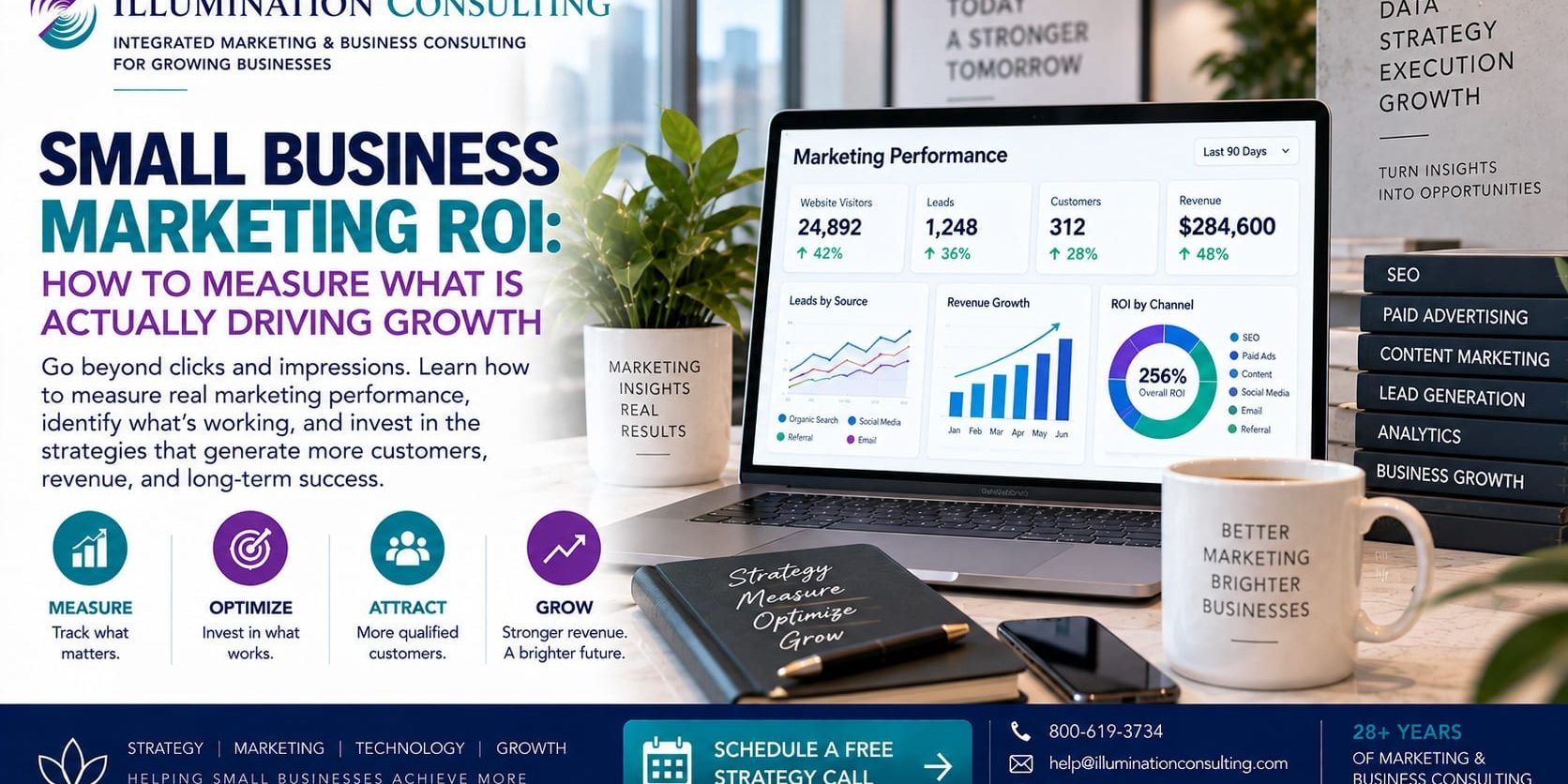
Small businesses have more marketing data available than ever, yet many owners still struggle to answer one fundamental question: Is our marketing actually producing profitable business growth? Website traffic, Google rankings, advertising clicks, social engagement, email opens, leads, and conversion rates can all provide useful information, but none of these metrics alone tells management whether marketing investment is creating sufficient economic value.
This is where small business marketing ROI becomes important. Measuring marketing return on investment requires looking beyond activity metrics and connecting marketing expenditures to qualified opportunities, customers, revenue, margins, retention, and customer value. The objective is not simply to prove that marketing is “working.” It is to understand which investments deserve more capital, which need improvement, and which may no longer justify their cost.
For companies investing in professional marketing services, better measurement can also improve future decision-making. When marketing performance is connected to business outcomes, management can allocate resources based on evidence rather than assumptions.
What Is Marketing ROI?
Marketing ROI is a way of evaluating the financial return generated by marketing investment.
At its simplest, a business might compare the amount spent on a marketing activity with the revenue or profit attributable to that activity.
A basic revenue-oriented calculation might be expressed as:
Marketing Return = Revenue Attributed to Marketing ÷ Marketing Cost
A more financially meaningful analysis can incorporate the profit generated rather than revenue alone.
For example:
Marketing ROI = (Return From Marketing − Marketing Cost) ÷ Marketing Cost × 100
The exact calculation a company uses depends on what it is trying to measure and how accurately costs and outcomes can be attributed.
The important point is consistency.
If a company changes its definition every month, performance comparisons become unreliable.
Revenue Is Not the Same as Profit
One of the most important distinctions in marketing measurement is the difference between revenue and profitability.
Imagine two campaigns.
Campaign A produces $100,000 in revenue.
Campaign B produces $70,000.
It would be easy to conclude that Campaign A performed better.
But suppose Campaign A required substantially more advertising, discounts, sales commissions, fulfillment expense, and promotional costs.
Campaign B might ultimately contribute more profit despite generating less revenue.
This is why sophisticated marketing decisions should eventually move beyond:
How much did we sell?
toward:
What economic value did this marketing investment create?
Start by Defining the Business Objective
Before choosing metrics, determine what the marketing activity is expected to accomplish.
Possible objectives include:
- generate qualified leads
- acquire customers
- increase ecommerce sales
- book consultations
- increase repeat purchases
- launch a new service
- enter a new geographic market
- build organic search visibility
- increase customer lifetime value
- reactivate previous customers
Different objectives require different measurements.
An SEO program intended to build long-term organic visibility should not necessarily be evaluated exactly like a short-duration paid advertising campaign designed to generate immediate inquiries.
Measurement should match the objective.
Separate Marketing Metrics From Business Metrics
Marketing platforms provide enormous quantities of data.
Common marketing metrics include:
- impressions
- reach
- clicks
- click-through rate
- website sessions
- rankings
- engagement
- video views
- email opens
- form submissions
These can be useful diagnostic indicators.
Business metrics include:
- qualified leads
- appointments
- proposals
- customers
- revenue
- gross profit
- customer acquisition cost
- repeat purchase rate
- customer lifetime value
The strongest reporting connects the two.
For example:
Google Search → Website Visit → Qualified Lead → Consultation → Customer → Revenue
Rather than:
Google Search → Website Visit
The farther measurement travels toward an economic outcome, the more useful it becomes for management.
Measure the Entire Customer Acquisition Funnel
Small business marketing ROI becomes easier to understand when the customer acquisition process is treated as a funnel.
A service business might track:
Impressions → Website Visitors → Leads → Qualified Leads → Appointments → Proposals → Customers → Revenue
An ecommerce business might track:
Impressions → Website Visitors → Product Views → Add to Cart → Checkout → Purchase → Repeat Purchase
Each stage answers a different question.
If visibility is increasing but traffic is not, the issue may involve targeting or messaging.
If traffic is increasing but inquiries are not, the problem may involve the website.
If inquiries are increasing but customers are not, lead management or sales may require attention.
Measurement helps management diagnose the constraint instead of simply spending more.
Track Marketing Cost Accurately
ROI calculations are only as useful as the cost data behind them.
Marketing costs may include more than advertising spend.
Depending on the analysis, relevant expenses might include:
- media spend
- agency fees
- consulting
- software
- content production
- photography
- video
- website work
- marketing employees
- contractors
- creative development
This does not mean every calculation must include every possible overhead expense.
It means management should know what the number represents.
A return calculation based solely on media spend should not be presented as if it represents the complete cost of customer acquisition.
Calculate Cost per Lead
One useful starting metric is cost per lead.
The simplified formula is:
Cost per Lead = Marketing Cost ÷ Leads Generated
Suppose a hypothetical campaign costs $5,000 and generates 100 leads.
$5,000 ÷ 100 = $50 per lead
This number becomes more useful when compared across campaigns or periods.
However, inexpensive leads are not automatically good leads.
That is why measurement should continue farther down the funnel.
Measure Cost per Qualified Lead
A campaign might produce many inquiries that do not fit the business.
Qualified lead cost provides additional context.
Cost per Qualified Lead = Marketing Cost ÷ Qualified Leads
Using an illustrative example, suppose the same $5,000 campaign generated 100 inquiries but only 25 met the company’s qualification criteria.
$5,000 ÷ 25 = $200 per qualified lead
Management now has a very different understanding of acquisition performance.
This is why the small business lead management process should feed information back into marketing.
Marketing needs to know not only how many leads it generated but what happened to them.
Calculate Customer Acquisition Cost
Customer acquisition cost moves the analysis another step closer to the business outcome.
A simplified calculation is:
Customer Acquisition Cost = Acquisition Spending ÷ New Customers Acquired
Suppose a company spends $10,000 on a marketing initiative and acquires 20 new customers.
$10,000 ÷ 20 = $500 CAC
The number itself does not tell management whether the campaign was successful.
That depends on what a customer is economically worth to the business.
Compare CAC With Customer Value
A $500 acquisition cost might be excellent for one business and unsustainable for another.
Consider two hypothetical situations.
Business A
Average new customer generates $800 of revenue with limited repeat business.
Business B
Average new customer generates $8,000 over the relationship.
The same $500 acquisition cost has dramatically different implications.
This is why customer acquisition cost should be considered alongside:
- average transaction value
- gross margin
- repeat purchases
- purchase frequency
- retention
- lifetime value
Marketing economics cannot be understood from CAC alone.
Measure Customer Lifetime Value
Customer lifetime value estimates the economic value created by a customer over the duration of the relationship.
The appropriate calculation varies substantially depending on the business model.
A subscription company, medical practice, professional-services company, retailer, and ecommerce brand may all calculate customer value differently.
At a conceptual level:
Customer Value = Purchase Value × Purchase Frequency × Customer Relationship Duration
More advanced models can incorporate gross margin, churn, discounts, servicing costs, and other financial variables.
The purpose is not mathematical complexity.
It is recognizing that the first transaction may represent only part of the customer’s value.
Understand CAC-to-LTV Relationships
Customer acquisition cost and lifetime value should be evaluated together.
If customer value increases while acquisition cost remains stable, the economics of marketing improve.
If CAC increases while customer value declines, growth becomes more difficult to sustain.
This creates two broad ways to improve acquisition economics:
Reduce the cost of acquiring customers.
or
Increase the economic value generated by each customer.
The strongest growth strategies frequently work on both.
Measure Conversion Rates Throughout the Funnel
Conversion rate should not be treated as a single website metric.
Businesses can calculate conversion between multiple stages.
Examples include:
Visitor → Lead
Lead → Qualified Lead
Qualified Lead → Appointment
Appointment → Proposal
Proposal → Customer
Visitor → Purchase
First Purchase → Repeat Purchase
This allows management to identify where opportunities are being lost.
A company might discover that advertising is producing excellent leads but proposal conversion is poor.
That is not necessarily an advertising problem.
It may be a sales-process problem.
Measure Website Conversion
The company website frequently sits between marketing investment and customer acquisition.
A simplified lead-generation conversion calculation is:
Website Conversion Rate = Conversions ÷ Visitors × 100
Suppose 5,000 relevant visitors produce 150 inquiries.
150 ÷ 5,000 × 100 = 3%
This is an illustrative example, not an industry benchmark.
Improving website conversion can increase the return generated from SEO, advertising, social media, referrals, and other traffic sources simultaneously.
That is why professional website design services should be considered part of marketing performance rather than purely a design expense.
Evaluate SEO Beyond Rankings
SEO measurement frequently becomes overly focused on keyword positions.
Rankings matter because they influence visibility, but they are an intermediate metric.
A more complete SEO measurement framework can include:
- organic impressions
- rankings
- organic clicks
- relevant landing-page traffic
- conversions
- qualified leads
- customers
- revenue
Professional SEO services should ultimately contribute to commercially meaningful visibility rather than rankings for their own sake.
A keyword ranking that attracts the wrong audience may have little economic value.
A lower-volume search term that consistently generates qualified customers may be substantially more important.
Account for SEO’s Longer Time Horizon
SEO creates a measurement challenge because the investment and return may occur in different periods.
A business might invest in:
- technical improvements
- service pages
- content
- internal linking
- authority development
months before the full impact becomes visible.
That makes evaluating SEO solely on immediate monthly revenue potentially misleading.
Businesses should monitor both:
Leading indicators
such as impressions, rankings, indexed pages, and relevant traffic
and:
Business outcomes
such as leads, customers, and revenue.
The time horizon matters.
Measure Content Marketing by Business Purpose
Content should also be evaluated according to what each asset is intended to accomplish.
An article might support:
- organic visibility
- customer education
- lead nurturing
- internal linking
- sales conversations
- email marketing
- authority
- conversion
This means an article should not automatically be judged unsuccessful because it did not directly generate a sale.
A useful content marketing program can influence customers across multiple stages of the buying process.
Businesses should still measure performance, but measurement should reflect the content’s strategic role.
Measure Paid Advertising Beyond ROAS
Return on ad spend, or ROAS, is widely used in digital advertising.
A simplified calculation is:
ROAS = Revenue Attributed to Advertising ÷ Advertising Spend
Suppose an ecommerce campaign generates $40,000 of attributed revenue from $10,000 in media spend.
The simplified ROAS is:
4.0
In other words, four dollars of attributed revenue were generated for every dollar of advertising spend.
But ROAS is not profit.
The business still may need to account for:
- product cost
- discounts
- fulfillment
- shipping subsidies
- agency fees
- payment processing
- returns
- overhead
A high ROAS can coexist with weak profitability.
Avoid Treating Platform Attribution as Absolute Truth
Advertising platforms attempt to attribute conversions to their own campaigns.
Analytics platforms may use different attribution logic.
CRM systems may record yet another source.
Customers themselves may interact with multiple channels before purchasing.
A buyer could:
- discover the company through social media
- read an article
- return through Google
- click an advertisement
- subscribe to email
- eventually contact the business directly
Which channel created the customer?
There may not be one perfect answer.
Attribution should therefore support decision-making without pretending that every customer journey can be reduced to a single touchpoint with complete certainty.
Track First-Touch and Last-Touch Information
One practical approach is preserving more than one attribution signal.
First-touch attribution asks:
Where did the customer first discover us?
Last-touch attribution asks:
What interaction immediately preceded conversion?
Both can be useful.
First touch can reveal discovery channels.
Last touch can reveal conversion channels.
Neither necessarily explains the entire journey.
Use CRM Data to Close the Measurement Loop
For lead-generation businesses, the CRM is often where marketing attribution becomes substantially more useful.
Marketing analytics can identify where the inquiry originated.
The CRM can reveal what happened afterward.
Together they can connect:
Source → Lead → Qualification → Sales Opportunity → Customer → Revenue
This is one reason improving lead management has implications far beyond sales administration.
It gives marketing better data.
Measure Revenue by Source
Once lead and sales information are connected, businesses can compare revenue generated from different sources.
For example:
| Source | Leads | Customers | Revenue |
|---|---|---|---|
| Organic Search | 60 | 12 | $48,000 |
| Paid Search | 90 | 10 | $37,000 |
| Referrals | 25 | 11 | $52,000 |
| Social Media | 70 | 5 | $14,000 |
These figures are entirely illustrative.
The point is that lead volume alone would produce a very different interpretation from customer and revenue data.
Marketing performance becomes clearer as measurement moves closer to economic outcomes.
Measure Profitability by Source When Possible
Revenue by source is useful.
Profitability by source is better.
Different acquisition channels may attract customers with different:
- transaction sizes
- margins
- repeat-purchase behavior
- service requirements
- retention
- discount sensitivity
A channel generating fewer customers can still be strategically valuable if those customers are more profitable.
This is where marketing analysis becomes a business-management discipline rather than simply a campaign-reporting function.
Account for Repeat Business
Marketing ROI can be understated when companies measure only the initial purchase.
Suppose acquiring a customer costs $300.
The customer’s first transaction generates $400.
The economics may initially look modest.
But if the customer purchases repeatedly and ultimately generates several thousand dollars in profitable revenue, the acquisition looks very different.
Businesses with meaningful repeat purchasing should therefore track:
- repeat purchase rate
- purchase frequency
- retention
- average customer value
- lifetime value
Acquisition and retention economics belong in the same conversation.
Distinguish New-Customer Revenue From Existing-Customer Revenue
Growth reporting can become misleading when all revenue is attributed to current marketing.
Some revenue may come from:
- existing customers
- recurring contracts
- subscriptions
- repeat purchasers
- longstanding relationships
- previous marketing efforts
Separating new-customer acquisition from existing-customer revenue provides a clearer picture.
Both matter, but they answer different questions.
Consider Payback Period
Customer acquisition cost also affects cash flow.
The CAC payback period asks how long it takes for the economic contribution from a customer to recover the cost of acquiring that customer.
This can matter significantly for small businesses.
Two acquisition strategies might eventually produce similar returns, but one may recover the investment much faster.
For a company with limited working capital, that difference can affect how aggressively it can scale.
Avoid Measuring Every Channel With the Same Standard
Different marketing channels perform different functions.
Paid search may capture existing demand.
SEO may build organic visibility.
Content may educate prospects.
Social media may create discovery and trust.
Email may nurture and retain customers.
A channel should be evaluated according to the role it plays within the customer acquisition system.
The objective is not forcing every activity to generate an immediately attributable transaction.
The objective is understanding how the portfolio works together to create customers and revenue.
Build a Marketing Performance Dashboard
A small business does not need hundreds of metrics.
A useful executive dashboard might include:
| Metric | What It Helps Answer |
|---|---|
| Marketing Spend | What are we investing? |
| Qualified Traffic | Are we reaching relevant audiences? |
| Leads/Sales | Is demand being created? |
| Qualified Leads | Are we attracting the right prospects? |
| Customers | Are opportunities converting? |
| Revenue | What economic output is being generated? |
| CAC | What does customer acquisition cost? |
| Conversion Rate | How efficiently does the funnel work? |
| Customer Value | What are acquired customers worth? |
| Revenue by Source | Which channels create business value? |
Additional channel-specific metrics can sit beneath this executive view.
Leadership should not have to interpret fifty platform reports to understand whether marketing is moving the business forward.
Review Trends, Not Isolated Days
Marketing performance fluctuates.
A single day or week can be influenced by:
- seasonality
- customer behavior
- campaign changes
- holidays
- competitive activity
- sales-cycle timing
- small sample sizes
Evaluate trends over appropriate periods.
The correct timeframe depends on the business and channel.
An ecommerce advertiser with hundreds of transactions each day can make decisions faster than a consulting firm that acquires a handful of high-value clients each month.
Establish a Baseline Before Making Major Changes
Before redesigning the website, changing agencies, launching a campaign, or dramatically increasing spending, document existing performance.
Record metrics such as:
- traffic
- conversion
- leads
- qualified leads
- customers
- revenue
- CAC
- source mix
Without a baseline, management may struggle to determine whether the change improved performance.
Measurement should precede optimization.
Do Not Confuse Correlation With Causation
Marketing performance often improves after several changes occur simultaneously.
For example, a company may:
- redesign the website
- increase advertising
- publish new content
- improve SEO
- hire a salesperson
If revenue increases, attributing the entire improvement to one change may be impossible.
This does not mean measurement is useless.
It means management should avoid false precision.
Controlled tests, channel-level data, attribution, and historical comparisons can improve confidence, but business analysis still requires judgment.
Use Marketing ROI to Allocate Future Budget
Measurement becomes valuable when it changes decisions.
The business can use performance data to decide where the next marketing dollar should go.
This connects directly with small business marketing budget allocation.
A disciplined process might look like:
Measure → Diagnose → Prioritize → Reallocate → Test → Measure Again
Strong channels can receive additional investment.
Weak channels can be improved, repositioned, or reduced.
New opportunities can be tested without abandoning proven acquisition systems.
Do Not Automatically Cut Long-Term Investments
ROI analysis can create a dangerous bias toward channels producing immediate measurable results.
Paid advertising is relatively easy to measure.
Brand development, SEO, content, reputation, and customer relationships can have longer and less direct effects.
A business focused exclusively on immediate attribution may underinvest in assets that create future competitive advantage.
The solution is not abandoning ROI.
It is evaluating different investments across appropriate time horizons.
Measure Incremental Growth
As marketing matures, businesses can ask a more sophisticated question:
What additional business did this investment create that probably would not have occurred otherwise?
This concept of incrementality matters because some customers would have purchased without a particular advertisement or campaign.
Perfect incremental measurement is difficult for many small businesses.
But the concept encourages better thinking.
Marketing should create additional economic value, not merely take credit for demand that already existed.
Build a Measurement System Before Scaling
A business should be cautious about dramatically increasing marketing investment when it cannot answer basic questions about existing performance.
Before scaling, management should ideally understand:
- where customers come from
- what acquisition costs
- which leads are qualified
- how effectively leads convert
- what customers are worth
- which channels produce revenue
- where the funnel is constrained
Without this information, scaling can magnify inefficiency.
With it, management can make substantially more informed growth decisions.
Marketing ROI Is Ultimately a Management Tool
Marketing ROI should not exist merely to produce attractive reports.
Its purpose is to improve decisions.
A strong measurement system helps management answer:
What is generating growth?
What is costing too much?
Where are opportunities being lost?
Which customers are most valuable?
Which channels deserve more investment?
Where should we improve before spending more?
Those questions connect marketing directly to business strategy.
Illumination Consulting helps businesses integrate marketing services, SEO, content marketing, website development, conversion strategy, and business consulting into measurable growth systems. Rather than evaluating marketing as a collection of disconnected tactics, the objective is to connect investment with customer acquisition, revenue, profitability, and sustainable business growth.
Frequently Asked Questions
What is a good marketing ROI for a small business?
There is no universal marketing ROI that applies to every company. Appropriate returns depend on gross margins, customer lifetime value, acquisition costs, sales cycles, repeat business, operating expenses, and the type of marketing investment being measured.
How should a small business calculate marketing ROI?
Businesses can compare marketing costs with attributable revenue or, preferably where possible, the economic contribution generated by acquired customers. The methodology should remain consistent so performance can be compared meaningfully over time.
Is ROAS the same as marketing ROI?
No. ROAS compares advertising revenue with advertising spend. Marketing ROI can consider broader marketing costs and profitability. A campaign can produce a strong ROAS without necessarily generating strong profit.
Should SEO be measured by ROI?
Yes, but SEO should be evaluated across an appropriate time horizon. Rankings, impressions, and organic traffic are useful leading indicators, while leads, customers, revenue, and acquisition economics provide stronger measures of business impact.
What marketing metrics should small businesses track?
Useful executive metrics can include marketing spend, qualified traffic, leads, qualified leads, customers, conversion rates, customer acquisition cost, revenue by source, retention, and customer value. The precise dashboard should reflect the business model.
Why is customer acquisition cost important?
CAC helps management understand how much it costs to acquire customers. When compared with customer value, margin, retention, and payback period, it provides important information about whether growth is economically sustainable.
How often should marketing ROI be reviewed?
Marketing performance should be monitored regularly, while strategic ROI reviews should use a timeframe appropriate to the company’s sales cycle and marketing channels. Short-term advertising and long-term SEO, for example, should not necessarily be judged over identical periods.