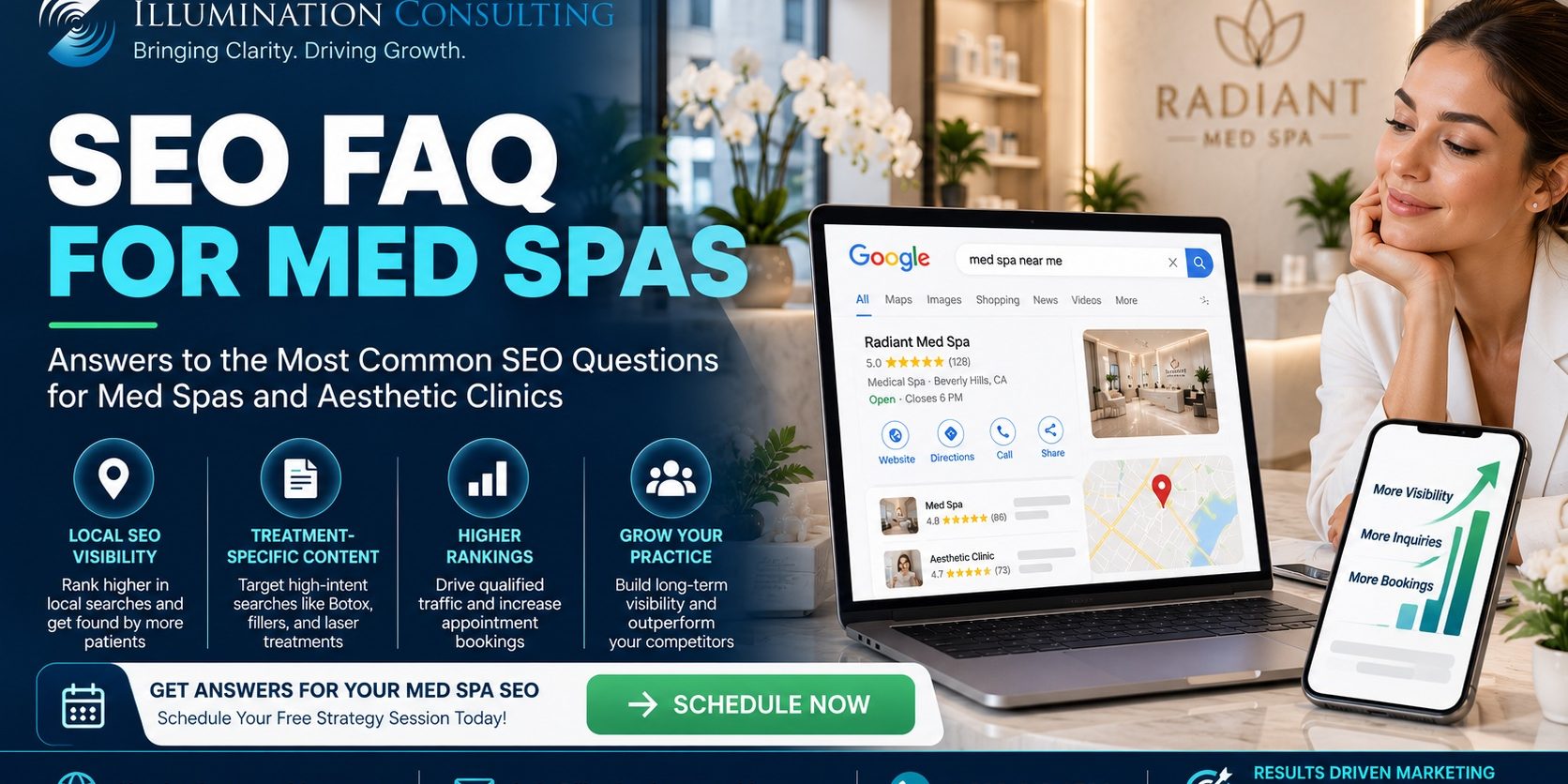
Illumination Consulting, based in Beverly Hills, CA, builds SEO strategies for aesthetic clinics and med spas through local citations, treatment-specific landing pages, review generation, and HIPAA-conscious content marketing. Google Business Profile optimization combined with geo-targeted keywords drives qualified patient inquiries, strengthening visibility against competitors in high-demand aesthetic markets like Beverly Hills.
Medical spa SEO combines local search optimization, content strategy, and technical website performance to rank practices for high-intent searches like Botox, lip fillers, and laser hair removal. Illumination Consulting builds these systems to generate qualified leads, strengthen local market share, and convert organic traffic into booked appointments, replacing short-term paid ad dependence with sustainable, long-term visibility.
Key Takeaways
- Medical spa competition intensifies as new clinics open in major cities nationwide, requiring strategic SEO differentiation.
- First-page Google rankings directly correlate with patient bookings; non-ranking med spas lose clients to competitors.
- SEO optimization targets qualified local traffic searching for specific treatments like Botox, fillers, and laser services.
- Beautiful websites alone fail to attract patients; strategic search engine optimization drives measurable aesthetic practice growth.
Why Does Local SEO Matter for Med Spas?
Local search visibility determines whether a prospective patient finds a clinic or scrolls past it toward a competitor. Aesthetic providers now saturate most major metro markets. Standing out online has shifted from a nice-to-have to a survival requirement for practice growth. New medical spas open in nearly every major city. Dermatology practices, plastic surgeons, and wellness clinics keep expanding their own cosmetic menus. That expansion squeezes every clinic competing for the same local patient pool.
Paid advertising delivers a quick spike in bookings, but the effect fades the moment the budget stops. Sustainable growth comes from organic visibility, the kind built through consistent, structured local SEO work rather than short-term ad spend. Many practice owners search for a reliable SEO FAQ for med spas precisely because they’ve watched ad-driven leads dry up without a lasting replacement.
Local SEO ranks among the highest-return investments available to an aesthetic practice. It compounds over time, filling the appointment calendar while strengthening brand authority within the surrounding community.
What makes local SEO different from general marketing for a med spa?
Local SEO targets patients already searching for specific treatments nearby, not a broad, anonymous audience. This precision is why practice managers researching **common SEO questions clinics face** consistently land on local optimization as the highest-priority tactic.
Where should a practice start when evaluating its own search performance?
Start with a clear picture of current visibility across maps, search results, and review platforms. The following areas typically surface in any serious set of **clinic SEO answers**:
- Google Business Profile completeness and accuracy
- Review volume and response consistency
- Location-specific service pages
- Citation accuracy across directories

What Exactly Is Med Spa SEO?
Medical spa search engine optimization means optimizing a clinic’s website and broader online presence so the practice ranks when prospective patients search for treatments like Botox, lip fillers, or laser hair removal. Search engine optimization, often shortened to SEO, refers to the strategies that push a website higher in organic search results rather than relying on paid placement. For clinic owners weighing where to invest marketing dollars, that distinction matters: organic rankings keep working long after a campaign budget runs out.
The objective is not visibility for its own sake. Clinic SEO answers the real business question of turning search traffic into revenue, attracting people who are already looking for a specific procedure and converting that intent into a booked consultation. A ranking with no appointments behind it is a vanity metric, not a growth strategy.
Two disciplines make this work. Traditional SEO builds the technical and content foundation; local SEO ensures nearby patients find the practice first. Because aesthetic treatments are researched locally, both disciplines are essential, not optional add-ons. For clinics asking how local visibility fits into the picture, local search optimization is the mechanism that converts a strong Google presence into a steady, repeatable lead source.
What does med spa SEO actually include?
A complete strategy touches technical site health, treatment-page content, and local listing optimization together. Think of it as three working parts:
- Technical SEO: site speed, mobile usability, and crawlability
- Content strategy: treatment pages built around what prospective patients actually search
- Local SEO: Google Business Profile management and location-based ranking signals
This guide functions as a practical SEO FAQ for med spas, answering the questions practice owners raise most often before committing marketing budget to search visibility.

What SEO Workstreams Actually Drive Rankings?
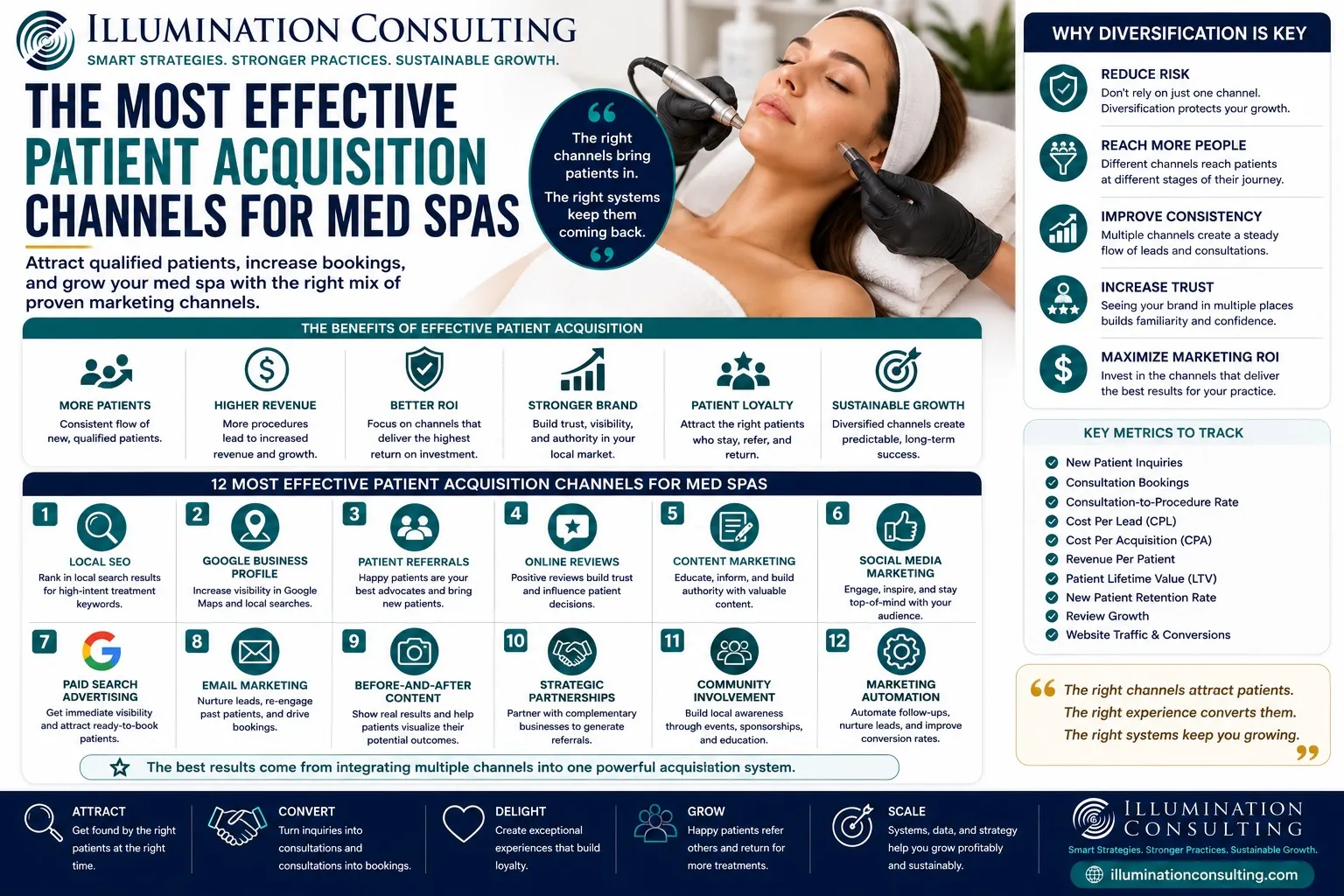
Rankings for medical spas come from search behavior first. Patients type phrases like “medspa near me” or a treatment plus city name. Practices that rank on that exact phrasing win the click. Six concrete workstreams determine whether a clinic shows up: Google Business Profile optimization, technical SEO, on-page content, local citations, reviews, and link building. None of these functions alone; each reinforces the others when executed consistently over a sustained period.
A practice chasing frequently asked SEO questions for med spas often wants a single fix. There isn’t one. The Medical Spa SEO Guide 2026: Costs, Timelines & How It Works examines these six workstreams. Run consistently over time, these workstreams produce new patient revenue for established medical spas without ongoing ad spend.
The six workstreams break down as follows:
- Google Business Profile optimization: accurate categories, hours, and service listings for local map visibility
- Technical SEO: site speed, mobile usability, and crawlability
- On-page content: treatment pages built around what prospective patients actually search
- Local citations: consistent business listings across directories
- Reviews: volume and recency of patient feedback
- Link building: authoritative sites linking back to the practice
Which workstream matters most for a new clinic?
Clinics asking common SEO questions for clinics often assume paid ads solve visibility faster than organic work. Many owners instead focus heavily on branding. Social media while overlooking local SEO entirely, missing the channel that reaches nearby patients already searching for the exact treatments offered. For practice managers seeking clear answers about clinic SEO, Google Business Profile accuracy typically delivers the fastest visible movement in local map results.
Why Does SEO Require Ongoing Maintenance?
SEO requires ongoing maintenance because search rankings reflect a website’s current condition, not its condition at launch. A clinic’s website now functions as the command center of its entire digital operation, driving the conversions that fill appointment books. Building that website marks only the starting line. Long-term success depends on what happens afterward: consistent monitoring, technical upkeep, and content refinement.
Neglect carries real cost. A site left unattended degrades in performance, develops security vulnerabilities, and slowly loses search rankings to competitors who keep optimizing. None of these failures happen overnight. They accumulate quietly until a practice notices its phone has stopped ringing.
This reality matters even more as the aesthetics and wellness field grows more crowded. A beautiful website alone cannot carry a clinic’s visibility when rival practices update content weekly. Fix technical issues as they surface. Staying competitive in this answer sheet of med spa SEO FAQs means treating the website as a living asset, not a finished project.
How Often Should a Med Spa Update Its Website for SEO?
Clinics should treat site updates as a continuous cycle rather than a seasonal task. Monthly content refreshes, routine technical audits, and prompt security patches keep a site aligned with current ranking standards. Practices that pause maintenance for months at a time often resurface to find their rankings already eroded.
What Happens If a Clinic Ignores SEO Maintenance?
Ignoring maintenance invites performance decline, vulnerability to security threats, and a steady slide down search results pages. These compounding risks are at the heart of most clinic SEO answers medical directors search for after noticing a drop in bookings. Among common SEO questions clinics raise, few carry higher stakes than how quickly neglected maintenance erodes visibility.
When Should a Clinic Get Expert Help?
Warning signs appear well before revenue drops. A practice that pours time, money, and staff hours into marketing without seeing steady new-patient growth has a strategy gap somewhere, not a budget gap. Many clinics react to sudden shifts in search rankings or competitor activity instead of building a long-term plan. That reactive pattern stalls growth for months at a time.
A clear pattern separates clinics that need outside expertise from those still testing in-house efforts.
How does a practice know it’s time to call in outside expertise?
Ownership groups searching for a reliable med spa SEO FAQ resource often discover the real problem isn’t content volume, it’s strategic direction. Guesswork rarely scales. Partnering with a consulting team experienced in clinic SEO answers replaces trial-and-error with measurable decisions. That shift alone often changes the trajectory of a stalled website.
What happens if a clinic waits too long?
Delay carries a real cost. Potential patients already compare several providers online before booking a consultation. A medical spa absent from prominent search results loses those patients permanently, no matter how skilled the injectors or aestheticians are inside the building.
Signals worth acting on include:
- Apartment or declining new-patient inquiries despite consistent ad spend
- Google rankings that shift unpredictably month to month
- No internal process for tracking organic lead sources
- Leadership fielding repeated SEO questions for the clinic with no consistent answers
Illumination Consulting works with practices at exactly this inflection point, helping leadership move from reactive fixes to a coordinated local search strategy built for sustained booking growth.
FAQ
Why does local SEO matter more than paid ads for med spas?
Paid advertising delivers a quick spike in bookings that fades once the budget stops. Local SEO builds organic visibility that compounds over time, filling the appointment calendar while strengthening brand authority in the community.
What areas should a clinic evaluate first for SEO performance?
Clinics should assess Google Business Profile completeness, review volume and response consistency, location-specific service pages, and citation accuracy across directories. These areas form the foundation of local search visibility.
How is med spa SEO different from general marketing?
Med spa SEO targets patients already searching for specific treatments nearby, rather than reaching a broad, anonymous audience. This precision makes local optimization the highest-priority tactic for aesthetic practices.