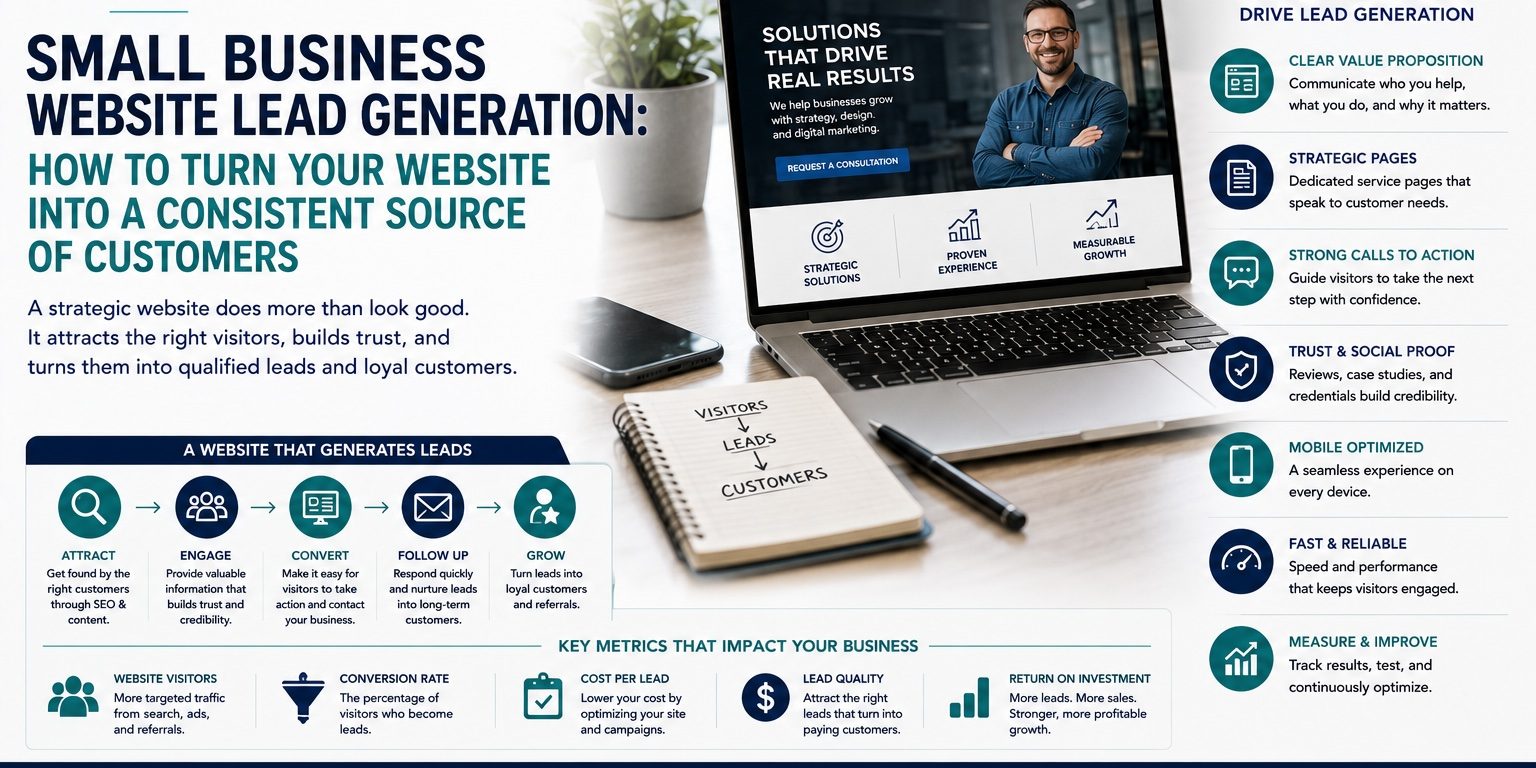
A small business website should do more than establish an online presence. It should help potential customers discover the company, understand what it offers, develop confidence in the business, and take the next step toward becoming a customer. Small business website lead generations starts with a proper business website. A feature rich small business website optimized for lead generation.
Yet many small business websites function primarily as digital brochures.
They describe the company. They list services. They provide contact information. They may even receive meaningful traffic. However, they are not intentionally designed around customer acquisition.
Small business website lead generation requires a different approach. The website must connect visibility, positioning, content, trust, conversion, and follow-up into a measurable system.
For companies investing in small business website design, the objective should not simply be launching an attractive website. The site should become a business asset capable of supporting sales and long-term growth.
Why Small Business Websites Fail to Generate Leads
A website can look professional and still perform poorly.
This happens because visual design represents only one component of website performance.
A prospective customer needs to move through several stages:
Discovery → understanding → trust → consideration → action → follow-up → customer
Problems at any stage can reduce lead generation.
A company may have excellent services but poor search visibility.
Another may receive substantial traffic but communicate its value poorly.
Another may generate inquiries but fail to respond effectively.
Before redesigning a website or spending more money on traffic, businesses should determine where the actual constraint exists.
Start With the Customer, Not the Website
One of the most common website mistakes occurs before design begins.
The company starts by deciding:
- which colors to use
- what photographs it likes
- which template looks best
- what animations to add
- what competitors’ websites look like
Those decisions matter eventually.
They should not come first.
A lead-generating website should begin with the prospective customer.
The business needs to understand:
Who are we trying to attract?
What problem does that customer need solved?
What information do they need before contacting us?
What objections could prevent them from acting?
Why should they choose us instead of another option?
What action do we want them to take?
These answers should influence the architecture and messaging of the entire website.
Clarify the Value Proposition
Visitors should quickly understand what the business does and why it is relevant to them.
A vague homepage headline such as:
“Solutions for a Better Tomorrow”
may sound polished but communicates very little.
A stronger value proposition identifies the service, customer, problem, outcome, or meaningful differentiator.
The objective is not cleverness.
It is clarity.
Visitors should not have to study the website to determine whether they have arrived at the right company.
Build the Website Around Search Intent
Customers frequently arrive through search engines rather than the homepage.
Someone searching for a specific service may land directly on an internal page.
That means each important service page should function as a meaningful entry point.
For example, a company offering five major services may benefit from dedicated pages explaining each one rather than listing everything briefly on a single page.
This gives search engines more context.
More importantly, it gives visitors information relevant to what they actually searched for.
A strong website architecture aligns:
Customer need → search query → relevant page → useful information → conversion opportunity
That relationship is fundamental to website lead generation.
Create Dedicated Service Pages
A generic Services page is rarely sufficient for a company with multiple important offerings.
Individual service pages can explain:
- what the service is
- who it is for
- problems it addresses
- how the company approaches the work
- important benefits
- relevant experience
- frequently asked questions
- what happens next
Dedicated pages can also support SEO services because each page can target a distinct area of search demand.
However, businesses should avoid creating dozens of nearly identical pages simply to target keyword variations.
Each page should provide genuine value.
Use Location Pages Strategically
Local businesses may serve several cities or geographic areas.
Location pages can support local search when they provide meaningful, location-specific information.
Weak location pages simply replace one city name with another while repeating identical content.
That creates little value for users.
A stronger location page may include:
- services available in the area
- relevant local information
- service territory
- customer examples where appropriate
- local contact information
- location-specific FAQs
- useful geographic context
The objective is not manufacturing pages for search engines.
It is helping local customers determine whether the company serves their needs.
Make Navigation Simple
Website navigation should help visitors move toward information rather than forcing them to understand the company’s internal structure.
Primary navigation usually needs to make important destinations obvious.
Depending on the business, these may include:
- services
- industries
- products
- locations
- about
- case studies
- resources
- contact
More navigation options do not necessarily create a better experience.
Too many choices can make the site harder to use.
The best structure reflects what prospective customers need to accomplish.
Create Strong Calls to Action
Every important page should have a logical next step.
Potential calls to action include:
Request a Consultation
Get a Quote
Schedule a Call
Request an Estimate
Book an Appointment
Contact Our Team
The right CTA depends on the business model.
A home-services company may prioritize quote requests.
A consultant may use strategy calls.
A professional service firm may encourage consultations.
An ecommerce company may direct visitors toward products.
Calls to action should match the customer’s buying journey rather than forcing every visitor into the same action.
Avoid Too Many Competing Calls to Action
Businesses sometimes attempt to maximize conversion by placing numerous choices everywhere.
Call us.
Email us.
Download this.
Subscribe.
Watch this.
Book a meeting.
Get a quote.
Read the guide.
Follow us.
When everything receives equal emphasis, nothing is prioritized.
Each page should have a clear primary action.
Secondary actions can exist, but the hierarchy should be obvious.
Reducing decision friction can make the website easier to use.
Put Trust Signals Near Decision Points
Visitors evaluate risk before contacting a business.
They may ask themselves:
Is this company legitimate?
Does it understand my problem?
Has it done this before?
Can I trust it?
What will happen if I contact them?
Trust signals can help answer these questions.
Depending on the business, they may include:
- customer reviews
- testimonials
- case studies
- years in business
- professional credentials
- awards
- client logos
- certifications
- portfolio examples
- guarantees that can legitimately be offered
- transparent company information
Placement matters.
A testimonial hidden on a separate page may have less influence than relevant proof positioned near a service decision.
Use Case Studies to Demonstrate Outcomes
Case studies can be particularly effective for service businesses.
A useful case study explains:
The situation
What challenge existed?
The work
What did the company do?
The result
What changed?
Where possible, measurable outcomes can strengthen credibility.
However, businesses should avoid inventing statistics or presenting unverifiable claims.
Even when exact financial results cannot be disclosed, the company can often describe the problem, approach, and outcome meaningfully.
Make Contact Forms Easy to Complete
Forms should collect enough information to support the next step without creating unnecessary friction.
A business may need:
- name
- phone
- company
- service interest
- brief message
More complex engagements may justify additional qualification fields.
But every required field creates another decision.
Businesses should ask:
Do we actually need this information before speaking with the prospect?
If not, it may not belong on the initial form.
Design for Mobile Lead Generation
Potential customers increasingly interact with websites from mobile devices.
A desktop website that technically “works” on a phone may still create a poor experience.
Businesses should test:
- navigation
- buttons
- forms
- text size
- phone links
- page speed
- images
- pop-ups
- scheduling
- checkout where applicable
Important actions should be easy to complete with a thumb and without excessive zooming or scrolling.
Mobile usability is not an optional design enhancement.
It is part of conversion.
Improve Website Speed
Visitors do not benefit from sophisticated design elements if the website takes too long to load.
Performance problems can come from:
- oversized images
- unnecessary plugins
- excessive scripts
- poorly implemented animations
- video
- inefficient themes
- weak hosting
- technical errors
Website speed also intersects with search performance and user experience.
Optimization should therefore be incorporated into development rather than treated solely as a technical cleanup project later.
Use Content to Capture Earlier-Stage Prospects
Not every potential customer begins by searching for a company.
Many begin with a problem.
A homeowner may search for information about a leaking roof.
A business owner may research ways to improve local SEO.
An entrepreneur may investigate how to launch a company.
Educational content allows businesses to become visible earlier in the decision process.
Useful formats can include:
- how-to articles
- FAQs
- comparisons
- buying guides
- checklists
- case studies
- videos
- industry explanations
Professional content marketing can support both search visibility and customer education when topics are aligned with actual buying journeys.
Connect Articles to Commercial Pages
Blog traffic has limited business value when visitors have nowhere logical to go afterward.
Articles should connect naturally with relevant service or product pages.
For example, an article explaining local SEO problems might link to an SEO service.
An article about website conversion could direct readers toward website design services.
An article discussing business startup mistakes could connect with startup consulting.
This creates a topical pathway:
Informational search → useful content → commercial solution → conversion opportunity
Internal linking also helps search engines understand relationships between content.
Use SEO to Build Compounding Visibility
Paid advertising stops producing traffic when spending stops.
Organic search can continue generating visibility from work performed earlier, although rankings are never guaranteed and require ongoing maintenance.
A small business SEO strategy can include:
- keyword research
- technical optimization
- service pages
- local search
- content
- internal linking
- schema
- authority development
- conversion optimization
The strongest approach connects SEO with commercial priorities.
Ranking for thousands of irrelevant searches is less valuable than attracting a smaller number of people actively looking for services the company provides.
Use Paid Traffic Carefully
Paid search and social advertising can accelerate website traffic.
But advertising does not repair a weak website.
Before significantly increasing paid acquisition, businesses should examine:
- landing-page relevance
- value proposition
- offers
- calls to action
- mobile experience
- forms
- tracking
- lead response
- conversion rates
Sending more paid traffic into an ineffective conversion process can increase marketing expenses without proportionately increasing revenue.
Build Dedicated Landing Pages When Necessary
Not every advertising campaign should send traffic to the homepage.
A dedicated landing page can create stronger alignment between:
Advertisement → customer intent → message → offer → CTA
For example, an advertisement for commercial website design should generally lead to information specifically about commercial website design rather than forcing visitors to navigate from a broad homepage.
Message continuity reduces friction.
It also makes campaign performance easier to evaluate.
Track Meaningful Website Conversions
Businesses need to define what constitutes a lead.
Depending on the company, conversions might include:
- qualified form submissions
- phone calls
- appointment bookings
- quote requests
- consultation requests
- purchases
- demo requests
Newsletter subscriptions or PDF downloads can be useful secondary conversions, but they are not necessarily equivalent to sales opportunities.
Tracking should distinguish between levels of intent.
Calculate Website Lead Conversion Rate
A simplified website lead conversion formula is:
Website Lead Conversion Rate = Qualified Leads ÷ Website Visits × 100
Suppose a website receives 5,000 visits and generates 100 qualified inquiries.
The simplified conversion rate is:
100 ÷ 5,000 × 100 = 2%
This example is illustrative rather than a universal benchmark.
The value comes from establishing a baseline and tracking whether performance improves.
Measure Cost per Lead
For paid acquisition, businesses should understand what leads cost.
A simplified calculation is:
Cost per Lead = Marketing Spend ÷ Qualified Leads
If a company spends $5,000 on a campaign and generates 50 qualified leads:
$5,000 ÷ 50 = $100 per lead
Again, this number is not meaningful by itself.
A $100 lead that becomes a $20,000 client may be extremely attractive.
A $20 lead that never becomes a customer may be expensive.
Lead quality matters.
Measure Lead-to-Customer Conversion
Website performance should eventually connect to sales.
A simplified calculation is:
Lead-to-Customer Rate = New Customers ÷ Qualified Leads × 100
If 50 qualified leads produce 10 customers:
10 ÷ 50 × 100 = 20%
The website generated the opportunity.
The sales process converted it.
Businesses should measure both.
Otherwise, poor sales follow-up may incorrectly be interpreted as poor website performance.
Track Revenue by Lead Source
The strongest measurement goes beyond leads.
Businesses should attempt to understand which acquisition sources generate actual customers and revenue.
Potential sources include:
- organic search
- Google Ads
- social media
- referrals
- direct traffic
- partnerships
- directories
Source attribution will not always be perfect.
Customers may interact with multiple channels before contacting a company.
Nevertheless, directional attribution can help management allocate resources more intelligently.
Respond Quickly to Website Leads
Website conversion does not end when someone submits a form.
A prospect may contact several businesses.
Slow response can waste the opportunity the website successfully generated.
Companies should establish clear responsibility for:
- form submissions
- missed calls
- emails
- quote requests
- appointment requests
Lead notifications and CRM automation can help prevent inquiries from being overlooked.
But someone still needs to take ownership of the conversation.
Use a CRM Instead of an Inbox
As lead volume grows, email alone becomes increasingly difficult to manage.
A customer relationship management system can help track:
- lead source
- contact information
- service interest
- contact attempts
- sales stage
- next action
- proposal status
- closed business
- lost opportunities
The purpose is not acquiring more software.
It is preventing qualified opportunities from disappearing because follow-up is inconsistent.
Use Automation to Support Follow-Up
Automation can help businesses respond consistently.
Potential uses include:
- immediate acknowledgments
- internal lead notifications
- follow-up tasks
- appointment reminders
- email sequences
- lead routing
- reporting
Automation should reduce administrative friction.
It should not replace thoughtful communication when a prospect needs personal attention.
Analyze Landing Pages Individually
A sitewide conversion rate can hide substantial differences.
One service page may generate excellent leads.
Another may receive significant traffic but produce almost no inquiries.
Businesses should analyze important pages separately.
Review:
- traffic
- traffic source
- engagement
- calls to action
- conversions
- mobile performance
- search queries
- exit behavior
Page-level analysis helps identify where optimization can produce the greatest return.
Diagnose the Website Constraint
Before rebuilding the entire site, identify what is actually wrong.
The Website Receives Almost No Traffic
Visibility may be the primary problem.
SEO, content, advertising, local search, or promotion may require improvement.
Traffic Is Growing but Leads Are Not
Positioning, page relevance, credibility, calls to action, or conversion may be weak.
Leads Are Coming but Quality Is Poor
Traffic targeting or messaging may be attracting the wrong audience.
Qualified Leads Are Strong but Sales Are Weak
The constraint may exist in sales follow-up, proposals, pricing, or the offer.
Customers Are Being Acquired but Profitability Is Weak
Customer acquisition cost, margins, pricing, or customer lifetime value may require attention.
Diagnosing the correct constraint prevents unnecessary redesigns and marketing expenditures.
Avoid Redesigning for Appearance Alone
Businesses frequently rebuild websites because they look outdated.
Sometimes a redesign is justified.
But appearance should not be the only consideration.
Before replacing a website, evaluate:
- organic rankings
- indexed pages
- backlinks
- conversion data
- highest-performing landing pages
- existing content
- forms
- analytics
- integrations
- URLs
A careless redesign can destroy valuable search equity or conversion assets.
The objective should be upgrading performance while preserving what already works.
Build a Website That Improves Over Time
A website should not be treated as a project that ends at launch.
Customer behavior changes.
Services change.
Competitors change.
Search results change.
Technology changes.
The business learns.
High-performing websites are continuously improved through:
Measure → diagnose → prioritize → improve → test → measure again
This creates an asset that becomes more useful as the business collects additional data.
Turn the Website Into a Revenue Asset
The strongest small business websites connect multiple disciplines.
SEO attracts prospective customers.
Content answers questions.
Positioning creates relevance.
Design communicates professionalism.
Case studies establish credibility.
Calls to action create opportunities.
Forms capture information.
CRM systems organize leads.
Follow-up moves prospects toward sales.
Analytics reveal what works.
When these elements operate together, the website becomes more than an online brochure.
It becomes part of the company’s customer acquisition infrastructure.
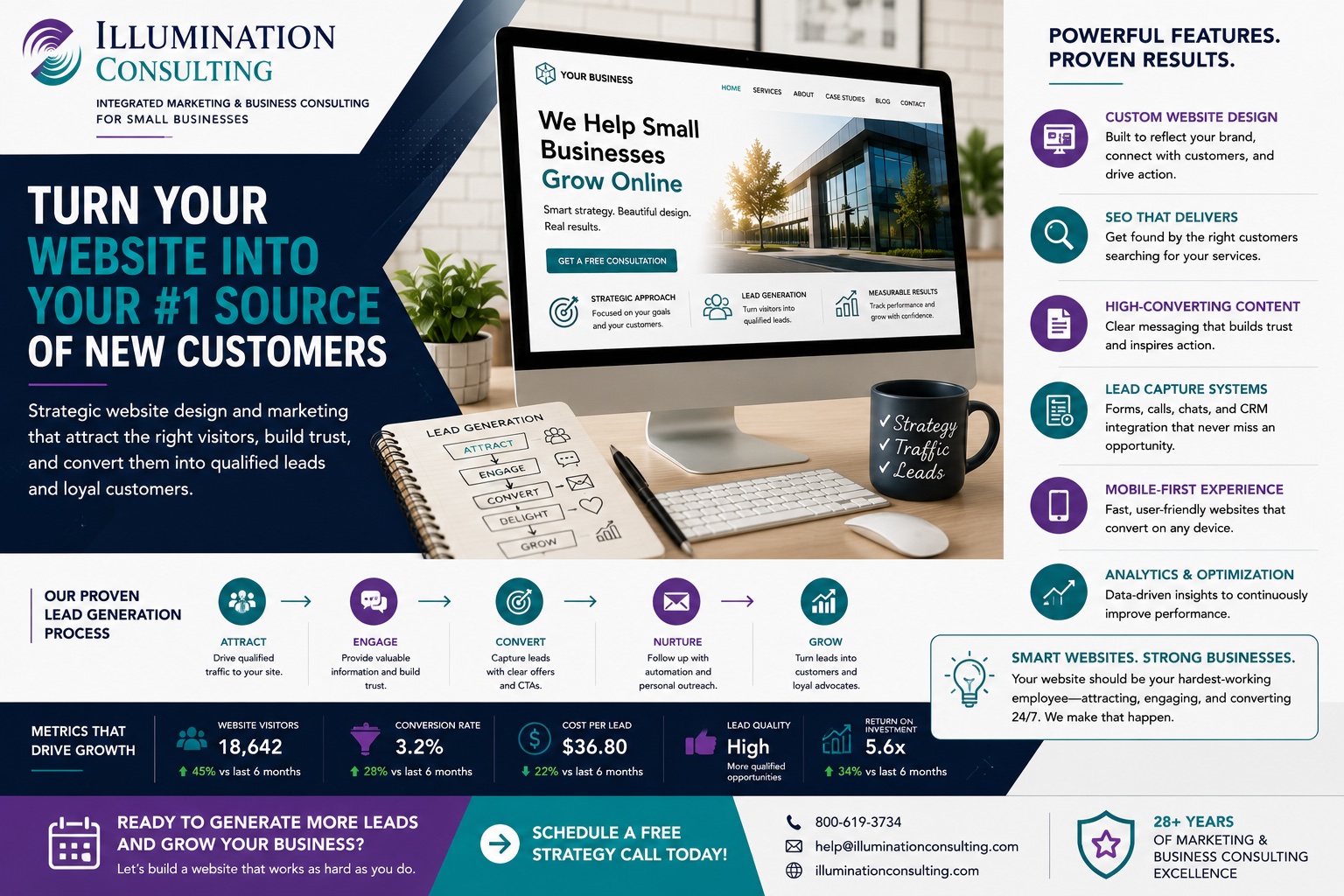
Illumination Consulting provides small business website design and integrated marketing services designed around business growth. The objective is not simply creating a better-looking website. It is building a digital platform that improves visibility, attracts qualified prospects, converts more opportunities, and contributes measurably to revenue.
Frequently Asked Questions
How can a small business website generate more leads?
A website can generate more leads by attracting qualified traffic, clearly communicating the company’s value, creating relevant service pages, building trust, using strong calls to action, simplifying forms, improving mobile usability, and connecting inquiries with effective follow-up.
Why does my website get traffic but no leads?
Possible causes include irrelevant traffic, weak positioning, unclear services, poor calls to action, insufficient trust, confusing navigation, mobile problems, slow performance, or forms that create excessive friction. Analytics and page-level conversion data can help identify the primary cause.
Does SEO help small businesses generate leads?
Yes, when potential customers actively use search engines to find the services or products the company provides. SEO should focus on commercially relevant searches and connect organic traffic with pages designed to educate and convert visitors.
Should a small business redesign its website to get more leads?
Not automatically. Businesses should first determine whether the primary problem involves design, traffic, positioning, content, conversion, technical performance, or sales follow-up. If a redesign is necessary, existing SEO assets and high-performing content should be protected during the transition.
What should a lead-generating small business website include?
Important elements can include clear positioning, dedicated service pages, strong calls to action, customer proof, useful content, simple navigation, mobile usability, contact options, analytics, search optimization, and a structured process for handling incoming leads.