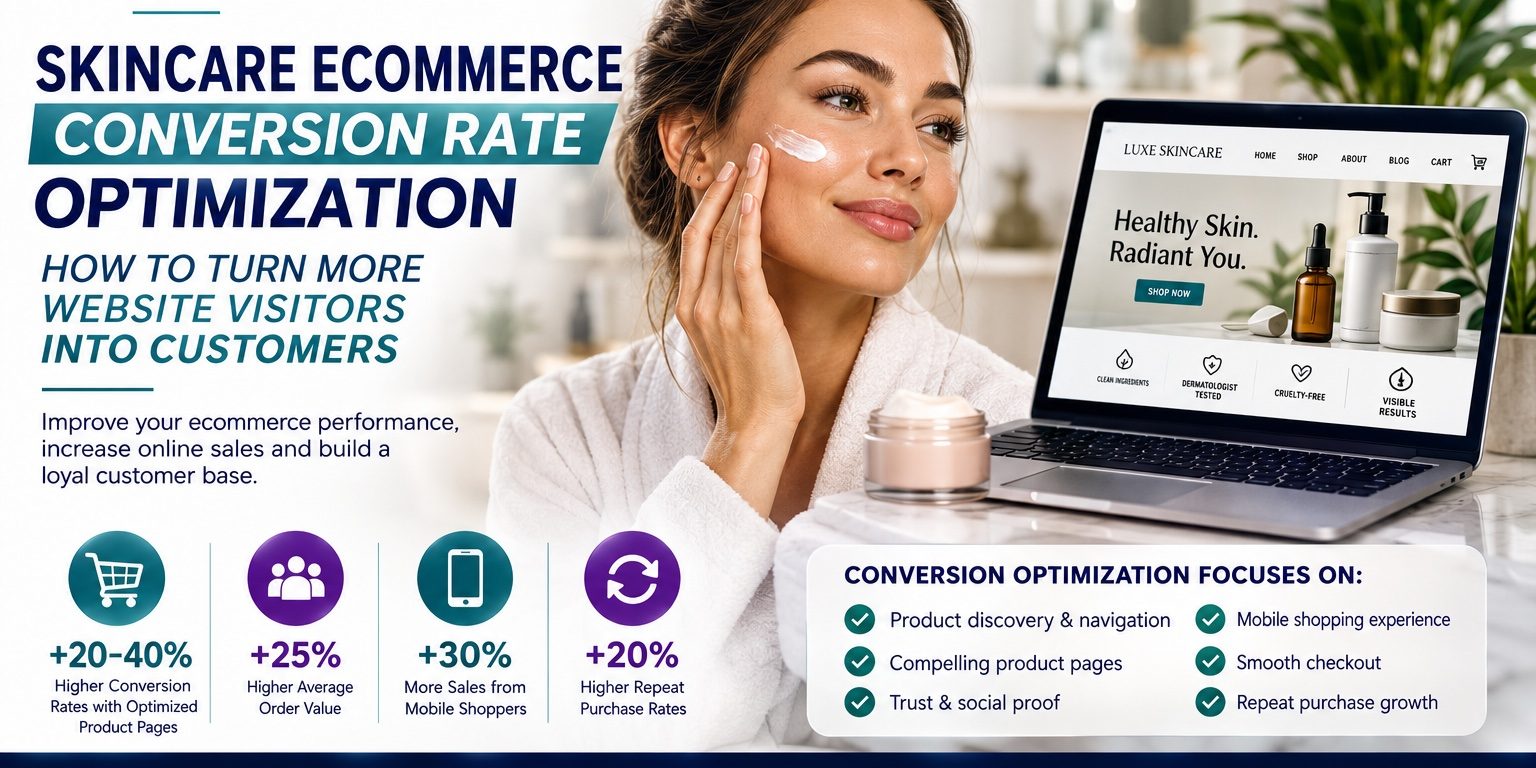
Skincare brands often focus heavily on generating more website traffic. They invest in SEO, paid advertising, influencer campaigns, social media, content marketing, email, and product launches to attract potential customers. Yet increasing traffic does not automatically increase profitable ecommerce sales.
The website still has to convert those visitors into customers.
Skincare ecommerce conversion rate optimization focuses on improving the percentage of qualified website visitors who complete desired actions, particularly product purchases. It examines the entire shopping experience, including product discovery, product pages, merchandising, trust, education, offers, checkout, mobile usability, and post-visit recovery.
For brands already investing in skin care marketing, conversion optimization can improve the economics of existing customer acquisition. Instead of relying exclusively on generating more traffic, brands can increase the value produced by traffic they already have.
Why Skincare Ecommerce Conversion Matters
Consider two hypothetical skincare websites.
Both receive 20,000 qualified visitors during a month.
The first converts 1% of visitors into customers and generates 200 orders.
The second converts 2% and generates 400 orders.
The second store generates twice as many orders from the same traffic volume.
This simplified example illustrates why conversion deserves attention alongside customer acquisition.
If a brand continually spends more on advertising while its ecommerce experience performs poorly, additional traffic can amplify an existing weakness.
The better question is not simply:
How do we get more visitors?
It is:
How effectively are we converting the qualified visitors we already attract?
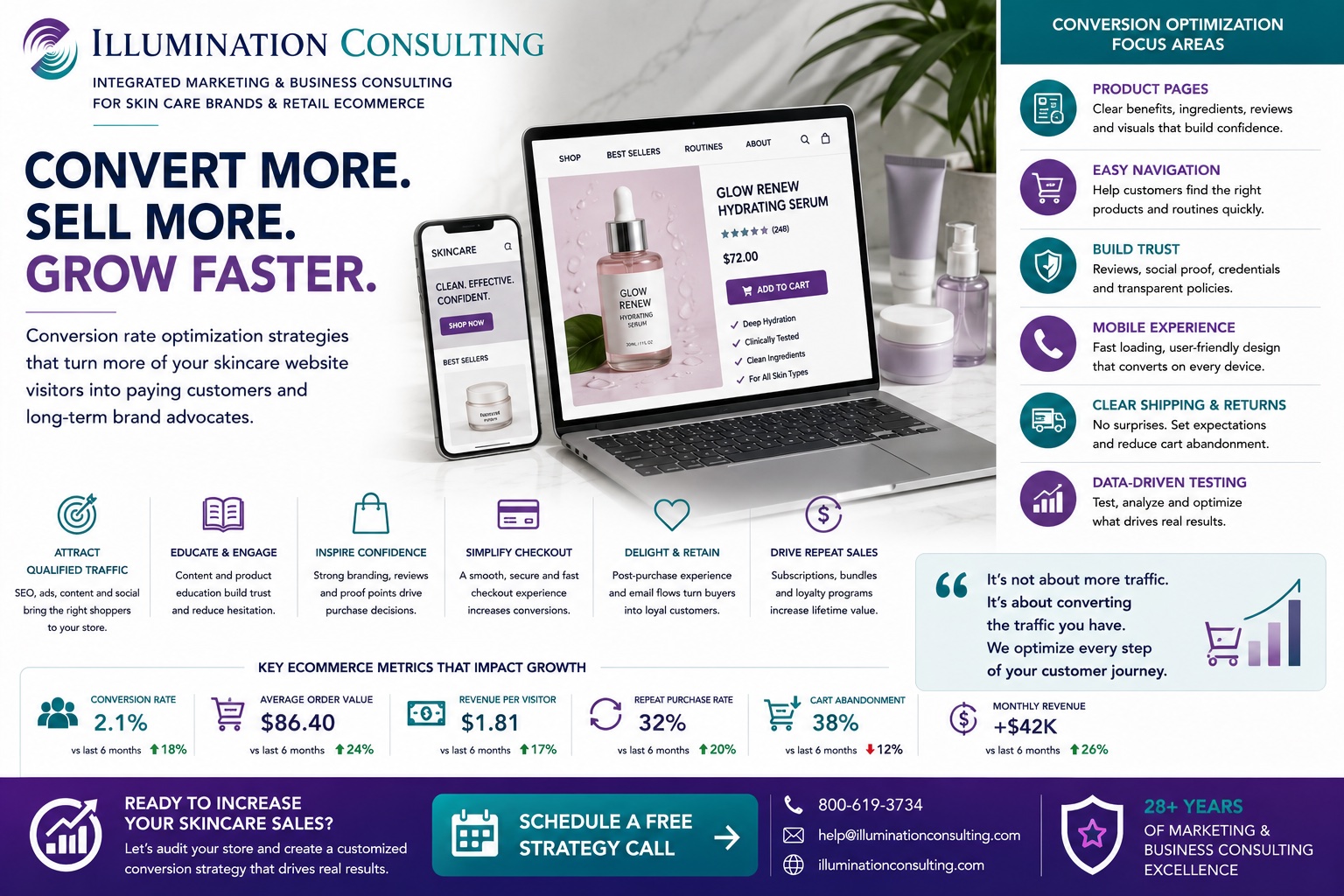
What Is Ecommerce Conversion Rate?
An ecommerce conversion rate measures the percentage of website visitors who complete a desired action.
For purchases, a simplified formula is:
Ecommerce Conversion Rate = Orders ÷ Website Visits × 100
If a skincare store receives 10,000 visits and generates 200 orders:
200 ÷ 10,000 × 100 = 2%
This is an illustrative calculation, not a benchmark for what a skincare website should achieve.
Conversion rates vary considerably depending on traffic source, product category, brand awareness, pricing, device, geography, promotions, returning customers, and many other variables.
The most useful benchmark is often the brand’s own historical performance segmented appropriately.
Start With Traffic Quality
Conversion optimization cannot compensate indefinitely for irrelevant traffic.
A website might appear to have a conversion problem when the actual issue is acquisition quality.
For example, a broad social campaign may generate thousands of inexpensive visitors who have little purchase intent.
Meanwhile, organic visitors searching for a specific skincare concern may convert differently because they are actively researching solutions.
Brands should therefore evaluate conversion by acquisition source.
Potential sources include:
- organic search
- paid search
- Meta advertising
- TikTok
- influencers
- affiliates
- direct traffic
- referral traffic
- retail or PR exposure
A blended sitewide conversion rate can hide substantial differences between these audiences.
Understand the Skincare Customer Journey
Skincare purchases can involve significant research.
Consumers may evaluate:
- skin concerns
- ingredients
- product benefits
- formulation
- product compatibility
- usage instructions
- reviews
- brand credibility
- price
- shipping
- return policies
- competing products
The path to purchase may look like:
Discovery → education → product evaluation → trust → cart → checkout → purchase → repeat purchase
Every stage creates potential friction.
Conversion optimization should examine the entire journey rather than simply changing button colors or adding promotional pop-ups.
Make the Brand Positioning Immediately Clear
Visitors should quickly understand what the skincare brand represents.
A homepage that attempts to communicate too many messages can make the company difficult to understand.
The opening experience should help answer:
What does this brand offer?
Who is it for?
What makes it different?
Where should I go next?
This becomes especially important for lesser-known brands.
Established companies may benefit from existing awareness. A newer skincare brand often has only seconds to establish relevance and credibility.
Clear positioning reduces the cognitive work required from the visitor.
Organize Products Around How Customers Shop
Brands sometimes organize websites around their internal product structure rather than customer needs.
Consumers may think differently.
They may shop according to:
- skin concern
- skin type
- product category
- ingredient
- routine
- desired outcome
For example, a consumer concerned about dry skin may want to find relevant products without understanding the brand’s internal collection names.
Navigation should reflect customer behavior.
A strong ecommerce website design should make product discovery intuitive rather than forcing customers to decode the brand’s organizational system.
Product Pages Carry the Conversion Burden
For many ecommerce visitors, the product page is where the purchase decision happens.
A skincare product page should provide enough information for a customer to evaluate the product confidently.
Depending on the product, useful elements can include:
- product name
- clear photography
- product benefits
- skin concerns addressed
- key ingredients
- usage instructions
- size or quantity
- price
- reviews
- shipping information
- return information
- frequently asked questions
- complementary products
- clear purchase options
The exact structure should reflect the product and applicable regulatory requirements.
The goal is to answer legitimate customer questions without overwhelming the shopper.
Sell Benefits Without Making Unsupported Claims
Skincare marketing requires careful language.
Consumers want to know what a product can do, but brands should avoid unsupported or inappropriate claims.
Strong product communication distinguishes between features and customer-relevant benefits.
For example, simply listing ingredients may not help a consumer understand why those ingredients matter.
At the same time, marketing language should remain consistent with what can appropriately be substantiated.
Trust is a conversion asset.
Overstated promises may increase initial attention while damaging credibility and long-term brand value.
Use Product Photography to Reduce Uncertainty
Consumers cannot physically examine an ecommerce product before purchasing it.
Photography has to compensate for some of that limitation.
Useful product imagery may show:
- packaging
- product texture
- scale
- applicator
- product in use
- multiple angles
- relevant lifestyle context
Image quality should be consistent across the catalog.
Poor or inconsistent photography can make even a strong formulation appear less credible.
Visual presentation is particularly important in skincare because packaging, texture, application, and overall brand aesthetics contribute to perceived value.
Use Video Where It Improves Understanding
Video can help demonstrate aspects of a product that static photographs cannot.
Examples include:
- product texture
- application
- routine placement
- packaging
- product demonstrations
- founder explanations
- ingredient education
Video should serve a purpose.
Adding video simply because it is fashionable can slow pages or distract visitors.
The correct question is whether the content helps shoppers make a more informed purchase decision.
Build Trust With Reviews
Product reviews can reduce uncertainty by showing experiences from previous customers.
Visitors may examine:
- overall rating
- number of reviews
- recent reviews
- written experiences
- verified purchase indicators where available
- customer photographs
- brand responses
Reviews should be easy to locate on product pages.
Brands should also monitor review content for useful business intelligence.
Repeated questions or complaints may identify opportunities to improve product descriptions, packaging, instructions, fulfillment, or the product itself.
Use Social Proof Beyond Product Reviews
Other forms of social proof can also strengthen credibility.
Depending on what the brand can legitimately substantiate, these might include:
- press coverage
- retailer availability
- professional recognition
- awards
- customer testimonials
- expert endorsements
- user-generated content
The key is authenticity.
Generic credibility badges or unsupported claims can have the opposite effect.
Consumers have become accustomed to aggressive ecommerce persuasion techniques.
Trustworthy evidence is more valuable than decorative trust signals.
Improve Skincare Product Education
Education can be particularly valuable when products contain unfamiliar ingredients or require a specific routine.
A customer may hesitate because they do not know:
- whether the product fits their skin type
- where it belongs in a routine
- whether it can be combined with another product
- how frequently to use it
- how much to apply
- what makes the formulation different
Brands can address these questions through:
- product pages
- FAQs
- ingredient guides
- routine guides
- articles
- videos
- comparison tools
Strong education supports both conversion and content marketing.
It can also improve organic search visibility by answering questions consumers already research.
Make Skincare Routines Easier to Understand
Brands selling multiple products can create another conversion problem: complexity.
A consumer may like the brand but not know what to buy.
Routine merchandising can help.
For example:
Step 1: Cleanse
Step 2: Treat
Step 3: Moisturize
Step 4: Protect
The precise routine depends on the products and appropriate usage guidance.
The strategic objective is reducing decision friction.
When customers understand how products relate to one another, the brand may also create legitimate cross-selling opportunities.
Use Bundles Strategically
Bundles can simplify product selection while increasing average order value.
Potential approaches include:
- starter routines
- concern-based collections
- complementary products
- travel sets
- gift sets
- regimen bundles
Bundles should create actual customer value rather than merely combine unrelated inventory.
The strongest bundles answer a recognizable customer need.
A shopper who wants a simple routine may appreciate a curated set more than navigating six individual product pages.
Improve Calls to Action
The primary purchase action should be obvious.
On product pages, customers should not have to search for the Add to Cart button.
Calls to action should be:
- visually identifiable
- appropriately positioned
- understandable
- functional across devices
Brands should also examine what happens after the button is clicked.
Does the cart open clearly?
Can customers continue shopping?
Are recommended products useful?
Is checkout easy to begin?
Conversion is a sequence, not a single button.
Optimize the Mobile Shopping Experience
A significant portion of ecommerce discovery occurs on mobile devices.
A desktop-first website can therefore create substantial friction.
Brands should test:
- navigation
- menus
- product images
- product descriptions
- variant selection
- reviews
- buttons
- forms
- cart functionality
- checkout
- payment methods
Testing should occur on actual devices rather than relying only on a desktop browser preview.
Small usability problems can become significant when repeated across thousands of mobile sessions.
Improve Website Speed
Slow websites create unnecessary friction.
Large product photographs, excessive scripts, unnecessary applications, poorly optimized video, and complicated themes can degrade performance.
Speed improvements may involve:
- image optimization
- code optimization
- reducing unnecessary applications
- improving hosting
- limiting excessive scripts
- better media delivery
- technical cleanup
Performance should be balanced against functionality.
Removing every feature is not the objective.
The goal is delivering the required shopping experience efficiently.
Reduce Cart Abandonment
Adding a product to the cart indicates meaningful purchase intent.
When customers abandon afterward, brands should investigate why.
Potential friction includes:
- unexpected shipping costs
- unclear delivery timing
- forced account creation
- complicated checkout
- payment limitations
- technical errors
- promotional code distractions
- lack of trust
- unclear return policies
Analytics can help identify where abandonment occurs.
Customer feedback can help explain why.
Make Shipping Information Clear
Shipping uncertainty can interrupt a purchase.
Customers may want to know:
- shipping cost
- free-shipping thresholds
- estimated delivery timing
- geographic restrictions
- expedited options
Brands should communicate relevant information before the final checkout stage whenever practical.
Surprising customers with significant shipping charges late in checkout can create avoidable abandonment.
Make Returns and Policies Easy to Find
Customers purchasing unfamiliar skincare products may consider return policies before buying.
Policies should be clear and accessible.
This does not mean the brand needs an unusually permissive policy.
It means customers should understand the terms before purchasing.
Hidden or confusing policies can create uncertainty.
Transparency supports trust.
Use Free Shipping Thresholds Carefully
Free shipping thresholds can encourage customers to increase order value.
For example, a shopper with $62 in the cart may add another product to qualify for free shipping at a hypothetical $75 threshold.
But the economics must work.
Brands should evaluate:
- average order value
- shipping expense
- gross margin
- product mix
- incremental order value
A threshold that increases revenue while destroying contribution margin is not successful optimization.
Increase Average Order Value Alongside Conversion
Conversion rate is only one ecommerce metric.
A brand should also understand average order value.
Average Order Value = Revenue ÷ Number of Orders
Suppose a store generates $60,000 from 1,000 orders.
Average order value would be:
$60
Increasing conversion while average order value falls substantially may produce different economics from increasing both.
Useful AOV strategies can include:
- bundles
- complementary products
- appropriate upsells
- free-shipping thresholds
- larger sizes
- subscriptions where suitable
The objective is increasing customer value without damaging the shopping experience.
Use Email to Recover Abandoned Opportunities
Not every visitor will purchase during the first session.
Email can help recover some opportunities when the brand has appropriately obtained the customer’s information and permission.
Common ecommerce sequences include:
- abandoned cart
- browse abandonment
- welcome
- post-purchase
- replenishment
- product education
- win-back
Automation allows these communications to occur consistently.
However, frequency and messaging should remain appropriate.
Aggressive email volume can reduce trust and increase unsubscribes.
Improve the Post-Purchase Experience
Conversion optimization should not stop after checkout.
The first purchase creates an opportunity for a longer customer relationship.
Post-purchase communication can help customers understand:
- order status
- shipping
- product usage
- routine placement
- support options
- complementary products
- replenishment timing
A positive first purchase can contribute to repeat sales and customer lifetime value.
This is particularly relevant for skincare because many products are consumable and potentially replenishable.
Measure Repeat Purchase Rate
Acquiring a customer can be expensive.
Brands should therefore understand whether customers return.
A simplified repeat purchase calculation is:
Repeat Purchase Rate = Customers Who Purchase Again ÷ Total Customers × 100
The appropriate measurement window depends on product consumption patterns and the business model.
Repeat purchase behavior can reveal important information about:
- product satisfaction
- retention
- replenishment
- customer experience
- acquisition quality
A high-converting website that produces few repeat customers may have a different underlying problem.
Measure Revenue per Visitor
Conversion rate alone does not capture order value.
Revenue per visitor can provide another useful perspective.
Revenue per Visitor = Ecommerce Revenue ÷ Website Visitors
Suppose two websites each convert at the same rate, but one produces significantly larger orders.
Their economics may be very different.
Revenue per visitor combines aspects of conversion and order value into one directional metric.
It can be useful when evaluating landing pages, traffic sources, and merchandising changes.
Segment Conversion by Device
A blended conversion rate may hide a significant mobile problem.
Track performance separately for:
- desktop
- mobile
- tablet where meaningful
If desktop converts strongly while mobile performs substantially worse, the brand should investigate the mobile customer journey.
The issue may involve navigation, speed, forms, checkout, images, or another usability problem.
Segment Conversion by Landing Page
Visitors do not all enter through the homepage.
SEO traffic may arrive through articles.
Paid traffic may enter through campaign landing pages.
Product searches may lead directly to product pages.
Influencer traffic may arrive through a collection or promotional page.
Analyze conversion according to entry point.
This helps determine which pages actually contribute to revenue.
Segment Conversion by New and Returning Visitors
New visitors and returning customers behave differently.
A returning customer may already understand:
- the brand
- products
- shipping
- quality
- checkout
- trustworthiness
A new visitor may require considerably more information.
Segmenting these audiences can help explain changes in overall conversion performance.
It also helps brands understand whether improvements are helping customer acquisition or primarily serving existing customers.
Avoid Blindly Copying Competitors
Competitive analysis is useful.
Copying competitors without understanding their economics is not.
A large skincare company may offer:
- aggressive discounts
- free shipping
- extensive sampling
- subscriptions
- loyalty rewards
That does not mean the same model is financially appropriate for a smaller brand.
Competitors may have different margins, acquisition costs, manufacturing economics, retailer relationships, capital, and customer lifetime value.
Use competitors for insight rather than instruction.
Test Meaningful Changes
Conversion optimization should become a disciplined testing process.
Potential tests might involve:
- product-page hierarchy
- navigation
- calls to action
- product photography
- product education
- bundles
- shipping communication
- review presentation
- checkout friction
- mobile usability
Brands should avoid changing numerous important variables simultaneously when doing so makes the result impossible to interpret.
The purpose of testing is learning.
Do Not Optimize Only for Conversion Rate
A higher conversion rate can still produce a worse business outcome.
Imagine a brand offers a massive discount.
Conversion increases dramatically.
But margins collapse and many customers never purchase again.
The website technically converted better while the business became less profitable.
Therefore, conversion optimization should be evaluated alongside:
- revenue
- gross margin
- average order value
- customer acquisition cost
- repeat purchase
- return rate
- customer lifetime value
- contribution margin
The objective is profitable conversion, not simply a larger percentage.
Build a Skincare Ecommerce Performance Dashboard
A practical dashboard can track:
| Metric | What It Helps Measure |
|---|---|
| Website sessions | Traffic volume |
| Conversion rate | Purchase efficiency |
| Add-to-cart rate | Product interest |
| Checkout initiation | Purchase intent |
| Cart abandonment | Checkout friction |
| Average order value | Order economics |
| Revenue per visitor | Traffic value |
| Customer acquisition cost | Acquisition efficiency |
| Repeat purchase rate | Retention |
| Revenue by product | Product performance |
These metrics should be segmented where useful by channel, device, product, and customer type.
The goal is not more reporting.
It is better decision-making.
Diagnose the Ecommerce Constraint Before Spending More
When ecommerce revenue stops growing, brands frequently assume they need more traffic.
Sometimes they do.
But first diagnose the bottleneck.
Traffic Is Low but Conversion Is Strong
Increase qualified acquisition through SEO, advertising, content, influencers, partnerships, or other appropriate channels.
Traffic Is Strong but Product Engagement Is Weak
Evaluate traffic quality, positioning, navigation, merchandising, and product-market alignment.
Product Engagement Is Strong but Add-to-Cart Is Weak
Improve product pages, value communication, education, reviews, pricing presentation, or offers.
Add-to-Cart Is Strong but Checkout Completion Is Weak
Investigate shipping, checkout usability, payment options, technical problems, and trust.
First Purchases Are Strong but Repeat Purchases Are Weak
Examine product experience, retention, replenishment, communication, and customer satisfaction.
This framework prevents brands from trying to solve every ecommerce problem by buying more traffic.
Turn Existing Skincare Traffic Into More Revenue
Customer acquisition and conversion optimization should work together.
SEO creates discoverability.
Advertising creates targeted traffic.
Content educates.
Social media builds familiarity.
Influencers can introduce products.
The ecommerce website then has to convert that attention into purchases.
Product experience and retention determine what happens afterward.
A successful skincare ecommerce strategy therefore follows a larger economic system:
Acquire → Educate → Convert → Increase Order Value → Retain → Repeat
Improving any one stage can create value.
Improving several together can materially change the economics of the business.
Illumination Consulting helps skincare brands connect skin care marketing with ecommerce strategy, SEO, website development, content, customer acquisition, and conversion optimization. The objective is not simply attracting additional website visitors. It is building a digital sales system capable of converting qualified traffic into customers, repeat purchases, and sustainable revenue.
Frequently Asked Questions
How can a skincare website increase its conversion rate?
Brands can improve product pages, navigation, product education, photography, reviews, mobile usability, website speed, calls to action, shipping transparency, checkout, merchandising, and customer trust. The highest-priority improvements should be identified from actual website data.
What is a good ecommerce conversion rate for skincare brands?
There is no universal conversion rate that every skincare brand should target. Performance varies according to traffic quality, pricing, product type, brand awareness, device, geography, customer mix, promotions, and other factors. Brands should compare segmented performance against their own historical data while using external benchmarks cautiously.
Why do skincare customers abandon their carts?
Possible reasons include unexpected shipping costs, unclear delivery information, checkout friction, technical problems, payment limitations, lack of trust, price concerns, distraction, or simply not being ready to purchase. Analytics and customer research can help identify the primary causes.
How can skincare brands increase average order value?
Potential strategies include product bundles, complementary recommendations, larger sizes, appropriate upsells, free-shipping thresholds, routines, and subscriptions where they make economic and customer sense.
Should skincare brands focus on traffic or conversion first?
It depends on the constraint. A website with little qualified traffic may need greater acquisition. A site already receiving substantial qualified traffic but converting poorly may produce a better return by improving conversion before significantly increasing advertising or traffic-generation spending.