Dermatology practices operate in an unusual marketing environment. They may serve patients seeking medical dermatology, cosmetic treatments, skin cancer screening, acne care, chronic condition management, aesthetic procedures, or combinations of these services. Each patient group can have different needs, search behavior, urgency, economics, and reasons for choosing a provider.
That makes dermatology patient acquisition more complex than simply generating additional website traffic or advertising a practice.
A sustainable strategy connects search visibility, local presence, reputation, website performance, patient education, referrals, advertising, conversion, and retention. The objective is to attract appropriate patients while building a system that supports the services and growth priorities of the practice.
Professional dermatology marketing should therefore begin with the practice’s business objectives and patient mix rather than treating every prospective patient as identical.
Define What Patient Growth Means for the Practice
“More patients” is not sufficiently specific to guide a marketing strategy.
A dermatology practice should first determine what type of growth it needs.
For example, management may want to:
- increase new medical dermatology patients
- grow cosmetic dermatology revenue
- attract more patients for a specific procedure
- increase skin cancer screenings
- fill capacity for a new provider
- grow a recently opened location
- increase higher-value services
- improve patient retention
- expand into surrounding communities
Each objective can require a different acquisition strategy.
A practice trying to fill a new dermatologist’s schedule may prioritize broad local visibility differently from one trying to increase demand for a particular cosmetic procedure.
Marketing should follow the business objective.
Understand the Different Dermatology Patient Segments
One of the most important strategic distinctions is between different patient populations.
Medical Dermatology Patients
These patients may seek care for conditions such as acne, eczema, psoriasis, rashes, suspicious lesions, hair loss, or other dermatological concerns.
Their search behavior can be problem-driven.
Preventive and Diagnostic Patients
Some patients may be looking for skin examinations, mole evaluations, or other preventive and diagnostic services.
Trust, accessibility, provider credentials, and appointment availability can strongly influence the decision.
Cosmetic Dermatology Patients
Cosmetic patients may research injectables, laser procedures, skin rejuvenation, chemical peels, body treatments, or other elective services.
These patients can behave more like aesthetic consumers and may spend considerably more time comparing providers.
Existing Patients
Current patients represent another important segment.
Someone who initially visits for medical dermatology may later become interested in other appropriate services offered by the practice.
The marketing strategy should recognize these differences rather than communicating with every patient using the same message.
Identify the Practice’s Highest-Priority Services
Not every service deserves equal marketing investment.
Practices should evaluate services according to factors such as:
Patient demand
Are people actively searching for the service?
Provider capacity
Can the practice accommodate additional patients?
Strategic importance
Is the service central to the practice’s growth plans?
Economics
What is the financial contribution of the service?
Repeat care
Does the service lead to ongoing patient relationships?
Competitive environment
How difficult is it to acquire visibility within the local market?
This analysis helps management decide where SEO, advertising, website development, content, and other resources should be concentrated.
Analyze How Local Patients Search for Dermatologists
Search engines play a major role in healthcare discovery.
Prospective patients may search for:
dermatologist near me
dermatologist in [city]
acne dermatologist
skin cancer screening
cosmetic dermatologist
laser skin treatment
or highly specific conditions and procedures.
These searches reveal different levels of intent.
Someone searching broadly about the causes of acne may still be researching.
Someone searching for an acne dermatologist nearby may be much closer to scheduling care.
An effective acquisition strategy should account for both informational and transactional search behavior.
Strengthen Local Search Visibility
Dermatology is fundamentally a local service.
Even when patients research conditions nationally, most ultimately need a provider they can reasonably visit.
Local search optimization should therefore be a major component of patient acquisition.
Important elements include:
- accurate practice information
- Google Business Profile optimization
- location pages
- patient reviews
- local citations
- relevant service information
- geographic content where appropriate
- consistent contact information
- structured data
- mobile usability
For multi-location practices, each location should have a clear and useful presence rather than relying exclusively on one generic page.
The goal is to help search engines and patients understand what the practice offers, where it operates, and why it is relevant to a particular search.
Build Service Pages Around Patient Intent
A dermatology website should not force every prospective patient through one general services page.
Priority conditions, treatments, and procedures deserve dedicated content when appropriate.
For example, a practice might develop individual pages for:
- acne treatment
- eczema
- psoriasis
- skin cancer screening
- mole evaluation
- hair loss
- Botox
- fillers
- laser treatments
- skin rejuvenation
The exact architecture should reflect the actual services and priorities of the practice.
Dedicated pages give search engines stronger contextual signals.
They also give prospective patients a more relevant experience.
Someone searching specifically for psoriasis treatment should arrive on a page that meaningfully addresses psoriasis rather than a generic dermatology homepage.
Use Dermatology SEO to Capture Existing Demand
Search engine optimization can become a valuable long-term acquisition channel because it reaches patients already searching for dermatological information and services.
A comprehensive dermatology SEO strategy can include several components.
Commercial Search Visibility
Service and location pages can target searches associated with selecting a provider.
Educational Search Visibility
Articles can answer questions patients research before scheduling.
Local Search
The practice can improve visibility for geographically relevant searches.
Technical SEO
Search engines need to crawl, index, and understand the website efficiently.
Authority Development
Relevant mentions, citations, links, expertise signals, and useful content can strengthen the site’s overall search presence.
SEO should not pursue traffic simply because a keyword has search volume.
The better question is:
Can this search visibility contribute to the practice’s patient acquisition strategy?
Create Educational Content That Supports Patient Decisions
Dermatology provides substantial opportunities for patient education.
People frequently research skin conditions and treatments before contacting a provider.
Useful content might address questions such as:
- When should acne be evaluated by a dermatologist?
- What happens during a skin examination?
- How are suspicious moles evaluated?
- What treatment options exist for acne scars?
- What is the difference between medical and cosmetic dermatology?
- How should patients prepare for certain procedures?
- What questions should patients ask a dermatologist?
Educational content can support organic search while helping prospective patients understand when professional care may be appropriate.
However, content should not attempt to diagnose individual patients.
Its role is education and helping readers identify an appropriate next step.
Build Trust Through Provider Expertise
Healthcare marketing requires more than visibility.
Patients need reasons to trust the provider.
Dermatology websites should make it easy to understand relevant provider information, including:
- education
- training
- board certification where applicable
- areas of expertise
- professional background
- practice philosophy
- relevant memberships
- publications or academic work where appropriate
Provider pages should not be treated as administrative biographies hidden deep inside the website.
For many patients, the provider is one of the most important factors in choosing a practice.
Make the Website Easy to Use
A patient who finds the practice through Google still needs to take action.
The website should make essential information easy to locate.
Patients should quickly understand:
What services are offered?
Where is the practice located?
Who are the providers?
How can an appointment be requested?
Does the practice provide the type of care the patient needs?
Depending on the practice, patients may also need information about insurance, referrals, forms, payment policies, or other administrative considerations.
Professional dermatology website design should integrate usability, search visibility, credibility, and conversion rather than focusing exclusively on visual appearance.
Improve Website Conversion
Traffic alone does not create patients.
A website receiving substantial organic traffic can still underperform if visitors struggle to determine what to do next.
Conversion opportunities may include:
- appointment requests
- online scheduling
- phone calls
- contact forms
- consultation requests for cosmetic services
- appropriate patient portal access
Calls to action should reflect the type of page.
Someone reading about a medical condition may need a different next step from someone evaluating an elective cosmetic procedure.
The objective is to make progression from research to appropriate patient action intuitive.
Develop a Reputation Strategy
Reviews can strongly influence local healthcare decisions.
Prospective patients may evaluate comments about:
- provider communication
- staff professionalism
- wait times
- scheduling
- treatment experience
- office environment
- responsiveness
- overall care
Practices should establish appropriate processes for monitoring reviews and requesting feedback while following applicable healthcare and platform requirements.
Management should also study recurring patterns.
If patients consistently praise a particular strength, that may represent an important positioning asset.
If complaints repeatedly identify the same operational problem, marketing cannot solve it by itself.
The patient experience needs attention.
Use Paid Search to Capture High-Intent Demand
Paid search can complement SEO when prospective patients actively search for relevant services.
Potential advantages include:
- immediate visibility
- geographic targeting
- service-specific campaigns
- measurable traffic
- controlled budgeting
However, advertising should be connected to relevant landing pages.
Sending every advertisement to the homepage can create unnecessary friction.
An acne campaign should generally lead to highly relevant acne information.
A cosmetic laser campaign should lead to relevant treatment information.
Message alignment between search, advertisement, and landing page can improve the patient experience and make performance easier to evaluate.
Use Social Media for Education and Familiarity
Social media can support dermatology marketing differently from search.
Patients may not currently be looking for a dermatologist when they encounter educational content.
Over time, that content can build familiarity with the practice and providers.
Potential topics include:
- skincare education
- dermatologist Q&As
- sun protection
- acne education
- treatment explanations
- provider introductions
- common misconceptions
- cosmetic procedure education
- practice updates
Medical content should remain accurate and appropriate.
Social media should support professional credibility rather than encourage sensational health claims.
Connect Medical and Cosmetic Dermatology Strategically
Practices offering both medical and cosmetic dermatology have an important strategic advantage: an existing patient relationship can create awareness of additional services.
However, cross-promotion needs to be handled appropriately.
The objective is not turning every medical patient into a cosmetic customer.
It is ensuring patients understand the legitimate range of services available through the practice.
For example, a patient already receiving dermatological care may not know the same practice offers:
- acne scar treatments
- laser procedures
- injectables
- skincare
- pigmentation treatments
- other cosmetic services
Appropriate patient education can increase awareness without making the clinical experience feel excessively promotional.
Improve New-Patient Response Processes
Marketing effectiveness can deteriorate after an inquiry reaches the practice.
Potential patients may encounter:
- unanswered calls
- long hold times
- slow callbacks
- complicated scheduling
- unclear instructions
- unavailable appointment times
- poor communication
These operational problems directly affect acquisition.
A practice should track whether qualified inquiries successfully become scheduled appointments.
If marketing is generating demand but the scheduling system cannot absorb it, increasing advertising may worsen the problem rather than solve it.
Track New-Patient Acquisition by Source
Management should understand where new patients originate.
Potential sources include:
- organic Google search
- Google Maps
- paid search
- referrals
- physician referrals
- social media
- advertising
- directories
- direct website traffic
Source attribution will never be perfect.
A patient may encounter the practice several times before scheduling.
Nevertheless, tracking acquisition sources provides useful directional information.
It helps management understand which channels contribute most strongly to patient growth.
Calculate Patient Acquisition Cost
A simplified patient acquisition cost calculation is:
Patient Acquisition Cost = Marketing Acquisition Costs ÷ New Patients Acquired
Suppose a practice invests $12,000 during a period in activities directly associated with patient acquisition and gains 60 new patients.
The simplified acquisition cost is:
$12,000 ÷ 60 = $200 per new patient
This example is hypothetical and should not be interpreted as an industry benchmark.
Whether that cost is attractive depends on the patient’s economic value, service mix, margins, retention, and other practice-specific factors.
Measure Acquisition by Service Line
A blended patient acquisition cost can hide important differences.
Medical dermatology and cosmetic dermatology may have very different economics.
Management may benefit from tracking:
- acquisition cost by service
- revenue by service
- new patients by service
- repeat visits
- conversion
- patient retention
- provider utilization
This provides a much stronger foundation for allocating marketing budgets.
Consider Patient Lifetime Value
A dermatology patient relationship may extend beyond the initial appointment.
Depending on the patient’s needs, future interactions can involve ongoing condition management, annual examinations, follow-up procedures, skincare, cosmetic services, or other appropriate care.
This makes lifetime value relevant to acquisition decisions.
A channel that appears expensive based only on the first appointment may produce valuable long-term patient relationships.
Conversely, inexpensive acquisition does not necessarily create strong economics if patients rarely return.
Marketing decisions should therefore consider more than the value of the first visit.
Patient Retention Supports Sustainable Growth
New-patient acquisition is only one side of practice growth.
Retention matters as well.
A practice that continuously acquires new patients while losing existing ones creates unnecessary pressure on marketing.
Retention can be influenced by:
- quality of care
- patient communication
- scheduling
- follow-up
- convenience
- provider relationships
- treatment outcomes
- office experience
- ongoing education
Marketing cannot compensate indefinitely for operational weaknesses that cause patients to leave.
Sustainable growth requires acquisition and retention to work together.
Build Referral Relationships
Digital marketing should not eliminate traditional professional relationships.
Depending on the practice model, referrals may remain an important source of patients.
Relevant relationships can include:
- primary care practices
- other medical specialists
- healthcare organizations
- appropriate community organizations
- complementary professional relationships
Referral development requires consistency and credibility.
A strong digital presence can reinforce these relationships because referred patients frequently research the dermatologist online before scheduling.
Measure Provider Capacity Before Scaling Acquisition
One of the most overlooked growth constraints is capacity.
If a dermatologist’s schedule is already full for an extended period, generating substantially more demand may create:
- longer waits
- frustrated patients
- increased staff pressure
- poorer conversion
- weaker patient experience
Marketing should therefore be coordinated with provider availability.
A practice may instead need to:
- fill another provider
- promote different services
- increase demand at another location
- improve scheduling
- recruit additional clinical capacity
The objective is profitable, manageable growth rather than maximum lead volume.
Create a Dermatology Patient Acquisition Dashboard
A practical management dashboard might track:
| Metric | Business Question |
|---|---|
| New patient inquiries | Are we generating demand? |
| New patients | Are inquiries becoming appointments? |
| Acquisition source | Where are patients coming from? |
| Cost per new patient | What does growth cost? |
| Website conversions | Is digital traffic taking action? |
| Organic search visibility | Are patients finding us? |
| Local search performance | Are we visible geographically? |
| New patients by service | Which services are growing? |
| Provider utilization | Do we have capacity? |
| Patient retention | Are relationships continuing? |
The purpose is not creating another reporting burden.
It is giving management enough information to decide what to improve next.
Diagnose the Growth Constraint
When patient volume is below expectations, the practice should determine why before investing more money.
Search Visibility Is Weak
SEO, local search, content, or advertising may require improvement.
Traffic Is Strong but Appointments Are Weak
Website conversion, messaging, scheduling, or calls to action may be the problem.
Inquiries Are Strong but Scheduling Is Weak
Response time, availability, staff processes, or intake may be constraining growth.
New Patients Are Strong but Revenue Is Weak
Service mix, patient value, retention, or capacity allocation may deserve attention.
Demand Exceeds Capacity
Additional marketing may not be the immediate priority.
The practice may need operational expansion instead.
This diagnostic approach helps avoid spending marketing dollars against the wrong problem.
Build a Diversified Patient Acquisition System
Relying heavily on one acquisition channel creates risk.
Search algorithms change.
Advertising costs change.
Competitors become more aggressive.
Referral relationships evolve.
A stronger dermatology growth strategy can combine:
SEO for long-term search visibility.
Local search for geographic discovery.
Paid advertising for targeted demand capture.
Content for education and authority.
Reputation for trust.
Social media for familiarity and education.
Referrals for professional and patient-driven growth.
Retention for long-term patient value.
These channels should reinforce one another.
Patient Acquisition Should Produce Sustainable Practice Growth
The purpose of dermatology marketing is not simply increasing website traffic.
It is helping the right patients discover the practice, understand its expertise, trust its providers, and take an appropriate next step.
That requires alignment between marketing and operations.
Search visibility creates discovery.
Content creates understanding.
Provider expertise creates credibility.
Reviews create social proof.
The website facilitates action.
Staff communication supports scheduling.
Clinical care and patient experience influence retention.
When these components work together, patient acquisition becomes a repeatable growth system rather than a collection of disconnected marketing campaigns.
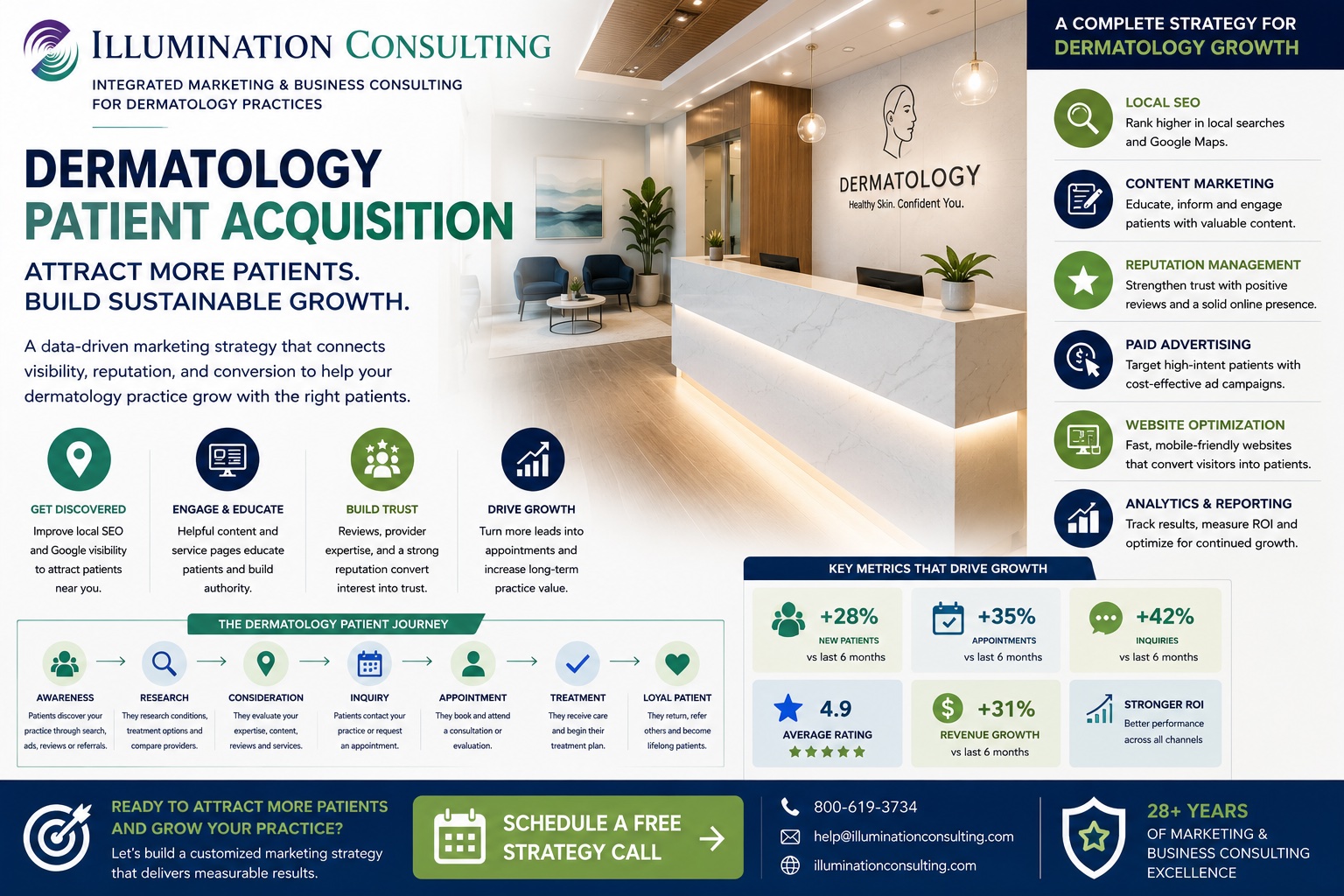
Illumination Consulting works with dermatology and aesthetic practices through integrated marketing services that connect SEO, websites, content, patient acquisition, conversion, and growth strategy. The objective is to identify where a practice’s growth opportunities actually exist and allocate resources toward the areas most capable of producing sustainable results.
Frequently Asked Questions
How can a dermatology practice attract more patients?
Practices can strengthen local search visibility, improve SEO, develop useful service pages, build patient reviews, improve website conversion, use targeted advertising, create educational content, develop referral relationships, and improve the new-patient scheduling experience.
What is dermatology patient acquisition?
Dermatology patient acquisition is the process of attracting prospective patients and converting them into new patients. It can involve search engines, local visibility, referrals, advertising, content, reputation, websites, scheduling, and other channels.
Is SEO effective for dermatologists?
SEO can be valuable because patients frequently use search engines to research skin conditions, treatments, providers, and local dermatology practices. Effective SEO should target commercially relevant and educational searches while supporting local visibility and patient conversion.
How should dermatologists measure marketing performance?
Useful measurements include qualified inquiries, new patients, acquisition source, patient acquisition cost, website conversion, organic search performance, local visibility, new patients by service, provider utilization, retention, and patient value.
Should dermatology practices market medical and cosmetic services differently?
Often, yes. Medical and cosmetic patients can have different motivations, search behavior, decision processes, economics, and expectations. The overall brand can remain consistent while messaging and acquisition strategies reflect the needs of each audience.