
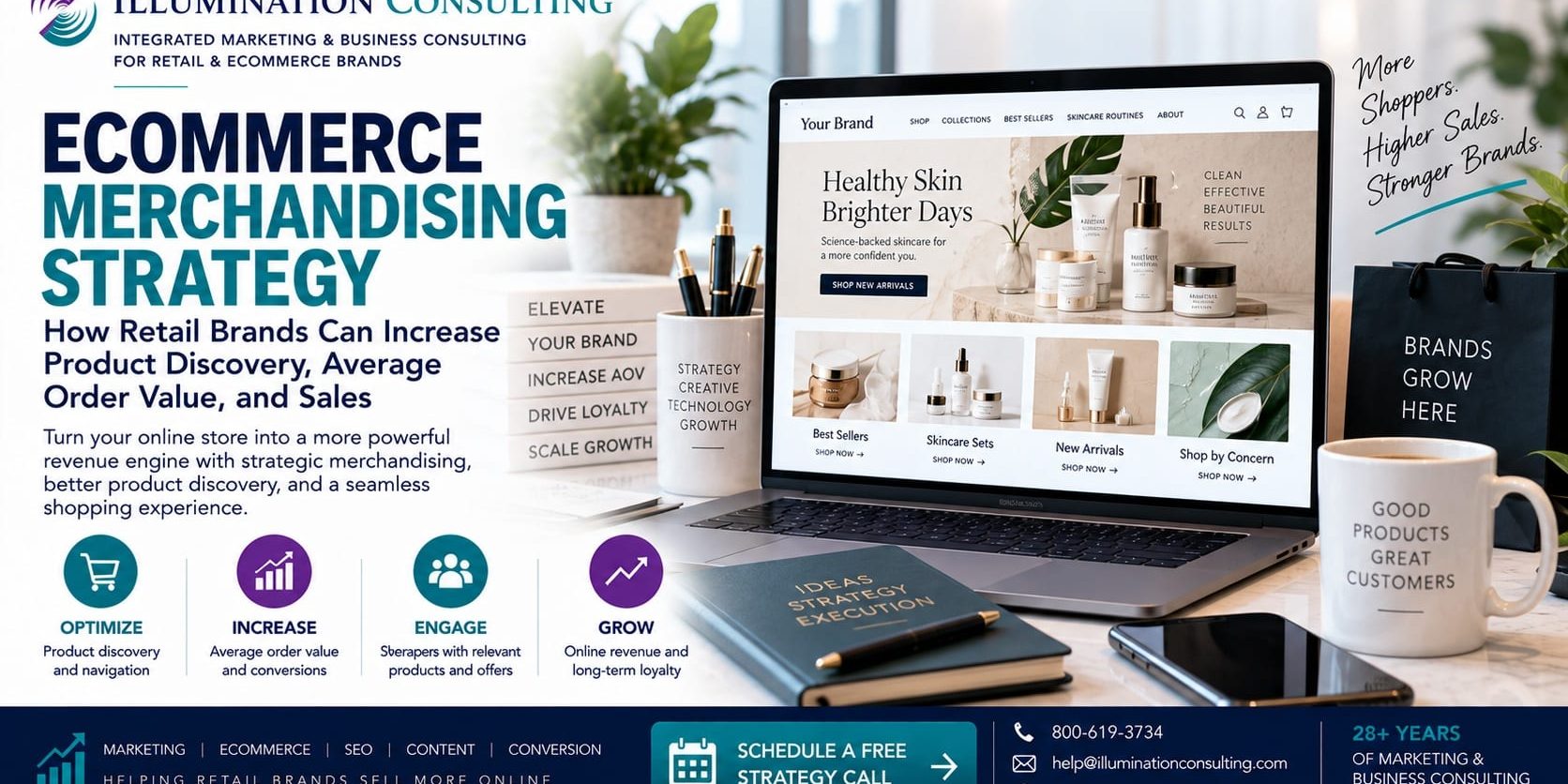
Driving more traffic to an ecommerce website does not automatically create more revenue.
A retailer can invest heavily in SEO, paid advertising, social media, influencers, email marketing, and content—only to lose potential sales once shoppers arrive.
The problem may not be traffic.
It may be merchandising.
In a physical retail store, merchandising determines what customers see, where products are positioned, which items appear together, what receives prominent placement, and how shoppers move through the store.
Ecommerce requires the same strategic thinking.
An effective ecommerce merchandising strategy helps shoppers discover the right products, understand their choices, identify complementary items, navigate categories, evaluate alternatives, and ultimately purchase more confidently.
For companies investing in retail marketing, ecommerce merchandising should therefore be viewed as part of the revenue system—not merely a website-design decision.
What Is Ecommerce Merchandising?
Ecommerce merchandising is the strategic organization, presentation, and promotion of products throughout an online store.
It influences questions such as:
- Which products appear first?
- Which collections receive prominence?
- What does a shopper see after selecting a product?
- Which products are recommended together?
- How are new products introduced?
- How are best sellers displayed?
- How does the website handle seasonal demand?
- How easily can customers compare alternatives?
- What products appear in search results?
- What does the customer see in the cart?
Good merchandising reduces the amount of work shoppers must do to find appropriate products.
The objective is not simply making the website attractive.
It is creating a more effective path from product discovery to purchase.
Online Stores Need Merchandising Just Like Physical Stores
Imagine entering a physical store where every product is arranged alphabetically.
There are no departments.
No featured products.
No displays.
No complementary items positioned together.
No seasonal merchandising.
No guidance.
Technically, the merchandise is available.
Commercially, the experience is poor.
Many ecommerce stores make a digital version of this mistake.
Products are uploaded into categories and left there.
The company then spends most of its energy trying to generate more traffic.
A stronger approach asks:
How can we make the traffic we already have more commercially productive?
That is where merchandising becomes important.
Start With Customer Shopping Intent
Merchandising should reflect how customers think—not necessarily how the company’s internal product database is organized.
A retailer may categorize products according to:
- manufacturer
- inventory system
- internal department
- SKU structure
- supplier
Customers may think differently.
They may shop according to:
- problem
- occasion
- style
- price
- use
- recipient
- size
- category
- season
- desired outcome
Strong ecommerce architecture translates the product catalog into a structure customers understand.
Build Categories Around How Customers Shop
Category architecture is one of the foundations of ecommerce merchandising.
Suppose a store sells hundreds or thousands of products.
If customers must scroll endlessly through a broad “Products” section, discovery becomes difficult.
Instead, create useful categories and subcategories.
A fashion retailer might organize around:
Women → Clothing → Dresses → Evening Dresses
A skincare retailer might use:
Skin Concern → Dryness → Moisturizers
A home retailer could use:
Room → Living Room → Lighting
The exact architecture depends on the business.
The principle is consistent:
Help customers narrow choices logically.
Avoid Creating Too Many Categories
More categories do not automatically create better navigation.
Over-segmentation can produce:
- thin category pages
- duplicate product groupings
- confusing navigation
- SEO overlap
- unnecessary decision-making
Each category should serve a meaningful customer or search purpose.
The objective is clarity, not complexity.
Treat Category Pages as Sales Pages
Retailers frequently invest heavily in individual product pages while treating category pages as little more than product grids.
That misses an important opportunity.
Category pages often receive significant organic and paid traffic.
They can help shoppers understand:
- what products are available
- how products differ
- which products are popular
- which option may fit their needs
- how to filter choices
- what makes the collection distinctive
A well-designed category page can function as both a shopping tool and commercial landing page.
Merchandise the First Products Customers See
Product order matters.
The first row of products on a category page receives disproportionately valuable visual attention simply because customers encounter it first.
Do not always allow product order to default to:
- newest SKU
- alphabetical order
- internal product ID
- arbitrary upload sequence
Consider merchandising according to:
- best sellers
- profitability
- inventory
- seasonality
- strategic products
- customer ratings
- conversion
- promotional priorities
The correct weighting depends on the retailer’s objectives.
Use Best Sellers as Decision Shortcuts
Consumers frequently look for signals that simplify purchasing decisions.
“Best Seller” can provide one such signal.
Best-selling products can be highlighted:
- on the homepage
- within categories
- in navigation
- on product pages
- within email campaigns
- in search results
The goal is not artificially labeling products.
It is using genuine purchasing behavior to help customers identify popular options.
Feature New Products Strategically
New products need visibility.
Simply adding a product to the catalog may not generate meaningful discovery.
Consider dedicated:
- New Arrivals sections
- homepage placements
- category features
- email announcements
- social content
- product recommendations
However, newness should not automatically override everything else.
If the retailer constantly pushes new inventory ahead of proven best sellers, conversion can suffer.
Merchandising should balance discovery and performance.
Use Product Badges Carefully
Badges can help customers scan large catalogs.
Examples include:
Best Seller
New
Limited Edition
Staff Pick
Exclusive
Back in Stock
But too many badges reduce their usefulness.
If every product has a special designation, none of them feels special.
Use visual merchandising cues selectively and accurately.
Improve On-Site Search
Customers using internal site search often have relatively strong intent.
They know what they want—or at least have a clearer idea than someone casually browsing.
That makes site search commercially important.
Review whether search can handle:
- product names
- categories
- common terminology
- spelling variations
- product attributes
- relevant synonyms
Search results should also be merchandised.
If a customer searches for a broad category, the website should not necessarily return products in arbitrary order.
Use Filters That Actually Help Customers Decide
Filters should reflect meaningful purchasing criteria.
Depending on the retailer, useful filters could include:
- size
- price
- color
- brand
- material
- product type
- rating
- availability
- concern
- feature
- use
Avoid adding filters merely because the product database contains the attribute.
Ask:
Would a customer actually use this information to narrow the purchase decision?
If not, the filter may add clutter.
Merchandise Around Customer Problems
One of the strongest merchandising approaches is organizing products around the problem the customer wants to solve.
Instead of forcing customers to understand every product category, help them start with their need.
For example:
Need better organization?
Shopping for a gift?
Building a skincare routine?
Preparing for travel?
Updating a home office?
This shifts merchandising from a product-centered model toward a customer-centered model.
Use Collections to Create Context
Collections can combine products in ways that standard categories cannot.
Possible collection concepts include:
- seasonal
- lifestyle
- occasion
- trend
- gift
- solution
- curated
- editorial
Collections can make large catalogs feel more manageable and give marketing campaigns stronger landing destinations.
A seasonal advertising campaign, for example, can send customers to a curated collection rather than a generic homepage.
Use Bundles to Increase Average Order Value
Merchandising can also influence how much customers purchase.
Product bundles can combine complementary items into a more convenient buying decision.
Examples might include:
- starter kits
- complete routines
- product sets
- gift packages
- complementary accessories
- multi-product solutions
The bundle should make sense from the customer’s perspective.
Randomly combining slow-moving inventory is not strong merchandising.
Cross-Sell Complementary Products
A cross-sell answers:
What else might this customer reasonably need?
Examples include:
Laptop → carrying case
Dress → accessories
Skincare product → complementary regimen item
Furniture → coordinating décor
Cross-selling can occur:
- on product pages
- in the cart
- after adding an item
- during checkout where appropriate
- after purchase
- through email
Relevance matters more than volume.
Showing ten unrelated recommendations can create more friction than value.
Use Upselling Appropriately
Upselling encourages the customer to consider a higher-value alternative.
That could mean:
- larger size
- premium model
- upgraded version
- higher quantity
- expanded bundle
The alternative should make the value difference understandable.
An effective upsell answers:
Why would I spend more?
Without a clear answer, it simply looks like the retailer is trying to increase the order.
Merchandise the Cart
The cart is not merely a technical step before checkout.
It is another merchandising opportunity.
Useful cart elements can include:
- complementary recommendations
- free-shipping progress
- bundle opportunities
- quantity adjustments
- clear product information
But restraint is important.
The shopper has already demonstrated purchase intent.
Do not turn the cart into another complicated shopping experience.
Use Free-Shipping Thresholds Strategically
Where economically appropriate, a free-shipping threshold can encourage customers to increase order value.
Suppose a shopper has $68 in the cart and free shipping begins at $75.
A clear message can communicate that only $7 remains.
Relevant product recommendations can then help the customer reach the threshold.
The economics must be modeled carefully.
Increasing average order value is not beneficial if shipping subsidies eliminate the additional margin.
Optimize Product Recommendations
Recommendation systems can range from simple rules to sophisticated personalization.
Possible recommendation logic includes:
- frequently purchased together
- customers also viewed
- similar products
- complementary products
- same collection
- recently viewed
- purchase history
- browsing behavior
The technology matters less than the relevance.
A sophisticated recommendation engine producing poor suggestions is less valuable than simple merchandising rules based on real customer behavior.
Personalize Where It Adds Value
Ecommerce personalization can alter merchandising based on known customer information or behavior.
For example, returning customers may see:
- recently viewed products
- replenishment items
- preferred categories
- relevant recommendations
- loyalty offers
New visitors may receive a different experience.
Personalization should reduce friction and improve relevance rather than making the experience feel unnecessarily intrusive.
Use Inventory Data in Merchandising Decisions
Marketing and merchandising should not operate independently from inventory.
Imagine heavily featuring a product that is almost sold out while ignoring another strategic item with substantial available inventory.
That may or may not make sense.
Merchandising decisions should consider:
- inventory depth
- replenishment timelines
- seasonal stock
- excess inventory
- sell-through
- margins
The goal is not allowing inventory to dictate every marketing decision.
It is preventing marketing from ignoring operational reality.
Do Not Hide Out-of-Stock Products Without a Strategy
Out-of-stock products create a merchandising decision.
Depending on the circumstances, options may include:
- show an expected restock
- offer back-in-stock notifications
- recommend alternatives
- preserve the page for SEO
- temporarily reduce prominence
Automatically deleting valuable product pages can create SEO and customer-experience problems.
The correct approach depends on whether the product is temporarily unavailable or permanently discontinued.
Use Merchandising to Improve Inventory Sell-Through
Not every product performs equally.
Merchandising can help expose under-discovered inventory.
But first determine why the product is underperforming.
Possible causes include:
- low visibility
- weak imagery
- unclear positioning
- poor reviews
- pricing
- low demand
- weak product-market fit
Giving a poor product more homepage exposure does not necessarily solve the problem.
Merchandising should amplify genuine opportunities, not conceal product weaknesses.
Connect Merchandising With SEO
Ecommerce merchandising and SEO can support one another.
Category and collection pages can target commercially valuable searches while helping shoppers discover products.
Internal linking can connect:
Articles → categories → products
and:
Products → related categories → complementary products
This creates a stronger website architecture.
Retailers investing in SEO services should therefore coordinate organic search strategy with ecommerce structure rather than treating SEO as a separate layer added after the store is built.
Avoid SEO and Merchandising Conflicts
Sometimes merchandising decisions can accidentally damage search performance.
For example:
- deleting categories
- constantly changing URLs
- creating duplicate collections
- hiding important content
- removing internal links
- using filters that generate uncontrolled indexable URLs
Commercial teams and SEO teams should coordinate structural changes.
A merchandising improvement should not unintentionally eliminate an organic traffic asset.
Connect Advertising to Merchandised Landing Pages
Paid campaigns should not automatically send every shopper to the homepage.
Match advertising intent with the most relevant destination.
For example:
Product advertisement → product page
Category campaign → category page
Seasonal campaign → seasonal collection
Gift campaign → gift guide
Problem-based campaign → curated solution page
This creates continuity between the advertisement and shopping experience.
Use Email as a Merchandising Channel
Email is not merely a promotional tool.
It can merchandise the catalog.
Campaigns can highlight:
- new arrivals
- best sellers
- curated collections
- product education
- bundles
- seasonal assortments
- replenishment products
- personalized recommendations
Instead of continually emailing discounts, retailers can use email to help customers discover products.
Use Content to Support Product Discovery
Content marketing can introduce products through education rather than direct promotion.
Examples include:
- buying guides
- comparisons
- how-to articles
- gift guides
- trend reports
- product-selection guides
- educational resources
Professional content marketing can therefore support both SEO and merchandising when editorial content is connected strategically to relevant products and categories.
Measure Product Discovery
Merchandising should be measured.
Useful indicators can include:
- category-page engagement
- product views
- internal search usage
- search exits
- filter usage
- product click-through rate
- add-to-cart rate
- conversion rate
- average order value
- units per transaction
These metrics reveal how effectively shoppers move from browsing to buying.
Measure Average Order Value
A simplified calculation is:
Average Order Value = Revenue ÷ Number of Orders
Suppose an ecommerce business generates $100,000 from 2,000 orders.
The average order value would be:
$100,000 ÷ 2,000 = $50
This example is illustrative.
Merchandising can influence AOV through:
- bundles
- cross-selling
- upselling
- quantity options
- shipping thresholds
- complementary recommendations
But AOV should not be increased at the expense of conversion or profitability.
Measure Units per Transaction
Another useful metric is:
Units per Transaction = Units Sold ÷ Number of Orders
If customers typically purchase only one product, there may be opportunities for stronger complementary merchandising.
Again, context matters.
Some categories naturally involve single-item purchases.
The objective is not maximizing the number of products in every order.
It is understanding customer behavior.
Measure Conversion by Category
Overall ecommerce conversion rate can hide important differences.
Track conversion according to:
- category
- product
- traffic source
- device
- new versus returning visitor
- campaign
One category may convert extremely well.
Another may receive significant traffic but produce few sales.
That provides a starting point for investigation.
Measure Revenue per Visitor
Revenue per visitor combines traffic and purchase performance.
A simplified calculation is:
Revenue per Visitor = Ecommerce Revenue ÷ Visitors
Suppose 20,000 visitors generate $100,000.
Revenue per visitor would be:
$5
If merchandising improvements increase revenue from the same traffic to $120,000, revenue per visitor rises to:
$6
These numbers are hypothetical.
This metric helps shift attention from simply acquiring traffic toward extracting more value from qualified traffic.
Run Merchandising Tests
Not every merchandising assumption will be correct.
Test changes such as:
- category product order
- recommendation placement
- bundle presentation
- navigation
- filters
- badges
- homepage features
- product-card design
Measure the result.
The objective is to learn which presentation helps customers shop more effectively.
Do Not Optimize Only for Immediate Revenue
Merchandising should also protect customer experience.
Aggressive upsells, endless pop-ups, artificial urgency, and irrelevant recommendations may increase short-term metrics while damaging trust.
Strong retail businesses balance:
Revenue + usability + customer satisfaction + brand positioning
Premium retailers in particular should be cautious about turning the shopping experience into a constant promotional environment.
Build a Merchandising Calendar
Retail merchandising changes throughout the year.
A calendar can coordinate:
- seasons
- product launches
- inventory arrivals
- holidays
- promotional periods
- gift occasions
- content
- advertising
- homepage changes
This prevents merchandising from becoming reactive.
Teams can prepare landing pages, photography, content, campaigns, and inventory in advance.
Coordinate Marketing, Ecommerce, and Inventory Teams
One of the biggest opportunities for established retailers is breaking down operational silos.
Marketing may know what campaigns are launching.
Ecommerce may know what converts.
Inventory teams know what is available.
Sales data shows what customers purchase.
These signals should inform one another.
The process becomes:
Demand data → merchandising decisions → marketing campaigns → customer behavior → sales data → inventory decisions → optimization
That is a more mature retail growth system.
Ecommerce Merchandising Is a Revenue Lever
Many retailers respond to slow growth by trying to generate more traffic.
Sometimes that is necessary.
But before spending substantially more on acquisition, ask:
Are we merchandising the traffic we already have effectively?
An ecommerce store with stronger navigation, category architecture, product recommendations, collections, bundles, cross-selling, search, and merchandising can generate more economic value from the same audience.
That can improve the performance of:
- SEO
- paid advertising
- social media
- influencer campaigns
- referral traffic
Merchandising therefore affects much more than the website itself.
Move From Product Catalog to Selling System
A product catalog tells customers what the retailer sells.
A merchandising system helps customers decide what to buy.
That distinction matters.
The stronger ecommerce model is:
Attract qualified shoppers → understand intent → guide discovery → present relevant products → reduce decision friction → encourage complementary purchases → convert → retain
When those stages work together, retailers can improve revenue without depending entirely on constantly increasing customer acquisition spending.
Illumination Consulting helps retail and ecommerce companies develop integrated retail marketing, ecommerce, SEO, content, website, and conversion strategies designed to improve customer acquisition and online sales. The objective is to connect traffic generation with the ecommerce experience so marketing investment translates into stronger product discovery, conversion, average order value, and sustainable growth.
Frequently Asked Questions
What is ecommerce merchandising?
Ecommerce merchandising is the strategic organization, presentation, recommendation, and promotion of products throughout an online store to help shoppers discover relevant products and make purchasing decisions.
How can ecommerce merchandising increase sales?
Merchandising can improve product discovery, category navigation, cross-selling, upselling, bundles, average order value, and conversion by helping customers find appropriate products with less friction.
What is the difference between ecommerce merchandising and ecommerce marketing?
Marketing primarily helps attract and engage customers, while merchandising influences how products are organized and presented once customers interact with the store. The two functions should work together.
What products should appear first on an ecommerce category page?
There is no universal rule. Retailers can consider best sellers, conversion, customer relevance, inventory, profitability, seasonality, strategic priorities, and other commercial factors when determining product order.
Can ecommerce merchandising improve average order value?
Yes. Relevant bundles, cross-selling, upselling, complementary recommendations, and shipping-threshold strategies can encourage customers to purchase more where the additional products provide genuine value.
How does ecommerce merchandising affect SEO?
Category architecture, collections, internal linking, product discovery, navigation, and URL structures can all affect organic search. Merchandising and SEO teams should coordinate major structural decisions.
What ecommerce merchandising metrics should retailers track?
Useful metrics include product views, product click-through rates, category conversion, add-to-cart rates, internal search behavior, average order value, units per transaction, revenue per visitor, and overall conversion.








1 Comment