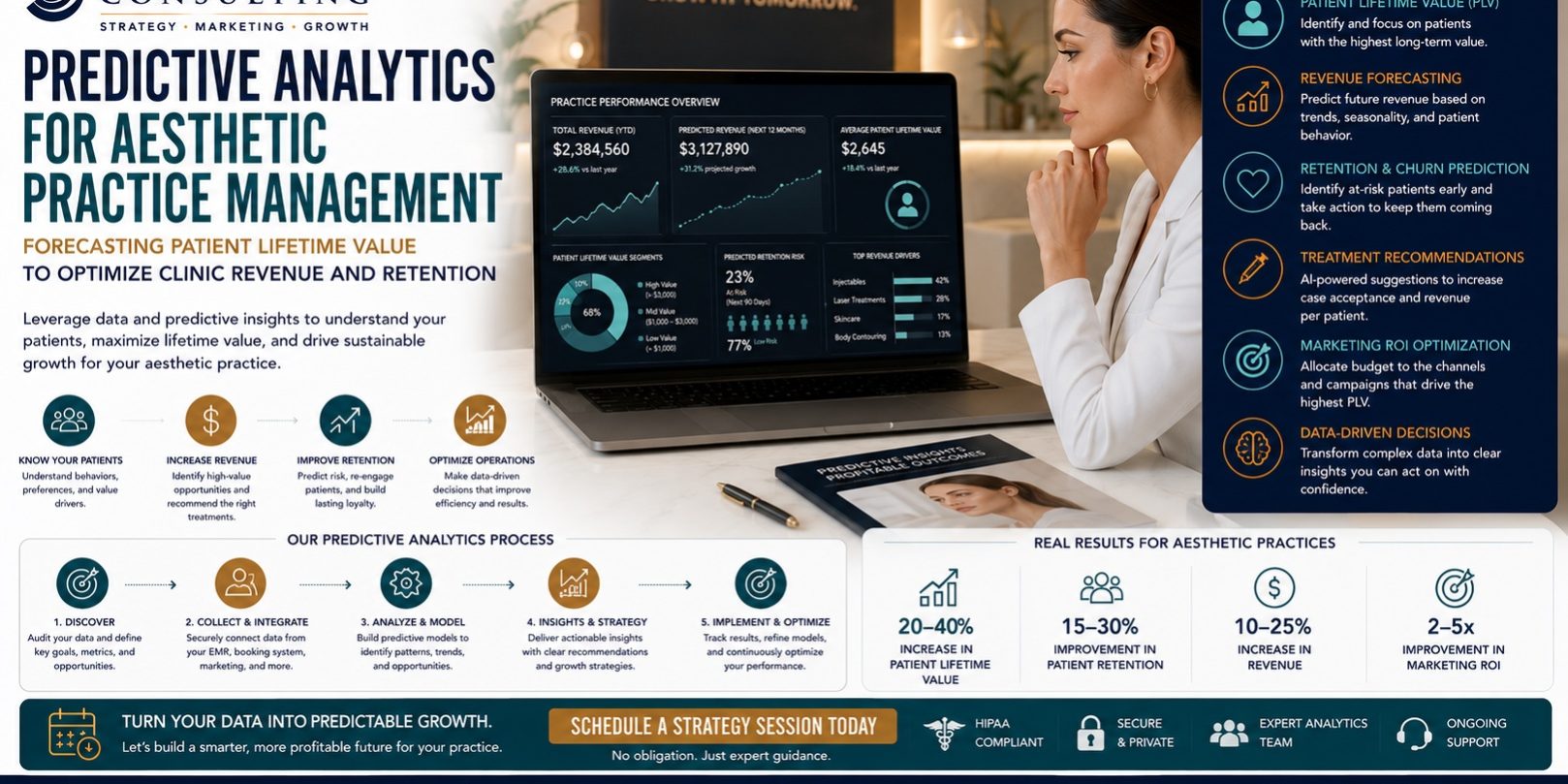
Predictive analytics is rapidly transforming aesthetic practice management by enabling clinics to forecast patient lifetime value (LTV) effectively. This comprehensive approach, known as aesthetic clinic predictive analytics, empowers aesthetic professionals to understand the long-term revenue potential of each patient, enhancing strategic decision-making and operational efficiency. Accurately predicting patient LTV optimization is crucial for maximizing revenue, improving patient retention, and ensuring sustainable growth in a competitive market. Through advanced clinic business intelligence tools integrated with AI, clinics can tailor their services and marketing strategies to better meet patient needs and apply actionable practice KPIs for continuous growth. This article explores critical concepts such as predictive modeling, patient churn forecasting, CAC-to-LTV ratio, treatment recurrence modeling, and provides actionable frameworks for implementation and maximized profitability.
Understanding Patient Lifetime Value (PLV) and Its Impact on Aesthetic Clinics Through Predictive Analytics
Defining Patient LTV and Why It Matters for Aesthetic Clinic Predictive Analytics
Patient lifetime value (PLV) estimates the total revenue a clinic expects from a patient over the duration of their relationship. This metric drives efficient allocation of marketing budgets and operational resources, influencing patient acquisition and retention strategies. Understanding PLV enables clinics to improve patient LTV optimization by deploying personalized engagement and retention cohort analysis to foster loyalty and enhance satisfaction using data-driven insights from aesthetic clinic predictive analytics.
Industry Benchmarks for Aesthetic Clinic Patient LTV and the Role of Clinic Business Intelligence
Industry benchmarks suggest that clinics achieving a higher CAC-to-LTV ratio—where Customer Acquisition Cost is significantly lower than lifetime revenue—see sustainable growth and profitability. A balanced ratio typically ranges from 1:3 to 1:5 in high-performing aesthetic clinics, emphasizing the importance of precise revenue cycle forecasting and targeting high-value patient segments through advanced predictive analytics integrated in clinic business intelligence platforms.
Calculating Patient Lifetime Value with Predictive Modeling and Clinic Business Intelligence Tools
Key Parameters, Formulas, and BI-Driven Forecasting
PLV calculation involves:
- Average purchase value per visit
- Purchase frequency or visit recurrence (treatment recurrence modeling)
- Customer lifespan
- Retention cohort analysis metrics
The formula integrates these factors to forecast revenue accurately. For example, if a patient visits an aesthetic clinic twice a year, spending an average of $500 per visit, and typically remains for five years, the PLV is $5,000. With the integration of clinic business intelligence tools, clinics can utilize real-time data and predictive modeling capabilities to adjust these estimates dynamically, enhancing accuracy by accounting for patient churn forecasting, behavioral trends, and marketing campaign impacts.
How Accurate LTV Forecasting via Predictive Analytics Fuels Revenue Growth and Operational Excellence
Strategic Budget Allocation and Marketing Efficiency Enabled by Clinic Business Intelligence
Accurate patient LTV optimization drives strategic decisions on marketing spend, enabling clinics to invest in high-yield channels. Clinic business intelligence systems provide comprehensive data insights for optimizing the CAC-to-LTV ratio, enabling efficient resource allocation and increasing return on investment. These platforms integrate patient data, financials, and marketing analytics to deliver actionable dashboards that guide decision-makers in real time.
Enhancing Retention with AI CRM Integrations and Predictive Modeling to Reduce Patient Churn
Integrating AI-powered CRM systems with aesthetic clinic predictive analytics allows clinics to automate retention cohort analysis and implement personalized communications, reducing patient churn. Predictive modeling algorithms assess patient behavior risks and forecast disengagement, enabling clinics to identify at-risk patients early and tailor outreach strategies effectively. This proactive approach leads to higher retention rates and improved patient LTV optimization.
Predictive Analytics Models and Algorithms for Patient Segmentation, Churn Reduction, and Retention
Effective Predictive Modeling Techniques Leveraging Clinic Business Intelligence
Key predictive modeling algorithms used in aesthetic practice include:
- Decision Trees: Visualize patient behavior and decision pathways to identify churn triggers.
- Random Forests: Improve accuracy via ensemble learning techniques by combining multiple decision trees.
- K-Means Clustering: Group patients by behavior or demographics for targeted marketing and personalized treatment offers.
Patient Churn Forecasting and Treatment Recurrence Modeling for Optimized Patient LTV
These models predict when patients may disengage and estimate treatment recurrence patterns, allowing clinics to proactively address retention risks and optimize appointment scheduling. By integrating predictive churn models with clinic business intelligence dashboards, clinics gain timely alerts and can design data-driven interventions, ultimately supporting sustained patient LTV optimization.
Leveraging Machine Learning and AI within Clinic Business Intelligence for Enhanced Patient Engagement
Automation, Personalized Outreach, and Predictive Insights
Machine learning facilitates rapid analysis of large datasets to uncover patient preferences and behaviors. AI CRM integrations enable personalized messaging and automate routine tasks, allowing clinical staff to focus on patient care while increasing engagement effectiveness. Combining these tools with clinic business intelligence platforms magnifies their impact by consolidating insights for tailored marketing, retention programs, and revenue forecasting.
Retention Cohort Analysis within Business Intelligence Frameworks for Continuous Improvement of Patient LTV
Cohort analysis tools track patient groups over time, measuring retention trends and the impact of engagement strategies. Actionable insights derived from clinic business intelligence enable aesthetic clinics to refine approaches continuously, improving lifetime patient value and operational success.
Clinic Business Intelligence Solutions: Forecasting Lifetime Patient Value and Supporting Data-Driven Decisions
Top BI Tools and Their Specific Roles in Aesthetic Clinics
- Tableau: Dynamic, intuitive data visualization for operational transparency and patient lifetime value tracking.
- Power BI: Comprehensive analytics and reporting integrated with diverse clinic data sources, facilitating predictive analytics and KPI monitoring.
- Google Analytics: Tracking patient interactions on digital platforms to refine outreach campaigns aligned with predictive insights.
Integrating Business Intelligence with Clinic Data Systems to Enhance Revenue Forecasting
Effective integration with EHR and practice management systems ensures real-time access to clean, consolidated patient data for comprehensive analysis. This consolidated data flow supports advanced revenue cycle forecasting and operational agility, providing aesthetic clinics with accurate lifetime patient value projections essential for sustained growth.
Real-Time Revenue Forecasting and Key Performance Indicators (KPIs) in Aesthetic Clinic Predictive Analytics
Features Driving Financial Agility with Clinic Business Intelligence
- Data Dashboards: Visual summaries of financial and operational KPIs tailored for patient LTV optimization.
- Predictive Analytics: Forecast revenue, patient volume trends, and churn risk based on integrated data models.
- Continuous Integration: Ensures up-to-date, accurate data for agile decision-making and performance tracking.
Actionable Practice KPIs to Monitor for Patient LTV Optimization
- Patient churn rates and retention cohorts analyzed via predictive modeling
- Revenue growth and CAC-to-LTV ratios to assess marketing efficiency
- Engagement metrics such as appointment adherence, treatment recurrence, and response rates
Case Studies and Industry Benchmarks Demonstrating Success in Patient LTV Optimization Using Predictive Analytics
Improved Patient Lifetime Value through Predictive Analytics and Clinic Business Intelligence
One aesthetic clinic used predictive modeling integrated with business intelligence dashboards to segment at-risk patients, deploying personalized follow-up campaigns that boosted retention by 15%, significantly increasing revenue. Another clinic optimized treatment offerings via data-driven insights to enhance patient engagement, improving LTV measurably while maintaining efficient resource allocation.
Revenue Growth with Customized Predictive Models Driving Patient LTV Optimization
Clinics tailoring predictive analytics and leveraging clinic business intelligence report revenue increases from 10% to 30% within a year by aligning marketing and operational strategies with patient data insights, focusing on maximizing patient lifetime value effectively.
Implementing Predictive Analytics and Clinic Business Intelligence Efficiently: Practical Frameworks for Patient LTV Optimization in Aesthetic Clinics
- Data Collection: Capture comprehensive, high-quality data spanning patient demographics, treatments, and engagement history to fuel predictive models and BI tools.
- Model Selection: Choose predictive modeling techniques aligned with clinic goals, emphasizing patient churn forecasting and treatment recurrence for accurate LTV estimates.
- Integration: Fully embed analytics and business intelligence tools within existing clinical and practice management systems, including AI CRM platforms, to enable real-time insights.
- Staff Training: Provide education and resources to ensure effective use of analytics systems, interpretation of KPIs, and data-driven decision-making.
- Continuous Monitoring and Refinement: Employ retention cohort analysis and revenue cycle forecasting to refine predictive models and business strategies periodically, adapting to evolving patient behaviors.
Structured Approach to Deploying Clinic Business Intelligence and Predictive Analytics for Optimal Patient LTV
- Define Clear Objectives: Establish specific aims such as improving retention, maximizing LTV, or enhancing revenue forecasting through analytic initiatives.
- Select Appropriate Technology: Evaluate BI and predictive analytics platforms compatible with clinic infrastructure and data requirements, focusing on scalability and integration.
- Data Integration: Consolidate patient, marketing, and financial data into unified platforms for holistic insights essential for LTV optimization.
- Ongoing Evaluation and Adjustment: Regularly review performance against KPIs, adapt predictive models, and update strategies as new data emerge to maintain effectiveness.
Monitoring Critical Metrics within Clinic Business Intelligence for Post-Implementation Success in Patient LTV Optimization
- Patient Retention Rates: Track returning patient percentages over time to assess engagement success.
- Revenue Growth: Measure financial improvements directly correlated with analytics implementation and patient LTV optimization initiatives.
- Engagement Metrics: Analyze patient interaction data for continuous strategy refinement and effectiveness.
- CAC-to-LTV Ratio: Monitor this balance to ensure marketing efficiency and profitability, critical for sustainable growth.
Consistent focus on these metrics enables clinics to pursue continuous improvement and maximize patient lifetime value optimization leveraging advanced aesthetic clinic predictive analytics and clinic business intelligence tools.
Enhance Your Aesthetic Clinic’s Profitability with Predictive Analytics and Clinic Business Intelligence Today
Use advanced aesthetic clinic predictive analytics and clinic business intelligence to transform patient lifetime value forecasting. Illumination Consulting helps clinics implement actionable KPIs and integrate AI-driven CRM tools to operate more efficiently, reduce patient churn, and grow sustainably.
Frequently Asked Questions
What is patient lifetime value (PLV) in an aesthetic clinic?
Patient lifetime value (PLV) estimates the total revenue a clinic can expect from a patient over the full course of their relationship with the practice. It accounts for average purchase value per visit, visit frequency, and patient lifespan, and it guides how clinics allocate marketing budgets, prioritize retention efforts, and apply aesthetic clinic predictive analytics for ongoing optimization.
How is patient lifetime value calculated?
PLV is calculated by combining average purchase value per visit, purchase frequency or visit recurrence, and expected customer lifespan. For example, a patient who visits twice a year at $500 per visit over five years represents a PLV of $5,000. Predictive models and clinic business intelligence tools refine this estimate further by factoring in patient churn forecasting, behavioral trends, and treatment recurrence patterns.
What is a healthy CAC-to-LTV ratio for an aesthetic clinic?
High-performing aesthetic clinics typically target a CAC-to-LTV ratio between 1:3 and 1:5, meaning lifetime patient revenue significantly outweighs the cost of acquiring that patient. Tracking this ratio using clinic business intelligence supports evaluation of marketing efficiency and long-term profitability.
How does predictive analytics help reduce patient churn?
Predictive analytics models, such as decision trees, random forests, and K-means clustering, analyze patient behavior and treatment recurrence patterns to flag patients at risk of disengaging. Clinics can then use AI CRM integrations combined with clinic business intelligence dashboards to deliver personalized outreach and retention campaigns before those patients are lost, thereby improving patient LTV optimization.
What tools support clinic business intelligence and revenue forecasting?
Platforms like Tableau, Power BI, and Google Analytics are commonly used to visualize KPIs, track patient interactions, and forecast revenue. When integrated with EHR and practice management systems, these tools provide clinics with real-time, consolidated data essential for accurate lifetime patient value forecasting and actionable insights within aesthetic clinic predictive analytics.