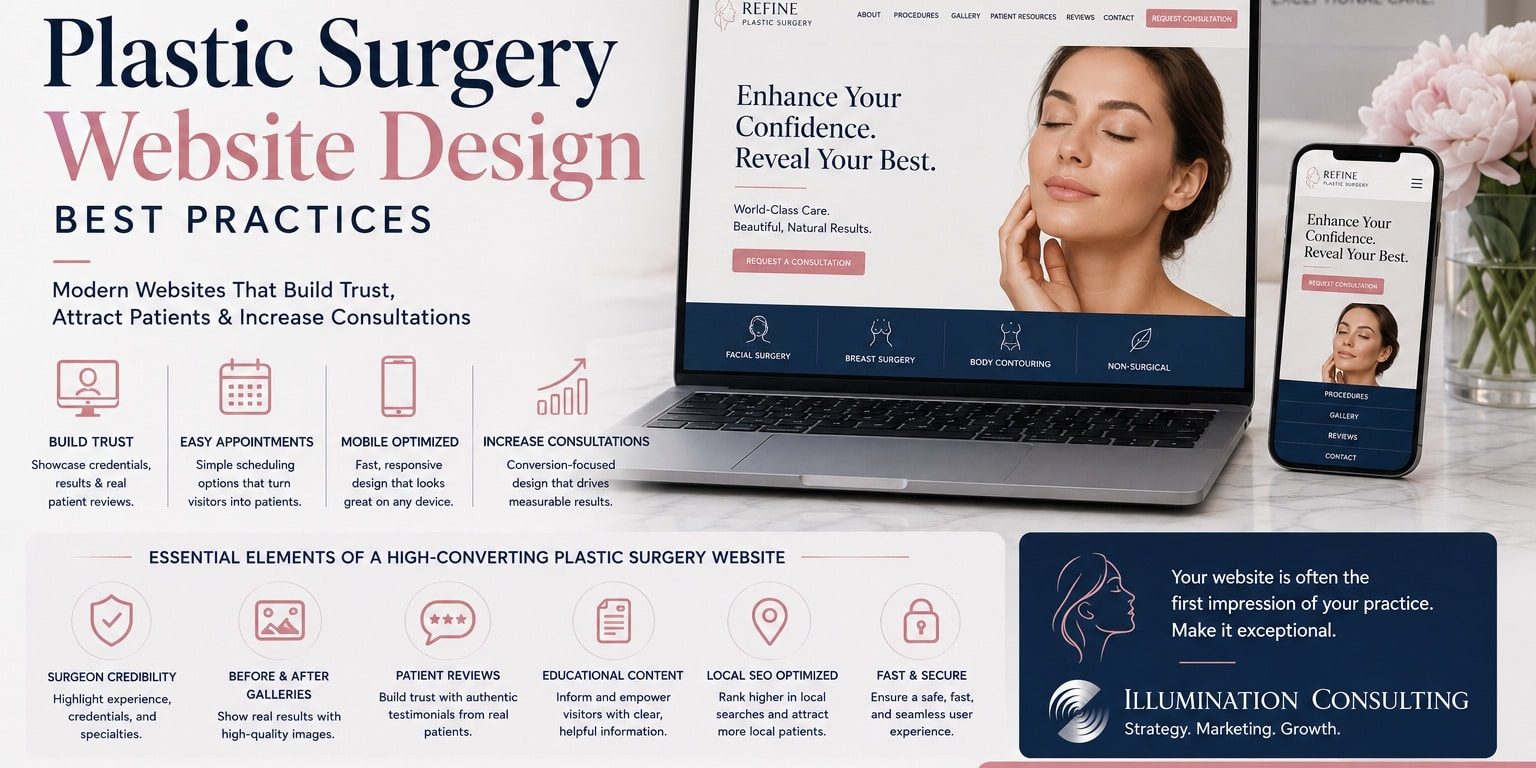
Effective plastic surgery website design best practices help practices create exceptional first impressions, establish credibility, and convert prospective patients into consultation requests. In today’s competitive cosmetic healthcare market, patients often evaluate multiple plastic surgeons online before making contact. A professionally designed website can become one of the practice’s most valuable marketing assets by building trust long before the initial consultation.
Unlike many other healthcare specialties, plastic surgery patients make highly personal and emotional decisions. They carefully review physician credentials, before-and-after galleries, patient testimonials, treatment information, office environments, and overall brand presentation. Every visual element, page layout, and piece of content influences whether a prospective patient feels confident enough to schedule a consultation.
Successful plastic surgery websites combine sophisticated design, intuitive navigation, educational content, compelling visuals, technical search engine optimization, and clear conversion pathways. The objective is not simply to showcase procedures but to communicate expertise, professionalism, safety, and outstanding patient care.
In this guide, we’ll explore proven plastic surgery website design best practices that help practices increase consultation requests, strengthen patient confidence, improve search visibility, and support sustainable long-term growth.
Why Website Design Matters for Plastic Surgeons
Your website frequently creates the first impression of your practice.
Patients researching cosmetic procedures often spend considerable time comparing providers before choosing whom to trust with their care. An outdated or confusing website can immediately reduce confidence, while a polished, modern website reinforces professionalism and clinical excellence.
A high-performing website can help practices:
- Increase consultation requests
- Build patient confidence
- Improve local search rankings
- Showcase surgical expertise
- Educate prospective patients
- Strengthen luxury brand positioning
- Improve mobile engagement
- Support cosmetic procedure marketing
- Increase patient inquiries
- Improve marketing return on investment
An effective website serves as both an educational resource and a powerful patient acquisition tool.
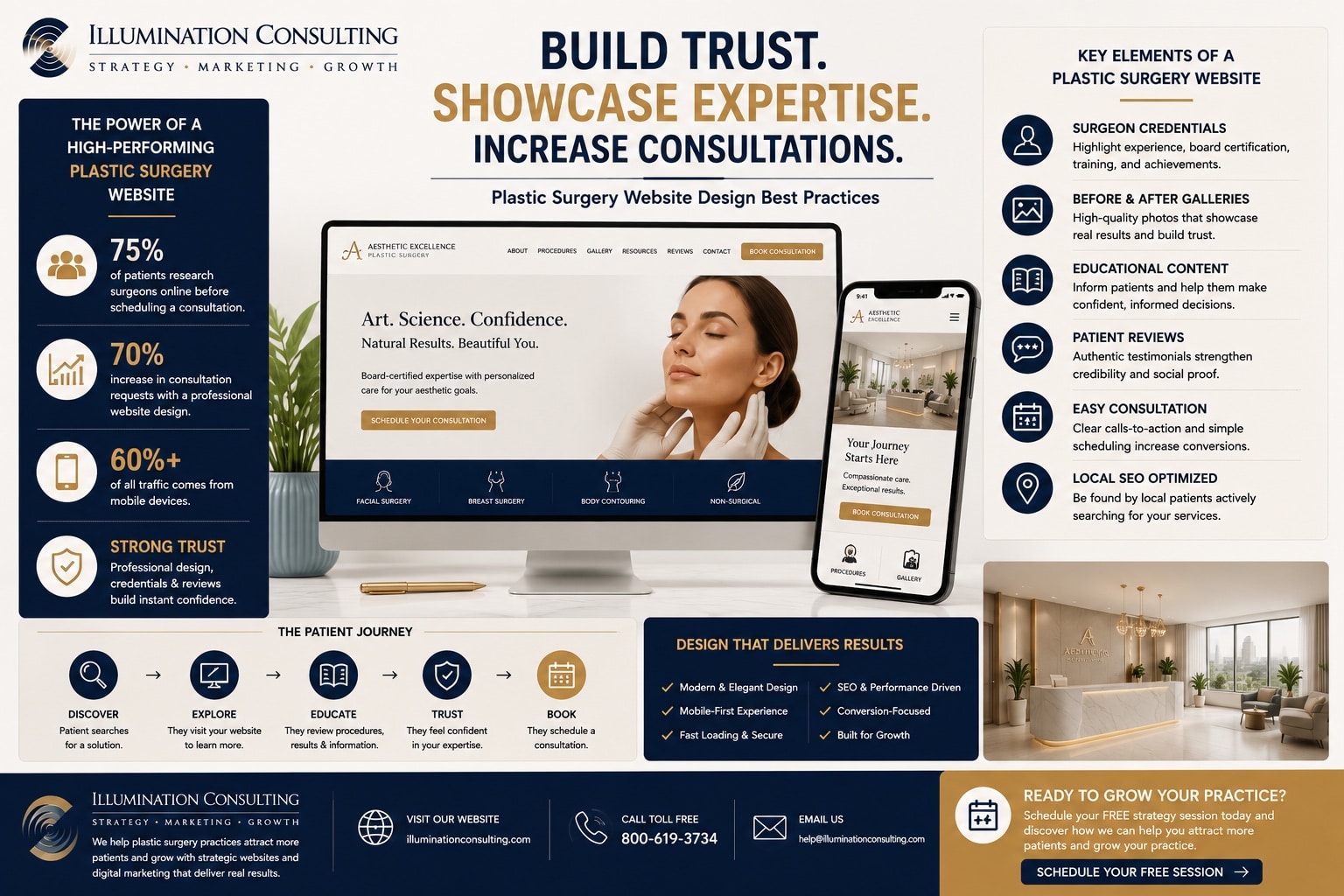
Design Around the Patient Journey
One of the most important plastic surgery website design best practices is designing every page around how prospective patients research cosmetic procedures.
Patients typically want answers to questions such as:
- Am I a good candidate?
- What results should I expect?
- How experienced is the surgeon?
- What does recovery involve?
- What are the risks?
- Can I view before-and-after results?
- What financing options are available?
- How do I schedule a consultation?
The website should guide visitors naturally through these questions while reducing uncertainty at every stage.
Create Simple Navigation
Visitors should immediately understand where to find the information they need.
Primary navigation should include:
- Surgical Procedures
- Non-Surgical Treatments
- Before & After Gallery
- Meet the Surgeon
- Patient Resources
- Financing
- Reviews
- Request a Consultation
Simple navigation improves usability while encouraging visitors to explore additional services.
Showcase Before-and-After Results Professionally
Visual proof remains one of the strongest conversion elements for cosmetic surgery websites.
High-quality before-and-after galleries help prospective patients understand realistic outcomes while demonstrating surgical expertise.
Best practices include:
- Consistent lighting
- Standardized photography
- Multiple patient examples
- Procedure categorization
- Treatment descriptions
- Natural-looking outcomes
- Mobile-friendly galleries
- High-resolution images
Professional galleries build credibility while helping patients visualize potential results.
Build Trust Through Surgeon Credentials
Choosing a plastic surgeon is a significant personal decision, and prospective patients want reassurance that they are selecting an experienced and qualified provider.
A dedicated surgeon profile should communicate far more than education and certifications. It should help patients understand the surgeon’s philosophy, experience, specialties, and commitment to patient care.
Include information such as:
- Board certification
- Education and training
- Years of experience
- Surgical specialties
- Professional memberships
- Hospital affiliations
- Awards and recognitions
- Continuing education
A professional biography accompanied by authentic photography helps establish credibility while creating a more personal connection.
Use Authentic Practice Photography
Professional photography significantly influences how patients perceive a cosmetic practice.
Instead of relying on generic stock imagery, showcase your own practice through high-quality photographs.
Consider including:
- Reception areas
- Consultation rooms
- Surgical facilities
- Recovery suites
- Clinical staff
- Office exterior
- Patient care environments
- Team photography
Authentic visuals reinforce professionalism while helping patients feel comfortable before their first consultation.
Create Individual Procedure Pages
One of the most valuable plastic surgery website design best practices is developing dedicated pages for every major procedure rather than grouping everything under one generic services page.
Each procedure page should educate patients while supporting search engine optimization.
Examples include:
- Breast augmentation
- Breast lift
- Breast reduction
- Tummy tuck
- Liposuction
- Mommy makeover
- Rhinoplasty
- Facelift
- Eyelid surgery
- Body contouring
Dedicated pages improve search visibility while helping patients find information relevant to their specific interests.
Educate Without Overwhelming Patients
Plastic surgery patients appreciate detailed information, but excessive medical terminology can make content difficult to understand.
Successful procedure pages should explain:
- Candidate qualifications
- Treatment goals
- Surgical techniques
- Recovery expectations
- Potential risks
- Expected results
- Frequently asked questions
- Consultation process
Clear explanations build confidence while helping patients make informed decisions.
Optimize Every Page for Mobile Devices
Most cosmetic surgery research begins on smartphones.
Following plastic surgery website design best practices means ensuring every page provides an exceptional mobile experience.
Mobile optimization should include:
- Responsive layouts
- Fast loading speeds
- Mobile-friendly navigation
- Large tap targets
- Click-to-call buttons
- Online consultation forms
- Readable typography
- Simplified page layouts
A seamless mobile experience improves engagement while increasing consultation requests.
Simplify Consultation Requests
Every important page should make requesting a consultation simple and convenient.
Patients should never struggle to locate contact information or appointment options.
Effective conversion elements include:
- Schedule a Consultation buttons
- Online request forms
- Click-to-call functionality
- Office locations
- Interactive maps
- Financing information
- Consultation expectations
- Contact forms
Reducing friction throughout the scheduling process increases conversions while improving patient satisfaction.
Improve Local Search Visibility
Website design should support local search engine optimization by helping nearby patients easily discover your practice.
Important local SEO elements include:
- Individual location pages
- Google Business Profile integration
- Consistent NAP information
- Local schema markup
- Embedded Google Maps
- Local patient reviews
- Community involvement
- Optimized contact pages
Strong local SEO helps practices attract highly qualified patients actively searching for cosmetic procedures in their area.
Highlight Patient Testimonials
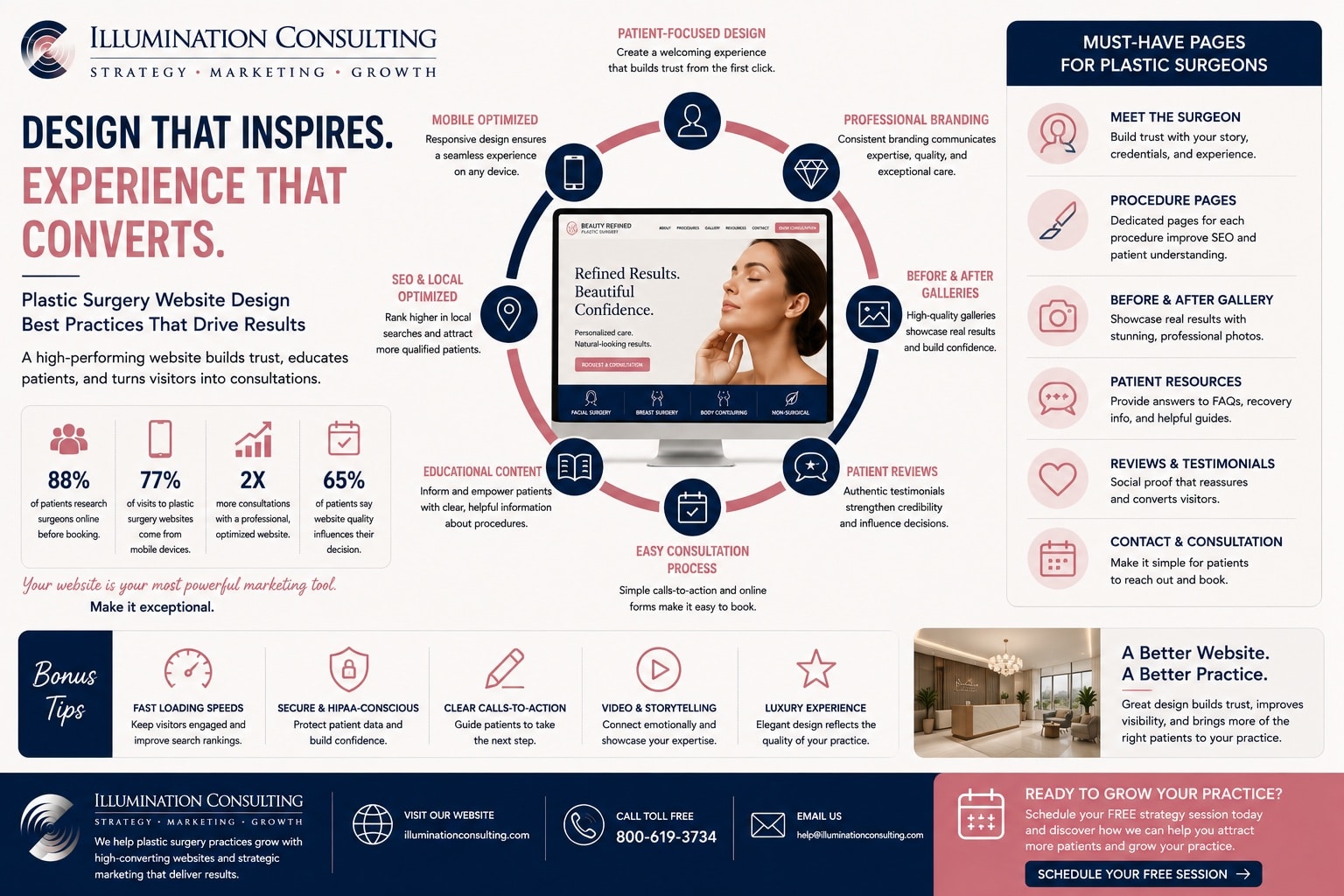
Patient testimonials help prospective patients understand the experience they can expect throughout their treatment journey.
Authentic reviews provide valuable social proof while reinforcing the quality of care your practice delivers.
Testimonials should emphasize:
- Overall patient experience
- Surgeon professionalism
- Staff friendliness
- Consultation process
- Surgical outcomes
- Recovery support
- Communication
- Patient satisfaction
Including verified reviews throughout the website strengthens credibility while increasing consultation requests.
Strengthen Calls to Action
Every page should encourage visitors to take the next step.
Rather than limiting calls to action to the bottom of each page, strategically place them throughout the patient journey.
Effective calls to action include:
- Request a Consultation
- Schedule Your Consultation
- Meet Our Surgeon
- View Before & After Gallery
- Explore Treatment Options
- Contact Our Office
- Call Today
- Book a Consultation
Clear calls to action reduce hesitation while improving conversion rates.
Improve Website Performance
Fast, reliable websites create better user experiences while supporting stronger search engine rankings.
Practices should regularly optimize:
- Image compression
- Page loading speed
- Core Web Vitals
- Browser caching
- Secure hosting
- Mobile responsiveness
- Code optimization
- SSL security
Website performance directly affects both user satisfaction and search visibility.
Support the Patient Decision Process
Plastic surgery patients rarely make immediate decisions.
Most visitors spend time researching procedures, comparing providers, and evaluating treatment options before scheduling a consultation.
Helpful decision-support content includes:
- Frequently asked questions
- Procedure comparison guides
- Recovery timelines
- Financing options
- Consultation expectations
- Educational videos
- Downloadable patient guides
- Blog articles
Educational content positions the practice as a trusted authority while encouraging prospective patients to return to the website.
Common Website Design Mistakes
Even highly respected plastic surgery practices can lose prospective patients because of avoidable website issues.
Recognizing these mistakes allows practices to improve usability while increasing consultation requests.
Overusing Stock Photography
Stock images often reduce authenticity.
Patients prefer seeing the actual practice, surgeon, team, and office environment whenever possible.
Professional photography should showcase:
- The surgeon
- Clinical team
- Office interiors
- Consultation rooms
- Reception area
- Patient-focused environment
- Practice culture
- Brand personality
Authentic visuals build stronger emotional connections while reinforcing trust.
Complicated Navigation
Visitors should never struggle to locate procedures or consultation information.
Common navigation problems include:
- Overcrowded menus
- Confusing procedure categories
- Hidden contact information
- Poor mobile usability
- Inconsistent page structure
- Broken internal links
- Unclear page hierarchy
Simple navigation improves the overall patient experience while increasing conversions.
Weak Branding
Luxury cosmetic practices compete on more than clinical expertise.
Website branding should consistently communicate professionalism, quality, trust, and exceptional patient care through:
- Consistent typography
- Sophisticated color palettes
- Premium photography
- Clear messaging
- Professional graphics
- Elegant layouts
- Consistent visual identity
- Strong brand positioning
Strong branding helps differentiate your practice in a competitive marketplace.
Use Artificial Intelligence to Improve Patient Engagement
Artificial intelligence is helping plastic surgery practices create more personalized, efficient, and responsive patient experiences while improving marketing performance and operational efficiency.
When implemented strategically, AI can assist practices with:
- Intelligent website chat assistants
- Consultation scheduling
- Patient communication
- Marketing automation
- Personalized content recommendations
- Search engine optimization
- Lead qualification
- Review monitoring
- Analytics and reporting
- Workflow automation
AI should complement the personalized care provided by your team while making it easier for prospective patients to engage with your practice.
Continuously Optimize Your Website
Following plastic surgery website design best practices is an ongoing process rather than a one-time redesign.
Patient expectations, technology, search algorithms, and digital marketing continue to evolve. Practices that regularly refine their websites remain more competitive and continue generating stronger marketing results.
Review your website regularly by evaluating:
- Consultation conversion rates
- User behavior
- Mobile usability
- Search rankings
- Core Web Vitals
- Patient feedback
- Page performance
- Local SEO visibility
Continuous improvement helps maximize both patient satisfaction and long-term practice growth.
Frequently Asked Questions
What are plastic surgery website design best practices?
Plastic surgery website design best practices are proven methods for creating professional, patient-focused websites that improve credibility, strengthen search visibility, educate prospective patients, and generate more consultation requests.
Why is website design important for plastic surgery practices?
Your website often creates the first impression of your practice. A modern, professionally designed website builds trust, showcases expertise, improves patient confidence, and increases the likelihood that prospective patients will schedule a consultation.
What should every plastic surgery website include?
Every plastic surgery website should include dedicated procedure pages, surgeon biographies, before-and-after galleries, patient testimonials, educational resources, financing information, online consultation requests, professional photography, and clear calls to action.
Does website design improve SEO?
Yes. Well-designed websites improve user experience, page speed, mobile responsiveness, internal linking, and overall engagement, all of which contribute to stronger search engine optimization and improved organic rankings.
How often should a plastic surgery website be updated?
Practices should review and update their websites regularly to improve content, refresh photography, optimize SEO, enhance website performance, add new procedures, and ensure patients always receive current and accurate information.
Grow Your Plastic Surgery Practice with Illumination Consulting
Successful plastic surgery website design best practices combine premium branding, exceptional user experience, technical SEO, patient education, mobile optimization, and conversion-focused design to create websites that consistently generate qualified consultation requests. Plastic surgery practices that invest in modern website design improve patient confidence, strengthen online visibility, increase consultations, and maximize the return on every marketing investment.
At Illumination Consulting, we help plastic surgery practices grow through custom healthcare website design, search engine optimization, digital marketing, content marketing, AI-powered business solutions, and strategic consulting. Our customized growth strategies are designed to improve online visibility, strengthen patient trust, increase consultation requests, and deliver measurable business results.
Whether you’re launching a new plastic surgery practice or redesigning an established website, our team can help you implement plastic surgery website design best practices that create exceptional patient experiences, increase consultation requests, and support sustainable long-term growth.