Advanced Growth Frameworks for High-Growth Clinics
By Illumination Consulting Editorial Team · Updated 2026-08-05
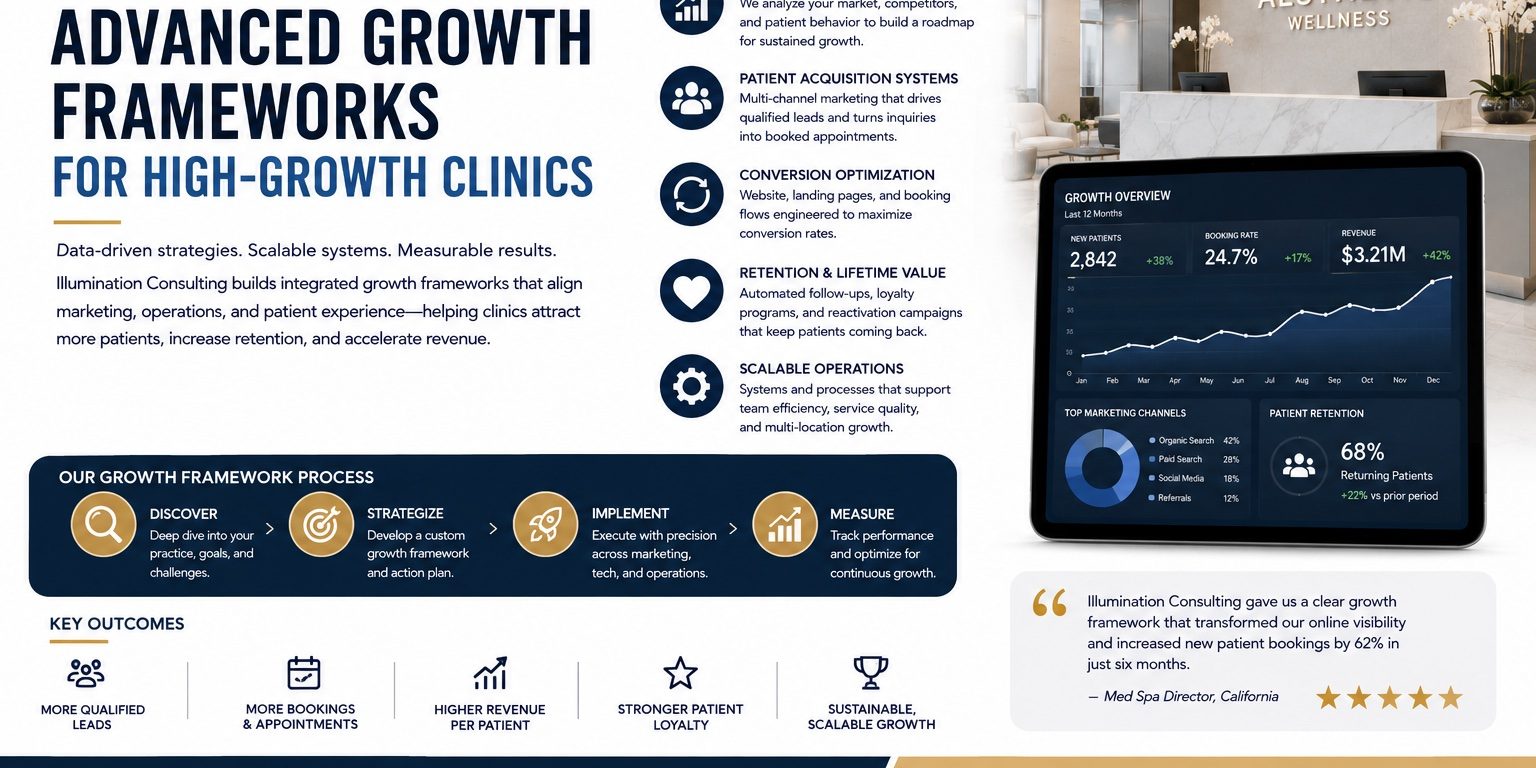
Illumination Consulting delivers advanced growth frameworks engineered specifically for high-growth clinics, combining data-driven marketing systems, scalable operational structures, and patient acquisition strategies. Based in Beverly Hills, our approach empowers aesthetic practices and multi-location clinics to implement sustainable growth with precision and operational excellence.
Advanced growth frameworks for high-growth clinics combine brand positioning, SEO, conversion optimization, and patient retention systems into one coordinated strategy. Illumination Consulting builds these frameworks around measurable outcomes—lead volume, booking rates, revenue per patient—rather than isolated tactics, giving practice directors a scalable structure for sustainable expansion instead of short-term campaign spikes.
Key Takeaways
- Oak Street Health transformed from private clinic to publicly traded vertically integrated healthcare system with CVS.
- High growth clinics implement structured habits and processes to fuel consistent practice expansion throughout 2026 and beyond.
- Illumination Consulting in Beverly Hills, CA specializes in advanced growth frameworks for healthcare clinic scaling.
- Clinical innovation strategy drives measurable outcomes; 27,000+ healthcare executives follow growth-focused healthcare finance analysis.
- Advanced Clinic Scaling Sub-Frameworks in Infrastructure, Talent & Provider Utilization, Technology Stack, and Multi-Unit Expansion streamline operational growth.
- Concrete financial models such as Patient Acquisition Cost (CAC) versus Lifetime Patient Value (LTV) enable data-driven decisions across surgical and non-surgical patient cohorts.
What Prerequisites Enable Successful Practice Scaling?
Three conditions determine whether a clinic scales successfully: a coordinated marketing system, a retention infrastructure, and leadership readiness to shift from individual tactics to full growth frameworks. A recent industry survey of 600 practices across the United States, spanning all sizes and growth stages, confirmed these are shared operational gaps—not market demand—that separate stagnant clinics from expanding ones.
What Does a Coordinated Growth Strategy Actually Include?
A single marketing tactic rarely produces lasting results. Practices ready to scale combine several elements into one coordinated approach:
- Search engine optimization and content marketing for sustained visibility
- Social media marketing and paid advertising for lead generation
- Conversion optimization to turn inquiries into booked patients
- Retention initiatives, including email marketing, to protect long-term revenue
Practice Scaling Sub-Frameworks Overview
To operationalize sustainable practice scaling, Illumination Consulting structures growth into four critical sub-frameworks:
- Infrastructure: Developing scalable clinical and administrative systems that handle increased patient volume efficiently.
- Talent & Provider Utilization: Optimizing staffing models, provider schedules, and maximizing treatment room productivity.
- Technology Stack: Implementing integrated platforms for marketing automation, electronic medical records (EMR), scheduling, and analytics.
- Multi-Unit Expansion: Designing phased approaches to growing beyond a single location with replicable systems and centralized management.
Practice Scaling: Financial Models for Patient Acquisition and Lifetime Value
Robust growth frameworks rely on understanding and optimizing the financial relationship between investment in acquiring new patients and the long-term revenue they generate. This balance is captured through Patient Acquisition Cost (CAC) and Lifetime Patient Value (LTV).
Defining Patient Acquisition Cost (CAC)
CAC = Total Marketing & Sales Expenses / Number of New Patients Acquired
Marketing and sales expenses include digital ads, content creation, staff time dedicated to outreach, and promotional events.
Defining Lifetime Patient Value (LTV)
LTV = Average Revenue per Patient Visit × Average Number of Visits per Patient × Gross Margin Percentage
This metric varies significantly between surgical and non-surgical cohorts:
- Surgical Patients: Tend to have higher one-time revenue but fewer repeat visits.Example: Average revenue per surgical visit = $10,000, average visits = 1.2, gross margin = 70%LTV = $10,000 × 1.2 × 0.70 = $8,400
- Non-Surgical Patients: Typically have lower per-visit revenue but higher visit frequency.Example: Average revenue per non-surgical visit = $300, average visits per year = 5, average retention span = 4 years, gross margin = 65%LTV = $300 × 5 × 4 × 0.65 = $3,900
Comparing CAC with LTV by cohort allows clinics to allocate marketing budget efficiently and prioritize high-value patient segments. A sustainable business model often targets an LTV:CAC ratio of at least 3:1.
Operational KPIs Driving Scalable Clinic Performance
Operational Key Performance Indicators (KPIs) quantify clinic efficiency, informing scaling strategies and process improvements. Leading KPIs include:
Implementing Operational KPIs in Practice
To embed these KPIs into daily operations, Illumination Consulting recommends a tactical implementation approach:
What Are the Core Steps to Build Growth Frameworks?
Five sequential steps build durable growth frameworks for clinics preparing to scale: audit acquisition, unify digital channels, build a full scaling plan, design for multi-location capacity, and phase expansion deliberately. Clinics that skip any one of these steps often generate early sales momentum, then stall before reaching sustainable scale.
- Audit patient acquisition and booking systems first. Many practices produce strong initial sales but hit a ceiling because intake, scheduling, and follow-up processes were never built to handle volume.
- Connect SEO, content, and digital channels into one system. Siloed campaigns waste budget; a unified strategy links search visibility, content, and patient communication so each channel reinforces the others.
- Assemble a full-scope scaling plan. This plan combines business consulting, SEO, website design, patient acquisition strategy, conversion optimization, reputation management, and brand positioning into a single, coordinated engine rather than disconnected tactics.
- Design systems for growth beyond one location. A boutique clinic and a multi-location practice both need infrastructure built to scale, not systems patched together after demand outpaces capacity.
- Phase expansion deliberately. Staged growth models in healthcare — moving from privately held, to public, to vertically integrated structures — demonstrate how disciplined, sequential scaling builds long-term enterprise value.
Why Do Growth Frameworks Fail Without an Acquisition Audit?
Frameworks collapse when leadership assumes booking systems can absorb new demand without review. Practice directors who skip this audit often discover bottlenecks only after scaling strategies are already underway, forcing costly rework mid-expansion.
How Does Practice Scaling Differ From Simple Growth?
Practice scaling requires infrastructure built for volume, not just increased marketing spend. Executive operators pursuing practice scaling need coordinated systems across acquisition, conversion, and reputation management, structured in phases rather than launched all at once.
Clinic Infrastructure Sub-Framework
Building a robust physical and operational infrastructure underpins all successful scaling strategies. Key areas include:
- Facility Optimization: Adequate treatment rooms, waiting areas, and patient flow designed for higher throughput
- Intake & Scheduling Systems: Automated scheduling, patient reminders, and efficient check-in reduce friction and increase capacity
- Standard Operating Procedures (SOPs): Documenting workflows ensures consistency and scalability across locations
Scaling Infrastructure Tactical Table
Talent & Provider Utilization Sub-Framework
Providers are the core revenue drivers. Efficient deployment maximizes ROI and patient experience.
- Maximize Hourly Revenue per Provider: Schedule providers during peak demand windows, support group treatment models where appropriate.
- Optimize Provider Mix: Balance surgical and non-surgical staff to meet patient cohort demand.
- Training & Retention: Invest in ongoing clinical training and employee engagement to reduce churn velocity.
Provider Utilization Tactical Table
Technology Stack Sub-Framework
Integrated technology systems enable data-driven decision-making and operational efficiency.
- Marketing Automation: Tools to nurture leads with personalized communications, reducing CAC.
- Electronic Medical Records (EMR): Streamlined documentation, scheduling, billing, and analytics.
- Patient Engagement Platforms: Portals and apps for patient communication and education improve rebooking rates.
- Analytics and Reporting: Real-time dashboards that monitor KPIs across acquisition, operational, and financial metrics.
Technology Stack Tactical Table
Multi-Unit Expansion Sub-Framework
Expanding from a single clinic to a multi-location enterprise demands a disciplined, phased approach to scaling infrastructure, technology, and talent.
- Phase 1 – Proof of Concept: Optimize and stabilize one location with full growth framework in place.
- Phase 2 – Regional Expansion: Open second location using documented SOPs; centralize administrative functions.
- Phase 3 – Platform Growth: Use technology to unify brand presence, patient data, and marketing efforts across sites.
- Phase 4 – Enterprise Scaling: Pursue vertical integration possibilities such as partnerships, acquisitions, or corporate restructuring to drive market leadership.
Multi-Unit Expansion Tactical Table
What Mistakes Stall Practice Scaling Efforts?
Reimbursement delays, staffing shortages, and operational friction stall the majority of clinics, regardless of size or EMR platform. Without a defined process for addressing these obstacles, growth stalls before it starts. Practice directors who treat these issues as one-off fires, rather than systemic patterns, waste resources fighting the same battles quarterly.
Weak or inconsistent social media presence ranks among the costliest errors. A thin online footprint erodes patient trust long before a prospective patient ever books a consultation. High-performing practices flip this dynamic: they use social channels to educate prospects, showcase clinical expertise, answer common questions, and demonstrate real treatment outcomes.
Why Does Relying on Advertising Alone Hurt Growth?
Advertising spend without a coordinated strategy produces short bursts of leads that fade once the budget stops. Retail and clinical brands alike hit growth ceilings when marketing depends on paid ads instead of integrated growth frameworks combining content, search visibility, and retention.
Common failure points include:
- No repeatable process for operational bottlenecks
- Inconsistent or absent social proof
- Single-channel marketing instead of coordinated scaling strategies
Avoiding these traps is foundational to sustainable practice scaling.
Advanced growth frameworks represent the strategic foundation that distinguishes thriving aesthetic clinics from stagnant competitors. By implementing systems-driven approaches to patient acquisition, operational efficiency, and market positioning, high-growth clinics establish sustainable competitive advantages. The integration of strategic consulting with digital optimization creates compounding returns that extend far beyond initial implementation. Clinics committed to these frameworks don’t simply grow—they build resilient, scalable businesses positioned for long-term market leadership and measurable success.
FAQ
What conditions determine successful clinic scaling?
A coordinated marketing system, retention infrastructure, and leadership readiness together determine scaling success. An industry survey of 600 U.S. practices confirmed operational gaps, not market demand, separate stagnant clinics from expanding ones.
What elements make up a coordinated growth strategy?
A coordinated strategy combines SEO and content marketing, social media and paid advertising, conversion optimization, and retention initiatives like email marketing into one system, rather than relying on isolated campaigns.
What are the core steps to build a growth framework?
Five sequential steps build durable frameworks: audit acquisition and booking systems, unify digital channels, assemble a full-scope scaling plan, design for multi-location capacity, and phase expansion deliberately.
How do I apply financial models to optimize marketing spend?
Calculate your Patient Acquisition Cost (CAC) and compare it to Lifetime Patient Value (LTV) across patient cohorts. Aim for an LTV to CAC ratio of at least 3:1 to ensure sustainable scaling strategies.
Which operational KPIs matter most during scaling?
Treatment room yield, hourly revenue per provider, rebooking rate, and churn velocity provide actionable insight into efficiency and patient retention, key for maintaining growth momentum.
Facts
- Illumination Consulting is located in Beverly Hills, CA, USA.
Partner with Illumination Consulting to Scale Your Clinic
Ready to implement comprehensive growth frameworks and scaling strategies tailored for aesthetic practices and multi-location clinics? Our expert consultants will guide your clinic on the path from optimized patient acquisition to operational excellence and enterprise expansion.