By Illumination Consulting Editorial Team · Updated 2026-07-29
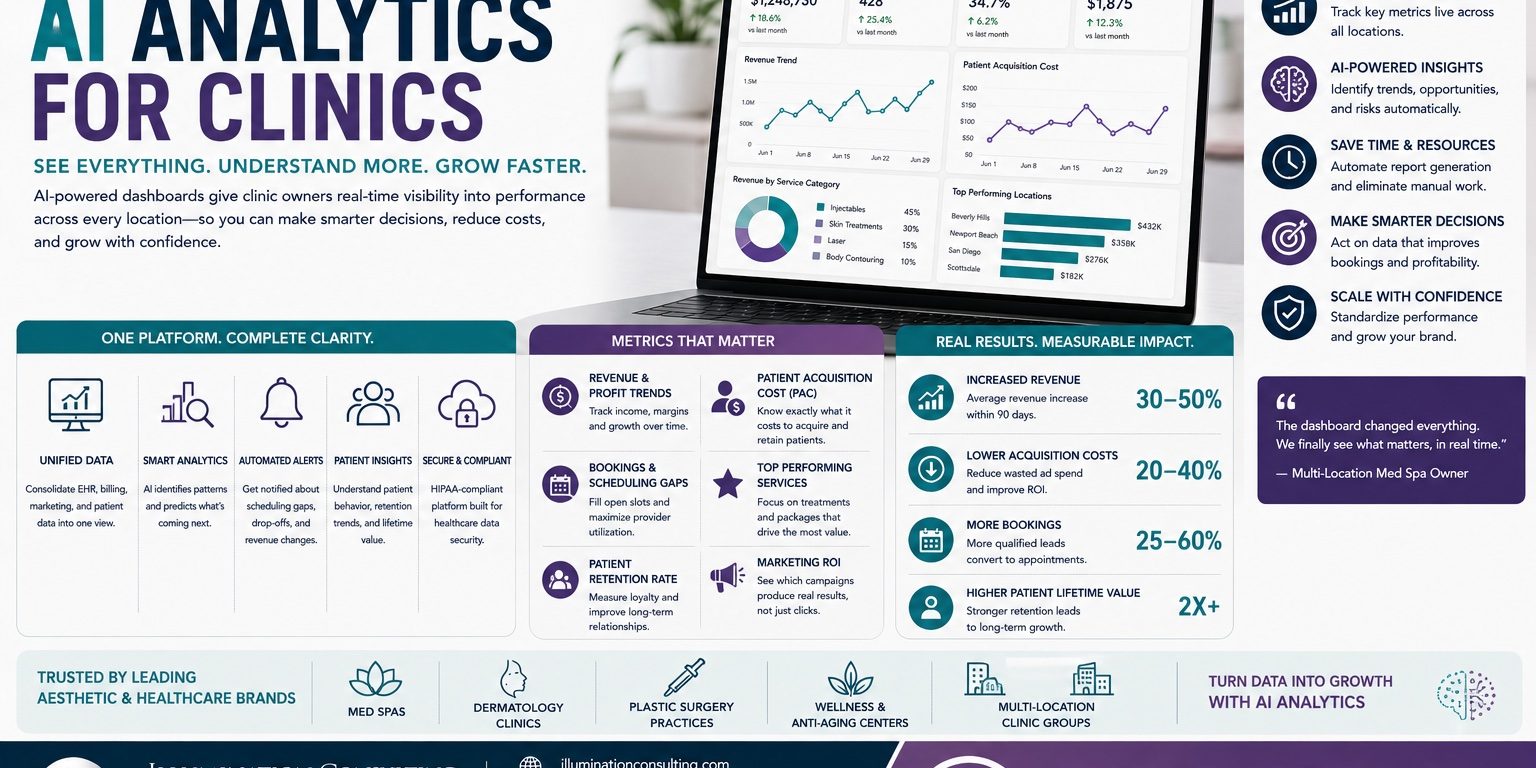
AI-powered analytics dashboards give clinic owners and multi-location operators real-time visibility into scheduling gaps, revenue trends, and patient acquisition costs, replacing guesswork with data-driven decisions. Purpose-built platforms go beyond generic business intelligence tools, translating complex healthcare data into actionable insights that reduce time to value and support scalable, system-wide operational transformation across every location.
Key Takeaways
- AI dashboards consolidate hospital data from ECGs, labs, prescriptions, and scans into unified clinical views.
- Real-time analytics reduce clinician time spent searching for patient information across fragmented systems.
- Automated insights enable healthcare teams to act on data faster, reducing decision-making delays significantly.
- Strategic analytics platforms transform raw data into actionable intelligence, supporting scalable system-wide healthcare improvements.
Why Are Clinics Struggling With Data Overload?
Patient records, billing systems, and marketing platforms each produce their own stream of numbers, and few clinics have a way to unify them. Every visit adds lab results, insurance codes, appointment histories, and campaign metrics to an already crowded pile. Staff members end up toggling between five or six systems just to answer one operational question. That kind of manual review eats hours administrators don’t have.
The real cost shows up in missed decisions, not just wasted time. Without a system that translates raw numbers into direction, growth opportunities slip past unnoticed. This is the gap Illumination Consulting was built to close, pairing AI analytics for clinics with consulting and marketing strategy so scattered figures become clear next steps.
What Kind of Data Overwhelms Most Practices?
Clinics juggle clinical records, billing details, and campaign performance data simultaneously, often across disconnected software. None of these systems were designed to talk to each other. Patterns between marketing spend and patient retention stay invisible.
Why Do Spreadsheets and Basic Reports Fall Short?
Static reports capture a snapshot, not a trend. Practice leaders need clinic performance dashboards u030b that track bookings, retention, and revenue continuously. Illumination Consulting builds growth strategies around these exact metrics, using AI reporting for med spas u030c to turn daily operational noise into decisions that support sustainable, measurable expansion.
What Can AI Dashboards Actually Track?
Clinic performance dashboards track five distinct data streams: patient inquiry volume, website conversion rates, operational workflow, financial performance, and reputation signals. Multi-location operators lose visibility fast without this consolidated view. Scattered spreadsheets and disconnected reports hide the metrics that actually predict growth. A well-built dashboard solves that problem by pulling every signal into one screen.
Search-driven inquiries top the list. AI analytics for clinics monitors how many qualified patient inquiries arrive through Google search, giving administrators a direct read on whether visibility efforts translate into real demand.
Do dashboards track conversion performance too?
Yes. Reporting systems built for clinics pair inquiry volume with conversion tracking, showing which channels turn website visitors into booked appointments. This pairing matters because traffic without conversion tells an incomplete story.
Beyond marketing metrics, dashboards reflect the full operational backbone of a practice:
- Consulting-driven business strategy performance
- SEO and organic visibility trends
- Website design and conversion optimization results
- Reputation management scores and review activity
- Long-term brand positioning indicators
What makes healthcare-specific reporting different from generic business tools?
Clinic performance dashboards built for healthcare rely on domain-specific data models covering clinical, operational, and financial information, unlike generic business intelligence tools. This specificity allows ai reporting for med spas to deliver real-time intelligence and automated insights inside a single interface, sharpening daily decisions instead of burying administrators in disconnected spreadsheets.
How Do You Choose the Right Dashboard for Your Clinic?
The right choice comes down to one test: does the platform turn data into action, or just display it? A strong system for AI analytics for clinics reduces the time between spotting a problem. Fixing it, rather than adding another screen for staff to check. Dashboards that only display numbers without prompting next steps fail this test regardless of how polished they look.
Clinic administrators should evaluate options against a short checklist:
- Does it quantify results from marketing efforts across channels, tying spend to new patient volume and revenue?
- Does it pair booking and retention numbers with reputation signals, like consistent content output and patient-facing communication?
- Does it support Beverly Hills-based growth models built for aesthetics and wellness brands, aligning reporting with bookings and retention?
What makes clinic performance dashboards worth the investment?
Value comes from action, not aesthetics. Clinic performance dashboards earn their cost when staff use the insights to adjust scheduling, follow-up, or marketing spend the same week they appear.
Should reputation data factor into AI reporting for med spas?
Yes. AI reporting for med spas should combine hard numbers with softer trust indicators. Consistent content and visible expertise reinforce the same growth the numbers are meant to track.
AI-powered analytics dashboards transform clinic performance by converting raw operational data into actionable intelligence that drives strategic decision-making. By centralizing patient metrics, treatment outcomes, and business performance indicators, these systems enable aesthetic providers to identify growth opportunities, optimize resource allocation, and enhance patient experiences with precision. The result is a data-informed clinic culture that sustains competitive advantage and accelerates long-term business expansion in an increasingly complex marketplace.
FAQ
Why are clinics struggling with data overload?
Patient records, billing systems, and marketing platforms each produce separate data streams that few clinics unify. Staff toggle between multiple systems for one answer, wasting hours and causing missed growth opportunities.
Why do spreadsheets and basic reports fall short for clinics?
Static reports only capture a snapshot, not a trend. Clinic leaders need continuous dashboards tracking bookings, retention, and revenue to make decisions that support sustainable, measurable expansion.
What kind of data can AI dashboards actually track?
AI dashboards track five distinct streams: patient inquiry volume, website conversion rates, operational workflow, financial performance, and reputation signals, consolidating them into one screen for multi-location operators.
Facts
- Illumination Consulting is located in Beverly Hills, CA, USA.