By Illumination Consulting Editorial Team · Updated 2026-07-29
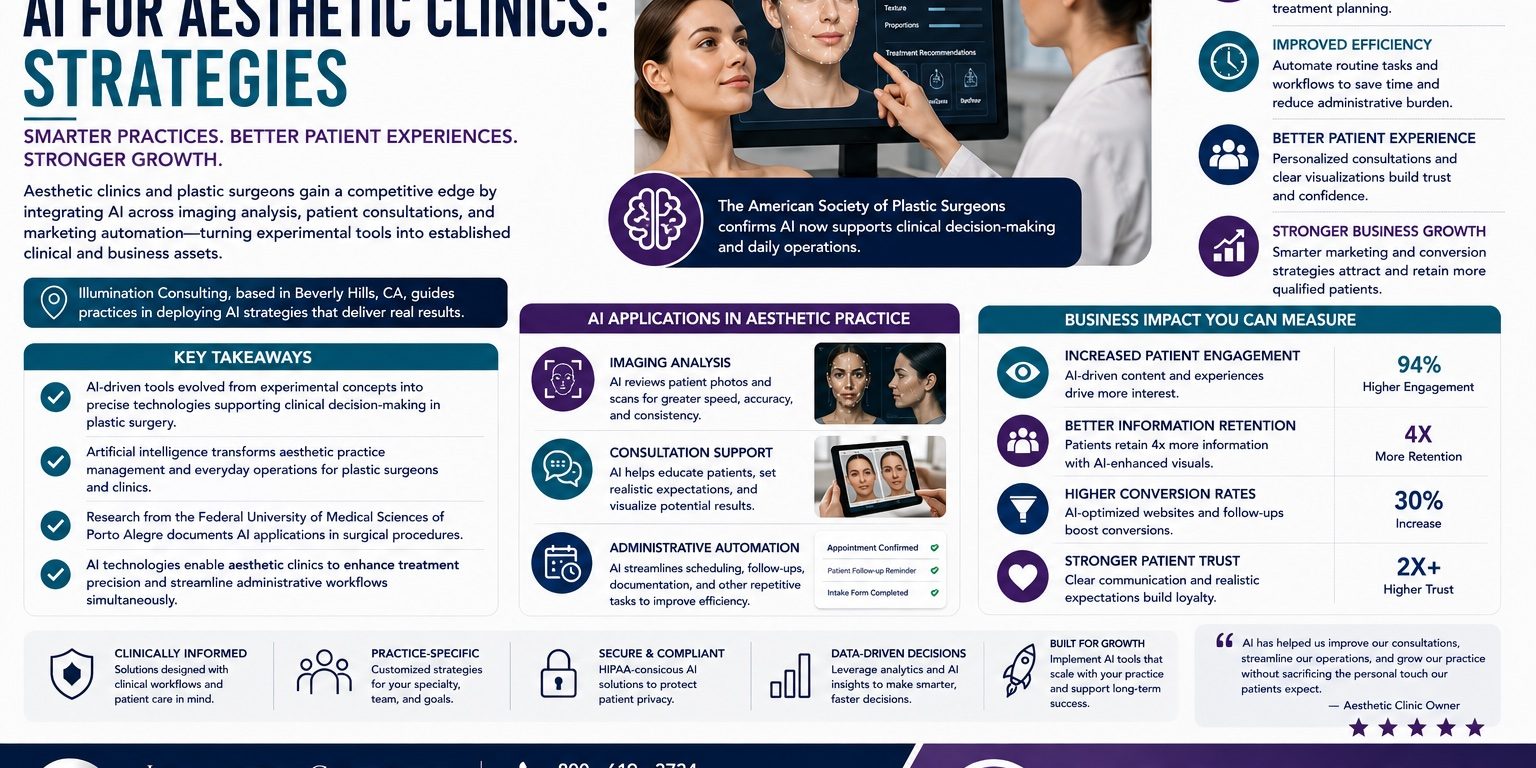
Aesthetic clinics and plastic surgeons gain a competitive edge by integrating AI across imaging analysis, patient consultations, treatment planning, predictive marketing, and clinic workflow automation. This evolution turns experimental tools into foundational clinical and business assets. Illumination Consulting, based in Beverly Hills, CA, guides practices in deploying these AI strategies effectively to maximize outcomes and operational efficiency.
Effective AI strategies for aesthetic clinics center on five critical areas: imaging analysis for patient consultations and automated diagnostic support, AI-driven treatment planning with personalized recommendations, practice management automation, predictive marketing analytics, and conversion-focused website design. The American Society of Plastic Surgeons confirms AI now supports clinical decision-making and daily operations, enhancing precision and patient satisfaction. Illumination Consulting integrates these tools into Plastic Surgery Marketing: Aesthetic Clinics & Med Spas that strengthen patient acquisition and operational efficiency for surgeons and clinic owners.
Key Takeaways
- AI-driven tools evolved from experimental concepts into precise technologies supporting clinical decision-making and personalized treatment planning in plastic surgery.
- Artificial intelligence transforms aesthetic practice management, streamlining administrative workflows and enhancing daily operations for plastic surgeons and clinics.
- Emerging predictive marketing analytics allow clinics to target and engage prospective patients more efficiently, improving conversion rates.
- Research from the Federal University of Medical Sciences of Porto Alegre documents AI applications in surgical procedures, including diagnostic imaging and treatment outcome prediction.
- AI technologies enable aesthetic clinics to improve treatment precision, automate diagnostic imaging support, and streamline administrative workflows simultaneously.
Where Is AI Already Improving Patient Care and Clinic Operations?
Five key clinical and operational functions show clear, measurable gains today: image analysis, automated diagnostic imaging support, AI-driven treatment planning with personalized recommendations, consultation support, and administrative automation. Practices once treated AI for aesthetic clinics as an experimental add-on; that period has ended. AI-driven tools now qualify as established technology, reliably supporting both clinical decision-making and practice management with measurable consistency.
Clinics risk losing ground when they ignore this shift. Competitors using plastic surgery AI tools move faster on imaging review, freeing surgeons to focus on clinical judgment rather than manual measurements, while simultaneously improving treatment planning through predictive analytics. Five distinct areas stand out:
- Image analysis and automated diagnostic support — reviewing patient photos, scans, and diagnostic imaging with greater speed and precision to assist clinical assessments
- AI-driven treatment planning — generating personalized aesthetic treatment recommendations based on patient data and predictive outcomes
- Consultation support — helping staff present options and set realistic patient expectations, enhancing education and satisfaction
- Administrative workflow automation — reducing manual scheduling, documentation, and follow-up burdens to increase clinic efficiency and reduce costs
- Predictive marketing analytics — analyzing patient acquisition data to target high-value segments and optimize marketing spend for maximum ROI
Does AI Replace Surgical Judgment?
No. AI supports decision-making; it does not replace the surgeon’s expertise or hands-on skill. The technology handles complex pattern recognition, data analysis, and repetitive tasks, leaving the nuanced clinical judgment and procedural skill to the surgeon.
How Does This Connect to Marketing?
A practice’s website is increasingly a full patient acquisition and engagement platform, not a static procedure directory. Aesthetic clinic automation applied to that front-end experience, combined with personalized content and SEO-driven strategies, converts more search traffic into booked consultations. The clinical innovations and marketing gains mutually reinforce each other for sustainable growth.
Which AI Tools Belong In Your Marketing and Clinical Technology Stack?
An effective AI-driven technology stack for aesthetic clinics integrates automation, personalization, advanced content engines, predictive analytics, image and video tools, and data-driven SEO into one seamless system. Four categories matter most:
- AI for aesthetic clinics covering clinical strategy and personalized treatment recommendation engines
- Image and video editing and diagnostic imaging tools optimized for aesthetic marketing and clinical accuracy
- Predictive marketing analytics platforms that enable data-driven targeting and patient segmentation
- SEO and analytics systems tracking organic growth, patient engagement, and conversion rates
Personalized content and time-saving automation now shape how practices attract, educate, and convert prospective patients. This shift touches video production, image editing, social media strategy, patient engagement, and clinic workflow optimization.
What AI Tools Actually Help Plastic Surgeons Market Their Practice and Improve Clinical Outcomes?
Plastic surgery AI tools worth prioritizing include automated content generators, image-editing platforms for before-and-after galleries, social scheduling systems tied to patient engagement metrics, diagnostic imaging automation platforms, and video production tools that reduce content creation time while boosting effectiveness.
- Content and social automation platforms integrating predictive patient engagement analytics
- Image and video editing and enhancement tools built for aesthetic marketing with clinical-grade imaging accuracy
- SEO and analytics systems monitoring organic traffic, engagement metrics, and conversion efficiency
- Automated diagnostic imaging support and AI-driven treatment planning software enhancing clinical precision
Does Automation Replace Strategy?
No. Aesthetic clinic automation works best paired with strategic SEO, content development, clinical AI integration, and technical optimization. This comprehensive approach helps med spas and plastic surgery practices improve search rankings, attract highly qualified local patients, and build long-term organic growth while delivering superior patient care.
Illumination Consulting builds these marketing and branding systems specifically for med spas and surgical practices. The goal remains consistent: stronger patient bookings, improved retention, enhanced clinical outcomes, and greater online visibility built on measurable results.
How Should Clinics Automate Growth and Clinical Operations?
Growth automation and clinical AI integration work best as coordinated, connected systems, not isolated tools. Clinics that scale successfully combine consulting, SEO, website design, patient acquisition strategy, conversion optimization, clinical AI applications, and reputation management into one integrated operation instead of managing each in isolation. This holistic approach turns AI for aesthetic clinics into a powerful growth and care delivery engine rather than a scattered collection of experiments.
Search visibility drives much of that engine. Automated SEO systems increase qualified patient inquiries arriving directly from Google, while parallel efforts strengthen local rankings on Google Maps. For practices competing in congested markets, that visibility often determines who receives consultation calls first.
Administrative and clinical efficiency matter equally. Plastic surgery AI tools now handle scheduling, patient intake, routine follow-ups, automated diagnostic imaging, and treatment plan customization that were traditionally manual and time-consuming.
What Should a Clinic Automate and Implement First? An Actionable Roadmap
A focused, phased roadmap for AI and automation implementation boosts results and minimizes disruption. Start by optimizing patient-facing systems that directly impact acquisition and engagement, then layer clinical AI and administrative automation as infrastructure matures.
- Local search and Google Maps optimization: Ensure high visibility in search results where prospective patients look first.
- Website conversion and lead capture enhancements: Improve calls to action, streamline inquiry forms, and implement AI chatbots for initial engagement.
- Aesthetic clinic automation: Automate scheduling, patient intake, and follow-up communications to reduce operational burden.
- Incorporate AI-driven clinical tools: Introduce automated diagnostic imaging analysis and AI-driven personalized treatment planning software to support clinical decision-making.
- Deploy predictive marketing analytics: Use AI platforms to analyze patient acquisition trends, refine audience targeting, and optimize marketing spend.
- Reputation management and review generation: Use automation platforms to solicit and manage patient reviews that bolster online credibility.
- Ongoing consulting and refinement: Continuously measure performance, optimize positioning, and integrate emerging AI solutions aligned with practice goals.
The sequence prioritizes immediate patient engagement and visibility while building a foundation for operational excellence and advanced clinical support. Clinics that automate administrative tasks too early risk inefficiency if visibility and lead volume are insufficient.
The integration of artificial intelligence into aesthetic practice represents a fundamental shift in how clinics operate and serve their patients. By implementing AI-driven systems strategically—from patient imaging and treatment planning to operational efficiency and predictive marketing—aesthetic providers establish competitive advantages that drive measurable growth. Practices that embrace these technologies thoughtfully position themselves as industry leaders, delivering superior patient experiences while building sustainable, scalable business models. The future of aesthetic medicine belongs to those who harness AI’s transformative potential today.
FAQ
Does AI replace a surgeon’s judgment during procedures?
No. AI handles complex pattern recognition, diagnostic imaging, treatment planning support, and repetitive tasks, while surgeons retain clinical judgment and hands-on skill. The technology supports decision-making rather than replacing expertise.
What areas benefit most from AI right now?
Image analysis, automated diagnostic imaging support, AI-driven treatment planning, consultation support, and administrative workflows show the clearest gains. These functions speed photo review, personalize treatments, help staff set realistic expectations, and reduce scheduling and documentation burdens.
How does AI improve a clinic’s marketing and patient acquisition?
Illumination Consulting integrates AI into growth systems that strengthen patient acquisition and operational efficiency. Personalized content, automation, predictive marketing analytics, and analytics-driven SEO turn a clinic’s website into a comprehensive acquisition engine.
AI Implementation Strategy & ROI Matrix for Aesthetic Clinics
Author Bio
The Illumination Consulting Editorial Team consists of experts specializing in med spa and aesthetic clinic business strategy, digital marketing, and AI adoption. Based in Beverly Hills, CA, they work with leading providers to implement innovative technologies that improve patient care and practice growth. Their insights bridge clinical excellence and cutting-edge operations to empower aesthetic professionals in an evolving healthcare landscape.
Frequently Asked Questions
Does AI replace a surgeon’s judgment during procedures?
No. AI handles complex pattern recognition, diagnostic imaging, treatment planning support, and repetitive tasks, while surgeons retain clinical judgment and hands-on skill. The technology supports decision-making rather than replacing expertise.
What areas benefit most from AI right now?
Image analysis, automated diagnostic imaging support, AI-driven treatment planning, consultation support, and administrative workflows show the clearest gains. These functions speed photo review, personalize treatments, help staff set realistic expectations, and reduce scheduling and documentation burdens.
How does AI improve a clinic’s marketing and patient acquisition?
Illumination Consulting integrates AI into growth systems that strengthen patient acquisition and operational efficiency. Personalized content, automation, predictive marketing analytics, and analytics-driven SEO turn a clinic’s website into a comprehensive acquisition engine.
Facts
- Illumination Consulting is located in Beverly Hills, CA, USA.