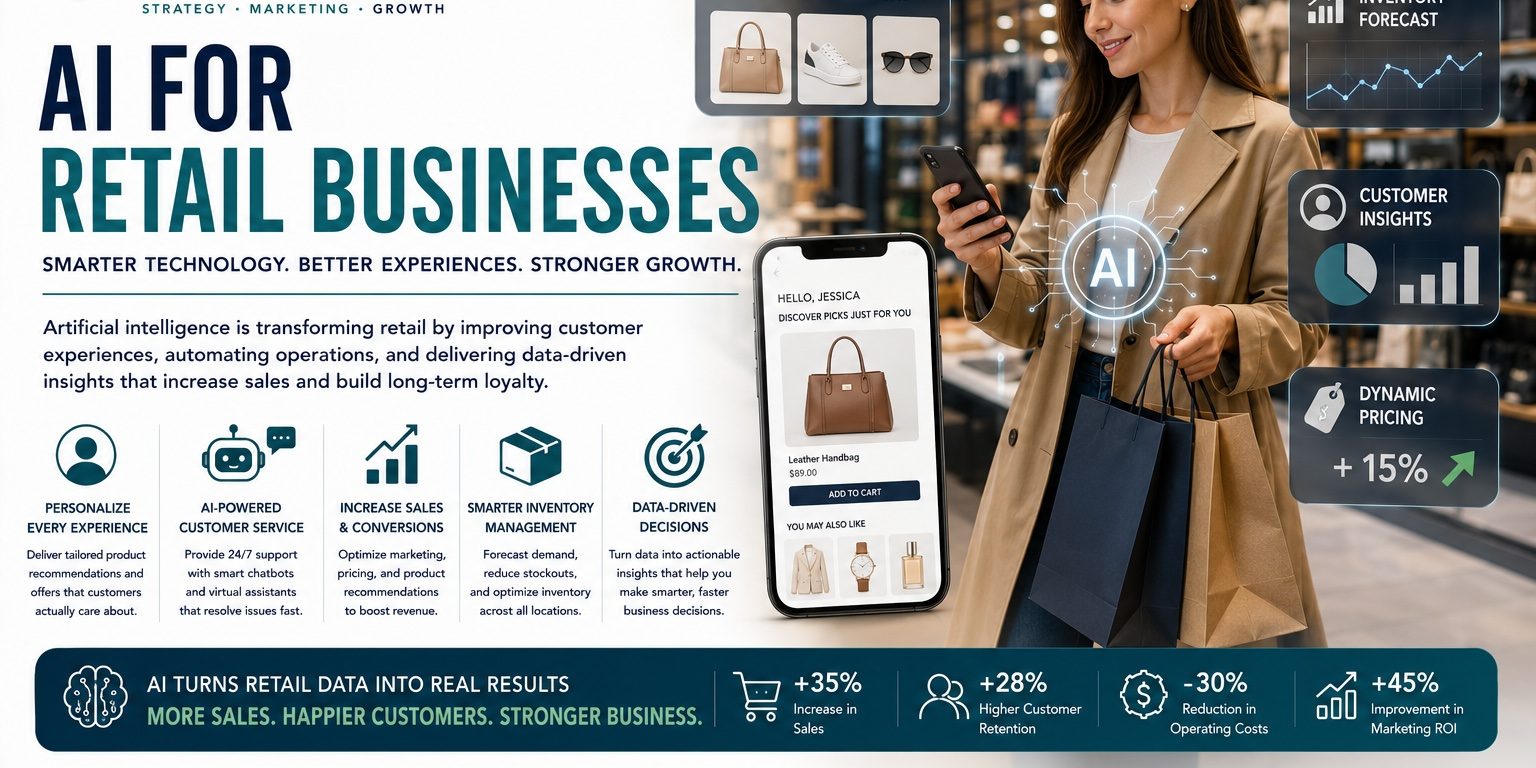
Artificial intelligence is transforming the retail industry faster than almost any other technology in recent decades. From neighborhood boutiques and specialty retailers to national chains and global e-commerce brands, businesses are using AI to better understand customers, improve operational efficiency, personalize shopping experiences, and make smarter decisions based on real-time data. What once required large teams and significant resources can now be accomplished through intelligent automation that helps retailers operate more efficiently while delivering exceptional customer experiences.
Today’s consumers expect more than quality products and competitive pricing. They want personalized recommendations, seamless shopping experiences across multiple channels, fast customer service, convenient purchasing options, and brands that understand their preferences. Retailers that fail to meet these expectations often lose customers to competitors that embrace modern technologies and continuously improve the customer journey.
Artificial intelligence enables retailers to meet these growing expectations by analyzing customer behavior, predicting buying patterns, automating repetitive processes, optimizing marketing campaigns, and providing personalized experiences at every stage of the purchasing journey. Rather than replacing employees, AI allows retail teams to focus on strategic initiatives, customer relationships, merchandising, and business growth while technology manages routine tasks.
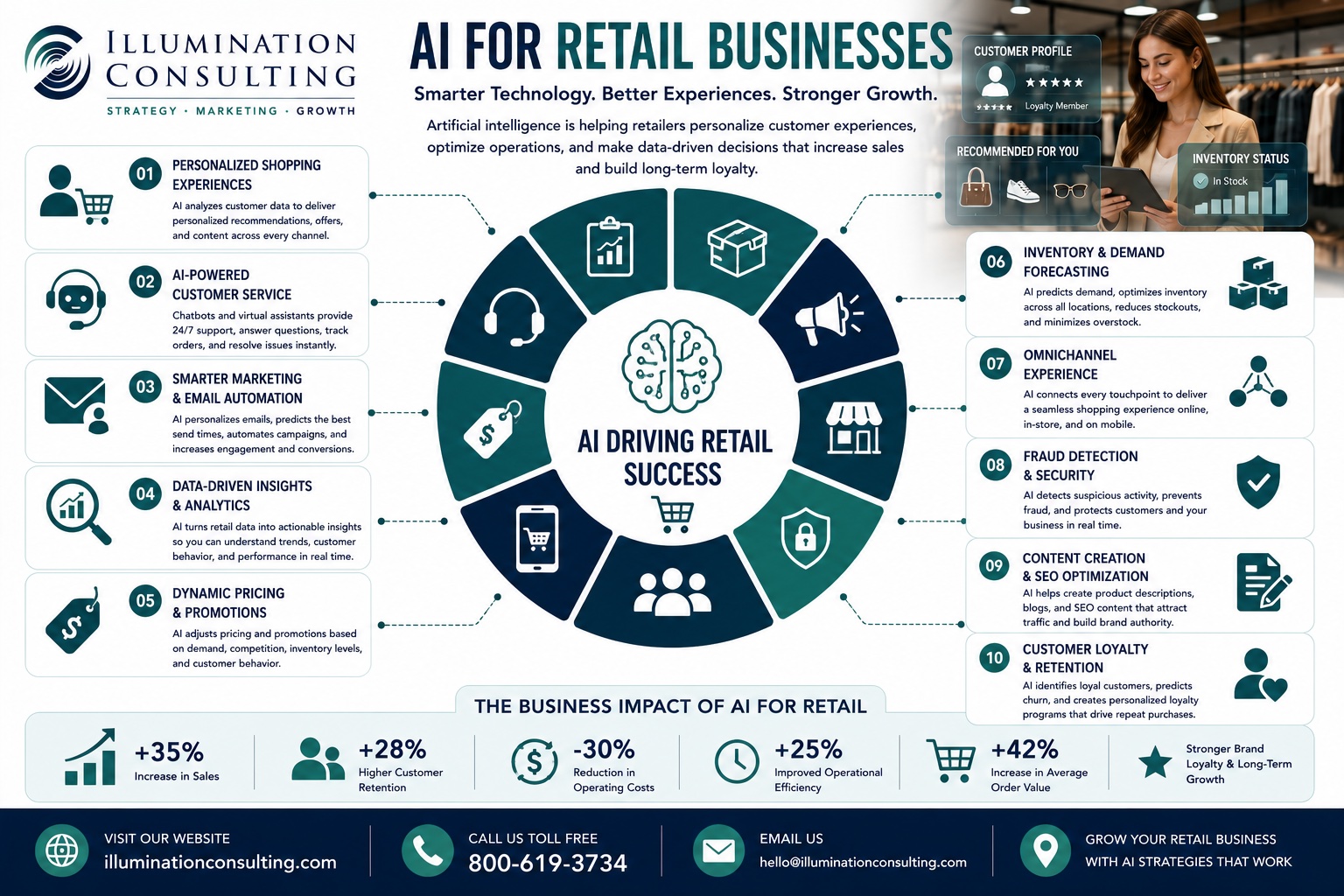
The impact of AI extends well beyond marketing. Retailers now use artificial intelligence to forecast inventory demand, improve supply chain management, optimize pricing, automate customer service, detect fraud, generate marketing content, analyze consumer trends, and increase operational efficiency. These capabilities help businesses reduce costs while improving customer satisfaction and profitability.
Whether you operate a local retail store, an established e-commerce business, or a multi-location retail organization, understanding how artificial intelligence can support your business is becoming increasingly important. Companies that adopt AI strategically are positioning themselves for stronger long-term growth in an increasingly competitive marketplace.
This guide explores the practical ways AI is transforming retail businesses and how organizations can leverage artificial intelligence to improve marketing, operations, customer experiences, and sustainable business growth.
Why Artificial Intelligence Matters for Retail
Retail has always been driven by understanding customer behavior.
Artificial intelligence makes that understanding significantly more accurate by analyzing enormous amounts of information that would be impossible to evaluate manually.
AI helps retailers:
- Increase sales
- Improve customer experiences
- Personalize shopping journeys
- Automate repetitive processes
- Reduce operational costs
- Optimize inventory management
- Strengthen marketing campaigns
- Improve demand forecasting
- Increase customer loyalty
- Make faster, data-driven decisions
Rather than relying on assumptions, retailers gain actionable insights that improve nearly every aspect of their business.
Deliver Personalized Shopping Experiences
Personalization has become one of the biggest competitive advantages in modern retail.
Consumers expect retailers to recommend products based on their interests, previous purchases, browsing behavior, and shopping habits.
Artificial intelligence helps retailers deliver:
- Personalized product recommendations
- Dynamic website content
- Customized promotions
- Personalized email campaigns
- Product bundles
- Cross-selling opportunities
- Upselling recommendations
- Loyalty rewards
- Replenishment reminders
- Individual shopping experiences
Customers are more likely to purchase when they feel a retailer understands their preferences and presents products that genuinely meet their needs.
Improve Customer Service with AI
Today’s customers expect immediate assistance, regardless of the time of day.
Artificial intelligence helps retailers provide faster, more consistent support while reducing pressure on customer service teams.
AI-powered customer service includes:
- Intelligent chatbots
- Virtual shopping assistants
- Order tracking
- Frequently asked questions
- Return assistance
- Shipping updates
- Product recommendations
- Appointment scheduling
- Live chat support
- Multilingual customer service
When routine questions are handled automatically, staff members can dedicate more time to solving complex customer issues and delivering exceptional service.
Smarter Inventory Management and Demand Forecasting
Inventory management has always been one of the biggest challenges in retail. Overstocking ties up valuable capital, while understocking leads to missed sales and disappointed customers.
Artificial intelligence helps retailers forecast demand more accurately by analyzing historical sales, seasonal trends, customer purchasing patterns, supplier performance, promotions, and external market conditions.
AI can improve inventory management by:
- Predicting future demand
- Reducing stock shortages
- Minimizing excess inventory
- Optimizing warehouse operations
- Forecasting seasonal purchasing
- Monitoring product performance
- Improving supplier planning
- Reducing waste
- Managing multi-location inventory
- Increasing overall profitability
Instead of reacting to inventory problems after they occur, retailers can make proactive decisions based on predictive analytics.
Optimize Digital Marketing Campaigns
Marketing has become increasingly data-driven, and artificial intelligence enables retailers to maximize the effectiveness of every campaign.
Rather than manually adjusting campaigns across multiple advertising platforms, AI continuously analyzes performance and recommends improvements.
AI enhances retail marketing through:
- Audience segmentation
- Campaign optimization
- Predictive customer targeting
- Budget allocation
- Creative performance analysis
- Keyword optimization
- Social media insights
- Remarketing campaigns
- Dynamic advertising
- Marketing performance forecasting
These capabilities help retailers improve return on advertising spend while reaching customers who are most likely to purchase.
AI-Powered Email Marketing
Email marketing remains one of the highest-performing digital marketing channels, particularly for retailers focused on customer retention and repeat purchases.
Artificial intelligence allows businesses to deliver highly personalized email campaigns based on customer behavior rather than sending generic promotions.
AI-powered email automation includes:
- Welcome sequences
- Cart abandonment campaigns
- Product recommendations
- Personalized discounts
- Loyalty rewards
- Birthday promotions
- Replenishment reminders
- Seasonal campaigns
- Win-back campaigns
- Predictive send-time optimization
Relevant communication increases open rates, click-through rates, and long-term customer engagement.
Strengthen Search Engine Optimization
Search engine optimization continues to be one of the most valuable long-term investments for retail businesses.
Artificial intelligence helps SEO professionals analyze search trends, discover keyword opportunities, improve technical optimization, and create content more efficiently.
AI supports retail SEO by assisting with:
- Keyword research
- Competitor analysis
- Search intent evaluation
- Content optimization
- Product page improvements
- Internal linking
- Technical SEO audits
- Metadata optimization
- Content gap analysis
- Performance reporting
Retailers that consistently publish optimized content improve organic visibility while reducing dependence on paid advertising.
Generate Better Content More Efficiently
Consumers increasingly research products before making purchasing decisions.
Educational content helps retailers build trust while attracting qualified traffic through search engines and social media.
AI assists content marketing by supporting:
- Blog articles
- Buying guides
- Product descriptions
- Comparison articles
- Email newsletters
- Social media posts
- Video scripts
- Frequently asked questions
- Landing pages
- Promotional campaigns
While AI accelerates production, successful retailers continue to rely on human expertise to ensure accuracy, authenticity, and brand consistency.
Personalize Pricing and Promotions
Retail pricing is constantly changing due to competition, demand, inventory levels, and customer behavior.
Artificial intelligence enables retailers to make smarter pricing decisions based on real-time market data.
AI-driven pricing strategies include:
- Dynamic pricing
- Promotional optimization
- Competitor price monitoring
- Customer segmentation
- Product bundle recommendations
- Discount optimization
- Seasonal pricing
- Inventory-based pricing
- Margin analysis
- Revenue forecasting
These insights help retailers balance profitability with competitive pricing.
Improve Customer Loyalty
Acquiring new customers is important, but long-term profitability often depends on retaining existing ones.
Artificial intelligence helps retailers identify loyal customers, predict churn, and create personalized loyalty experiences.
Examples include:
- Personalized rewards
- VIP customer programs
- Purchase reminders
- Exclusive offers
- Product recommendations
- Anniversary campaigns
- Customer lifetime value analysis
- Loyalty segmentation
- Predictive retention campaigns
- Personalized shopping incentives
Customers who feel recognized and valued are significantly more likely to continue purchasing from the same retailer.
Better Business Intelligence Through AI
Retailers generate enormous amounts of business data every day.
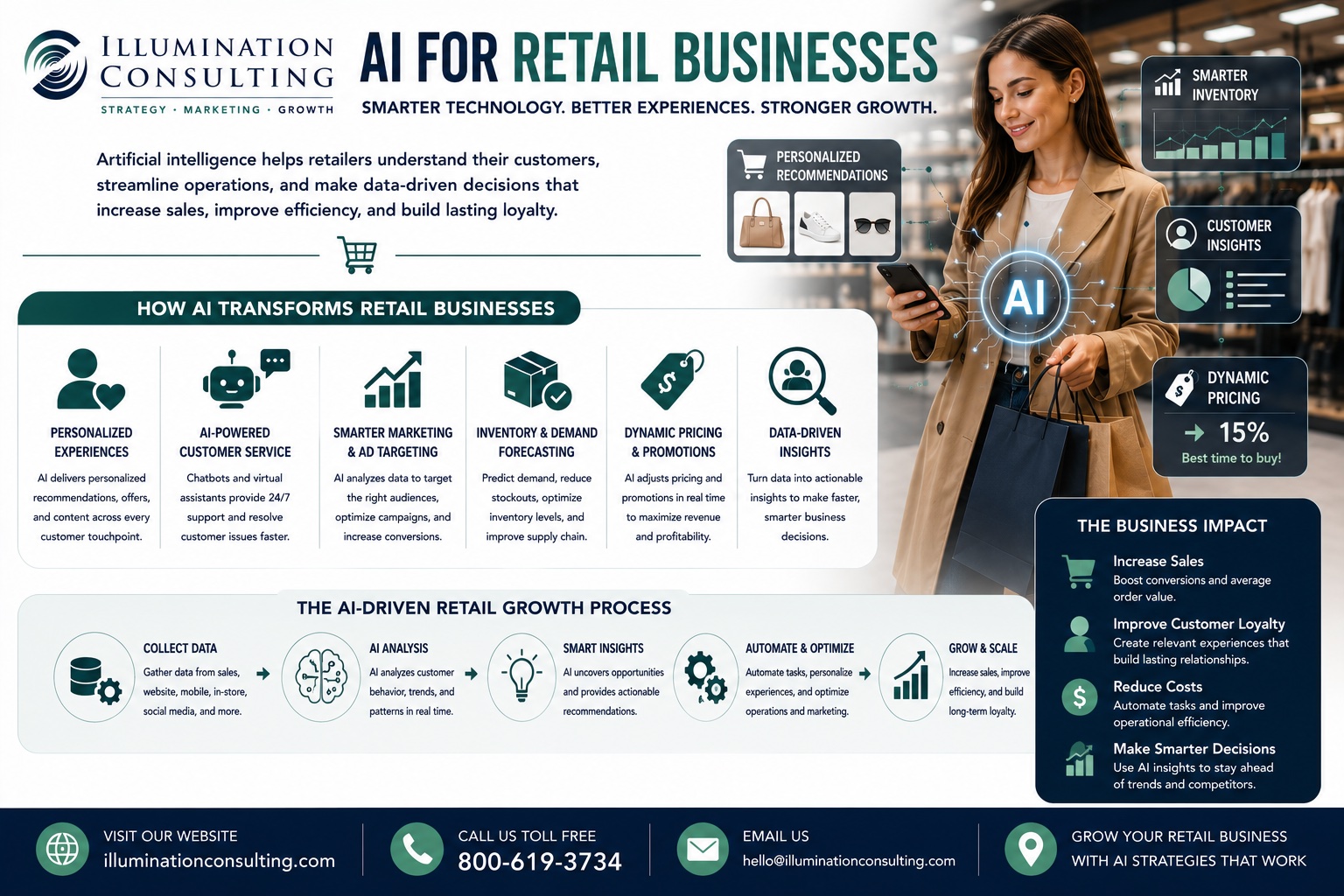
Artificial intelligence transforms this information into actionable insights that support smarter decision-making.
AI dashboards can analyze:
- Sales trends
- Revenue growth
- Product profitability
- Customer acquisition
- Marketing performance
- Inventory turnover
- Regional demand
- Customer lifetime value
- Shopping behavior
- Operational efficiency
Business owners can quickly identify opportunities, recognize emerging trends, and respond more effectively to changing market conditions.
AI Helps Retailers Stay Competitive
Consumer expectations continue to evolve rapidly, and retailers that embrace artificial intelligence are better positioned to meet those expectations.
AI is not simply another technology trend—it is becoming an essential business capability that improves customer experiences, strengthens marketing performance, streamlines operations, and supports long-term growth.
Businesses that begin implementing AI today will be better prepared to compete tomorrow, regardless of their size or market segment. By combining intelligent automation with exceptional products, outstanding customer service, and strategic leadership, retailers can create more resilient businesses that continue to grow in an increasingly digital marketplace.
AI in the Omnichannel Retail Experience
Today’s customers move effortlessly between online stores, physical locations, mobile apps, marketplaces, and social media before making a purchase. They may discover a product on Instagram, research it on your website, visit a retail location to see it in person, and complete the purchase from their smartphone later that evening.
Artificial intelligence helps retailers create a seamless omnichannel experience by connecting customer interactions across every touchpoint.
AI improves omnichannel retail by enabling:
- Unified customer profiles
- Consistent product recommendations
- Cross-channel shopping experiences
- Real-time inventory visibility
- Personalized promotions
- Buy Online, Pick Up In Store (BOPIS) optimization
- Mobile shopping enhancements
- Customer journey analysis
- Cross-device personalization
- Consistent brand messaging
When every channel works together, customers enjoy a smoother buying experience while retailers increase engagement, loyalty, and revenue.
AI Improves Fraud Detection and Security
As online retail continues to grow, so does the risk of fraud.
Artificial intelligence continuously monitors transactions for unusual behavior that may indicate fraudulent activity while minimizing disruptions for legitimate customers.
AI can identify:
- Suspicious purchasing patterns
- Stolen payment methods
- Account takeover attempts
- Abnormal login activity
- Fake customer accounts
- Return fraud
- Coupon abuse
- High-risk transactions
- Identity verification issues
- Chargeback risks
These systems learn continuously, allowing retailers to strengthen security without creating unnecessary friction during the checkout process.
Common AI Mistakes Retail Businesses Should Avoid
Artificial intelligence delivers the best results when implemented strategically. Many retailers invest in AI tools expecting immediate transformation without first establishing clear business objectives.
Avoid these common mistakes:
- Implementing AI without a defined strategy
- Purchasing too many disconnected AI platforms
- Ignoring data quality
- Publishing AI-generated content without human review
- Over-automating customer interactions
- Neglecting employee training
- Failing to measure performance
- Ignoring customer privacy regulations
- Choosing technology based solely on price
- Expecting AI to replace experienced staff
Successful retailers understand that AI is a business accelerator—not a substitute for strong leadership, customer service, and strategic planning.
Preparing Your Retail Business for an AI-Driven Future
Artificial intelligence will continue to reshape every aspect of retail over the coming decade.
Businesses that begin integrating AI today will gain valuable experience while building systems that can evolve alongside future technologies.
Preparing for the future includes:
- Building a high-quality customer database
- Investing in scalable technology
- Improving data accuracy
- Training employees on AI tools
- Continuously testing automation opportunities
- Monitoring customer feedback
- Measuring AI performance
- Strengthening cybersecurity
- Optimizing digital experiences
- Remaining adaptable as technology evolves
Retailers do not need to implement every available AI solution. The greatest success comes from identifying the technologies that solve real business challenges and create measurable value for customers.
Frequently Asked Questions
What is AI for retail businesses?
AI for retail businesses refers to the use of artificial intelligence to improve marketing, inventory management, customer service, pricing, forecasting, analytics, and shopping experiences. It helps retailers make smarter decisions while increasing operational efficiency and customer satisfaction.
Can small retailers benefit from AI?
Absolutely. Many AI platforms are designed specifically for small and medium-sized businesses. Even independent retailers can use AI for email marketing, customer support, product recommendations, SEO, advertising optimization, and inventory forecasting without requiring a large technology budget.
How does AI improve customer loyalty?
AI analyzes customer behavior to deliver personalized product recommendations, customized promotions, loyalty rewards, and timely communications. These personalized experiences strengthen customer relationships and encourage repeat purchases.
Does AI replace retail employees?
No. Artificial intelligence automates repetitive administrative tasks, allowing employees to focus on customer service, merchandising, strategic planning, and relationship building. Human expertise remains essential to delivering exceptional retail experiences.
Is AI expensive to implement?
Not necessarily. Many cloud-based AI platforms offer affordable subscription models that make artificial intelligence accessible to businesses of all sizes. Retailers can often start with one or two solutions and expand as their business grows.
What is the biggest advantage of AI in retail?
One of the greatest advantages is the ability to make faster, data-driven decisions. AI enables retailers to better understand customers, optimize operations, personalize shopping experiences, and identify growth opportunities that increase both revenue and profitability.
Artificial Intelligence Is Redefining the Future of Retail
Artificial intelligence is no longer an emerging technology reserved for the world’s largest retailers. It has become an accessible business tool that empowers organizations of every size to operate more efficiently, better understand their customers, and compete in an increasingly digital marketplace. From personalized shopping experiences and intelligent inventory forecasting to marketing automation and advanced business analytics, AI is transforming nearly every aspect of modern retail.
The retailers that will thrive in the years ahead are those that embrace innovation while maintaining the human relationships that customers value most. Artificial intelligence should enhance—not replace—the expertise, creativity, and service that distinguish successful retail businesses. By combining AI with thoughtful strategy, exceptional customer experiences, and continuous improvement, retailers can build stronger brands that adapt quickly to changing consumer expectations.
Whether you operate a local boutique, a growing e-commerce business, or a multi-location retail organization, now is the time to begin integrating artificial intelligence into your operations. Businesses that start today will be better prepared to improve efficiency, increase customer loyalty, strengthen marketing performance, and achieve sustainable long-term growth.
At Illumination Consulting, we help retail businesses leverage artificial intelligence to improve marketing, e-commerce, SEO, automation, customer engagement, and digital transformation. Our practical AI strategies are designed to help retailers streamline operations, increase sales, and build long-term competitive advantages in an increasingly technology-driven marketplace.