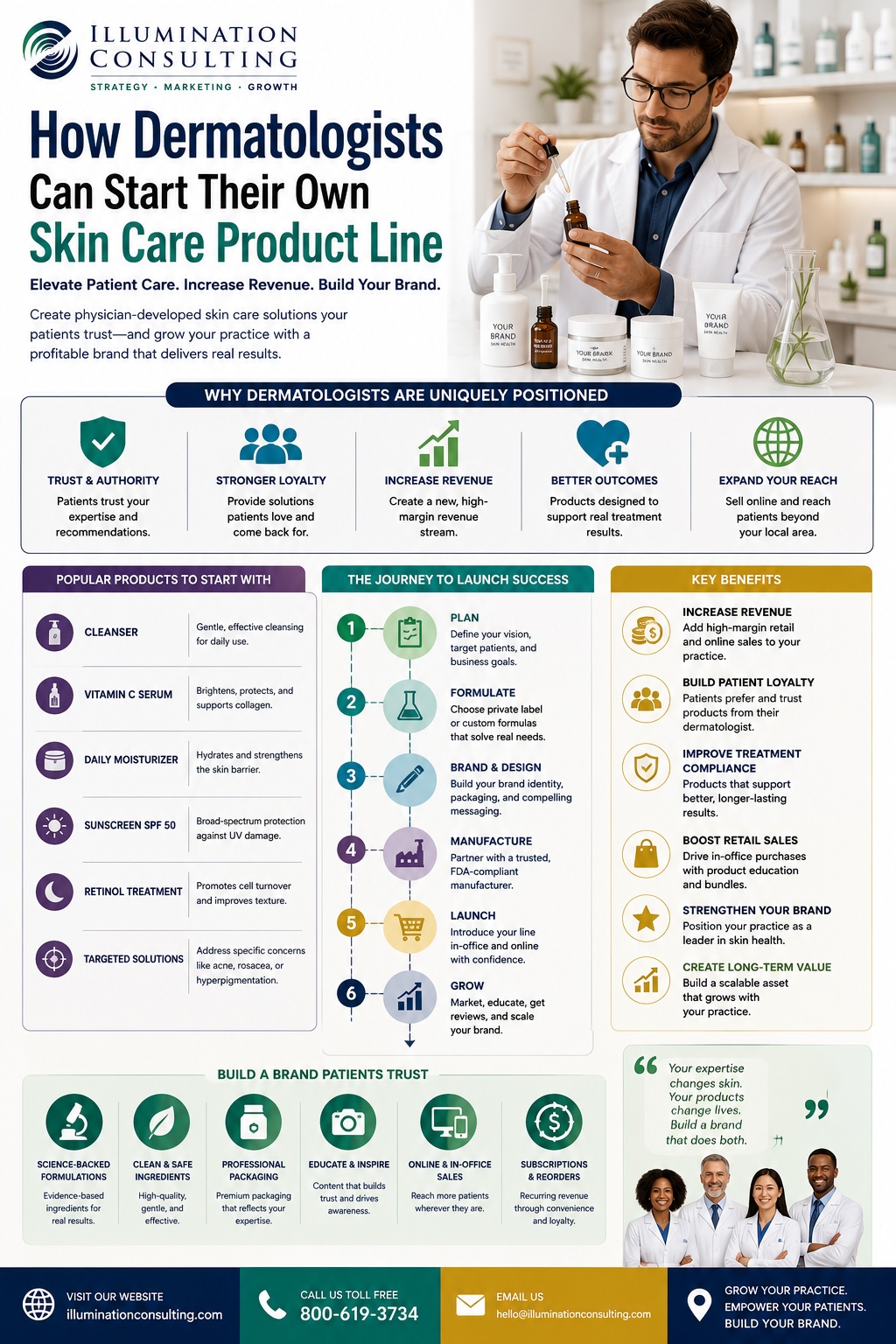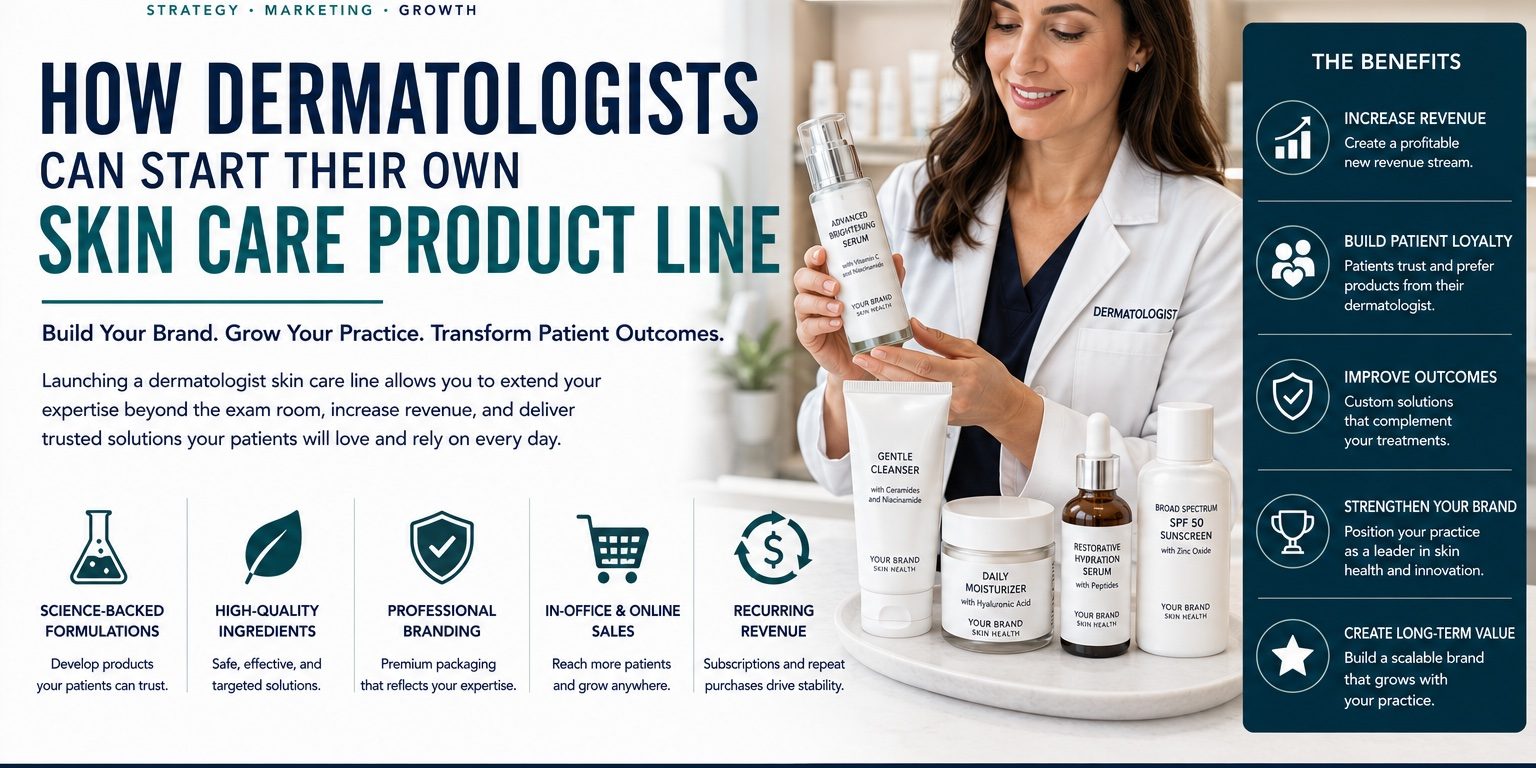
For many dermatology practices, patient care does not end when an appointment concludes. Patients frequently ask which cleanser they should use, whether a vitamin C serum is worth the investment, which sunscreen offers the best protection, or what moisturizer complements a prescribed treatment plan. While many dermatologists recommend established brands, an increasing number are recognizing a significant business opportunity: developing their own physician-branded skin care product line.
Launching a dermatologist-branded skin care collection offers far more than an additional revenue stream. It allows practices to extend their expertise beyond the examination room, strengthen patient trust, improve treatment compliance, and build a recognizable brand that differentiates the practice in an increasingly competitive marketplace. Patients often have greater confidence in products developed or recommended by the physician they already know and trust, making dermatologist-branded products a natural extension of comprehensive skin health.
The growing demand for medical-grade skin care has also created favorable market conditions. Consumers have become more ingredient-conscious and increasingly seek products supported by clinical expertise rather than celebrity endorsements or social media trends. Dermatologists are uniquely positioned to meet this demand because they combine scientific knowledge with firsthand experience treating thousands of patients across a wide range of skin conditions and concerns.
Launching a product line no longer requires building a manufacturing facility or investing millions of dollars in research and development. Today’s contract manufacturers and private label laboratories allow dermatologists to create high-quality products efficiently while maintaining professional branding and clinical positioning.
Whether your goal is improving patient outcomes, diversifying practice revenue, strengthening your reputation, or creating a scalable long-term business asset, developing a dermatologist skin care line can become one of the most valuable investments your practice makes.
This guide explains how dermatologists can successfully launch their own skin care product line while avoiding common mistakes and building a profitable brand that supports both patient care and long-term practice growth.
Why Dermatologists Are Uniquely Qualified to Lead Skin Care Brands
Few professionals possess the credibility that board-certified dermatologists have within the skin care industry.
Patients seek dermatologists because they trust their expertise, education, and clinical experience. Every patient consultation creates an opportunity to educate individuals about proper skin care while recommending products that support treatment goals.
Unlike influencers or celebrity-backed brands, dermatologists have medical authority that immediately establishes credibility.
Launching a physician-branded product line allows practices to:
- Strengthen patient trust
- Extend care beyond appointments
- Improve treatment compliance
- Increase practice revenue
- Build long-term brand equity
- Differentiate from competing clinics
- Enhance patient loyalty
- Improve treatment outcomes
- Create recurring revenue
- Expand beyond geographic limitations
Rather than simply recommending another company’s products, dermatologists can offer solutions developed around their own clinical philosophy and standards.
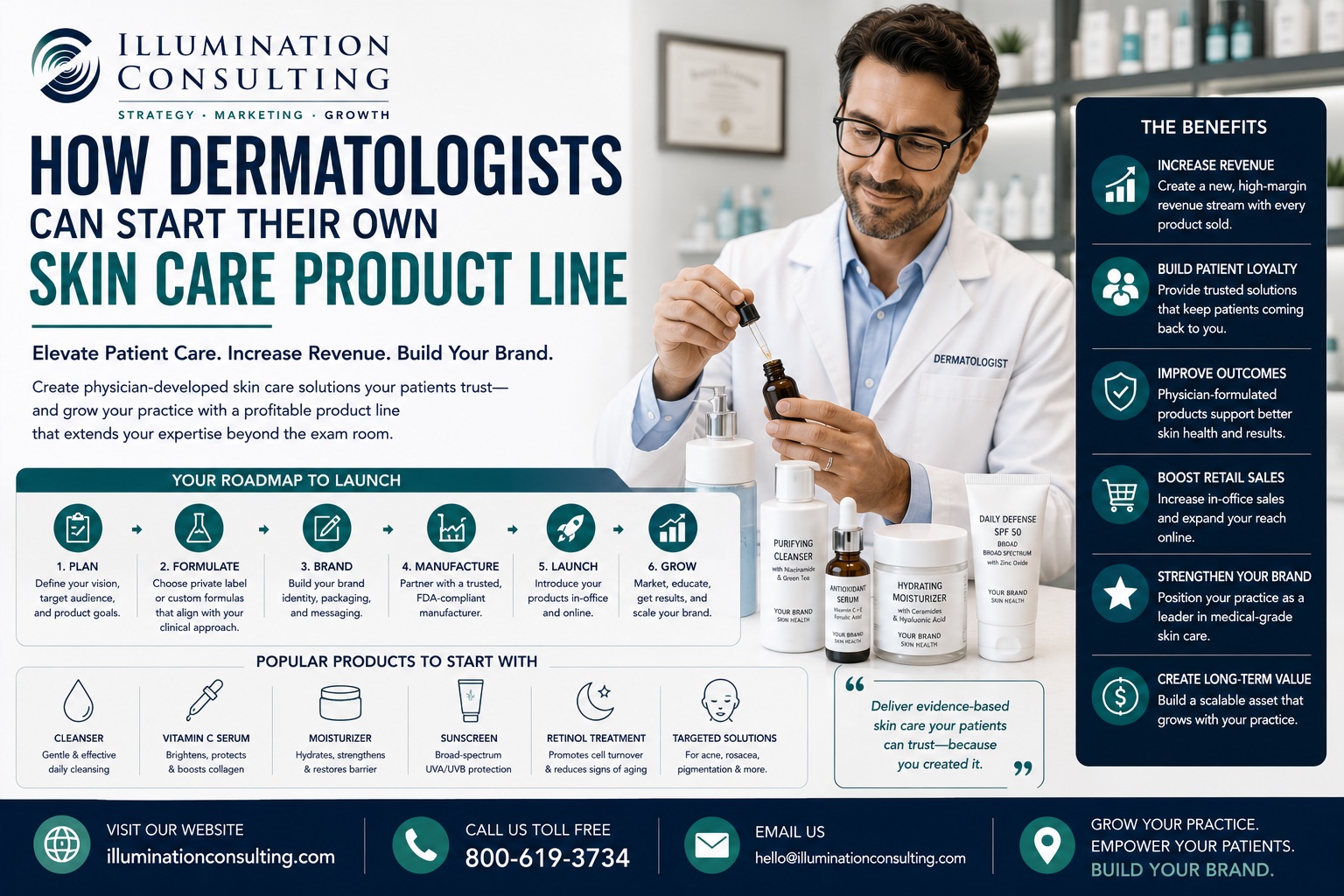
The Business Benefits for Dermatology Practices
Many dermatology practices rely heavily on appointment-based revenue.
Although clinical services remain the foundation of every practice, physician-branded products introduce recurring revenue that is not tied directly to appointment availability.
Benefits include:
- Higher patient lifetime value
- Increased retail sales
- Additional monthly revenue
- Better patient retention
- Improved treatment compliance
- Greater brand recognition
- E-commerce opportunities
- Subscription revenue
- Wholesale opportunities
- Practice valuation growth
Over time, a successful product line can become an important asset that contributes significantly to the overall value of the practice.
Private Label vs. Custom Formulation
One of the first decisions dermatologists must make is whether to launch a private label product line or develop completely custom formulations.
Each approach offers distinct advantages depending on your goals, timeline, and budget.
Private Label
Private label manufacturers offer professionally formulated products that can be customized with your practice’s branding, packaging, and labeling.
Advantages include:
- Lower startup costs
- Faster launch timelines
- Proven formulations
- Lower minimum order quantities
- Simplified manufacturing
- Faster revenue generation
- Easier inventory management
- Lower product development risk
Private labeling is often the ideal starting point for dermatologists who want to validate market demand before investing in custom product development.
Custom Formulation
Custom formulation involves creating unique products developed specifically for your practice.
Benefits include:
- Proprietary formulations
- Greater brand differentiation
- Exclusive ingredients
- Stronger intellectual property
- Premium positioning
- Long-term brand value
Although custom development requires larger investments and longer production timelines, it provides greater control over product innovation and can significantly strengthen brand positioning.
Many successful dermatologists begin with private label products before gradually introducing exclusive formulations as their brand grows.
Choosing the Right Products to Launch First
One of the most common mistakes new skincare brands make is launching too many products simultaneously.
A focused product collection is easier to manage, market, and refine based on patient feedback.
For most dermatology practices, an initial collection of four to six products is ideal.
Popular launch products include:
- Gentle daily cleanser
- Vitamin C serum
- Hyaluronic acid serum
- Daily moisturizer
- Broad-spectrum SPF 50 sunscreen
- Retinol night treatment
These products address the needs of a broad patient population while naturally complementing many dermatological treatment plans.
Once demand is established, additional specialty products can be introduced for acne, rosacea, pigmentation, aging skin, sensitive skin, and post-procedure recovery.
Designing Products Around Real Patient Needs
One of the greatest advantages dermatologists possess is direct access to patient feedback.
Every consultation provides insight into recurring concerns, treatment challenges, and product frustrations.
Instead of chasing temporary beauty trends, dermatologist-developed brands should focus on solving real clinical problems.
Common patient concerns include:
- Acne
- Hyperpigmentation
- Melasma
- Fine lines
- Wrinkles
- Dry skin
- Sensitive skin
- Rosacea
- Sun damage
- Uneven skin tone
Products designed around these concerns naturally integrate into treatment plans while providing patients with trusted at-home maintenance solutions.
Selecting a Manufacturing Partner
Choosing the right manufacturing partner is one of the most important decisions in launching a successful skin care line.
An experienced laboratory should do far more than simply manufacture products.
Look for partners that provide:
- FDA-compliant manufacturing
- GMP-certified facilities
- Ingredient sourcing
- Stability testing
- Packaging assistance
- Label compliance
- Regulatory guidance
- Product testing
- Scalable production
- Ongoing product support
Working with an experienced manufacturer significantly reduces development risks while ensuring product consistency and quality.
Branding Is More Than a Logo
Patients purchasing dermatologist-developed skin care expect professionalism.
Your brand should reflect the same level of quality and trust patients experience during office visits.
Professional branding includes:
- Memorable product name
- Elegant logo
- Premium packaging
- Consistent typography
- Modern color palette
- Ingredient transparency
- Professional photography
- Educational messaging
- Luxury presentation
- Consistent brand voice
Well-designed branding increases perceived value while strengthening consumer confidence.
Packaging That Reflects Medical Expertise
Packaging should communicate both scientific credibility and premium quality.
Medical-grade skin care buyers often prefer clean, sophisticated packaging over flashy designs commonly found in mass-market beauty products.
Packaging should prioritize:
- Airless pumps
- UV-protective containers
- Sustainable materials
- Clear ingredient labeling
- Easy-to-read instructions
- Clinical appearance
- Consistent branding
- Durable construction
- Premium finishes
- Consumer convenience
High-quality packaging enhances the customer experience while reinforcing the credibility of the products inside.
Pricing for Profitability
Pricing should reflect product quality, clinical expertise, and brand positioning—not simply manufacturing costs.
Dermatologist-developed products compete within the premium medical-grade skincare category, where patients expect superior formulations and are willing to invest in trusted recommendations.
Pricing considerations include:
- Manufacturing costs
- Packaging expenses
- Shipping
- Marketing
- Wholesale margins
- Online retail pricing
- Distributor pricing
- Practice profitability
- Competitive positioning
- Long-term brand value
A sustainable pricing strategy allows practices to generate healthy margins while maintaining perceived value and supporting future product development.
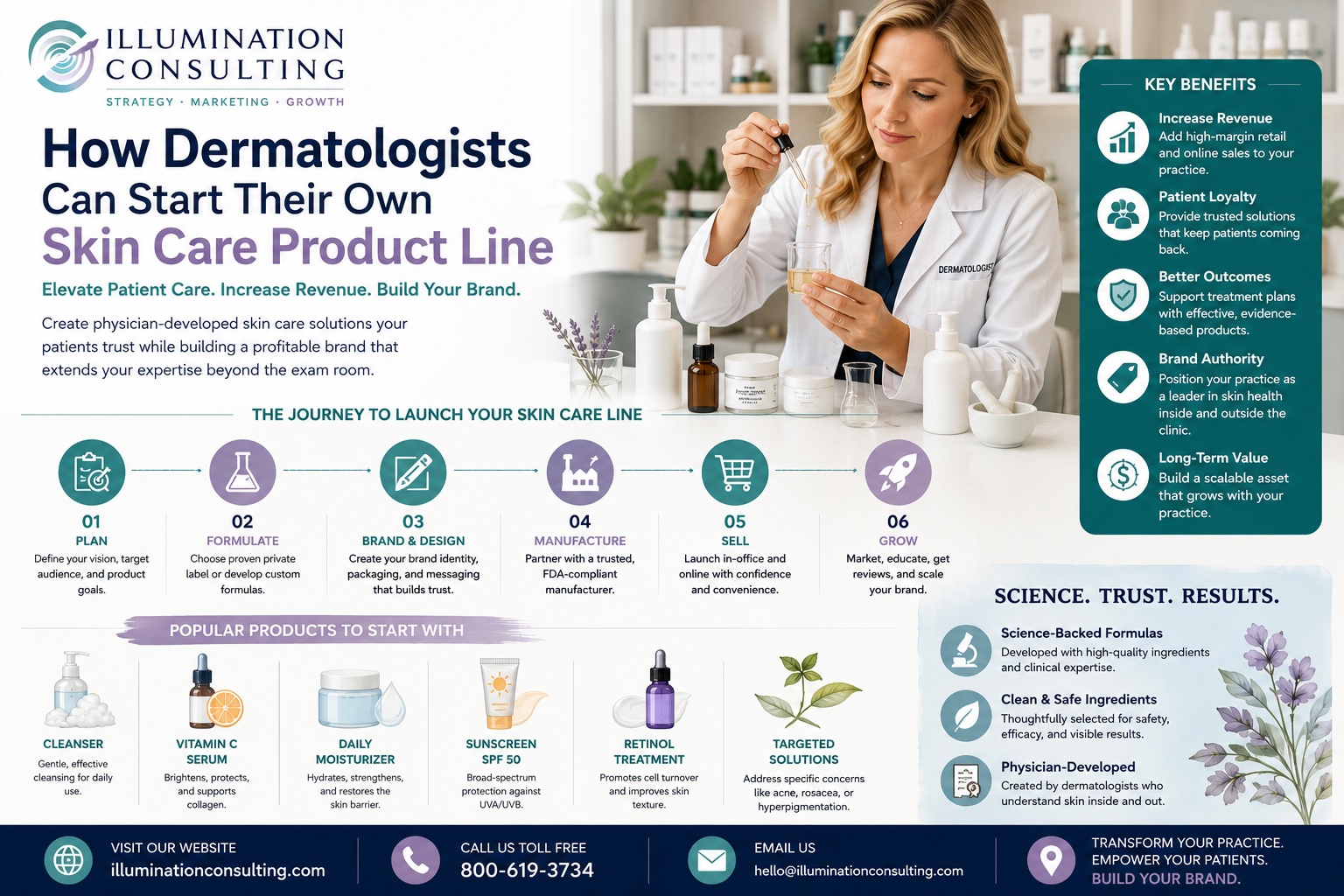
Selling Products Inside Your Dermatology Practice
One of the biggest advantages dermatologist-owned skin care brands is immediate access to an established customer base.
Every patient walking through your doors represents someone who already trusts your expertise. Rather than recommending products they must purchase elsewhere, you can provide physician-developed solutions that complement treatment plans and simplify the patient’s skincare routine.
Retail products also reinforce treatment recommendations between appointments. Patients who use professionally recommended products consistently are often more likely to achieve better outcomes, increasing both satisfaction and loyalty.
Effective in-office retail strategies include:
- Attractive product displays
- Treatment-specific product bundles
- Staff product education
- Post-procedure care kits
- Seasonal promotions
- New patient starter kits
- Checkout product recommendations
- Educational brochures
- Digital displays
- Loyalty rewards
When presented as part of a comprehensive treatment plan rather than a sales opportunity, patients generally view physician-recommended products as an extension of their clinical care.
Building an E-Commerce Store
While in-office sales are important, limiting your product line to clinic visitors restricts long-term growth.
An e-commerce website allows dermatologists to serve patients beyond their local market while generating revenue around the clock.
An effective online store should include:
- Professional product photography
- Detailed product descriptions
- Ingredient information
- Educational videos
- Before-and-after photography
- Customer reviews
- Subscription purchasing
- Secure checkout
- Mobile-friendly design
- Fast shipping options
Many practices find that online sales continue to grow even among existing patients because replenishing products online is more convenient than returning to the office.
A professionally designed Shopify website or custom e-commerce platform can transform your product line from a local retail offering into a scalable national brand.
Marketing Your Skin Care Brand
Creating outstanding products is only part of building a successful skin care business. Patients and consumers must also discover, trust, and remember your brand.
Fortunately, dermatologists already possess one of the most powerful marketing assets available: credibility.
Marketing strategies should focus on education first and promotion second.
Effective marketing channels include:
- Search engine optimization (SEO)
- Educational blog articles
- YouTube videos
- Social media content
- Email newsletters
- Patient testimonials
- Product demonstration videos
- Ingredient education
- Before-and-after galleries
- Google Business Profile optimization
Educational content establishes authority while helping prospective customers understand why physician-developed skin care offers advantages over mass-market alternatives.
Strengthen Your Brand Through Content Marketing
Consumers are increasingly researching products before making purchasing decisions.
Publishing educational content positions your practice as a trusted authority while improving search engine visibility.
Content ideas include:
- Ingredient guides
- Skin condition education
- Product comparison articles
- Seasonal skincare tips
- Sun protection guides
- Anti-aging advice
- Acne treatment resources
- Rosacea management
- Post-procedure skincare
- Frequently asked questions
Over time, a consistent content strategy attracts highly qualified visitors who are already interested in improving their skin health.
Create Subscription and Auto-Replenishment Programs
Most skincare products are used daily and require regular replacement.
Subscription programs provide convenience for patients while creating predictable recurring revenue for the practice.
Popular subscription options include:
- Monthly replenishment
- Every 60-day delivery
- Every 90-day delivery
- Complete skincare systems
- Customized treatment bundles
- VIP memberships
- Automatic discounts
- Free shipping
- Early access to new products
- Loyalty rewards
Recurring subscriptions increase customer lifetime value while improving treatment compliance by ensuring patients never run out of essential products.
Common Mistakes Dermatologists Should Avoid
Launching a successful skin care line requires thoughtful planning.
Many physician-led brands struggle not because of product quality, but because of avoidable business mistakes.
Common pitfalls include:
- Launching too many products initially
- Weak branding
- Poor packaging design
- Choosing the wrong manufacturing partner
- Inadequate inventory planning
- Neglecting e-commerce
- Underinvesting in marketing
- Inconsistent patient education
- Ignoring customer feedback
- Treating products as an afterthought instead of a core business initiative
Avoiding these mistakes allows practices to build stronger brands while protecting both their reputation and investment.
Measuring Success
Like any business initiative, your product line should be evaluated using measurable performance indicators.
Important metrics include:
- Monthly product revenue
- Average order value
- Repeat purchase rate
- Customer lifetime value
- Subscription growth
- Online conversion rate
- In-office retail sales
- Inventory turnover
- Product review ratings
- Overall profitability
Regularly reviewing these metrics helps identify opportunities for improvement while supporting smarter long-term business decisions.
Frequently Asked Questions
Do dermatologists need to manufacture their own products?
No. Most dermatologists partner with experienced private label or contract manufacturers that produce high-quality medical-grade skincare products. This significantly reduces startup costs while allowing practices to focus on branding, patient care, and business growth.
Is private label skincare a good option for dermatologists?
Yes. Private label products allow dermatologists to launch a professional skincare line quickly using proven formulations, customized branding, and lower minimum order quantities. Many successful physician brands begin this way before expanding into custom formulations.
How many products should a dermatologist launch initially?
Most practices benefit from launching four to six core products. Starting with essentials such as a cleanser, vitamin C serum, moisturizer, sunscreen, and retinol treatment keeps inventory manageable while addressing the needs of most patients.
Can dermatologist-branded skincare be sold online?
Absolutely. An e-commerce website enables practices to sell products nationwide, provide convenient reordering for existing patients, and create recurring revenue through subscription programs and automatic replenishment services.
How profitable can a dermatologist skin care line become?
Profitability depends on product selection, pricing, marketing, patient adoption, and online sales. For many practices, physician-branded skincare becomes a significant additional revenue stream while also increasing patient loyalty and overall practice value.
Building a Brand That Extends Beyond the Exam Room
Launching a dermatologist-branded skin care line is more than introducing new products—it is an opportunity to expand your practice into a trusted lifestyle brand built on clinical expertise. By offering products that align with your treatment philosophy, you strengthen patient relationships, improve continuity of care, and create additional revenue streams that are not dependent solely on appointment availability. The combination of physician credibility, evidence-based formulations, and patient trust gives dermatologists a unique advantage that few other skincare brands can replicate.
Success, however, requires more than selecting quality formulations. A well-designed brand, premium packaging, a professional e-commerce website, educational marketing, and a long-term growth strategy are equally important. When these elements work together, a dermatologist-owned product line can evolve from an in-office retail offering into a recognized brand that reaches customers well beyond your local community.
At Illumination Consulting, we help dermatologists transform their vision into successful skin care brands. From branding, packaging, and e-commerce website design to digital marketing, SEO, content creation, and long-term growth strategies, we provide the expertise needed to launch and scale physician-branded product lines that increase revenue, strengthen patient loyalty, and build lasting business value.