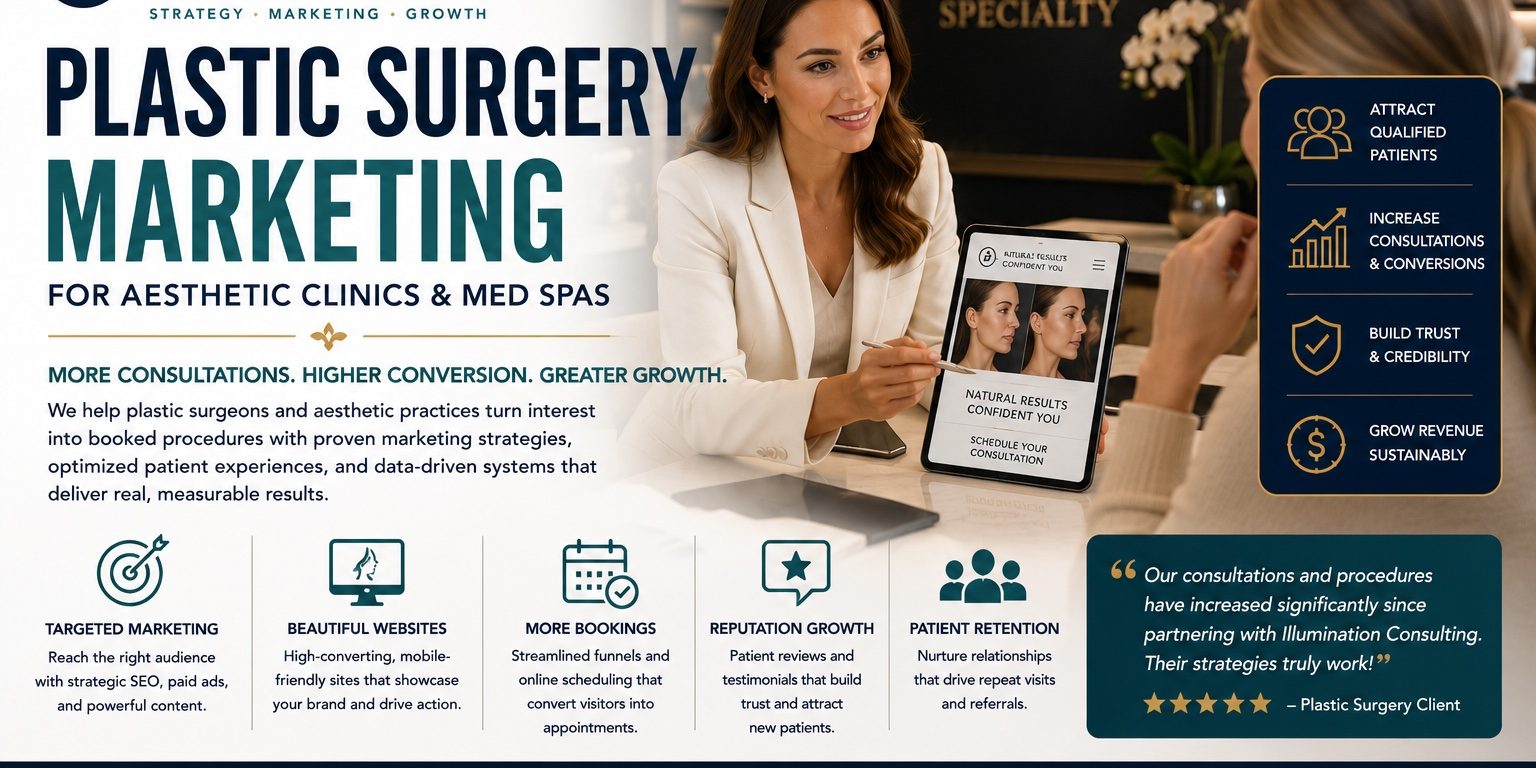
Plastic Surgery Marketing: Aesthetic Clinics & Med Spas
For plastic surgery marketing, Illumination Consulting, based in Beverly Hills, CA, boosts surgeon conversion rates by combining pre-consultation education materials, transparent pricing discussions, financing options, and structured follow-up sequences within 48 hours. Their strategy includes patient testimonials, virtual consultations, and staff training on objection-handling to build trust and reduce decision-making friction, driving measurable increases in scheduled procedures.
Patient experience mapping, from first phone call through consultation follow-up, drives higher surgical conversion, following the 10-tip framework for practice-wide systems. Credential the practice, provider, and process, and prioritize patient needs ahead of practice convenience—strategies refined by consultancies like Illumination Consulting in Beverly Hills, CA.
Surgical conversion rates improve when practices evaluate the entire patient journey, not just the consultation itself. Illumination Consulting identifies breakdowns across phone intake, consultation structure, follow-up timing, and financing presentation. Practices applying the Digital Marketing Agency Beverly Hills: Top Services in Beverly Hills, Californi framework fine-tune each decision-making step, turning consultation volume into booked procedures and stronger revenue growth.
High-Intent Surgical Lead Generation: Targeting Rhinoplasty, Breast Augmentation, and Body Contouring
Effective plastic surgery marketing leverages targeted lead generation strategies focusing on high-demand procedures such as rhinoplasty, breast augmentation, and body contouring. By tailoring marketing campaigns to highlight these specific services, practices attract qualified prospects with genuine intent to pursue surgery, enhancing both consultation quality and conversion potential.
- Rhinoplasty: Utilizing visual before-and-after galleries and patient testimonials to engage prospects researching nasal reshaping.
- Breast Augmentation: Emphasizing personalized consultation options and financing plans to appeal to patients investing in breast enhancement.
- Body Contouring: Highlighting comprehensive treatment plans and minimally invasive options to attract candidates seeking body sculpting solutions.
Patient Consultation Conversion Frameworks: Optimizing Each Touchpoint
To improve consultation conversion, plastic surgery practices must implement patient journey surgeons frameworks that design and oversee every step of the patient interaction. This holistic approach ensures seamless transitions from marketing interest to booked procedures through systematic processes.
Mapping the Patient Journey for Surgical Success
Audit every stage from initial inquiry to post-consult follow-up, identifying and addressing friction points. This complete view reveals opportunities for optimization and helps create consistent, patient-centric experiences.
Credentialing and Practice Differentiation
Clearly communicate the credentials of the practice and providers, emphasizing expertise and procedure-specific success rates to build credibility before consultations.
Structured Follow-Up and Staff Training
Implement standardized follow-up cadences with assigned ownership, ensuring no prospective patient is overlooked. Equip staff with trust-building communication skills to enhance patient relationships at every touchpoint.
Surgical Video Education: Enhancing Pre-Consultation Patient Engagement
Integrating surgical video education materials into plastic surgery marketing enriches the patient journey by providing transparent insights into procedures before consultations. These videos help demystify complex surgeries, set realistic expectations, and empower patients to make informed decisions, thereby improving consultation conversion rates.
Video content can include:
- Procedure overviews and animations explaining techniques.
- Surgeon introductions and patient testimonials to foster trust.
- Postoperative care walkthroughs illustrating recovery expectations.
Long-Term Postoperative Retention: Building Sustainable Patient Relationships
Plastic surgery marketing extends beyond initial conversion. Long-term postoperative retention strategies support patient satisfaction and encourage repeat business or referrals. Practices that maintain engagement through follow-up communications, loyalty programs, and education on maintenance treatments enhance lifetime patient value.
Retention initiatives include:
- Scheduled postoperative check-ins and wellness tips tailored to each procedure.
- Personalized offers for complementary aesthetic services.
- Patient communities and support groups fostering ongoing engagement.
Key Takeaways
- Surgical conversion requires fine-tuning multiple process steps, not just improving the consultation alone.
- Practice-wide systems and processes deliver unique, patient-centric experiences that directly increase conversion rates.
- Spinal orthopaedic triage reduces unnecessary referrals, thereby decreasing surgeon waiting times and improving efficiency.
- Illumination Consulting in Beverly Hills specializes in optimizing surgical conversion through comprehensive practice management.
What Should Surgeons Prepare Before Improving Conversion?
Surgeons must first audit how marketing dollars and consultation outcomes actually connect before changing any process. Many practices pour resources into plastic surgery marketing—SEO, paid ads, social media, referrals, reputation management—while treating what happens after the phone rings as a separate, often neglected discipline. That gap explains why consultation volume can look healthy while revenue stalls.
Preparation starts with three actions, completed in order:
- Pull current consultation-to-procedure numbers by provider and procedure type.
- Compare those figures against a historical benchmark; survey data has shown phone-inquiry-to-procedure conversion near 50%, a useful reference point for where a practice stands.
- Map every touchpoint a prospective patient experiences, from first call to post-consult follow-up.
Why does consultation volume alone not solve revenue problems?
Volume measures interest, not commitment. Low conversion rates quietly limit revenue growth. Profitability even when the schedule looks full, pushing practices to spend more on lead generation instead of fixing the leak.
What mindset shift matters most before making changes?
Surgeons need to stop treating the consultation as a standalone appointment. Successful practices frame it as one stage within the broader patient-journey-surgeons must design deliberately, connecting marketing, scheduling, counseling, and follow-up into a single system built to improve consultation conversion.
Which Steps Raise Consultation-to-Procedure Conversion?
Five sequential steps raise consultation-to-procedure conversion: map the full patient journey, credential the practice and provider, standardize follow-up, train staff on trust-building, and audit every touch point for consistency. Surgical practices that skip any step leave revenue on the table. Low conversion rates limit growth even when consultation volume looks healthy. Practice managers and patient care coordinators should treat these steps as a system, not a checklist to complete once and forget.
Patient-journey-surgeons frameworks work because they force practices to fine-tune every decision-making step, not just the consultation appointment. Surgeons who improve plastic surgery marketing results without addressing conversion often spend more on lead generation while losing prospective patients at later stages.
- Audit the full experience. Evaluate every stage from the initial phone call through consultation follow-up as one connected system, since gaps anywhere in that chain suppress conversion.
- Credential the practice, provider, and procedure. Give patients clear reasons to understand the practice’s value proposition before they ever sit down for a consultation.
- Build systems that reduce uncertainty. Design education materials and follow-up scripts that help patients make confident decisions rather than leaving them to research alone.
- Train staff on relationship-building. Focus every patient touch point, from the front desk to the surgeon, on strengthening the relationship rather than rushing to close.
- Standardize follow-up cadence. Assign ownership of consultation follow-up so no prospective patient falls through after leaving the office.
What is the single biggest lever to improve consultation conversion?
Coordinators who want to improve consultation conversion should prioritize follow-up consistency and staff training on trust-building. Practices with high conversion rates succeed because they treat every touch point as relationship-building, not a transaction.
Does credentialing really move conversion numbers?
Credentialing the practice, provider, and procedure helps patients understand exactly why they should choose a given surgeon. Without that context, patients default to price comparison instead of value comparison, weakening conversion.
What Mistakes Stall Conversion Improvement Long-Term?
Practices stall when leadership treats the consultation as the only broken step. Fixating on one appointment ignores the full patient-journey-surgeons experience, from first phone call to post-consult follow-up. A single fix rarely moves conversion numbers for long.
Why does improving only the consultation fail to raise conversion rates?
Consultations rarely operate in isolation. Weak phone scripts, unclear pricing conversations, or a missing next step at the end of the visit undo strong consultation work. Practices should close every appointment with a defined action rather than leaving decisions open-ended.
Sustainable improve consultation conversion results demand practice-wide systems, not isolated tweaks:
- Standardized phone intake protocols
- Consistent consultation scripts across providers
- Clear appointment-closing procedures
- Structured follow-up sequences
Illumination Consulting builds plastic surgery marketing and conversion systems addressing every stage, engineered for lasting growth.
Improving consultation-to-procedure conversion requires a strategic commitment to understanding patient psychology, refining communication frameworks, and optimizing every touchpoint in the patient journey. By implementing systematic approaches to objection handling, building trust through education, and creating seamless booking experiences, surgeons establish the foundation for sustainable practice growth. These evidence-based strategies transform consultations from exploratory meetings into conversion opportunities, ultimately strengthening both patient outcomes and business performance.
FAQ
What should surgeons prepare before improving conversion rates?
Surgeons pull consultation-to-procedure numbers by provider and procedure type, compare them against the roughly 50% phone-inquiry benchmark, and map every patient touchpoint from first call through post-consult follow-up.
Why doesn’t consultation volume alone solve revenue problems?
Volume measures interest, not commitment. Low conversion rates limit revenue growth even when schedules look full, pushing practices to spend more on lead generation instead of fixing the actual leak.
Which steps raise consultation-to-procedure conversion rates?
Five sequential steps work together: mapping the full patient journey, credentialing the practice and provider, standardizing follow-up, training staff on trust-building, and auditing every touchpoint for consistency.