By Illumination Consulting Editorial Team · Updated 2026-07-29
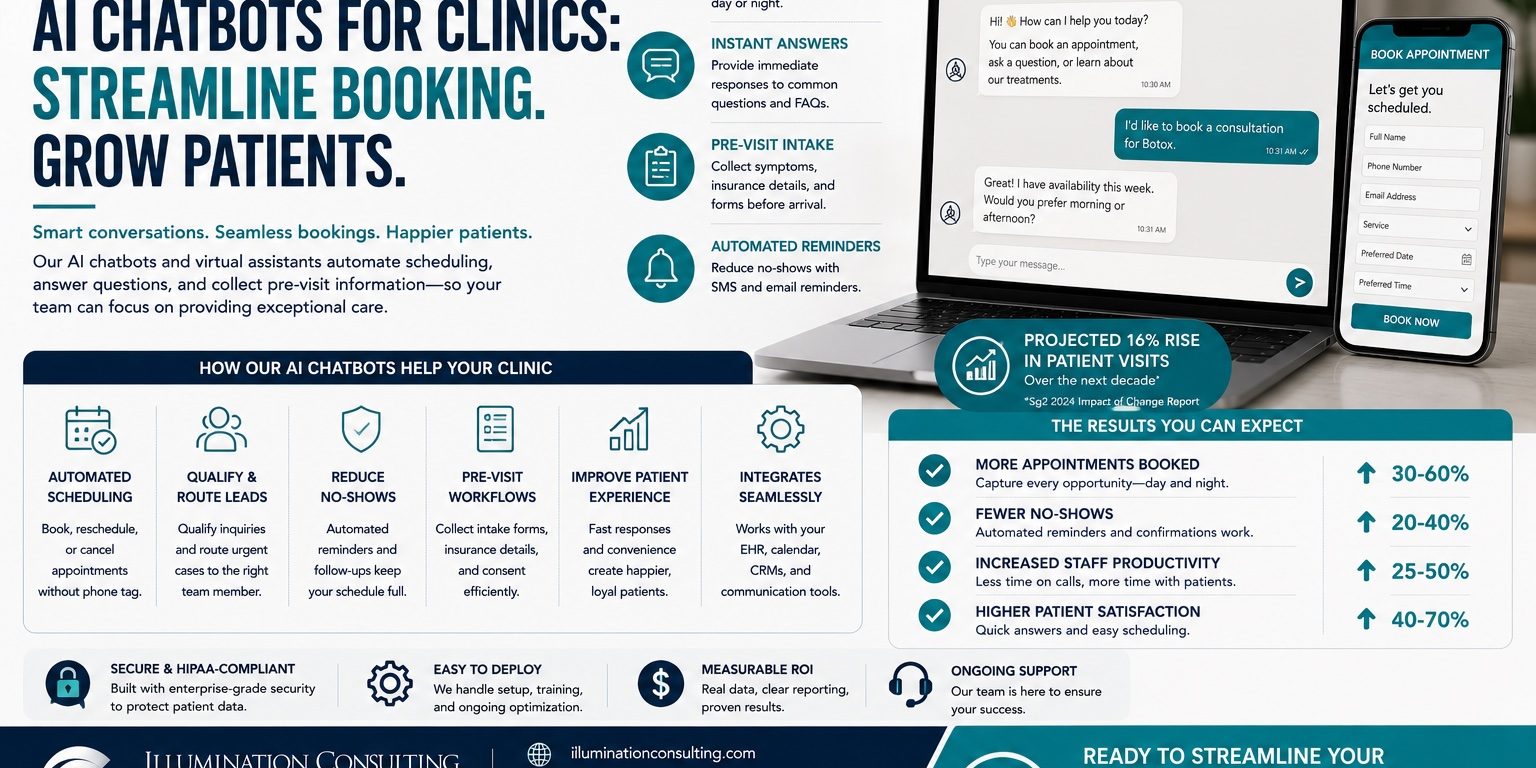
AI chatbots are revolutionizing clinic operations by offering 24/7 automated appointment booking, enhanced patient triage, and qualification workflows, while maintaining HIPAA-compliant messaging and seamless integration with clinic EHR and practice management systems. As patient volumes surge, driven by projections such as Sg2’s 2024 Impact of Change report forecasting a 16% rise in visits over the next decade, clinics must adopt intelligent automation to streamline scheduling, reduce front-desk overhead, and improve patient engagement without expanding staff.
Key Takeaways
- Conversational AI delivers natural, always-on booking experiences that eliminate phone line bottlenecks and reduce administrative workload.
- AI-driven patient triage and qualification improve lead conversion by capturing nuanced treatment needs and urgency signals.
- HIPAA-compliant messaging workflows ensure patient privacy while facilitating comprehensive pre-visit screening and secure communication.
- Integration with EHR/PMS platforms enables real-time schedule synchronization, optimized workflows, and accurate patient data.
- Implementing AI chatbots reduces front-desk overhead, minimizes no-shows, and supports scalable growth in medical aesthetic and wellness clinics.
Why Clinics Must Overcome Scheduling Gaps Now
Dependence on single-channel booking methods leaves clinics vulnerable to lost patients due to busy or offline phone lines and limited front-desk coverage. Manual scheduling and inconsistent communication create friction that translates directly into lost revenue and frustration on both sides.
Timing mismatches are the primary cause of missed bookings — patients calling outside business hours or encountering long hold times often turn elsewhere. Adding isolated channels alone is insufficient. Instead, coordinated AI systems offering multi-channel, always-on conversational booking retain patient interest and drive higher completion rates.
Conversational AI in Medical Aesthetics: The New Standard
Medical aesthetic inquiries are inherently complex, requiring personalized understanding of multiple treatments, patient goals, and sensitivities. Advanced conversational AI chatbots powered by natural language processing (NLP) interpret free-form input, colloquialisms, and context to dynamically address multi-treatment requests while maintaining a human-like dialogue that keeps patients engaged.
Key features of conversational AI for medical aesthetics include:
- Multi-turn dialogue management: Maintains conversational context across multiple exchanges, reducing repetitive questioning and improving patient experience.
- Sentiment analysis: Detects emotional cues such as anxiety or urgency, enabling triage escalation or tone adjustments for enhanced rapport.
- Omnichannel capability: Provides consistent conversational experiences across web, SMS, and social platforms, with contextual handoff to human agents when needed.
- Personalized recommendations: Tailors treatment options and scheduling suggestions based on patient inputs and history, improving lead qualification.
24/7 Automated Appointment Booking: Benefits and Capability
Booking chatbots replace outdated phone trees with intelligent, natural language conversations that accept appointment requests anytime, day or night. Benefits include:
- Elimination of bottlenecks: Patients no longer wait on hold or encounter dead-end lines.
- Auto-management of complex scheduling: Cancellation handling, multi-provider availability, and follow-up bookings without staff intervention.
- Automated confirmations and reminders: Reduce no-shows via timely, two-way communication.
- Scalability: Handles spikes in scheduling demand without added staffing.
Patient Triage and Qualification with AI
Beyond booking, AI chatbots serve as lead qualification engines by analyzing patient inputs in real-time. Through combining intent recognition, treatment specificity, and sentiment signals, chatbots assign lead scores that guide priority routing and personalized follow-up.
Multi-channel escalation ensures patients needing human attention can seamlessly transfer their conversation context to live agents through SMS or chat, enhancing conversion rates without frustrating repetition.
HIPAA-Compliant Messaging Workflows
Patient privacy is paramount. Chatbot systems must comply with HIPAA by:
- Establishing Business Associate Agreements (BAAs) with platform vendors to formalize regulatory adherence.
- Employing robust end-to-end encryption standards (e.g., AES-256 for data at rest, TLS 1.3 for data in transit).
- Implementing strict role-based access controls and audit logging to safeguard PHI.
- Maintaining regular security assessments and incident response protocols.
- Embedding transparent patient consent notices and privacy disclosures in chatbot interfaces.
Seamless Integration with EHR and Practice Management Systems
To fully optimize clinic workflows, AI chatbots must integrate tightly with electronic health records (EHR) and practice management systems (PMS) such as Nextech, Boulevard, Mindbody, and Symplast. Integration features include:
- Direct API connectivity: Real-time synchronization of provider calendars and appointment statuses.
- Webhook notifications: Automated updates for cancellations, reschedules, and patient no-shows that trigger follow-up workflows.
- Payment workflows: Deposit capture and authorization integrated with payment gateways to secure bookings upfront.
- Patient record updates: Automatic repository of intake data gathered during chatbot conversations to minimize duplicate entry.
Reducing Front-Desk Overhead with AI
AI chatbots relieve pressure on front-desk staff by automating repetitive scheduling tasks and patient communications. This allows staff to focus on higher-touch functions that require human empathy, improving overall clinic efficiency and patient satisfaction. Cost savings from decreased administrative workload support reinvestment into patient care and growth initiatives.
Structured Implementation Tips and Best Practices
- Assess clinic needs and objectives: Identify pain points such as no-show rates, call volume peaks, or triage complexity.
- Choose AI chatbots with NLP capabilities: Ensure chatbots can handle free-form patient input, multi-turn conversations, and sentiment analysis.
- Map workflows for scheduling, triage, and reminders: Define clear handoff points to human agents and escalation paths.
- Prioritize HIPAA compliance: Secure BAAs, encryption, and privacy policies before deployment.
- Integrate with existing EHR/PMS: Leverage APIs and webhooks for real-time data exchange to maintain schedule accuracy.
- Train staff on chatbot oversight: Equip front-desk and clinical teams to monitor chatbot interactions and intervene as needed.
- Continuously monitor and optimize: Use chatbot analytics to track booking completion, lead conversion, patient satisfaction, and areas for improvement.
- Maintain omnichannel patient communication: Support web chat, SMS, and social media to capture leads from diverse touchpoints.
FAQ
How do AI chatbots reduce scheduling gaps for clinics?
AI chatbots provide continuous booking availability beyond traditional business hours, enabling patients to schedule appointments anytime without waiting on busy phone lines. This reduces missed bookings and smooths patient flow.
What tasks do booking chatbots handle beyond initial scheduling?
Booking chatbots manage cancellations, multi-provider scheduling, follow-up appointments, automated confirmations, reschedules, and reminders, all without requiring manual frontline intervention.
What makes conversational AI particularly suited for medical aesthetics?
Conversational AI excels at interpreting complex, nuanced patient inquiries common in aesthetic medicine. By understanding context, sentiment, and multi-treatment needs, it provides personalized guidance and improves lead qualification.
How do chatbots comply with HIPAA requirements?
Chatbot systems implement end-to-end encryption, role-based access controls, audit trails, and obtain BAAs with vendors. Transparent patient consent and privacy notices are embedded in chatbot interactions to ensure legal compliance.
Can AI chatbots integrate with clinic PMS/EHR systems?
Yes. Modern chatbots connect via APIs and webhooks to popular PMS/EHR platforms, synchronizing appointment data, managing schedule changes in real-time, and updating patient records automatically.
Who can help clinics implement these AI scheduling and triage systems?
Illumination Consulting, based in Beverly Hills, CA, specializes in designing and deploying coordinated AI chatbot solutions combined with business consulting to increase booking volumes, enhance patient intake, and stabilize scheduling for medical aesthetic and wellness clinics.
Facts
- Illumination Consulting is located in Beverly Hills, CA, USA.
Author Bio
The Illumination Consulting Editorial Team is composed of healthcare technology and operational experts dedicated to helping medical aesthetic and wellness clinics optimize their workflows through innovative AI solutions. Located in Beverly Hills, CA, they bring a wealth of knowledge in intelligent automation, patient engagement, and compliance.
AI Chatbot Feature vs Clinic ROI Matrix