Medical spas have evolved far beyond offering Botox®, dermal fillers, laser treatments, and facials. Today’s most successful med spas understand that exceptional client care extends beyond the treatment room. Clients want guidance on maintaining their results between appointments, preventing future skin concerns, and investing in products that genuinely support healthier skin. This shift has created one of the largest untapped revenue opportunities in the aesthetic industry: professional skincare retail.
Despite this opportunity, many medical spas still treat retail as an afterthought. Products sit behind the reception desk with little merchandising, staff receive minimal sales training, and recommendations are inconsistent from one provider to another. As a result, clinics miss opportunities to improve patient outcomes while leaving significant recurring revenue on the table.
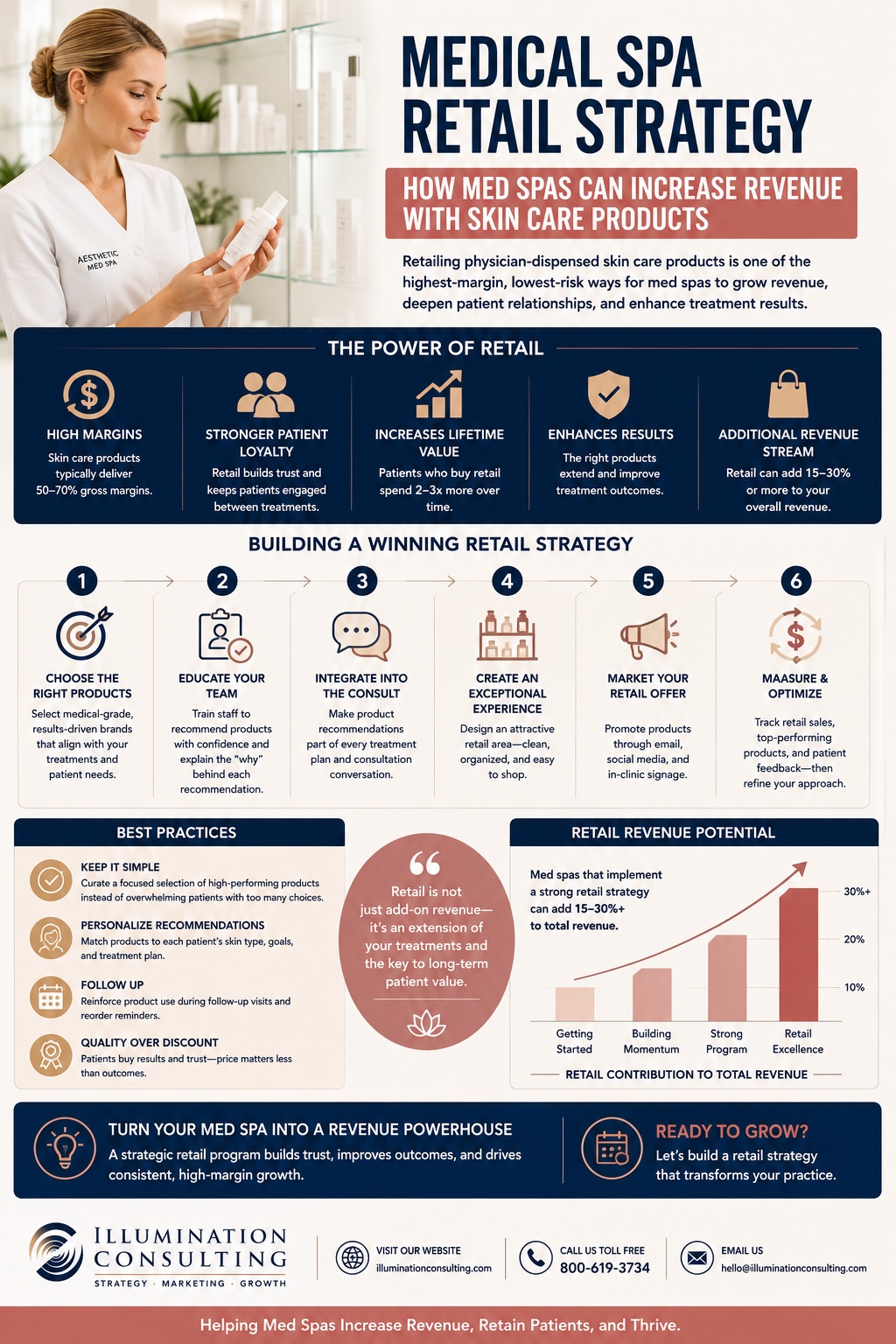
Retail should never be viewed as simply selling products. Instead, it should be considered an extension of every treatment plan. Whether a client receives microneedling, chemical peels, laser resurfacing, or injectable treatments, professional home care plays an essential role in achieving and maintaining optimal results. When clients leave with physician-recommended products specifically chosen for their skin, they are more likely to experience better outcomes, remain satisfied with their treatments, and return for future services.
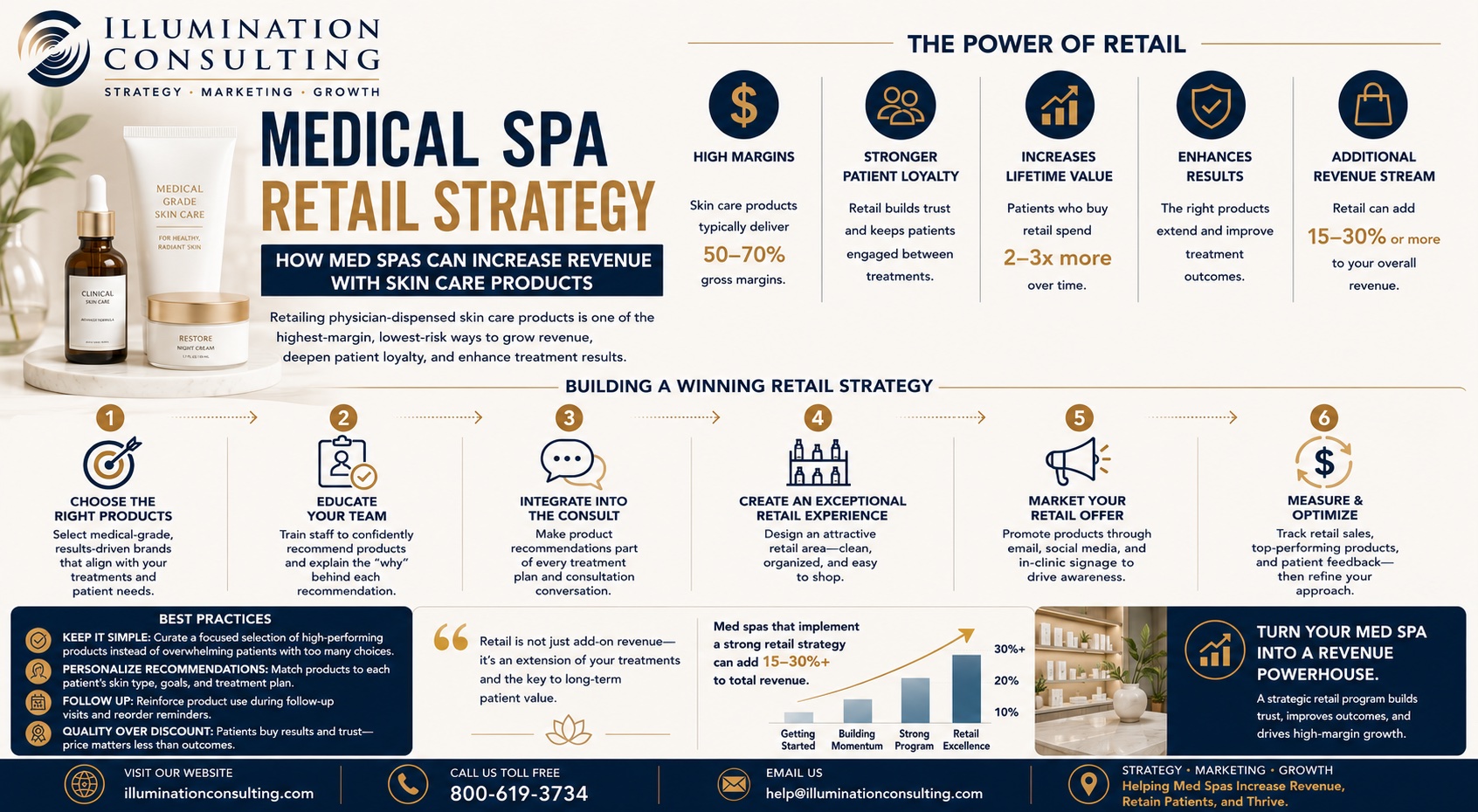
The business benefits are equally compelling. Retail revenue is not limited by treatment room availability or provider schedules. Professional skincare products generate higher patient lifetime value, improve client retention, create recurring monthly income, and strengthen the overall brand of the medical spa. Combined with an e-commerce platform and subscription programs, retail becomes a scalable revenue stream that continues generating income between appointments.
As consumers become increasingly educated about ingredients and skincare science, they are also becoming more selective about where they purchase products. Rather than relying on department stores or online marketplaces, many prefer buying directly from trusted medical professionals who understand their skin concerns and treatment goals.
This guide explores how medical spas can develop a successful retail strategy that benefits both their clients and their business. From selecting the right product lines and training staff to merchandising, marketing, subscriptions, and e-commerce, you’ll learn how retail can become one of the most profitable components of your practice.
Why Retail Matters More Than Ever
Many medical spas focus almost exclusively on service revenue. While treatments remain the core of every successful practice, relying entirely on appointment-based income creates natural limitations. Every provider has a finite number of appointments available each day, and treatment rooms can only accommodate so many clients.
Retail products remove those limitations.
Professional skincare can be sold during consultations, after treatments, through your website, via email campaigns, through subscriptions, during follow-up appointments, through social media, with membership programs, through gift packages, and during seasonal promotions.
Unlike treatment revenue, retail sales continue even when providers are not actively performing procedures.
Successful medical spas understand that retail is not separate from patient care—it is part of the complete patient experience.
The Benefits of Professional Skincare Retail
An effective retail program creates value for both clients and the practice.
Benefits include increased monthly revenue, higher average transaction values, improved treatment outcomes, better client compliance, greater patient loyalty, more recurring revenue, increased lifetime customer value, stronger practice branding, higher profitability, and better overall patient satisfaction.
Clients also appreciate having confidence that the products recommended by their provider are appropriate for their specific skin concerns rather than relying on conflicting advice from influencers or online reviews.
Retail Should Be Part of Every Treatment Plan
One of the biggest mistakes medical spas make is separating treatments from home care.
Professional skincare should never feel like an optional upsell.
Instead, products should be presented as an essential component of the treatment protocol.
For example, after microneedling, clients should leave with a gentle cleanser, healing moisturizer, mineral sunscreen, and growth factor serum. Following a chemical peel, they should receive a barrier repair cream, SPF protection, gentle cleanser, and brightening serum. After laser treatments, recovery moisturizers, anti-inflammatory serums, and broad-spectrum sunscreen help maximize healing while protecting results. Acne treatment plans should include cleansers, retinoids, moisturizers, and oil-free SPF products that support long-term improvement.
When recommendations become part of the clinical conversation, clients perceive them as medical guidance rather than a sales presentation.
Selecting the Right Product Lines
Not every skincare brand is appropriate for every medical spa.
Choosing products should begin with understanding your patient demographics, treatment offerings, pricing strategy, and brand positioning.
Look for product lines that offer clinically proven ingredients, evidence-based formulations, professional exclusivity, consistent availability, attractive profit margins, excellent manufacturer support, comprehensive education, modern packaging, strong consumer reputation, and scalable product portfolios.
Many successful medical spas initially partner with established professional skincare brands before eventually introducing private-label products as their business grows.
Create Product Collections Instead of Individual Recommendations
Clients often become overwhelmed when presented with dozens of individual products.
Instead of selling one product at a time, create complete treatment systems.
For example, an Anti-Aging Collection could include a Vitamin C Serum, Retinol Treatment, Daily Moisturizer, and SPF 50 Sunscreen. An Acne Control Collection may combine a cleanser, exfoliating treatment serum, oil-free moisturizer, and sunscreen. A Brightening Collection could include Vitamin C, pigment corrector, cleanser, and SPF. A Post-Procedure Recovery Kit might feature a healing cleanser, recovery cream, growth factor serum, and mineral sunscreen.
Product systems simplify purchasing decisions while increasing average order value and improving treatment compliance.
Train Your Team to Recommend, Not Sell
One of the biggest reasons retail programs underperform is because staff members feel uncomfortable recommending products. Fortunately, successful retail programs are not built around sales techniques—they are built around education.
Every provider, aesthetician, nurse injector, and patient coordinator should understand:
- The purpose of each product
- Key active ingredients
- Which treatments each product complements
- How products improve treatment outcomes
- Common patient questions
- Proper application instructions
- Expected timelines for visible results
- How products work together within a skincare regimen
When providers confidently explain why a product is recommended, clients perceive the recommendation as part of their treatment plan rather than a sales pitch.
For example, instead of asking, “Would you like to purchase this serum today?” a provider might explain, “To protect the results of today’s laser treatment, I recommend using this recovery serum and mineral sunscreen over the next several weeks. They help reduce inflammation, accelerate healing, and protect your investment.” The conversation immediately shifts from selling to patient care.
Increase Average Order Value with Product Bundles
One of the easiest ways to increase medical spa retail revenue is by creating bundled skincare systems instead of recommending individual products.
Product bundles offer several advantages:
- Increase average transaction value
- Improve treatment compliance
- Simplify purchasing decisions
- Increase client satisfaction
- Provide greater perceived value
- Make staff recommendations easier and more consistent
Examples of high-performing bundles include:
Anti-Aging Collection
- Gentle Cleanser
- Vitamin C Serum
- Retinol Treatment
- Hyaluronic Acid Moisturizer
- SPF 50 Sunscreen
Acne Recovery Collection
- Salicylic Acid Cleanser
- Clarifying Serum
- Oil-Free Moisturizer
- Daily Sunscreen
Pigmentation Correction Collection
- Brightening Cleanser
- Vitamin C Serum
- Pigment Corrector
- Retinol
- Mineral Sunscreen
Post-Procedure Recovery Collection
Ideal for clients after:
- Microneedling
- Fractional Laser
- RF Microneedling
- Chemical Peels
Recommended products may include:
- Recovery Cleanser
- Healing Cream
- Growth Factor Serum
- Mineral Sunscreen
- Hydrating Mist
Bundled systems simplify the purchasing process while increasing retail revenue and improving clinical outcomes.
Design a Retail Display That Sells
Many medical spas unintentionally hide thousands of dollars in retail opportunities.
Products are often stored:
- Behind the reception desk
- Inside cabinets
- On crowded shelves
- Without pricing
- Without educational materials
- Without visual merchandising
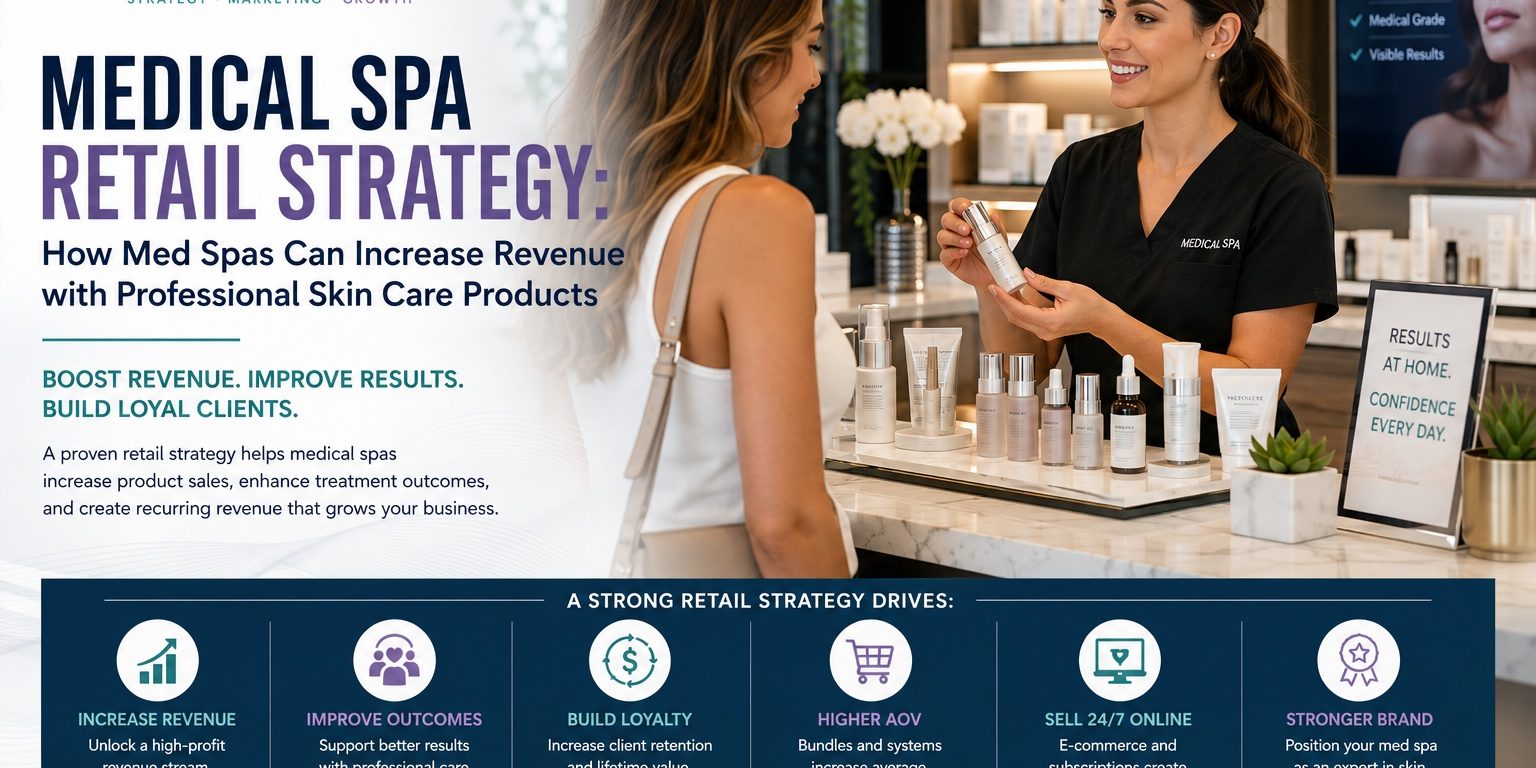
Instead, your retail area should feel like a premium skincare boutique that complements your clinical environment.
A professional retail display should include:
- Illuminated shelving
- Clearly organized product categories
- Educational product signage
- Before-and-after photography
- Ingredient highlight cards
- Digital educational displays
- Product testers when appropriate
- Lifestyle photography
- Seasonal merchandising
- “Provider Favorites” recommendations
An attractive retail area naturally encourages conversations and allows clients to discover products that support their treatment goals.
Leverage Before-and-After Photography
Visual proof remains one of the most persuasive marketing tools available.
Clients are significantly more likely to purchase skincare products when they can see authentic treatment results.
Before-and-after photography can demonstrate improvements in:
- Acne
- Hyperpigmentation
- Melasma
- Fine lines
- Wrinkles
- Rosacea
- Skin texture
- Sun damage
- Uneven skin tone
- Overall skin quality
Always obtain written patient consent and ensure all images comply with HIPAA requirements and applicable advertising regulations.
Use these images throughout your:
- Website
- Product pages
- Consultation rooms
- Waiting areas
- Social media
- Email marketing
- Educational presentations
Real patient success stories build trust while reinforcing the value of professional skincare recommendations.
Expand Beyond Your Clinic with E-Commerce
Today’s clients expect convenience.
Many patients prefer ordering skincare online instead of returning to the clinic every time they need a refill.
A professionally designed e-commerce website allows your medical spa to:
- Sell products 24 hours a day
- Reach customers outside your local market
- Generate recurring revenue
- Automate product replenishment
- Launch promotional campaigns
- Track customer purchasing behavior
- Increase annual revenue per client
A successful online store should include:
- Professional product photography
- Detailed product descriptions
- Complete ingredient information
- Educational videos
- Customer reviews
- Frequently Asked Questions
- Related product recommendations
- Subscription purchasing
- Secure checkout
- Mobile-first design
- Fast page speeds
Many successful medical spas eventually generate as much revenue from online skincare sales as they do from in-office retail, making e-commerce one of the highest-return investments for long-term practice growth.