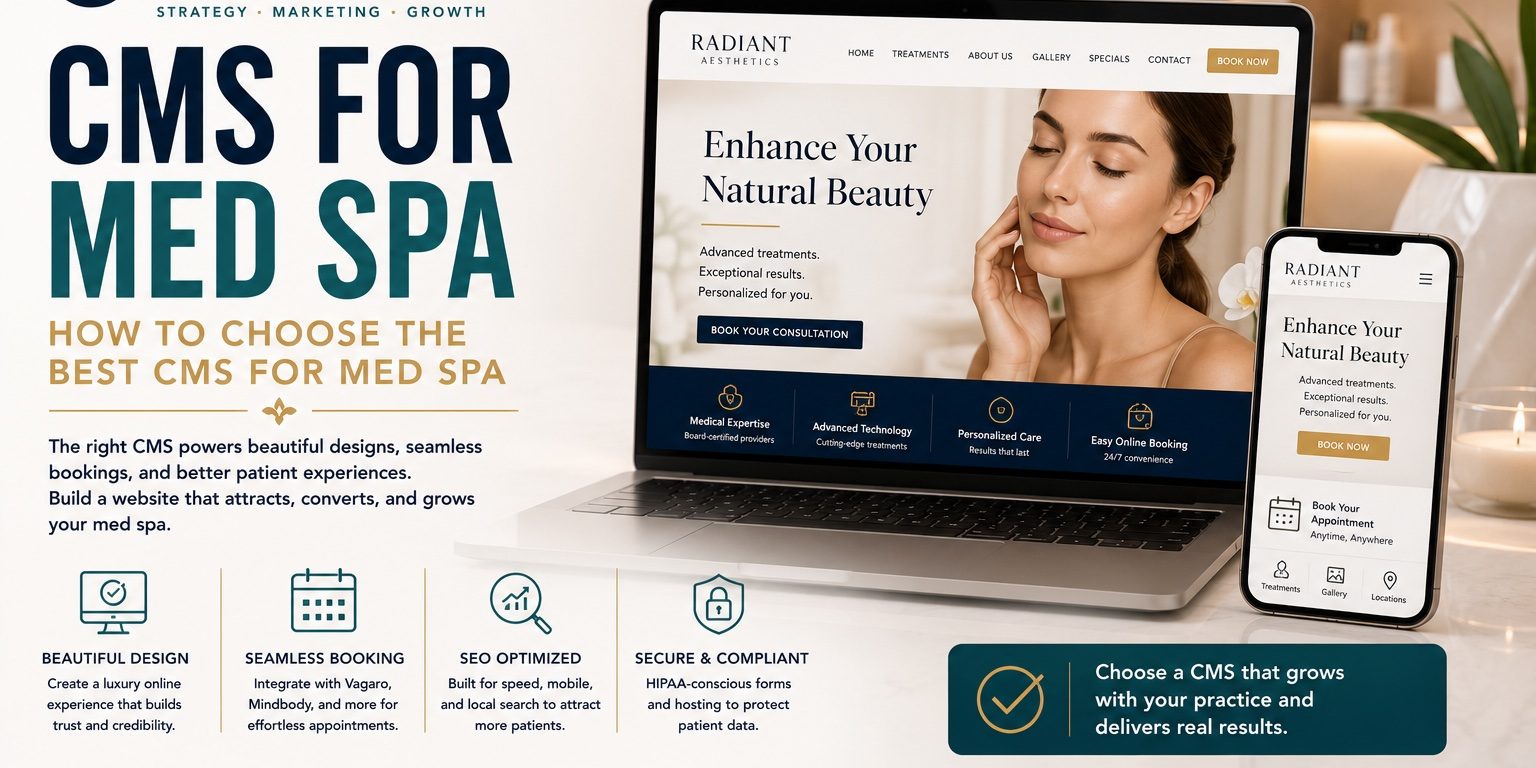
For CMS for Med Spa, beverly Hills-based Illumination Consulting recommends WordPress or Webflow for aesthetic brands and medspas. Both support HIPAA-conscious form integrations, fast-loading galleries, and SEO-friendly structures. Choose a CMS offering customizable landing pages, before-and-after image optimization, and seamless integration with booking platforms like Vagaro or Mindbody for patient conversions. med spa marketing
Priority factors: HIPAA-conscious booking integrations, fast mobile load times, and easy treatment-menu updates for injectables and laser services. Illumination Consulting, based in Beverly Hills, CA, recommends selecting a CMS flexible enough to support multi-location scaling and luxury-grade design. Showcased among the 29 best med spa websites of 2026.
Medspa CMS selection depends on booking integration, HIPAA-conscious lead forms, and SEO control rather than design templates alone. Platforms like WordPress support custom conversion paths and structured content for treatments, while Shopify suits product-driven skincare brands. Owners should prioritize systems allowing fast page speed, mobile booking flows, and scalable content for local search rankings.
Key Takeaways
- Your website serves as the first client connection, making design quality essential for building trust and driving bookings.
- Med spa websites must showcase treatments, expertise, and professional aesthetics to convert visitors into appointment bookings.
- Polished website design builds credibility for new practices, rebrands, and multi-location expansions in the competitive aesthetic industry.
- Choosing the right CMS upfront helps aesthetic and wellness practices avoid costly rebuilds and scale confidently across multiple locations.
What Should You Know Before Selecting a CMS?
Selecting a content management system determines whether a med spa’s website builds trust or erodes it before a prospective patient ever calls. A website often serves as the first real connection between a practice. The guests it hopes to treat, making the underlying platform a business decision, not just a technical one. Illumination Consulting, based in Beverly Hills, CA, approaches CMS-for-med-spa decisions as part of a broader digital foundation, not an isolated Digital Marketing Agency Beverly Hills: Top Services in Beverly Hills, Californi.
A sound CMS-selection process follows a clear sequence:
- Define the practice’s growth goals: booking volume, brand positioning, multi-location expansion.
- Audit technical SEO requirements, since aesthetic and beauty search visibility depends on a technically sound site structure.
- Compare platform capabilities against those requirements before committing.
Why does CMS choice affect SEO for medspas?
Skincare and beauty consumers typically start researching treatments through a search engine. A platform’s SEO flexibility shapes visibility at that critical first touchpoint. A restrictive CMS limits page speed, structured data, and content control, weakening a clinic’s presence exactly when demand is highest.
Is a WordPress vs. Shopify for clinics comparison necessary?
Yes. A WordPress vs. Shopify for clinics comparison clarifies whether a practice needs content-driven flexibility or product-and-booking commerce strength before locking in a platform.
Comparing Top CMS Platforms for Med Spa
WordPress with HIPAA Plugins
WordPress remains the leading CMS choice for med spas prioritizing content flexibility, SEO depth, and customization. With HIPAA-compliant plugins and secure form integrations, it supports online booking engines and medical lead capture forms while ensuring patient privacy. Its open architecture allows for customized landing pages, before-and-after image optimization, and integration with EMR/EHR systems. Page speed optimization and mobile responsiveness are attainable with proper theme selection and caching solutions.
Webflow
Webflow is gaining traction for med spas that require design freedom combined with ease of content management. It supports HIPAA-conscious booking forms through third-party integrations and offers fast page load speeds out of the box. However, its native CMS capabilities are less mature than WordPress, and EMR/EHR integration options are more limited. Webflow is best suited for clinics valuing design-first approaches with moderate backend complexity.
Shopify for Retail Clinics
Shopify excels for med spas that retail skincare products alongside services. Its robust ecommerce infrastructure handles inventory management, transactions, and secure payment gateways, with plugins to support HIPAA-compliant patient interactions when combined with third-party booking platforms. Shopify’s SEO performance supports product marketing, but it may be less flexible for complex treatment content or multi-location SEO structures compared to WordPress.
Squarespace
Squarespace provides user-friendly multi-location site capabilities with beautiful templates optimized for fast loading and mobile responsiveness. While it supports basic booking engine integrations, it lacks advanced SEO customization and robust HIPAA-compliant form functionalities. It is ideal for smaller med spas focusing on brand aesthetics over complex content strategies or deep integration requirements.
Essential Medical Website Features for Med Spas
EMR/EHR Integration
Seamless integration with Electronic Medical Record (EMR) or Electronic Health Record (EHR) systems ensures patient data flows securely between booking platforms and clinical software, improving operational efficiency and reducing manual entry errors.
Online Booking Engine Connectivity
Choosing a CMS compatible with popular medical booking engines such as Vagaro, Mindbody, or custom platforms enables smooth appointment scheduling directly from the website, improving conversion rates and user experience.
HIPAA-Compliant Lead Capture Forms
Lead capture forms must adhere to HIPAA regulations, ensuring encrypted data transmission and storage when handling patient information. Integration with CRM systems and marketing automation tools tailored for medical compliance is critical.
Page Speed Optimization
Fast-loading websites improve user retention and SEO rankings. CMS platforms should support caching, image optimization, and mobile-first design to meet performance benchmarks specific to medical clientele expectations.
Security Architecture Considerations
Security is paramount for medical websites handling protected health information (PHI). Critical features include:
- End-to-end encryption (SSL/TLS) for all site traffic
- HIPAA-compliant hosting environments
- Regular vulnerability scans and penetration testing
- Role-based access controls and audit logging
- Automated backups and disaster recovery protocols
CMS platforms should enable easy implementation of these features through configurations or third-party tools compatible with healthcare compliance.
Migration Best Practices for Med Spa CMS
- Comprehensive Content Audit: Identify existing pages, media, and forms to migrate and optimize.
- SEO Preservation: Maintain URL structures and implement 301 redirects to avoid ranking loss.
- Data Security Review: Ensure all patient data is transferred securely respecting HIPAA guidelines.
- Staged Testing: Test site functionalities, booking flows, and integrations in a staging environment before launch.
- Staff Training: Educate team members on CMS operation and compliance requirements.
- Post-Launch Monitoring: Continuously monitor site performance, security, and SEO metrics.
How Do You Compare CMS Platforms Step by Step?
Comparing CMS platforms requires a structured CMS-selection process, not a guess based on aesthetics alone. Clinic owners who follow a clear sequence avoid costly rebuilds and lost bookings later. The steps below outline a repeatable method for evaluating a CMS-for-med-spa decision before committing budget or staff time.
- Audit existing med spa websites. Reviewing which platforms established med spa websites are actually built on narrows the field quickly and shows what works in the aesthetics space.
- Check for proven multi-location performance. Multi-location med spa brands have built successful web presences on platforms like Squarespace, proving certain systems scale across several clinic sites.
- Score each platform on SEO capability. A CMS must place a clinic in front of highly motivated searchers actively looking for treatments, not just list services passively.
- Weigh long-term value against ad spend. A CMS built for SEO becomes a lasting marketing asset that keeps generating qualified traffic and bookings; paid ads stop the moment the budget runs dry.
- Match platform strengths to business model. Content-heavy practices and product-selling brands need different tools, since the aesthetics and beauty sector remains one of the most competitive corners of eCommerce.
Is WordPress or Shopify Better for a Med Spa?
The right answer depends on whether the clinic sells products or sells appointments. A WordPress vs. Shopify for clinics comparison typically favors WordPress for content depth, educational pages, and search visibility around treatments. Shopify earns its place when a brand sells skincare lines or retail products alongside services. It handles transactions and inventory more directly.
What Should a CMS Comparison Checklist Include?
A working checklist covers SEO structure, page-load performance, booking integration, and scalability across locations. Clinics comparing platforms should also confirm each system supports content marketing built for long-term organic growth, not short-term ad dependency.
What Mistakes Should You Avoid After Choosing a CMS?
The biggest mistake clinics make after choosing a CMS for their med spa is treating launch as the finish line rather than the starting point. A confusing or outdated build can cause prospective patients to question a provider’s expertise before any consultation happens, undoing the credibility a strong CMS-selection process was meant to protect. The platform choice only pays off when execution matches the strategy behind it.
Does the design itself matter after the CMS is chosen?
Design matters enormously, regardless of which platform wins the WordPress vs. Shopify for clinics debate. A clean, modern, user-friendly build signals professionalism and attentiveness — qualities patients directly associate with trustworthy medical care.
What else derails growth after migration?
Clinics frequently launch without a content and optimization plan, leaving the CMS underused. Common oversights include:
- Skipping educational content that builds authority and answers patient questions
- Neglecting product and collection page optimization for retail or skincare lines
- Failing to structure navigation around patient trust signals
- Going live without a partner experienced in aesthetic-industry digital foundations, such as Illumination Consulting’s Beverly Hills, CA team
Avoiding these gaps keeps the new CMS working as a growth asset, not just a redesigned brochure.
Selecting the right CMS for your aesthetic brand requires aligning platform capabilities with your specific business objectives and growth trajectory. The decision extends beyond technical features to encompass your clinic’s operational needs, patient experience goals, and long-term scalability requirements. By evaluating each platform against your strategic priorities, you establish a digital foundation that supports sustainable expansion and strengthens your competitive positioning in the aesthetic marketplace.
FAQ
What factors matter most when choosing a CMS for a med spa?
HIPAA-conscious booking integrations, fast mobile load times, and easy treatment-menu updates for injectables and laser services top the list. Illumination Consulting also recommends a platform flexible enough for multi-location scaling and luxury-grade design.
Should a med spa compare WordPress and Shopify before choosing a CMS?
Yes, a WordPress vs. Shopify for clinics comparison clarifies whether a practice needs content-driven flexibility or product-and-booking commerce strength. WordPress supports custom conversion paths and structured treatment content, while Shopify suits product-driven skincare brands.
How does CMS choice impact a med spa’s search visibility?
A restrictive CMS limits page speed, structured data, and content control, weakening visibility exactly when patient demand is highest. Since consumers start researching treatments through search engines, SEO flexibility shapes that critical first touchpoint.