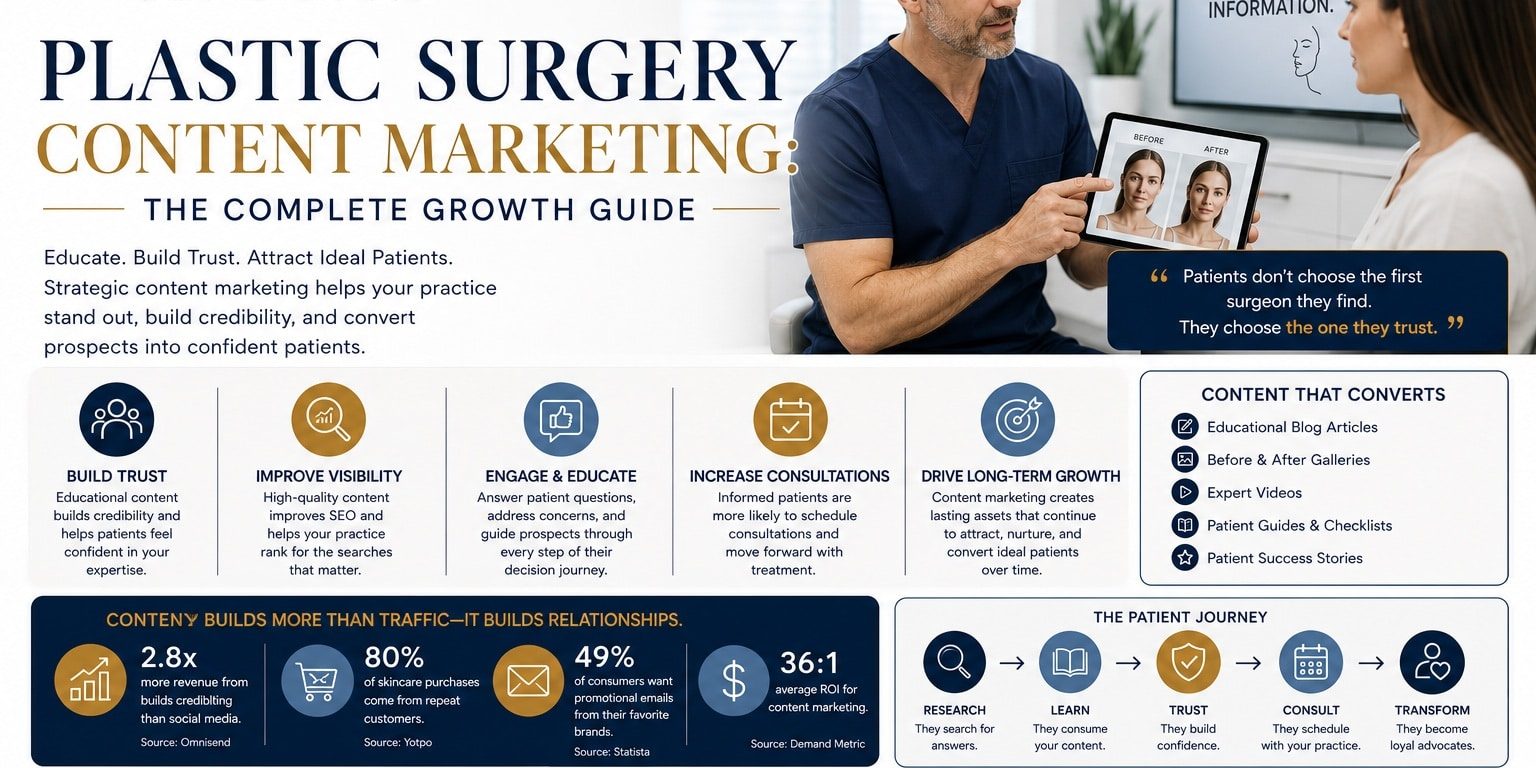
Choosing a plastic surgeon is one of the most personal and carefully researched decisions a patient will ever make. Unlike many healthcare services, cosmetic procedures are rarely purchased impulsively. Prospective patients spend weeks or even months researching providers, comparing credentials, reviewing before-and-after galleries, reading patient testimonials, watching educational videos, and evaluating treatment options before scheduling a consultation.
Because of this extended decision-making process, content marketing has become one of the most effective long-term growth strategies for plastic surgery practices. High-quality educational content helps establish credibility, answer patient questions, improve search engine rankings, and build trust long before a prospective patient contacts your office.
Today’s patients expect more than a list of procedures on your website. They want clear explanations of treatment options, realistic expectations, recovery timelines, candidacy requirements, risks, benefits, financing information, and insight into your experience and philosophy of care. The practices that consistently provide valuable educational content position themselves as trusted authorities while attracting patients who are already informed and motivated.
Content marketing also supports every major digital marketing channel. Educational blog articles strengthen search engine optimization (SEO), videos improve social media engagement, patient guides increase email subscribers, and informative landing pages improve paid advertising performance. Instead of relying exclusively on paid lead generation, content marketing creates a long-term digital asset that continues attracting qualified visitors month after month.
Artificial intelligence has also transformed modern content marketing by helping practices identify patient interests, organize editorial calendars, personalize educational resources, optimize content for search engines, and automate distribution across multiple platforms. Combined with expert medical oversight, AI enables practices to publish more consistently while maintaining exceptional quality.
Whether your practice specializes in facial rejuvenation, breast surgery, body contouring, reconstructive procedures, or non-surgical cosmetic treatments, a strategic content marketing program helps educate prospective patients while differentiating your practice in an increasingly competitive marketplace.
In this comprehensive guide, you’ll learn how to develop an effective plastic surgery content marketing strategy, create educational resources that build patient confidence, improve your search visibility, and generate more qualified consultation requests.
Why Content Marketing Matters for Plastic Surgeons
Patients want confidence before committing to a cosmetic procedure.
Educational content provides that confidence by answering questions, reducing uncertainty, and demonstrating your expertise long before the consultation begins.
Patients Research Extensively Before Scheduling
Most prospective patients investigate multiple providers before making a decision.
During this research process, they commonly search for:
- Procedure explanations
- Before-and-after results
- Recovery timelines
- Risks and benefits
- Cost considerations
- Surgeon credentials
- Patient testimonials
- Frequently asked questions
- Alternative treatments
- Expected outcomes
Practices that provide comprehensive educational resources become trusted authorities during this critical decision-making stage.
Content Builds Trust
Trust is the foundation of every successful plastic surgery practice.
High-quality content demonstrates:
- Experience
- Expertise
- Transparency
- Professionalism
- Compassion
- Patient education
- Commitment to informed decision-making
Rather than aggressively selling procedures, educational content allows prospective patients to build confidence naturally.
Content Improves SEO
Search engines reward websites that consistently publish valuable, authoritative content.
A comprehensive content marketing strategy helps your practice rank for searches such as:
- Facelift recovery
- Rhinoplasty consultation
- Breast augmentation recovery timeline
- Liposuction candidacy
- Tummy tuck before and after
- Mommy makeover guide
- Blepharoplasty recovery
- Chin augmentation options
Each article creates another opportunity to attract highly qualified organic traffic.
Content Supports Every Marketing Channel
Unlike advertising campaigns that stop producing leads when budgets end, content continues generating value over time.
One educational article can support:
- SEO
- Social media
- Email marketing
- Paid advertising
- Patient consultations
- Referral marketing
- Video production
- Downloadable guides
This makes content marketing one of the highest-return investments available to plastic surgery practices.
Building an Effective Content Marketing Strategy
Publishing occasional blog articles is not enough to establish your practice as a trusted authority.
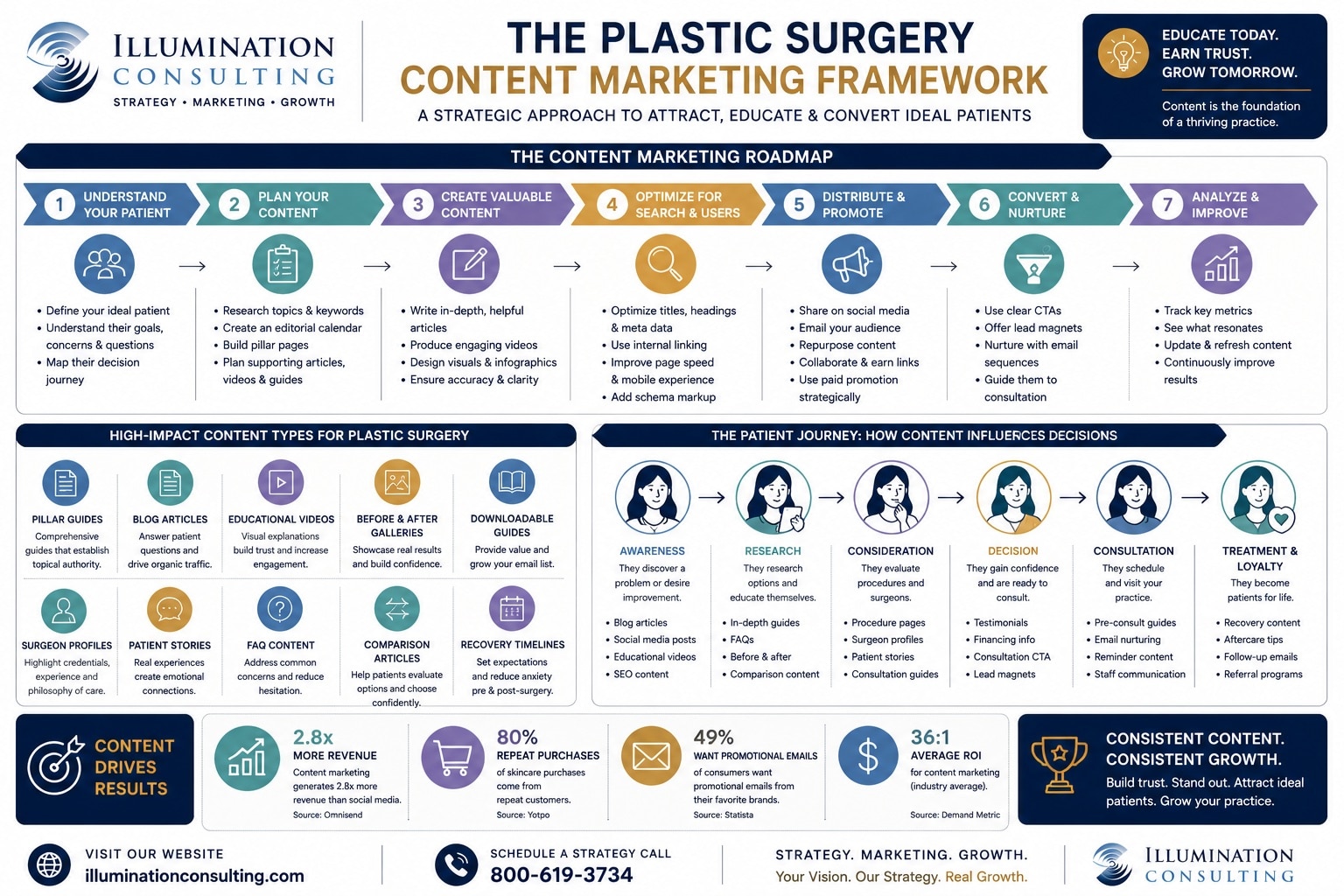
Successful plastic surgery practices develop comprehensive content strategies that educate patients throughout every stage of the decision-making process. Each piece of content should answer a specific question, address a concern, reduce uncertainty, or help prospective patients better understand their treatment options.
Over time, this educational library becomes one of your practice’s most valuable marketing assets.
Define Your Ideal Patient
Every content strategy should begin with a clear understanding of who you want to attract.
Consider factors such as:
- Age
- Gender
- Lifestyle
- Career
- Income level
- Cosmetic goals
- Geographic location
- Procedure interests
- Common concerns
- Stage in the buying journey
For example, someone researching rhinoplasty has very different questions than a patient considering a mommy makeover or eyelid surgery. Understanding these differences allows you to create highly relevant content that resonates with each audience.
Build Content Around Patient Questions
The best content doesn’t start with keywords—it starts with patient conversations.
Think about the questions your staff answers every day during phone calls and consultations.
Examples include:
- Am I a candidate?
- How long is recovery?
- Will there be visible scars?
- What are the risks?
- How long do results last?
- How much downtime should I expect?
- What procedures can be combined?
- What financing options are available?
- What should I expect during recovery?
- How do I choose the right plastic surgeon?
Every question represents an opportunity to create educational content that builds trust while improving your visibility in search engines.
Developing Pillar Content
Long-form educational guides serve as the foundation of a successful plastic surgery content strategy.
These comprehensive resources establish topical authority while providing valuable internal linking opportunities.
Examples include:
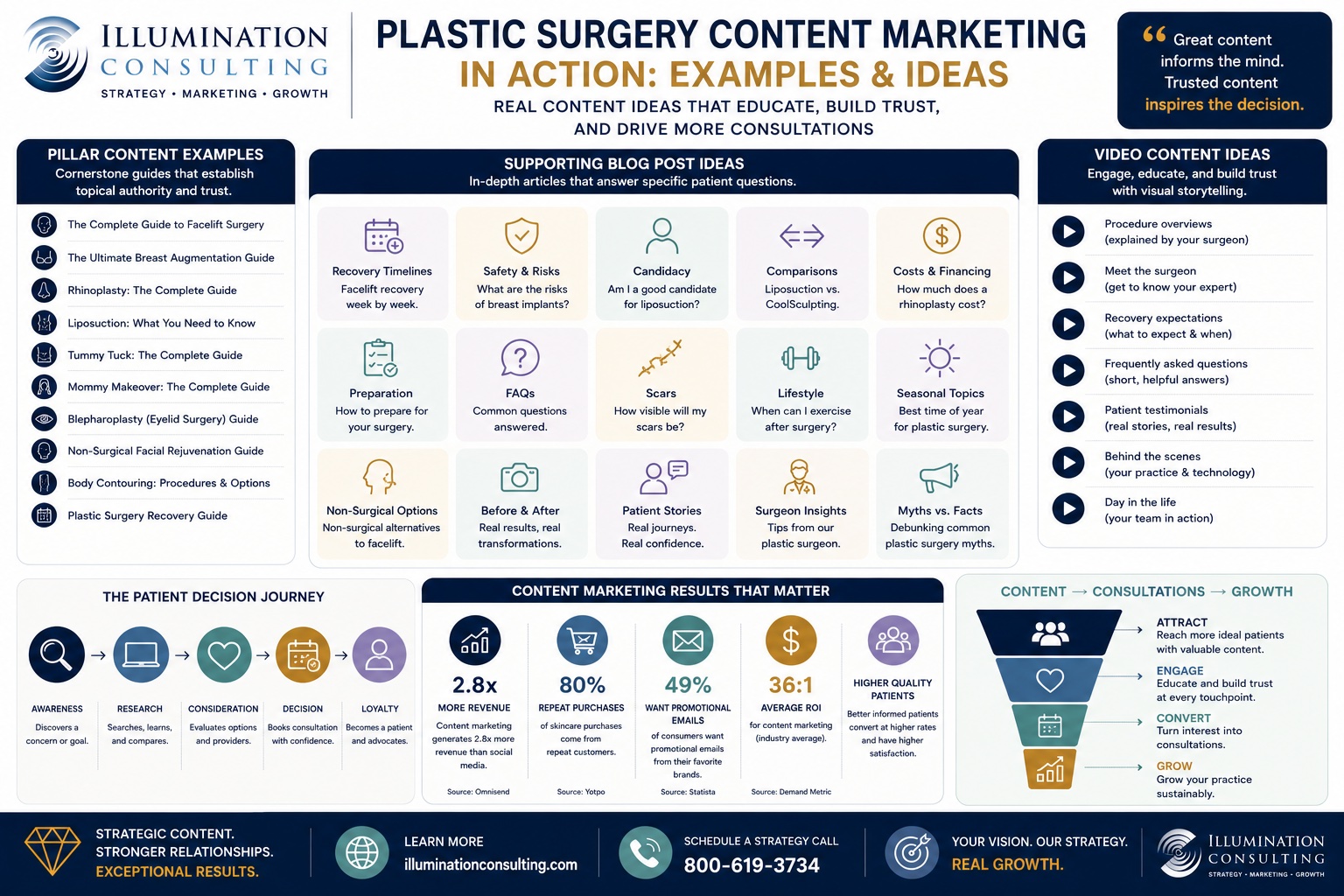
- Complete Facelift Guide
- Breast Augmentation Guide
- Liposuction Guide
- Rhinoplasty Guide
- Mommy Makeover Guide
- Blepharoplasty Guide
- Tummy Tuck Guide
- Facial Rejuvenation Guide
- Body Contouring Guide
- Plastic Surgery Recovery Guide
These cornerstone articles can each support dozens of supporting blog posts that explore specific questions in greater detail.
Supporting Articles That Build Authority
Once pillar content is established, expand your content library with focused educational articles.
Examples include:
- How Long Does Rhinoplasty Recovery Take?
- Preparing for Breast Augmentation Surgery
- Facelift Recovery Timeline Week by Week
- Understanding Liposuction Recovery
- What to Expect After a Tummy Tuck
- Are Breast Implants Right for You?
- Common Myths About Plastic Surgery
- How to Choose the Right Cosmetic Procedure
- Non-Surgical Alternatives to Facelift Surgery
- Plastic Surgery Consultation Checklist
Together, these articles strengthen topical authority while creating additional opportunities to rank for highly targeted search queries.
Educational Content Builds Better Patients
One overlooked benefit of content marketing is that it creates more informed patients before they ever enter your office.
Patients who consume educational content typically arrive with:
- More realistic expectations
- Better understanding of procedures
- Greater confidence
- More thoughtful questions
- Increased trust
- Stronger commitment to treatment
This often leads to more productive consultations and higher-quality patient relationships.
Content Formats That Perform Best
Modern patients consume information in many different ways.
Rather than relying exclusively on written blog articles, diversify your content across multiple formats.
Educational Blog Articles
Blogging remains one of the strongest long-term SEO strategies available.
Topics should focus on:
- Procedure education
- Recovery
- Safety
- Patient expectations
- Treatment comparisons
- Seasonal advice
- Frequently asked questions
Well-written articles continue attracting qualified visitors for years after publication.
Before-and-After Galleries
Visual results are among the most influential forms of content for cosmetic surgery practices.
Professional galleries should include:
- High-quality photography
- Multiple viewing angles
- Procedure descriptions
- Recovery timelines
- Patient goals
- Expected outcomes
When appropriate patient consent has been obtained, these galleries provide powerful visual evidence of your expertise.
Educational Videos
Video marketing continues to grow rapidly within healthcare.
Popular topics include:
- Procedure overviews
- Recovery expectations
- Consultation preparation
- Meet the surgeon
- Frequently asked questions
- Patient testimonials
- Facility tours
- Technology demonstrations
Videos increase engagement while helping prospective patients become more comfortable with your practice.
Downloadable Patient Guides
Comprehensive resources encourage website visitors to exchange their email address for valuable educational content.
Examples include:
- Plastic Surgery Preparation Guide
- Recovery Checklist
- Procedure Comparison Guide
- Cosmetic Surgery Planning Workbook
- Questions to Ask During Your Consultation
These downloadable assets help grow your email list while nurturing prospective patients who may not yet be ready to schedule a consultation.
Creating Content That Converts Visitors into Patients
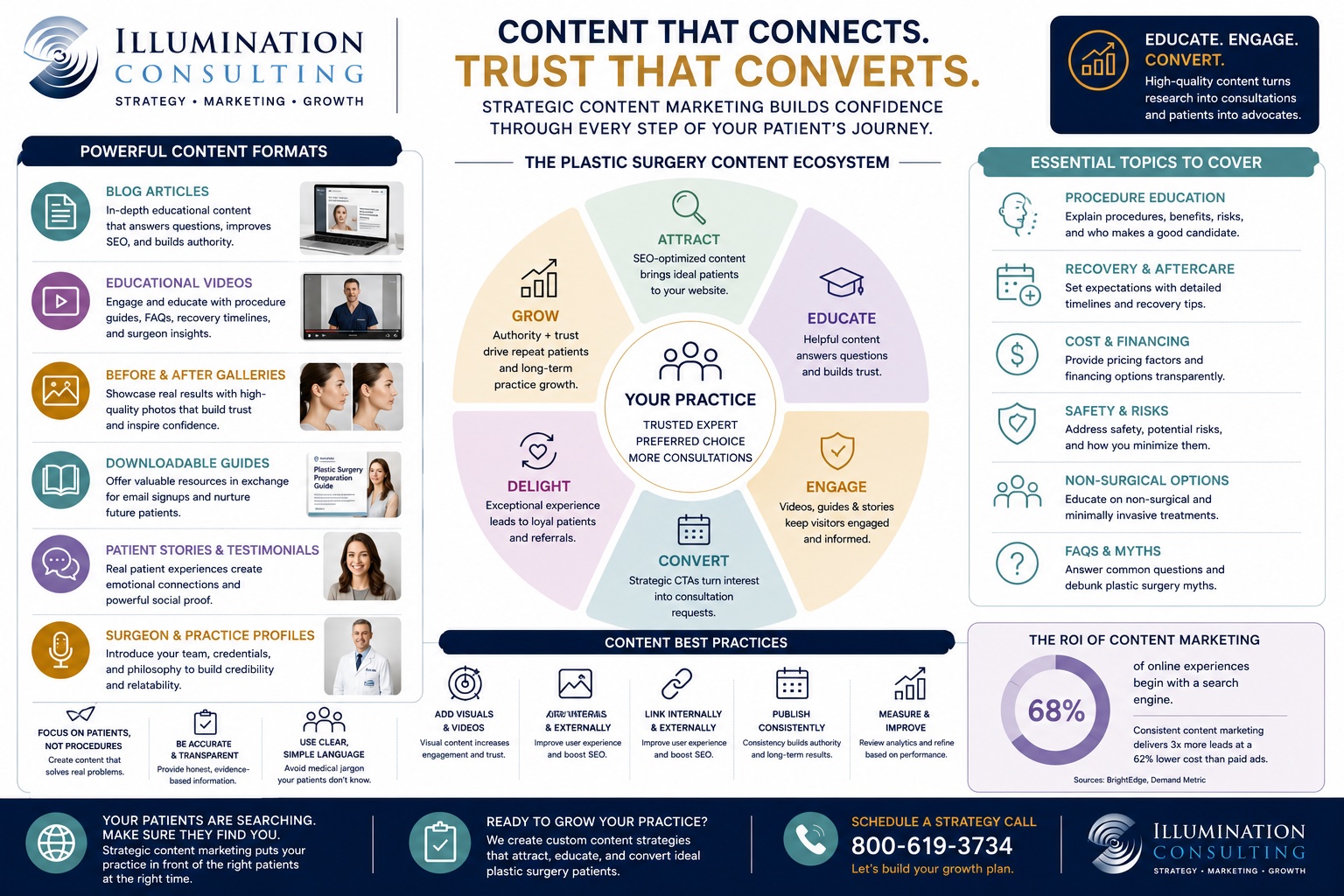
The ultimate purpose of content marketing is not simply to generate website traffic—it’s to help prospective patients feel informed, confident, and ready to schedule a consultation.
Every article, video, guide, and patient resource should move visitors one step closer to choosing your practice.
Successful plastic surgery content balances education with strategic conversion opportunities without feeling overly promotional.
Use Clear Calls-to-Action
Every piece of content should encourage readers to take a logical next step.
Examples include:
- Schedule Your Consultation
- Meet Our Plastic Surgeon
- View Before-and-After Results
- Download Our Procedure Guide
- Explore Related Treatments
- Contact Our Team
- Request More Information
- Learn About Financing Options
Calls-to-action should feel like a natural continuation of the educational experience rather than an aggressive sales pitch.
Internal Linking Improves User Experience
Each article should connect readers to additional educational resources throughout your website.
For example, an article about breast augmentation might naturally link to:
- Breast Lift
- Implant Options
- Recovery Timeline
- Before-and-After Gallery
- Consultation Process
- Breast Implant Revision
- Patient Testimonials
Internal linking encourages visitors to spend more time exploring your website while strengthening your SEO.
Storytelling Builds Emotional Connections
Plastic surgery is deeply personal.
Patients are often motivated by confidence, self-image, lifestyle changes, or major life events. Educational content should acknowledge these emotional factors while maintaining professionalism and ethical communication.
Share Your Practice Story
Patients appreciate learning:
- Why your practice was founded
- Your philosophy of care
- Your surgical approach
- Your commitment to patient education
- Your focus on safety
- Your continuing education and training
Authentic storytelling humanizes your practice while helping prospective patients connect with your team.
Introduce Your Surgical Team
People choose people—not just procedures.
Create detailed profile pages featuring:
- Surgeon biographies
- Professional credentials
- Board certifications
- Areas of specialization
- Years of experience
- Personal philosophy
- Continuing education
- Professional memberships
These pages often become some of the most visited sections of a plastic surgery website.
Patient Success Stories
With appropriate patient consent, success stories provide powerful social proof.
Stories can highlight:
- Initial concerns
- Consultation experience
- Surgical journey
- Recovery milestones
- Final outcomes
- Emotional transformation
- Patient satisfaction
Authentic stories help prospective patients envision their own journey while building confidence in your practice.
Video Content for Plastic Surgeons
Video continues to be one of the most engaging forms of healthcare content.
Many patients prefer watching a short educational video rather than reading several thousand words.
Procedure Overview Videos
Create concise educational videos explaining:
- How procedures work
- Ideal candidates
- Benefits
- Recovery expectations
- Frequently asked questions
- Consultation process
These videos can be embedded within blog articles, shared on YouTube, and distributed across social media.
Meet the Surgeon Videos
Patients often want to become familiar with their surgeon before scheduling a consultation.
Videos introducing your surgeon help communicate:
- Personality
- Communication style
- Expertise
- Compassion
- Professionalism
These videos help reduce anxiety while strengthening trust.
Frequently Asked Question Videos
Turn your most common consultation questions into short educational videos.
Examples include:
- Does liposuction tighten skin?
- How painful is breast augmentation recovery?
- How long do facelift results last?
- Will rhinoplasty affect breathing?
- When can I exercise after surgery?
These videos improve patient education while expanding your searchable content library.
AI and Content Marketing
Artificial intelligence has become a valuable tool for supporting modern content marketing strategies.
While AI should never replace medical expertise or professional review, it can significantly improve efficiency.
AI can assist with:
- Content planning
- Keyword research
- Editorial calendars
- Topic clustering
- Draft organization
- Content optimization
- Internal linking suggestions
- Meta descriptions
- Content summaries
- Performance analysis
Practices that combine AI efficiency with physician-reviewed content can publish consistently while maintaining exceptional quality and medical accuracy.
Integrating Content with Your Marketing Strategy
Content marketing becomes even more powerful when it supports every other marketing channel.
Rather than functioning independently, each article should contribute to a larger digital marketing ecosystem.
Search Engine Optimization
Educational content remains one of the strongest drivers of long-term organic visibility.
A comprehensive content strategy helps your practice rank for hundreds of relevant search terms while demonstrating expertise, authority, and trustworthiness.
Social Media
Every blog article can generate multiple social media posts.
Examples include:
- Educational graphics
- Short video clips
- Recovery tips
- Patient FAQs
- Procedure facts
- Myth-versus-fact posts
- Surgeon insights
- Carousel posts
Repurposing long-form content extends its reach while maximizing the return on every article you publish.
Email Marketing
Educational content keeps your practice connected with prospective and existing patients.
Share articles through:
- Monthly newsletters
- Procedure-specific campaigns
- Recovery education
- Seasonal cosmetic trends
- Practice updates
- Patient resources
Consistent educational emails reinforce your expertise while encouraging repeat website visits.
Paid Advertising
High-quality content also strengthens paid advertising campaigns.
Instead of sending visitors directly to service pages, many practices achieve stronger engagement by directing traffic to educational resources that answer patient questions first.
This approach builds trust before asking prospective patients to schedule a consultation, often resulting in higher-quality leads and improved conversion rates.
Measuring the Success of Your Content Marketing Strategy
Publishing high-quality content is only the beginning. The most successful plastic surgery practices continuously evaluate performance, identify opportunities for improvement, and refine their strategy based on real patient behavior.
Data-driven content marketing allows your practice to produce more of what prospective patients find valuable while eliminating topics that generate little engagement.
Key Content Marketing Metrics
Monitor performance indicators such as:
- Organic website traffic
- Search engine rankings
- Consultation requests
- Website conversion rate
- Time on page
- Pages per session
- Bounce rate
- Returning visitors
- Email subscribers
- Video engagement
- Social media shares
- Revenue generated from organic traffic
Review these metrics regularly to understand which content contributes most effectively to patient acquisition.
Evaluate Patient Engagement
Not every successful article produces immediate consultation requests.
Some educational resources serve as trust-building assets that support the patient journey over weeks or months.
Look for engagement signals including:
- Long reading times
- Multiple page visits
- Guide downloads
- Video completions
- Newsletter signups
- Contact form submissions
- Repeat website visits
These interactions often indicate growing patient confidence before a consultation is scheduled.
Common Content Marketing Mistakes
Many plastic surgery practices invest in content marketing but fail to maximize results because they focus on quantity instead of quality.
Avoid these common mistakes to build a stronger long-term marketing program.
Publishing Thin Content
Short articles that provide only basic information rarely perform well.
Instead, create comprehensive educational resources that answer patient questions thoroughly and establish your practice as a trusted authority.
Writing for Search Engines Instead of Patients
While SEO is important, your primary audience is always prospective patients.
Focus on creating clear, informative, and engaging content that addresses real concerns in language patients can easily understand.
Search engines increasingly reward content that demonstrates expertise while delivering genuine value.
Ignoring Visual Content
Plastic surgery is highly visual.
Articles supported by:
- Professional photography
- Before-and-after galleries
- Educational infographics
- Procedure illustrations
- Videos
- Recovery timelines
typically generate stronger engagement and improve the overall user experience.
Inconsistent Publishing
Publishing several articles followed by months of inactivity weakens long-term momentum.
Develop an editorial calendar that supports consistent publication throughout the year.
Regular publishing helps:
- Improve SEO
- Build topical authority
- Increase website traffic
- Expand keyword coverage
- Keep your website current
Consistency often outperforms occasional bursts of content production.
Failing to Update Existing Content
Medical technology, patient expectations, and search algorithms evolve continuously.
Review older articles periodically to:
- Update statistics
- Refresh procedure information
- Add internal links
- Improve visuals
- Expand educational content
- Optimize for current SEO best practices
Content updates often produce significant improvements in search visibility without creating entirely new articles.
Frequently Asked Questions
What is plastic surgery content marketing?
Plastic surgery content marketing is the process of creating educational resources that help prospective patients understand cosmetic procedures, recovery expectations, candidacy, and treatment options. It includes blog articles, videos, patient guides, before-and-after galleries, email campaigns, and social media content designed to educate while building trust.
Why is content marketing important for plastic surgeons?
Content marketing establishes credibility, improves search engine rankings, answers patient questions, supports informed decision-making, and helps prospective patients feel confident before scheduling a consultation. It also creates long-term marketing assets that continue generating traffic and leads over time.
What types of content perform best?
The highest-performing content typically includes comprehensive procedure guides, recovery timelines, patient FAQs, before-and-after galleries, educational videos, surgeon profiles, patient testimonials, downloadable resources, and treatment comparison articles.
How often should a plastic surgery practice publish new content?
Most practices benefit from publishing at least two to four high-quality educational articles each month while consistently updating existing content. Maintaining a regular publishing schedule helps strengthen topical authority and improve long-term SEO performance.
Can AI help with content marketing?
Yes. AI can assist with keyword research, editorial planning, topic clustering, content organization, SEO optimization, internal linking recommendations, and workflow automation. However, all medical content should be reviewed by qualified professionals to ensure accuracy, compliance, and patient safety.
Build Patient Trust Through Strategic Content Marketing
Today’s cosmetic surgery patients expect more than an attractive website—they expect expertise, transparency, and trustworthy educational resources that help them make informed decisions. A strategic content marketing program positions your practice as a reliable authority while guiding prospective patients through every stage of their research and consultation journey.
The most successful plastic surgery practices view content as a long-term investment rather than a short-term marketing tactic. Comprehensive procedure guides, educational videos, patient success stories, before-and-after galleries, and physician-reviewed articles continue attracting qualified visitors long after they are published. Combined with search engine optimization, social media, email marketing, and AI-powered marketing automation, quality content becomes one of the most valuable assets for sustainable practice growth.
At Illumination Consulting, we help plastic surgery practices develop comprehensive content marketing strategies that increase online visibility, strengthen patient confidence, improve search rankings, and generate more qualified consultation requests. From healthcare SEO and premium website design to AI-powered content creation and digital marketing, our customized growth strategies are designed to help your practice stand out in an increasingly competitive marketplace.
Get Your Growth Strategy today or Speak with a Growth Specialist to learn how strategic content marketing can elevate your online presence, attract ideal patients, and support long-term practice growth.