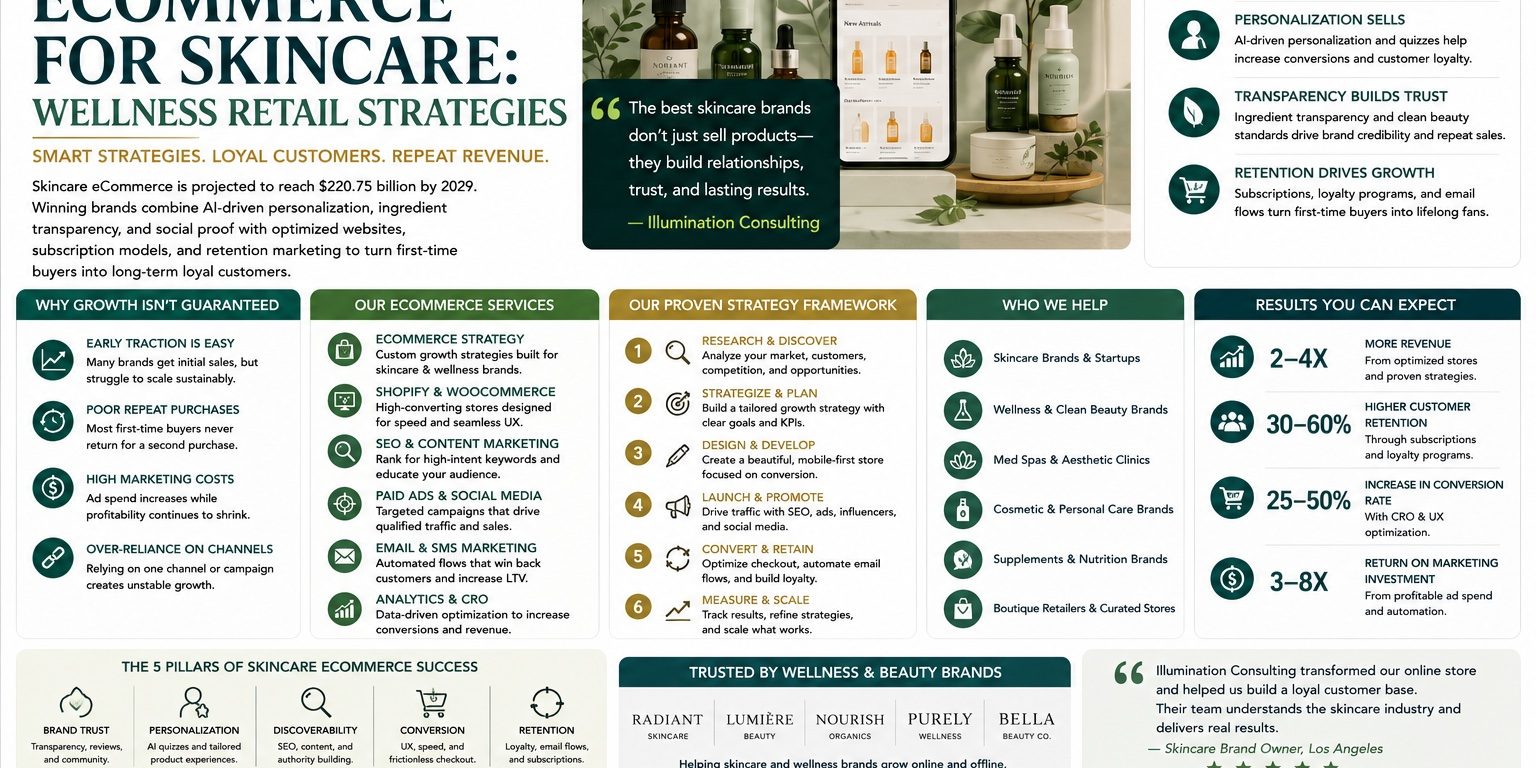
When it comes to ecommerce for skincare, skincare and wellness ecommerce strategies combine AI-driven personalization, ingredient transparency, and social proof to convert browsers into buyers. Skincare is projected to reach $220.75 billion by 2029. Winning brands pair Shopify or WooCommerce optimization with retention marketing, subscription models, and omnichannel retail integration, turning first-time purchases into long-term customer loyalty and repeat revenue.
Essential Market Insights for Skincare E-commerce
- Skincare ecommerce market reaches $220.75 billion by 2029, driven by ingredient transparency and personalization strategies.
- Health and beauty sales generate $646 billion in revenue in 2024 across all online channels.
- AI-driven personalization solutions capture consumer attention and drive sales in competitive skincare retail landscapes.
- Social proof and ingredient transparency differentiate skincare brands in the most competitive ecommerce category.
Why Is Skincare Ecommerce Growth Not Guaranteed?
Growth stalls for one core reason: most skincare brands never build the systems required to sustain it. Sales momentum feels strong at launch. Consumer expectations, technology, and competition shift the marketplace faster than many teams can adapt. That volatility punishes brands that rely on a single hot product or one viral moment instead of durable infrastructure.
The category itself is not the problem. Skincare is projected to reach $220.75 billion by 2029, and demand shows no sign of slowing. Opportunity exists in abundance. What separates the brands that capture it from those left behind is operational discipline, not market size.
Why Do Skincare Startups Stall After Early Success?
Initial sales often come easily through founder networks, influencer buzz, or a well-timed launch. Scaling past that phase is a different challenge entirely. Many skincare brands generate strong early traction, then plateau because repeat purchases and predictable customer acquisition never materialize.
Is Product Quality the Real Barrier to Scaling?
Rarely. Formulation and packaging typically are not what block growth. The actual gap is structural: businesses often lack the systems needed to consistently attract new customers, convert website visitors, and drive repeat purchases.
Brands feeling this gap tend to show the same patterns:
- Traffic arrives but conversion rates stay apartment
- First-time buyers rarely return for a second purchase
- Marketing spend increases while profitability shrinks
- Growth depends on one channel or one campaign
Closing that gap requires retail brand consulting built around measurable systems, not one-off tactics. Sustainable scale comes from strategy, not luck.
What Should A Skincare Ecommerce Strategy Include?
A complete strategy for ecommerce for skincare blends technology, storytelling, and operational precision. High-performing online stores pair strong design with modern technology, search optimization, automation, analytics, and marketing working as one system rather than separate projects. Skincare brands that treat these elements independently lose momentum; the ones that integrate them build compounding growth.
Foundational technical work matters most. Product catalog structure, individual product page performance, and checkout flow determine whether traffic converts into revenue. Weak catalog organization buries bestsellers. Slow checkout pages abandon carts before payment completes.
What technical elements drive skincare ecommerce performance?
Catalog design, page speed, and a frictionless checkout form the technical backbone of any skincare storefront. Brands should treat these as ongoing optimization projects, not one-time builds.
- Product catalog design that groups items by skin concern, ingredient, or routine step
- Individual product page optimization highlighting formulation details and usage results
- Checkout flow refinement that removes unnecessary steps between cart and confirmation
Why does ingredient transparency matter for skincare buyers?
Skincare shoppers respond to ingredient transparency, social proof, and personalization more strongly than promotional claims. A bottle labeled “clinically proven” convinces fewer buyers than a page explaining exact formulation, cited results, and verified reviews. Personalization tools that recommend products based on skin type or concern extend that trust further, turning first-time visitors into repeat customers.
Category-specific retail brand consulting closes the gap between generic ecommerce advice and what skincare buyers actually expect. Effective guidance covers platform optimization, go-to-market planning, and positioning built specifically for skincare’s crowded, ingredient-driven market. Brands that combine technical infrastructure with category expertise outperform competitors relying on either alone.
How Does Retail Brand Consulting Fix Scaling Gaps?
Scaling gaps emerge when marketing, technology, and operations run as separate efforts instead of one system. Retail brand consulting closes those gaps by connecting the pieces that most skincare founders manage in silos. Illumination Consulting works with retailers, manufacturers, distributors, and wholesalers to strengthen profitability and improve operational efficiency across the full supply chain, not just the storefront.
Growth stalls happen for a predictable reason: teams patch individual problems. A slow website, a weak email sequence, a fulfillment bottleneck — without addressing how those problems interact. Consulting engagements avoid that trap by combining consulting, marketing, technology, and analytics into one coordinated strategy rather than a series of disconnected fixes.
What does a retail consulting engagement actually look like?
Every engagement starts before any tactic gets recommended. Illumination Consulting begins by understanding a brand’s objectives, industry position, competitors, and target audience. That groundwork shapes decisions on pricing, distribution, and channel mix, so recommendations fit the business instead of a generic playbook.
Why does coordination matter more than individual tactics?
A single high-performing tactic rarely fixes a scaling gap on its own. Brands need consistency across:
- Inventory and fulfillment systems that support order volume
- Marketing channels that reinforce, rather than compete with, each other
- Analytics that connect sales data back to strategy decisions
- Pricing and distribution plans built around actual demand
Illumination Consulting is based in Beverly Hills, California, and applies this integrated model to skincare and wellness brands working to convert early traction into durable, repeatable growth.
What Makes Omnichannel Retail Strategies Succeed?
Successful omnichannel retail strategies connect every sales channel into one coordinated customer experience rather than treating each as a separate business line. Skincare brands that unify their storefronts, marketplaces, and physical retail locations convert browsers into buyers more consistently than those running disconnected channels. Consistency across touchpoints, not channel volume, drives the results.
Omnichannel planning sits alongside retail expansion and digital transformation as a core pillar of retail strategy work. These three elements function together: expansion without digital infrastructure creates fragmented customer data. Digital transformation without expansion planning limits growth potential. Brands that treat them as one integrated system scale faster than those addressing them separately.
Performance depends on more than channel presence. Ongoing marketing success requires customer behavior analysis, structured performance reporting, and continuous optimization cycles that adjust tactics based on real purchasing patterns. Without that feedback loop, omnichannel investments stall.
Why does omnichannel matter more for skincare brands specifically?
Health and beauty ecommerce sales reached an estimated $646 billion in revenue projections for 2024 alone. That scale means skincare brands competing only through a single channel forfeit a substantial share of reachable customers.
Who benefits most from omnichannel retail consulting?
Specialty retailers, Shopify merchants, WooCommerce businesses, and omnichannel retail organizations represent the clients best positioned to gain from structured retail brand consulting. These businesses typically already operate across multiple platforms but lack the unified strategy connecting them.
Key components of a working omnichannel model include:
- Synchronized inventory and customer data across every channel
- Consistent brand messaging from storefront to marketplace to retail shelf
- Behavior-driven reporting that informs channel-specific adjustments
- Coordinated expansion planning tied to digital infrastructure
How Do You Build Lasting Skincare Ecommerce Growth?
Lasting growth in ecommerce for skincare comes from ecosystems, not isolated campaigns. Brands positioned to thrive build complete business systems that connect product, marketing, technology, and customer experience rather than chasing one tactic at a time. A single viral post or discount code produces a spike; a coordinated system produces a curve that keeps climbing.
That kind of system depends on strategic alignment. Effective retail brand consulting ties business strategy, search engine optimization, website design, artificial intelligence, automation, and branding into a single coordinated growth engine instead of scattered vendor relationships. Each component reinforces the others: a well-branded site converts better, strong SEO fuels the traffic that automation nurtures, and consistent messaging builds the trust repeat customers rely on.
Does AI Replace Marketing Strategy for Skincare Brands?
No. AI and automation exist to support strategic decisions, not substitute for them. Tools can personalize product recommendations and streamline fulfillment, but human strategy still sets direction, tone, and priorities. Brands that treat automation as a shortcut around strategy typically see efficiency gains without real growth.
What Keeps Skincare Growth Strategies on Track?
Measurement keeps strategy honest. Every recommendation within a growth plan should rest on measurable performance, practical execution, and ongoing data review rather than guesswork.
Reliable systems typically include:
- Integrated branding and website design that reinforce credibility
- SEO and content strategy built for organic discovery
- Automation and AI tools aligned to defined business goals
- Continuous performance review across every channel
Omnichannel retail strategies complete the picture, connecting online sales, retail partnerships, and customer data so growth compounds across every touchpoint instead of stalling in one channel.
Building a sustainable skincare and wellness retail e-commerce business requires integrating strategic planning, customer-focused design, and continuous optimization into every operational system. Success emerges from aligning product strategy with authentic brand positioning, strengthening search visibility, and creating seamless customer experiences across digital and physical touchpoints. Organizations that commit to data-driven decision-making, operational excellence, and long-term customer relationships establish competitive advantages that drive profitability and enterprise value. The most successful skincare and wellness retailers view e-commerce not as an isolated sales channel. As a strategic growth system that strengthens overall business performance and customer lifetime value.
FAQ
Why does skincare ecommerce growth stall for established brands?
Growth stalls because most brands never build systems to sustain it. Consumer expectations, technology, and competition shift the marketplace faster than teams relying on one hot product or viral moment can adapt.
Is product quality the main barrier to scaling a skincare brand?
Rarely. The actual gap is structural: brands lack systems to consistently attract new customers, convert website visitors, and drive repeat purchases, not formulation or packaging problems.
What does a complete skincare ecommerce strategy include?
A complete strategy blends technology, storytelling, and operational precision, integrating design, search optimization, automation, analytics, and marketing as one system rather than separate projects.
Facts
- Illumination Consulting is located in Beverly Hills, CA, USA.