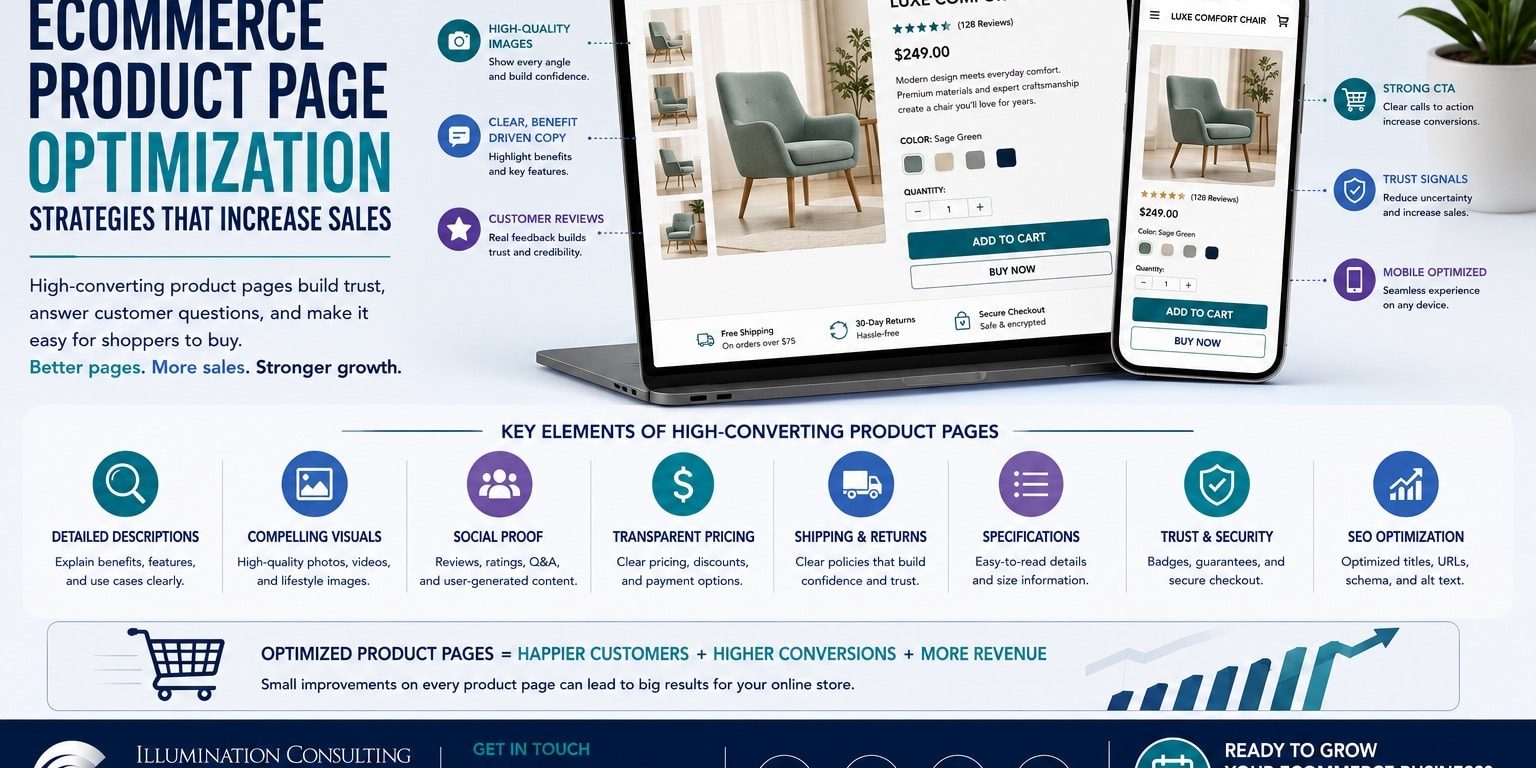
Effective ecommerce product page optimization strategies help online retailers convert more visitors into customers by creating engaging, informative, and trustworthy shopping experiences. While attracting website traffic is essential, product pages ultimately determine whether shoppers add products to their cart or leave without making a purchase.
Today’s consumers expect far more than basic product descriptions and a few images. Before buying, they compare features, read reviews, evaluate pricing, examine product photography, review shipping information, and seek reassurance that they are making the right decision. Every element on a product page influences confidence and purchasing behavior.
High-performing product pages combine persuasive content, intuitive design, search engine optimization, fast performance, and clear calls to action. Together, these elements reduce uncertainty, improve user experience, and increase conversion rates while supporting long-term ecommerce growth.
In this guide, we’ll explore proven ecommerce product page optimization strategies that help retail brands increase conversions, improve search visibility, strengthen customer trust, and generate more online sales.
Why Product Pages Matter
Product pages are often the final step before a customer decides whether to purchase.
Every visitor arriving from search engines, paid advertising, email campaigns, or social media eventually evaluates the product page before making a buying decision.
Well-optimized product pages help retailers:
- Increase conversion rates
- Improve customer confidence
- Reduce shopping cart abandonment
- Increase average order value
- Improve product discoverability
- Strengthen SEO performance
- Lower product returns
- Improve customer satisfaction
- Increase repeat purchases
- Generate higher online revenue
Small improvements across multiple product pages can produce significant increases in total ecommerce revenue.
Understand Customer Intent
Every shopper arrives with specific questions that must be answered before they feel comfortable purchasing.
Successful product pages anticipate these questions and provide clear, helpful answers.
Customers commonly want to know:
- What problem does this product solve?
- Why is it better than alternatives?
- Is it the right size?
- What materials are used?
- How do I use it?
- How quickly will it ship?
- Can I return it?
- What do other customers think?
Removing uncertainty builds confidence and encourages faster purchasing decisions.
Write Benefit-Focused Product Descriptions
Many retailers focus only on product specifications.
While technical information is important, customers are more interested in understanding how the product improves their lives.
Effective product descriptions should explain:
- Key benefits
- Primary features
- Customer outcomes
- Use cases
- Product advantages
- Quality standards
- Care instructions
- Unique selling points
Clear, benefit-focused copy creates stronger emotional connections while helping shoppers understand the value of the product.
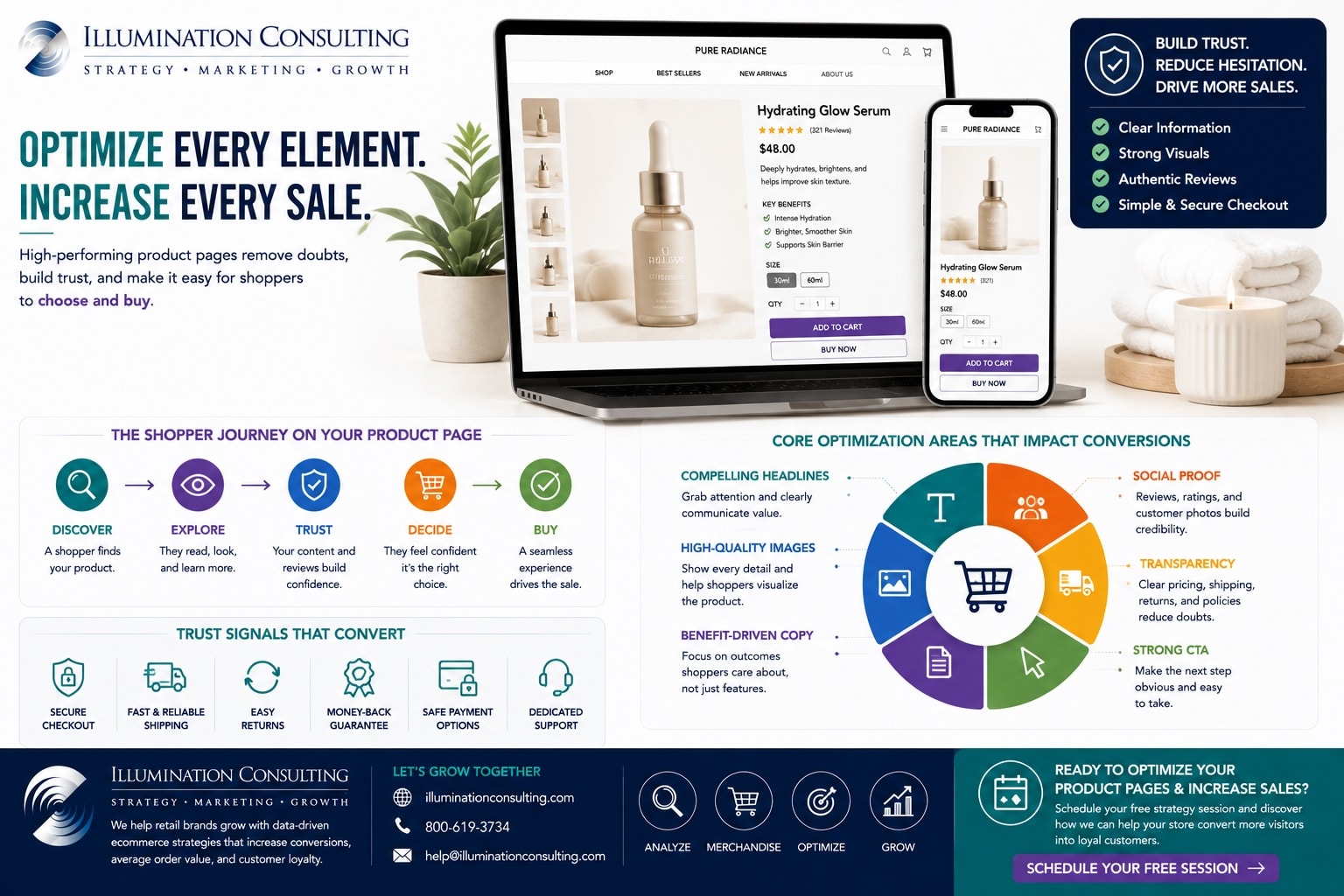
Use High-Quality Product Photography
Visual presentation has a direct impact on ecommerce conversions.
Professional photography helps shoppers evaluate products while reducing uncertainty.
Include:
- Multiple product angles
- Close-up details
- Lifestyle photography
- Scale references
- Packaging images
- Product variations
- Zoom functionality
- Short product videos
High-quality visuals improve engagement while reducing the likelihood of returns caused by unmet expectations.
Showcase Products in Real-Life Settings
Lifestyle photography allows customers to imagine using the product.
Rather than relying solely on isolated product images, demonstrate products in authentic environments that reflect how customers actually use them.
Examples include:
- Home décor in furnished rooms
- Clothing worn by diverse models
- Beauty products in skincare routines
- Kitchen products during meal preparation
- Outdoor equipment in real environments
Contextual photography increases perceived value while helping shoppers visualize ownership.
Optimize Product Titles
Product titles serve two important purposes: they help customers immediately understand what they are viewing while also supporting search engine optimization.
Well-written titles should be:
- Clear
- Descriptive
- Easy to scan
- Keyword relevant
- Brand consistent
- Free of unnecessary wording
Avoid generic product names that fail to communicate value or distinguish the product from similar alternatives.
Improve Product Images for SEO
Image optimization supports both website performance and organic search visibility.
Every product image should include:
- Descriptive filenames
- Keyword-focused alt text
- Optimized file sizes
- Modern image formats
- Responsive image scaling
- Fast loading speeds
Optimized images improve page performance while increasing opportunities to appear in image search results.
Build Trust with Customer Reviews
Authentic customer reviews remain one of the strongest conversion factors on ecommerce product pages.
Reviews provide reassurance by demonstrating that real customers have purchased and enjoyed the product.
Encourage reviews by:
- Requesting feedback after delivery
- Simplifying the review process
- Displaying verified purchases
- Allowing customer photos
- Responding to reviews professionally
- Highlighting common product benefits
Positive reviews improve credibility while helping shoppers make confident purchasing decisions.
Display Trust Signals
Trust signals reduce purchase hesitation by reinforcing your company’s credibility.
Effective trust signals include:
- Secure checkout badges
- Money-back guarantees
- Free shipping offers
- Easy return policies
- Satisfaction guarantees
- Industry certifications
- Award recognition
- Secure payment options
These elements reassure shoppers throughout the purchasing process.
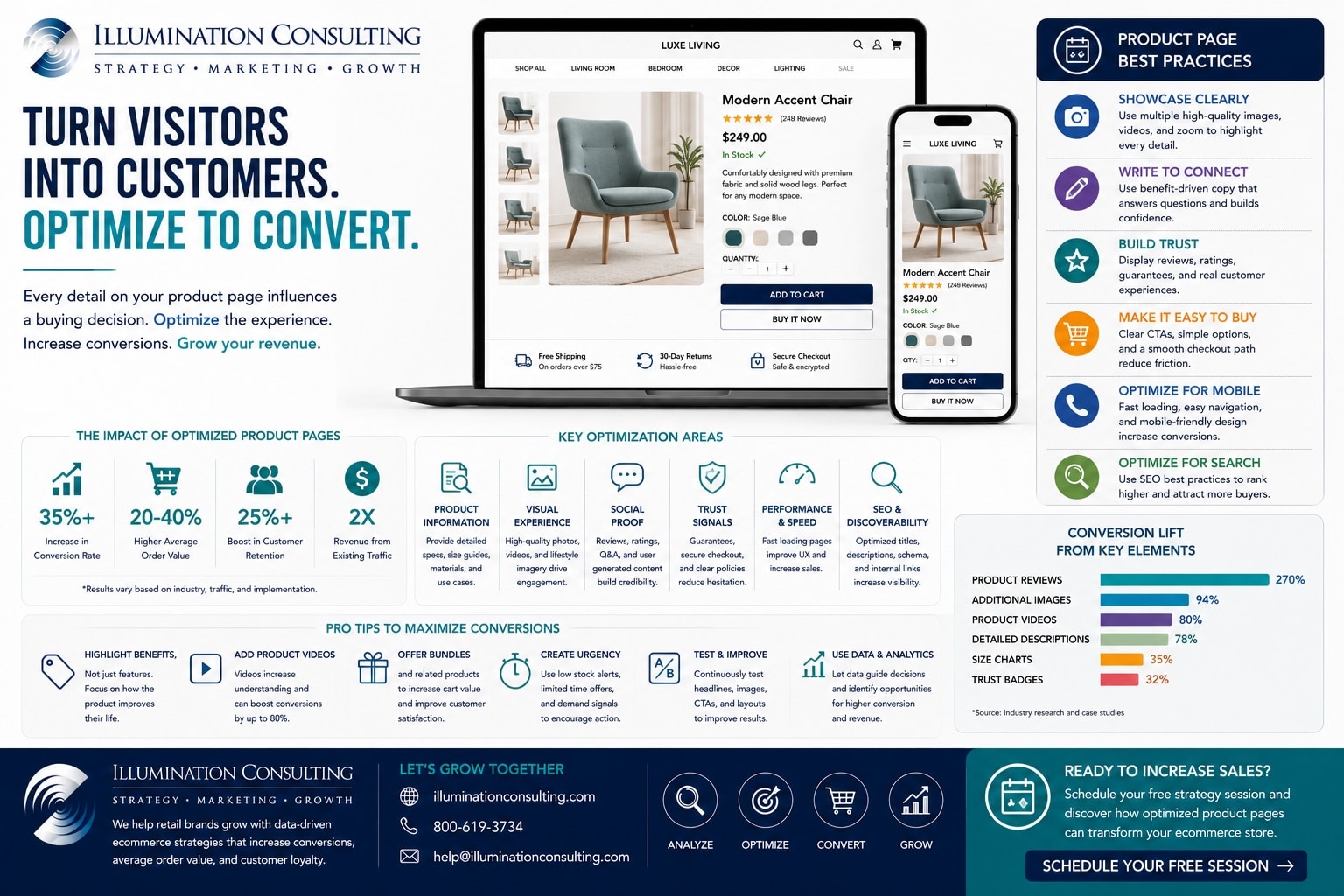
Write Strong Calls to Action
Every product page should clearly communicate the next step.
Calls to action should be highly visible and action-oriented.
Examples include:
- Add to Cart
- Buy Now
- Choose Your Size
- Customize Your Order
- Subscribe & Save
- Check Availability
Avoid clutter around the primary action button that may distract shoppers from completing the purchase.
Improve Mobile Product Pages
Most ecommerce traffic now comes from mobile devices, making mobile optimization essential.
Mobile product pages should provide:
- Fast loading
- Large product images
- Thumb-friendly navigation
- Sticky purchase buttons
- Simple product selection
- Easy scrolling
- Mobile payment options
- Minimal form fields
A smooth mobile experience increases both customer satisfaction and conversion rates.
Optimize Product Pages for Search Engines
Strong ecommerce product page optimization strategies improve both conversions and organic visibility.
Every product page should include:
- Unique title tags
- Optimized meta descriptions
- Structured headings
- Internal links
- Schema markup
- Optimized URLs
- Relevant keyword usage
- Fast page performance
SEO and conversion optimization should work together to generate qualified traffic that converts into sales.
Use Internal Linking Strategically
Internal links help both customers and search engines navigate your website.
Link product pages to:
- Related products
- Product collections
- Buying guides
- Educational blog articles
- Frequently asked questions
- Accessories
- Product comparisons
Strong internal linking improves user engagement while distributing authority across your ecommerce website.
Reduce Purchase Anxiety
Every purchase involves some degree of uncertainty.
Successful product pages proactively remove common concerns before they become objections.
Address questions about:
- Shipping times
- Return policies
- Product sizing
- Materials
- Care instructions
- Product compatibility
- Warranty coverage
- Customer support
Reducing uncertainty helps shoppers complete purchases with greater confidence.
Common Product Page Optimization Mistakes
Many ecommerce businesses invest significant resources in attracting visitors but overlook weaknesses on their product pages that prevent customers from completing purchases. Avoiding these common mistakes can substantially improve conversion rates and overall ecommerce performance.
Using Manufacturer Descriptions
Many online retailers simply copy product descriptions supplied by manufacturers.
This creates duplicate content that provides little value for either customers or search engines.
Instead, create original descriptions that:
- Explain product benefits
- Highlight unique features
- Address customer questions
- Match your brand voice
- Improve search engine optimization
- Differentiate your products
Original content helps build authority while improving organic rankings.
Hiding Important Information
Customers should never have to search for essential purchase information.
Clearly display:
- Pricing
- Product availability
- Shipping costs
- Delivery estimates
- Return policies
- Warranty information
- Product dimensions
- Materials
Making this information easy to find builds confidence and reduces hesitation.
Overlooking Page Speed
Slow product pages increase bounce rates and reduce conversions.
Optimize performance by:
- Compressing images
- Using modern image formats
- Reducing unnecessary scripts
- Enabling browser caching
- Optimizing code
- Choosing reliable hosting
- Improving Core Web Vitals
- Limiting third-party plugins
Fast-loading pages create a better shopping experience while supporting stronger search engine rankings.
Personalize the Shopping Experience
Personalization helps customers discover products that match their interests while increasing engagement and average order value.
Effective personalization includes:
- Recently viewed products
- Recommended products
- Related accessories
- Frequently purchased together
- Personalized promotions
- Wishlist reminders
- Product recommendations based on browsing history
- Loyalty rewards
Relevant recommendations improve the shopping experience while encouraging additional purchases.
Use Artificial Intelligence to Improve Product Pages
Artificial intelligence is helping retailers optimize product pages more efficiently than ever before.
AI can support:
- Product description creation
- SEO optimization
- Image tagging
- Customer segmentation
- Personalized recommendations
- Search optimization
- Product categorization
- Performance analysis
- A/B testing recommendations
- Inventory forecasting
When combined with experienced ecommerce strategy, AI helps retailers improve efficiency while maintaining high-quality customer experiences.
Continuously Test Product Pages
Successful ecommerce product page optimization strategies rely on ongoing testing rather than assumptions.
Retailers should regularly evaluate:
- Headlines
- Product descriptions
- Images
- Call-to-action buttons
- Product videos
- Pricing displays
- Page layouts
- Trust signals
Even small improvements across hundreds of product pages can generate significant long-term revenue growth.
Frequently Asked Questions
What are ecommerce product page optimization strategies?
Ecommerce product page optimization strategies are methods used to improve product pages so they rank better in search engines, build customer confidence, and convert more visitors into paying customers.
Why are product pages important?
Product pages often determine whether a visitor completes a purchase. Well-designed pages answer customer questions, reduce uncertainty, improve user experience, and increase conversion rates.
How can product pages improve SEO?
Product pages support SEO by using optimized titles, unique descriptions, structured data, descriptive image alt text, internal linking, fast loading speeds, and keyword-focused content that aligns with customer search intent.
What should every product page include?
Every product page should include professional images, benefit-focused descriptions, product specifications, customer reviews, trust signals, shipping information, return policies, clear pricing, and a strong call to action.
How often should product pages be updated?
Product pages should be reviewed regularly to improve content, refresh imagery, optimize SEO, update customer reviews, test new layouts, and respond to changing customer expectations and market trends.
Optimize Your Ecommerce Store with Illumination Consulting
Successful ecommerce product page optimization strategies combine persuasive content, professional design, technical SEO, user experience, customer psychology, and continuous testing to create product pages that consistently convert visitors into customers. Retailers that invest in optimizing every product page improve customer confidence, increase conversion rates, strengthen organic visibility, and generate sustainable long-term ecommerce growth.
At Illumination Consulting, we help retail brands accelerate online growth through ecommerce website design, conversion optimization, search engine optimization, content marketing, AI-powered business solutions, digital marketing, and strategic consulting. Our customized ecommerce strategies are designed to improve product performance, increase online sales, strengthen customer loyalty, and maximize return on investment.
Whether you’re launching a new online store or improving an established ecommerce business, our team can help you implement ecommerce product page optimization strategies that create exceptional shopping experiences and drive measurable business results.