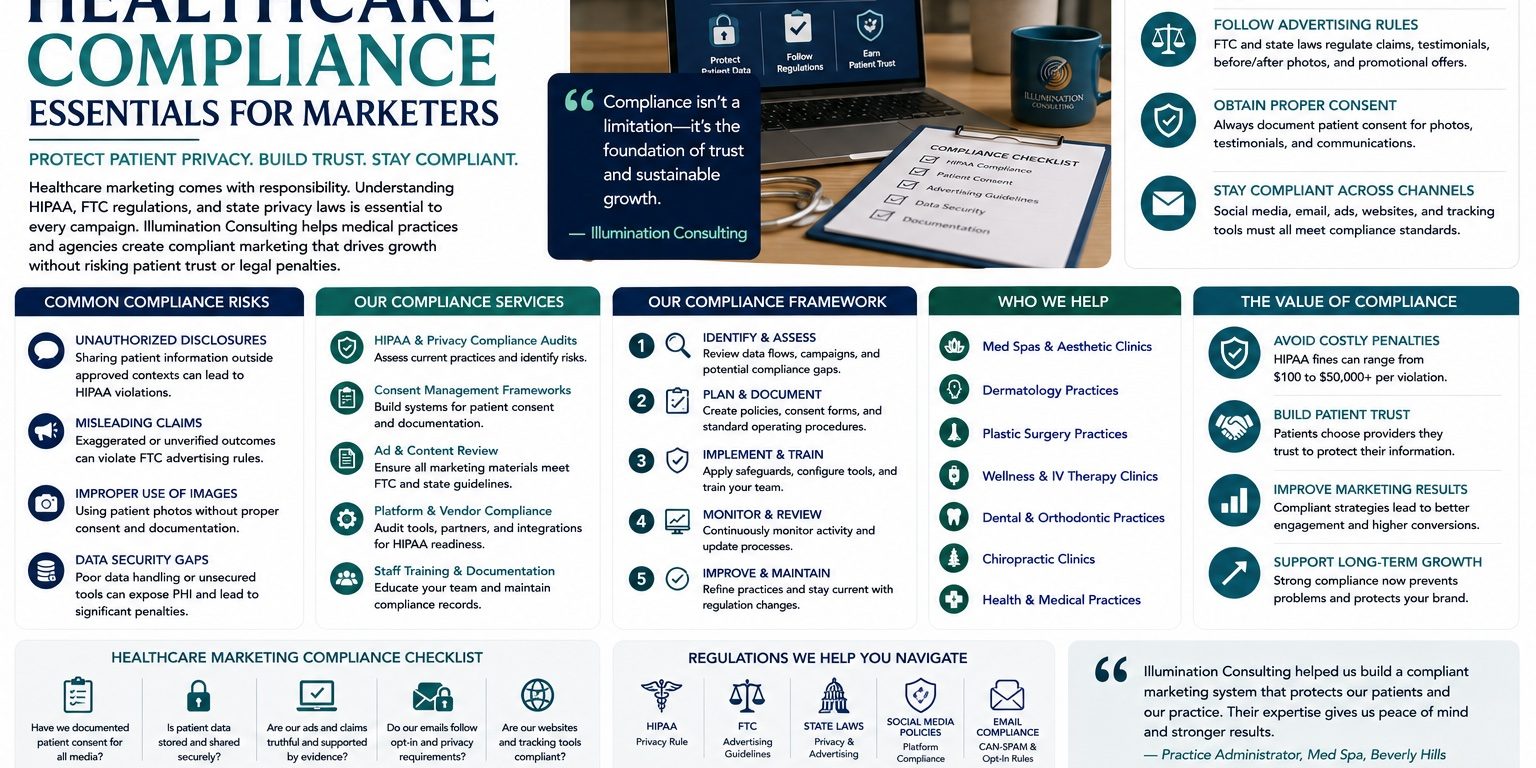
When it comes to healthcare compliance, healthcare marketing compliance requires adherence to HIPAA, FTC advertising rules, and state privacy laws across every campaign channel, from social platforms like Instagram and TikTok to email and paid ads. Medical practice administrators and agency teams must document patient consent, avoid unverified outcome claims, and safeguard patient privacy in all promotional content Illumination Consulting develops.
Key Takeaways
- HIPAA violations occur when healthcare professionals discuss patient diagnoses outside authorized work contexts.
- Healthcare marketers navigate four distinct compliance challenges through specialized certificate course training programs.
- Privacy regulations create unique marketing obstacles that differ fundamentally from standard commercial marketing practices.
- Illumination Consulting, based in Beverly Hills, CA, specializes in healthcare marketing compliance guidance.
What Is Healthcare Marketing Compliance, Really?
Marketing compliance in healthcare means aligning every campaign, ad, and patient touchpoint with federal privacy law, state regulations, and platform-specific rules. Loose talk about “HIPAA violations” fills break rooms and boardrooms alike, but much of it misses the mark entirely. A nurse mentioning a diagnosis to a friend, a technician gossiping about a recognizable patient, a physician sharing a case at a dinner party. These scenarios sound like violations, yet they often have little to do with the actual statute governing marketing activity.
That widespread mislabeling signals something more concerning than sloppy vocabulary. It points to a real gap in understanding what healthcare compliance actually covers, which organizations it applies to, and where genuine exposure begins. Marketing directors who confuse office gossip with regulatory risk often overlook the areas where true liability lives: ad platforms, tracking pixels, email segmentation, and patient list handling.
Why does this confusion matter for marketing teams?
Confusion breeds complacency. Teams that dismiss compliance as an overblown HR concern tend to underinvest in the safeguards that actually matter. Consent tracking, vendor agreements, and platform audits.
For providers, compliance officers, and IT professionals building promotional campaigns, the stakes are far from casual. Marketing decisions touch patient privacy directly, from the audience lists uploaded to ad platforms to the analytics scripts embedded on appointment pages. Getting the fundamentals right requires:
- Understanding which data qualifies as protected
- Knowing which marketing rules govern consent and disclosure
- Auditing every vendor and platform touching patient data
Casual assumptions about what counts as a violation leave real gaps unaddressed.
HIPAA Privacy and Security Rules in Digital Ads
The HIPAA Privacy and Security Rules set strict standards for the use and disclosure of protected health information (PHI) in digital marketing efforts. When healthcare marketers create targeted ads using data about patients, they must ensure that:
- Any PHI used for advertising has patient authorization aligned with HIPAA guidelines.
- Digital platforms handling PHI comply with security requirements to protect data from unauthorized access or breaches.
- Marketing campaigns avoid sharing identifiable patient information without explicit consent.
Violating these rules in digital ads can lead to significant legal penalties and damage to patient privacy trust.
FTC Guidelines on Medical Testimonials
The Federal Trade Commission (FTC) enforces guidelines ensuring medical testimonials and endorsements in healthcare advertising are truthful, substantiated, and not misleading. Compliance with these marketing rules includes:
- Verifying that testimonials represent typical patient experiences.
- Disclosing any material connections between endorsers and the medical practice.
- Avoiding unverified claims of treatment outcomes or benefits.
Marketers must carefully curate testimonial content to uphold regulatory standards and maintain patient privacy.
Business Associate Agreements (BAAs)
Business Associate Agreements (BAAs) are legally binding contracts required under HIPAA that define how vendors and third parties handling PHI must protect patient data. In marketing contexts, BAAs are critical when:
- Using external agencies that access patient lists or healthcare data for campaign targeting.
- Employing software platforms that process or transmit electronic PHI.
- Sharing data with analytics or advertising vendors involved in campaign delivery.
Ensuring BAAs are in place helps healthcare organizations maintain healthcare compliance and safeguard patient privacy.
Pixel Tracking Compliance
Tracking pixels embedded in healthcare websites or digital ads provide behavioral data used to optimize marketing efforts. However, compliance with HIPAA and privacy laws requires that:
- Pixels do not collect or transmit PHI without proper patient consent.
- Information collected is anonymized or aggregated when possible.
- Healthcare providers conduct periodic audits of pixel usage to prevent inadvertent data exposure.
Proper pixel tracking protocols align campaigns with marketing rules and protect patient privacy.
Compliant Patient Review Management
Managing patient reviews ethically is vital to both healthcare compliance and marketing success. Practices should:
- Obtain explicit authorization before posting patient testimonials publicly.
- Respect patient confidentiality by avoiding sensitive details in reviews.
- Respond to reviews in a manner that adheres to HIPAA and FTC guidelines.
- Use review platforms that comply with healthcare data privacy standards.
Transparent and compliant review management strengthens trust while adhering to marketing rules.
What Do the HIPAA Marketing Rules Require?
Direct patient-facing communications must serve a permitted purpose under federal law. Any use of protected health information for promotional purposes requires proper authorization from the patient. This is the core structure of healthcare compliance as it applies to marketing: purpose and permission govern every outbound message, whether it arrives by email, text, or targeted ad.
Practice administrators and agency teams often assume these marketing rules are static. They are not. Additional HIPAA provisions can apply depending on the specific tactics used and the technology platforms that create, receive, maintain, or transmit electronic patient data. A campaign built on a compliant email platform can still trigger scrutiny if the underlying data flow changes.
Why do the rules keep expanding?
Healthcare marketing regulation has shifted substantially since HIPAA became law in 1996. Since the first Privacy Rule appeared in 2000. New platforms, new ad technologies, and new data-sharing arrangements have each added layers of obligation. What counted as compliant a decade ago may no longer satisfy current expectations around patient privacy.
For marketing directors managing multi-channel campaigns, the practical requirement breaks down into three checkpoints:
- Purpose test — confirm the communication qualifies as a permitted marketing purpose before it goes out.
- Authorization check — verify that any PHI used was disclosed with proper patient consent.
- Platform review — evaluate whether the technology handling patient data introduces additional HIPAA obligations.
Skipping any one of these checkpoints exposes a practice to regulatory risk, regardless of how polished the creative work looks.
Why Does Patient Privacy Shape Campaign Trust?
Trust starts before a single word of ad copy gets written. A medical spa’s public-facing presence functions as an extension of its brand, shaping perception long before a prospective patient books a consultation. In visually driven fields like aesthetics, that first impression carries real weight. And mishandled patient privacy can destroy it instantly.
Prospective patients research providers extensively before making contact. They browse Instagram, Facebook, TikTok, YouTube, and LinkedIn to evaluate credentials, review treatment results, and judge whether a practice matches their expectations. Every image, testimonial, and comment thread either reinforces confidence or raises doubt about how carefully a practice handles sensitive information.
Does a practice’s online presence really count as a first impression?
Yes. In many cases, a practice’s social channels create that first impression well before a patient visits the website or picks up the phone. If patient privacy feels casually treated in that early digital interaction, trust erodes before intake forms are even mentioned.
What connects compliance to marketing performance?
Healthcare marketers juggle two demands that often pull in opposite directions: aggressive campaign goals and strict privacy regulation. Balancing healthcare compliance against active promotion requires marketing teams fluent in both disciplines, not just creative output.
Strong campaigns treat marketing rules as a design constraint, not an afterthought. Practices that integrate compliance into strategy typically see stronger results across several fronts:
- Reputation management that protects credibility while showcasing outcomes
- Patient acquisition strategies built on transparent, permission-based data use
- SEO and website design aligned with long-term brand positioning
- Consistent messaging that avoids exposing identifiable patient information
These elements work together, not in isolation. A practice that treats privacy as a strategic asset — rather than a legal afterthought. Builds the kind of trust that converts browsers into booked consultations.
Which Marketing Skills Actually Transfer to Healthcare?
Core marketing competencies carry directly into medical practice campaigns. Audience research, brand positioning, content strategy, and conversion optimization function the same way in a med spa or dermatology practice as they do in retail or consumer brands. What changes is the regulatory layer wrapped around execution. A distinction every practice administrator and agency team needs to internalize before launching a campaign.
Coordinated strategy matters more in healthcare, not less. Advertising alone rarely moves the needle. Results depend on combining search engine optimization, content marketing, social media, paid media, and retention campaigns into a single system rather than disconnected tactics. That principle holds true across regulated and competitive industries alike. Healthcare marketing directors who treat channels as isolated projects typically see weaker patient acquisition outcomes than those running integrated strategies.
Do Traditional Marketing Skills Really Work in Healthcare?
Yes — audience segmentation, brand storytelling, and campaign measurement remain fully transferable. The skill set doesn’t get rebuilt for healthcare; it gets filtered through healthcare compliance requirements and stricter marketing rules governing patient communications.
Skills that translate cleanly include:
- Target audience identification and segmentation
- Brand positioning and messaging development
- Content marketing and educational campaigns
- Website design and conversion optimization
- Paid advertising and retargeting strategy
- Retention and loyalty campaign design
What Actually Changes When Marketing Healthcare Services?
Patient privacy protections reshape how data gets collected, stored, and used in campaigns. Growth systems built for medical aesthetics practices layer consulting, marketing, branding, and website development on top of these constraints to strengthen visibility while protecting patient information. Practice growth strategy, done correctly, tightens daily operations, improves patient retention, and scales revenue — proving that compliant marketing and aggressive growth aren’t mutually exclusive.
How Should Healthcare Teams Build Compliant Campaigns?
Compliant campaigns start with education, transparency, and authentic engagement rather than one-way advertising. Patient relationships built through digital channels grow stronger when practices explain treatments honestly instead of pushing hard sales messages. This distinction matters for healthcare compliance, since promotional claims carry more scrutiny than typical retail advertising.
Marketing directors and practice administrators need a repeatable process, not a one-time checklist. A coordinated strategy works best when it combines several elements into a single system:
- Brand positioning that reflects accurate, provider-approved messaging
- Search engine optimization built on verifiable claims
- Content marketing and social media that educate rather than oversell
- Paid advertising with clear disclosures
- Conversion optimization and email marketing that respect patient privacy
- Retention initiatives that reinforce trust over time
Publishing consistent, valuable content does double duty. It demonstrates clinical expertise while reinforcing a provider’s reputation as a trustworthy source, not just a seller of services. Teams that answer common patient questions, showcase real outcomes, and introduce their staff build credibility gradually.
What role do marketing rules play in campaign approval workflows?
Marketing rules determine what claims can run, how patient stories get used, and which disclosures accompany paid promotions. Agencies and internal teams need sign-off processes that catch privacy risks before content publishes, not after.
Illumination Consulting, headquartered in Beverly Hills, CA, works directly with healthcare and aesthetics organizations to build these coordinated growth systems. The firm structures campaigns around measurable outcomes without sacrificing the trust patients expect from medical providers.
Healthcare compliance represents a foundational responsibility that protects patient privacy, builds organizational credibility, and strengthens long-term practice growth. By implementing robust compliance systems, maintaining transparent communication, and prioritizing regulatory adherence across all marketing channels, healthcare organizations establish trust with patients while reducing legal and reputational risk. Compliance-driven marketing strategies create sustainable competitive advantages that support measurable patient acquisition and enduring business success.
FAQ
Is every mention of a patient diagnosis a HIPAA violation?
No. Casual scenarios like a nurse mentioning a diagnosis to a friend often have little to do with the actual statute governing marketing activity, despite common assumptions.
What triggers real compliance risk in marketing campaigns?
True liability lives in ad platforms, tracking pixels, email segmentation, and patient list handling — not office gossip. Every campaign must align with federal privacy law, state regulations, and platform-specific rules.
When does HIPAA authorization apply to marketing communications?
Any use of protected health information for promotional purposes requires proper authorization from the patient. Purpose and permission govern every outbound message across email, text, or targeted ads.
Facts
- Illumination Consulting is located in Beverly Hills, CA, USA.