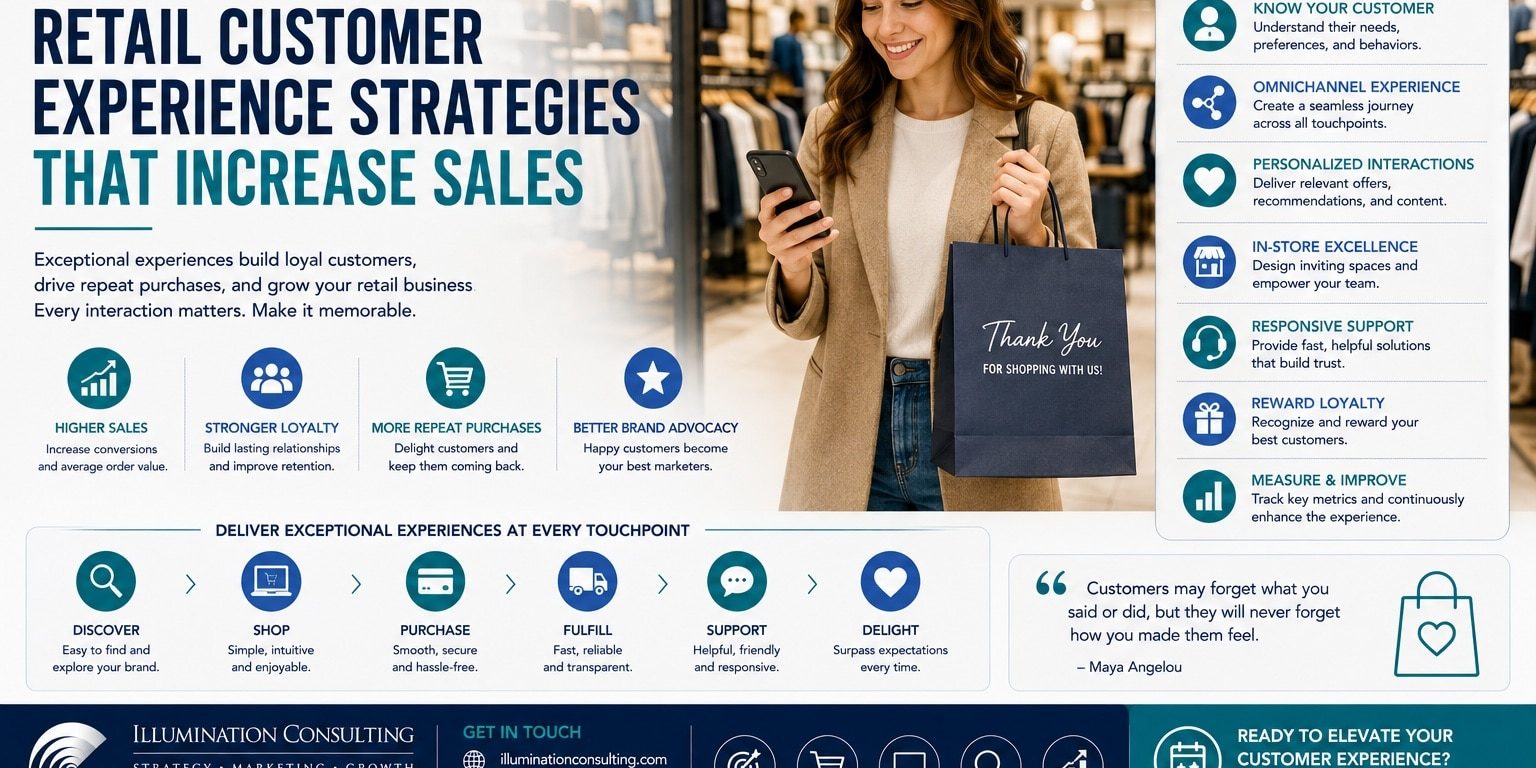
Effective retail customer experience strategies help brands turn ordinary transactions into stronger customer relationships that increase sales, loyalty, and long-term business value. In a highly competitive retail environment, customers evaluate much more than products and pricing. They also judge convenience, service, website usability, store environments, communication, delivery, returns, and how consistently the brand treats them across every interaction.
Consumers increasingly move between physical stores, ecommerce websites, mobile devices, social media, email, and customer service before completing a purchase. When those experiences feel disconnected, confusing, or inconsistent, retailers create unnecessary friction. When every touchpoint works together, customers gain confidence and are more likely to purchase, return, and recommend the brand.
Customer experience therefore cannot be treated as a single department or isolated retail marketing initiative. It involves merchandising, technology, employees, operations, branding, ecommerce, fulfillment, and customer support working together around the needs of the shopper.
In this guide, we’ll explore proven retail customer experience strategies that help retailers improve satisfaction, strengthen loyalty, increase conversions, and create more profitable long-term customer relationships.
Why Retail Customer Experience Matters
Customers have more purchasing options than ever before.
If an experience feels difficult, slow, impersonal, or unreliable, competitors are usually only a search or click away. Retailers that reduce friction and consistently deliver value create meaningful competitive advantages that are difficult to replicate through discounts alone.
Strong customer experiences can help retailers:
- Increase conversion rates
- Strengthen customer loyalty
- Improve repeat purchase rates
- Increase average order value
- Generate more referrals
- Reduce customer churn
- Improve online reviews
- Strengthen brand perception
- Increase customer lifetime value
- Support sustainable revenue growth
The objective is not simply to make customers happy. A strong experience should make purchasing easier while increasing trust in the brand.
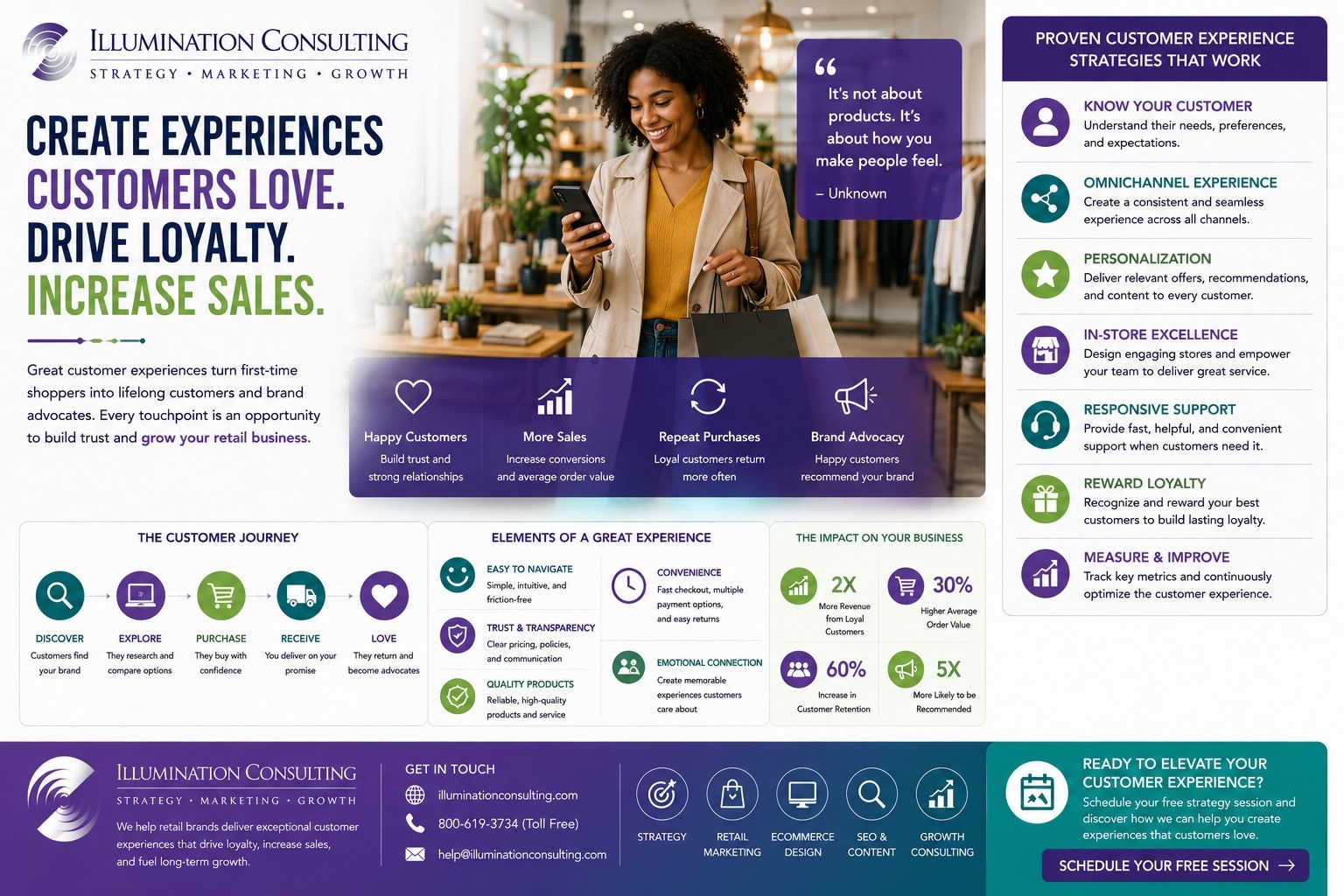
Understand the Complete Customer Journey
Retail experiences begin long before shoppers arrive at checkout.
A customer may first discover a brand through Google, Instagram, an advertisement, a marketplace, a referral, or a physical store. From there, they may research products online, visit a location, compare reviews, subscribe to email, contact customer service, and return several times before purchasing.
Successful retailers map these interactions to understand where customers encounter friction.
Typical stages include:
- Awareness
- Discovery
- Research
- Product comparison
- Purchase
- Fulfillment
- Product use
- Customer support
- Repeat purchase
- Advocacy
Each stage should strengthen confidence rather than create another obstacle.
Identify Customer Friction
Friction is anything that makes purchasing or interacting with your brand unnecessarily difficult.
Common examples include confusing navigation, poor inventory information, slow checkout, inconsistent pricing, unavailable customer support, long delivery times, and complicated returns.
Retailers should regularly evaluate where customers struggle through:
- Website analytics
- Customer feedback
- Support inquiries
- Product reviews
- Shopping cart abandonment
- Store observations
- Return reasons
- User testing
Removing friction often generates faster improvements than adding new marketing campaigns.
Create a Consistent Omnichannel Experience
One of the most important retail customer experience strategies is ensuring customers receive a consistent experience regardless of where they interact with the brand.
A shopper may browse on a smartphone, purchase from a laptop, pick up the product in a store, and contact customer service through email. Each interaction should feel like part of the same relationship.
Consistency should extend across:
- Branding
- Pricing
- Promotions
- Product information
- Inventory availability
- Customer accounts
- Loyalty programs
- Customer service
- Returns
- Communication
Customers should never feel as though they are dealing with completely different companies when moving from one channel to another.
Connect Physical and Digital Retail
Physical and digital retail should complement each other rather than compete.
Effective omnichannel capabilities may include:
- Buy online, pick up in store
- Reserve online
- Ship from store
- In-store returns for online purchases
- Real-time inventory visibility
- Digital receipts
- Mobile loyalty programs
- Online access to store purchases
Connecting these experiences gives customers greater flexibility while increasing opportunities for additional purchases.
Make Convenience a Competitive Advantage
Convenience has become a core component of retail value.
Retailers should continuously evaluate how much effort customers must expend to complete simple tasks.
Important areas include:
- Product discovery
- Store navigation
- Website navigation
- Checkout
- Payment
- Shipping
- Pickup
- Returns
- Customer support
The easier a retailer makes these processes, the more likely customers are to complete purchases and return in the future.
Personalize Every Customer Interaction
Customers appreciate experiences that feel relevant to their interests and purchasing behavior.
Personalization no longer means simply using a customer’s first name in an email. It involves presenting the right products, recommendations, offers, and content at the appropriate time throughout the customer journey.
Retailers can personalize experiences through:
- Product recommendations
- Purchase history
- Browsing behavior
- Loyalty rewards
- Personalized email campaigns
- Exclusive promotions
- Birthday offers
- Recently viewed products
Relevant personalization increases engagement while encouraging repeat purchases.
Empower Employees to Deliver Better Service
For retailers with physical locations, employees remain one of the most important parts of the customer experience.
Well-trained staff should be able to:
- Answer product questions
- Recommend solutions
- Resolve problems quickly
- Process returns efficiently
- Explain promotions
- Assist with online orders
- Build customer relationships
- Represent the brand professionally
Excellent service creates memorable experiences that customers often remember more than pricing alone.
Build Customer Trust
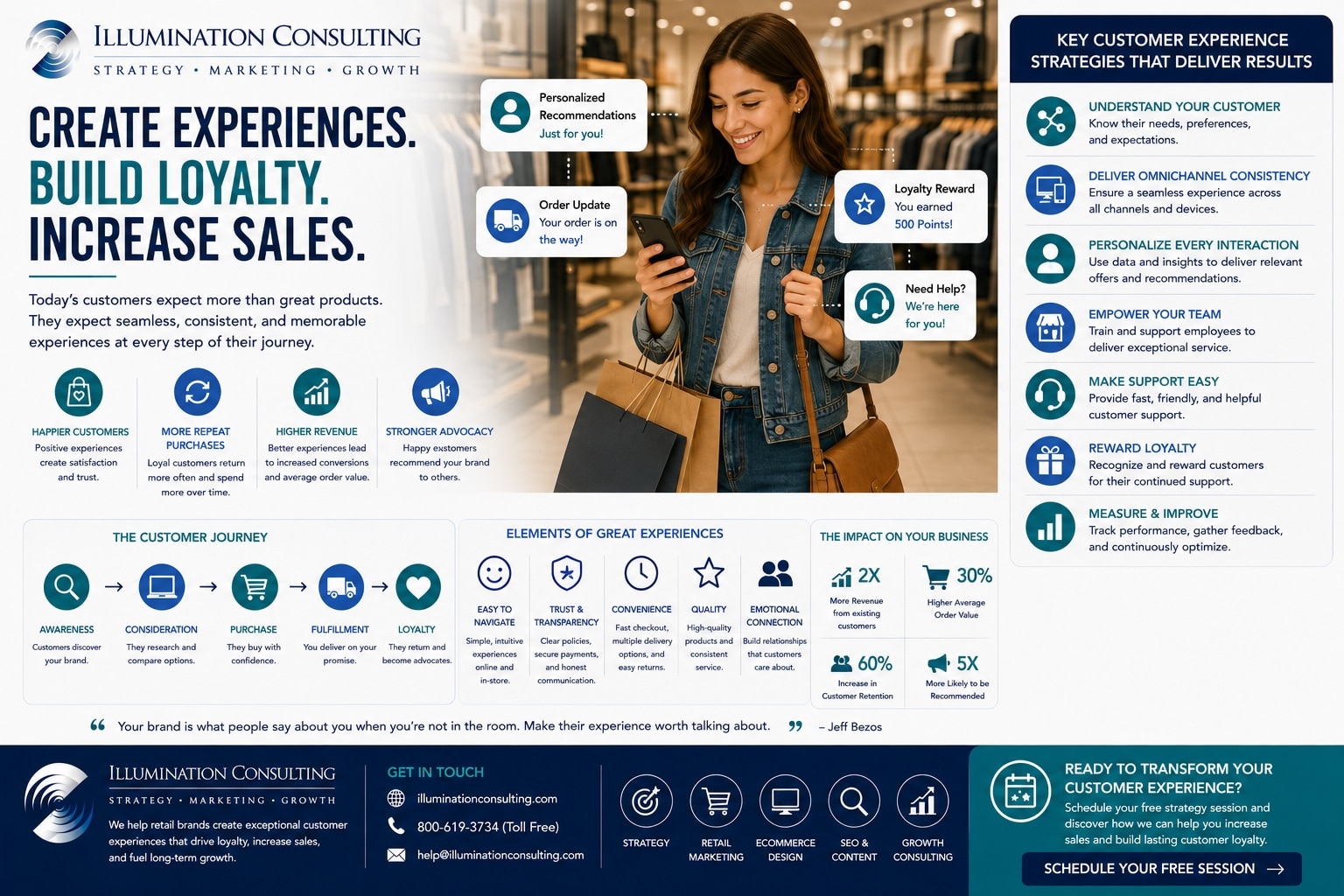
Trust influences every purchasing decision.
Customers who trust a retailer are more likely to purchase, recommend the brand, and become repeat buyers.
Retailers can strengthen trust by providing:
- Transparent pricing
- Honest product descriptions
- Accurate inventory information
- Reliable shipping estimates
- Secure payment processing
- Easy return policies
- Responsive customer support
- Authentic customer reviews
Trust should be reinforced throughout every stage of the customer journey rather than only at checkout.
Improve Customer Communication
Clear communication reduces uncertainty while strengthening customer confidence.
Customers should receive timely updates regarding:
- Order confirmations
- Shipping status
- Delivery notifications
- Product availability
- Return requests
- Loyalty rewards
- Customer support inquiries
- Promotional offers
Consistent communication demonstrates professionalism while improving the overall customer experience.
Design Retail Spaces That Encourage Engagement
For brick-and-mortar retailers, store design directly influences customer behavior.
A well-designed retail environment should encourage shoppers to explore products comfortably while making purchasing decisions easier.
Important considerations include:
- Store layout
- Product visibility
- Wayfinding
- Lighting
- Cleanliness
- Interactive displays
- Checkout efficiency
- Waiting areas
The goal is to create an environment that feels inviting while supporting sales.
Improve Ecommerce User Experience
Online experiences require the same attention as physical stores.
Retail websites should emphasize:
- Fast page loading
- Mobile responsiveness
- Simple navigation
- Clear product categories
- Powerful search
- Product filtering
- Easy checkout
- Secure payment options
An intuitive ecommerce experience reduces frustration while increasing conversions.
Use Customer Feedback to Improve Experiences
Customer feedback provides valuable insights into opportunities for improvement.
Retailers should actively collect feedback through:
- Customer surveys
- Product reviews
- Online ratings
- Social media
- Customer support interactions
- In-store conversations
- Net Promoter Score (NPS)
- Website feedback tools
Listening to customers helps identify recurring issues before they become larger business problems.
Measure Customer Experience Performance
Successful retail customer experience strategies depend on continuous measurement rather than assumptions.
Important metrics include:
- Customer satisfaction (CSAT)
- Net Promoter Score (NPS)
- Customer retention rate
- Repeat purchase rate
- Average order value
- Customer lifetime value
- Conversion rate
- Cart abandonment
- Return rate
- Online review ratings
These metrics help retailers understand where improvements will generate the greatest impact on long-term business performance.
Common Customer Experience Mistakes
Even well-established retailers can lose customers because of avoidable customer experience problems. Identifying and correcting these issues helps improve customer satisfaction while increasing long-term profitability.
Prioritizing Sales Over Relationships
Many retailers focus almost exclusively on immediate transactions instead of building lasting customer relationships.
Long-term success comes from creating positive experiences that encourage customers to return repeatedly rather than maximizing a single purchase.
Relationship-building strategies include:
- Loyalty programs
- Personalized recommendations
- Post-purchase follow-up
- Exceptional customer support
- Exclusive customer offers
- Educational content
- Community engagement
- Consistent communication
Strong relationships increase customer lifetime value while reducing dependence on constant customer acquisition.
Inconsistent Brand Experiences
Customers expect the same level of service regardless of where they interact with a business.
Common inconsistencies include:
- Different pricing across channels
- Conflicting promotions
- Outdated inventory
- Inconsistent messaging
- Poor communication between departments
- Different return policies
- Varying service quality
Maintaining consistency strengthens confidence and improves overall brand perception.
Ignoring Customer Feedback
Customer feedback provides one of the clearest opportunities for continuous improvement.
Retailers should actively review:
- Product reviews
- Customer surveys
- Online ratings
- Social media comments
- Customer support tickets
- Return reasons
- Store feedback
- Website behavior
Listening to customers often reveals operational improvements that directly increase sales and loyalty.
Use Artificial Intelligence to Enhance Customer Experience
Artificial intelligence is transforming retail by helping businesses deliver faster, more personalized, and more efficient customer experiences.
AI can support customer experience through:
- Personalized product recommendations
- Intelligent search
- Customer service chat assistants
- Marketing automation
- Predictive analytics
- Customer segmentation
- Inventory forecasting
- Sentiment analysis
- Dynamic merchandising
- Performance reporting
When combined with human expertise, AI enables retailers to provide more relevant experiences while improving operational efficiency.
Build Long-Term Customer Loyalty
Customer loyalty develops through consistently positive experiences rather than isolated promotions.
Retailers should continually create reasons for customers to return by delivering:
- Reliable service
- High-quality products
- Valuable rewards
- Helpful content
- Personalized recommendations
- Exclusive offers
- Consistent communication
- Memorable experiences
Loyal customers often become a retailer’s most valuable marketing asset by generating referrals and repeat business.
Continuously Improve the Customer Experience
Successful retail customer experience strategies require ongoing evaluation and refinement.
Retailers should regularly assess:
- Customer journeys
- Store layouts
- Ecommerce usability
- Checkout efficiency
- Customer support
- Marketing communications
- Loyalty programs
- Employee training
Continuous improvement helps businesses adapt to changing customer expectations while maintaining a competitive advantage.
Frequently Asked Questions
What are retail customer experience strategies?
Retail customer experience strategies are methods that improve every interaction customers have with a retail brand, including in-store experiences, ecommerce, customer service, marketing, fulfillment, and post-purchase support to increase satisfaction, loyalty, and sales.
Why is customer experience important in retail?
Customer experience influences purchasing decisions, repeat business, customer loyalty, referrals, and long-term profitability. Positive experiences encourage customers to return and recommend the brand to others.
How can retailers improve customer experience?
Retailers can improve customer experience by simplifying the shopping journey, creating consistent omnichannel experiences, personalizing communications, strengthening customer support, improving website usability, and continuously gathering customer feedback.
Does customer experience affect online sales?
Yes. A seamless ecommerce experience, intuitive navigation, fast loading pages, clear product information, secure checkout, and responsive customer support all contribute to higher conversion rates and increased online revenue.
How should retailers measure customer experience?
Retailers should monitor customer satisfaction scores, Net Promoter Score (NPS), retention rates, repeat purchases, conversion rates, online reviews, customer lifetime value, and customer feedback to identify opportunities for continuous improvement.
Improve Customer Experience with Illumination Consulting
Successful retail customer experience strategies combine customer psychology, operational excellence, technology, employee engagement, ecommerce optimization, and continuous improvement to create memorable shopping experiences that strengthen customer loyalty and drive sustainable business growth. Retailers that consistently invest in customer experience build stronger brands, improve retention, increase conversions, and create long-term competitive advantages.
At Illumination Consulting, we help retail businesses accelerate growth through customer experience strategy, ecommerce website design, retail marketing, search engine optimization, AI-powered business solutions, digital marketing, and strategic consulting. Our customized retail solutions are designed to improve customer satisfaction, strengthen brand loyalty, increase conversions, and generate measurable business results.
Whether you’re launching a new retail brand or optimizing an established business, our team can help you implement retail customer experience strategies that create exceptional customer journeys, increase sales, and support long-term success.