By Illumination Consulting Editorial Team · Updated 2026-08-05
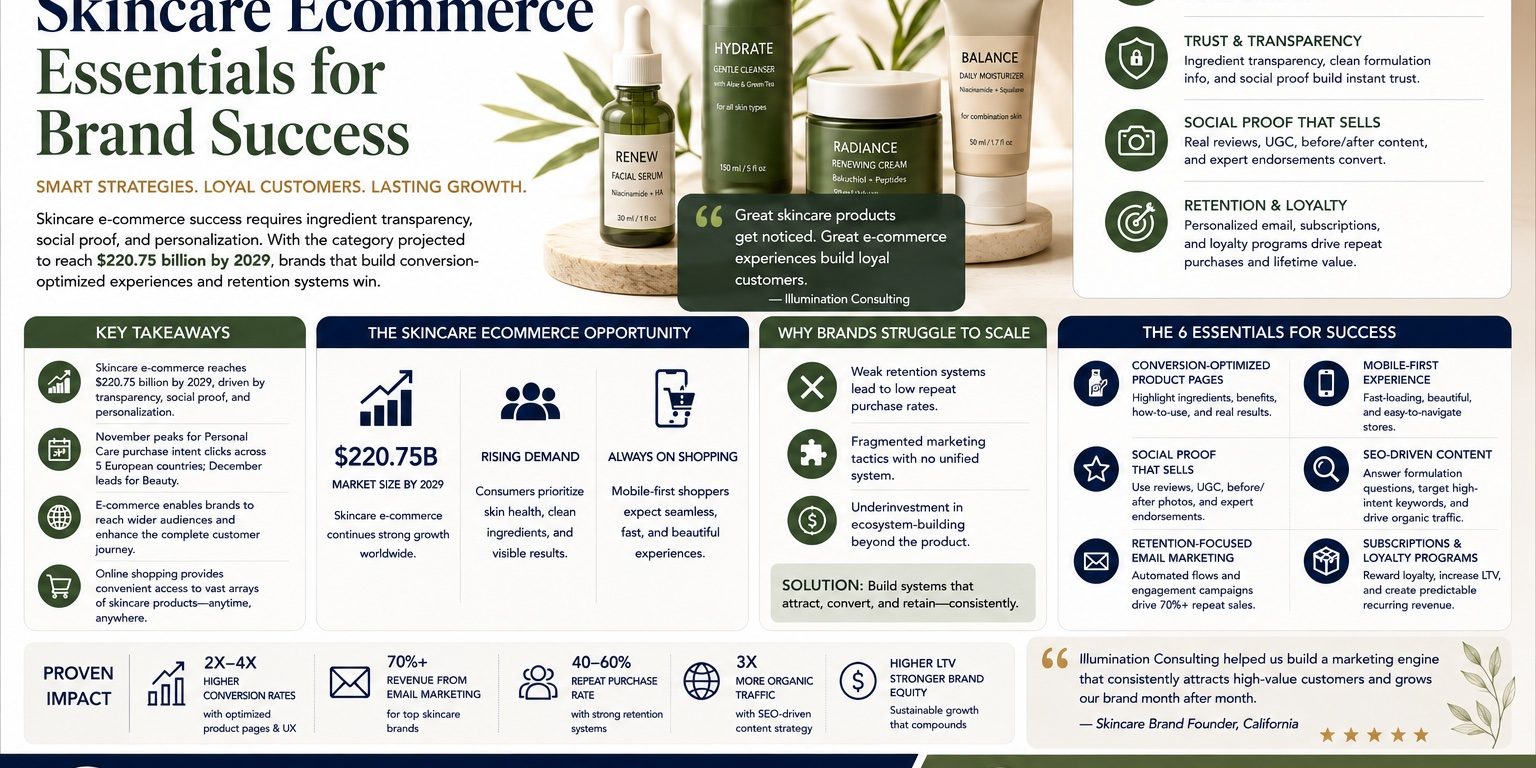
Skincare e-commerce success requires ingredient transparency, social proof, and personalization, three factors driving category growth toward a projected $220.75 billion market by 2029. DTC founders need conversion-optimized product pages, retention-focused email marketing, mobile-first checkout, and SEO-driven content that answers formulation questions, turning browsing traffic into repeat, loyal customers.
Key Takeaways
- Skincare ecommerce reaches $220.75 billion by 2029, driven by ingredient transparency, social proof, and personalization strategies.
- November peaks for Personal Care purchase intent clicks across five European countries; December leads for Beauty.
- E-commerce enables skincare brands to reach wider audiences and enhance the complete customer journey significantly.
- Online shopping provides consumers convenient access to vast skincare product arrays, transforming industry purchasing behavior.
Why Do Skincare Ecommerce Brands Struggle to Scale?
Scaling failures rarely stem from weak formulas or bad packaging. Most skincare ecommerce brands stall because they never build repeatable systems for attracting customers, converting visitors, and generating repeat purchases. Early sales momentum masks this gap until growth slows and revenue plateaus.
Demand is not the bottleneck. The skincare market is projected to reach $220.75 billion by 2029, and consumer appetite keeps expanding. The real obstacle is differentiation. Standing out inside a crowded field where dozens of competitors sell similar formulas through similar channels.
Brands that break through this ceiling treat their online store as one piece of a larger ecosystem, not the entire strategy. Positioning, content, retention marketing, and operational execution work together as one system instead of competing as isolated tactics.
Why Do Sales Plateau After a Strong Launch?
Launch buzz fades fast without infrastructure behind it. First-time buyers convert on curiosity or social proof. Nothing brings them back without retention systems and clear product discovery paths. Founders who never fix underperforming product listings or acquisition funnels watch traffic climb while revenue stalls.
Common scaling gaps include:
- Weak retention infrastructure that fails to turn one-time buyers into repeat customers
- Fragmented marketing tactics with no unified system connecting them
- Underinvestment in ecosystem-building relative to product development
Fixing these gaps means treating growth as an engineered outcome, not a byproduct of good products.
What Makes an Online Store Convert Browsers Into Buyers?
Conversion depends on strategy, not ad spend alone. Skincare brands that pour budget into advertising while ignoring the rest of the funnel typically see traffic spike and sales stall. Retail success requires a coordinated system spanning brand positioning, search visibility, content, and social channels working together rather than in isolation.
This coordinated approach does more than fill a skincare ecommerce storefront with visitors. It attracts qualified customers already interested in the product category, strengthens brand recognition, and improves online visibility across search and social platforms. The result shows up in measurable terms: higher site traffic and stronger revenue growth, not just impressions.
E-commerce itself has become essential infrastructure for skincare brands. Selling online lets a brand reach a far wider audience than physical retail alone allows, while also improving the customer journey from discovery to purchase.
Why Do Some Skincare Stores Struggle to Convert Traffic?
Many stores rely on a single channel, usually paid ads, and skip brand positioning or content that builds trust. Shoppers arrive, browse, and leave without context on ingredients or credibility. A converting online store needs positioning and search visibility working alongside advertising, not instead of it.
Does Product Presentation Affect Conversion Rates?
Yes. Clear, detailed product listings with accurate descriptions help shoppers make faster, more confident purchase decisions. Weak listings force visitors to search elsewhere for answers, costing the brand the sale.
How Should Product Listings and Timing Drive Sales?
Strong product listings answer two questions before a shopper scrolls past: what’s actually in the formula, and does it solve their specific skin concern. Ingredient transparency now outweighs flashy marketing claims. Shoppers want proof, not promises, and pages that dodge specifics lose the sale to competitors who don’t.
Timing matters just as much as content. Beauty and personal care traffic climbs sharply at year-end. Listing updates, bundle offers, and promotional pushes should build toward that surge rather than react to it after the fact.
What Should a Skincare Product Page Include?
Every listing needs a clear ingredient breakdown, expected results, and guidance on skin type fit. Vague descriptions cost conversions; specificity builds trust.
When Should Skincare Brands Ramp Up Promotions?
Late-year months bring the heaviest shopper traffic for beauty and personal care categories. Brands that plan inventory, content, and ad spend around this window capture demand before competitors do.
Illumination Consulting, based in Beverly Hills, California, works with skincare and beauty brands nationwide to align online store content, listing structure, and seasonal timing. Local storefronts, multi-location operations, and pure e-commerce brands alike benefit from customized systems built for acquisition, retention, and long-term growth.
E-commerce Tech Stack Selection for Skincare Ecommerce Success
Choosing the right e-commerce tech stack is foundational for creating a seamless online store experience in skincare ecommerce. Platforms like Shopify Plus offer robust scalability, modular architecture, and integration capabilities vital for handling product complexity, subscription services, and advanced marketing automation.
Integrating third-party tools such as Recharge or Skio enables efficient management of subscription and auto-replenishment workflows, while Klaviyo integration supports lifecycle email marketing and customer segmentation. Selecting a backend with strong analytics and API support allows continuous optimization of customer journeys and operational efficiencies.
High-Converting Product Listing Page (PLP) Design
Effective product listings on Category or Product Listing Pages (PLPs) are crucial in skincare ecommerce to increase click-through and conversions. PLPs should feature intuitive filters for ingredient transparency, skin concerns, and formulation types to help users narrow choices swiftly.
Visual consistency and concise product summaries with key benefits visible upfront enhance scanning ease. Incorporating badges highlighting clinical validation, bestsellers, or repeat customer ratings strengthens credibility. Quick-view options reduce friction by enabling fast access to essential product details without leaving the listing page.
Ingredient Transparency Filters
Ingredient transparency is a key trust factor in skincare ecommerce. Implementing sophisticated filter systems powered by ingredient databases allows shoppers to search by active ingredients, avoid allergens, or select formulas suited for specific skin conditions.
These filters should be integrated into PLPs and online store navigation to enable personalized, science-driven product discovery. Clear labeling combined with interactive ingredient insights on product pages empowers consumers to make confident, informed purchases.
Subscription Rebilling Platforms for Retention and Growth
Incorporating subscription rebilling platforms like Recharge or Skio strengthens retention by automating replenishment for clinical skincare regimens. These systems support flexible cadence management, pause or skip options, and tier-based loyalty rewards to increase customer lifetime value.
Subscription integration with advanced CRM and email marketing tools facilitates personalized communications aligned with usage patterns and promotional calendars. This ensures low churn rates and predictable recurring revenue, essential for scalable skincare ecommerce operations.
Checkout Frictionless UX Optimization
The checkout experience is a critical conversion point. Frictionless UX in the online store includes mobile-first, one-page checkout flows with saved payment and shipping data to speed transactions. Minimizing form fields, enabling guest checkout, and offering multiple payment methods reduce abandonment.
Embedding progress indicators and clear error messaging enhances usability and trust. Integration of post-purchase upsells and transparent shipping and return policies further improve average order value (AOV) and customer satisfaction.
Optimizing Product Detail Pages (PDP) for Clinical Skincare: Ingredients, Formats, and Social Proof
For clinical skincare brands aiming to convert at scale, optimization of Product Detail Pages (PDP) is paramount. The above-the-fold section must captivate and educate instantly with concise, compelling messaging that highlights key benefits supported by clinically-backed ingredients. Core elements include clear calls-to-action, visible trust badges, and user-generated content (UGC) testimonials to enhance credibility.
Advanced ingredient transparency is crucial. Visual ingredient breakdowns presenting percentages, active versus inactive components, and references to scientific studies invite confident buying decisions. These can be displayed through interactive infographics or tables featuring active ingredient concentrations and clinically tested benefits, establishing brand authority.
Rich media elevates engagement: high-resolution videos showcasing unboxing experiences and product textures allow customers to preview sensory qualities remotely, reducing hesitation. Structured clinical before-and-after galleries showing real user progress reinforce efficacy and validate product claims, blending scientific rigor with authentic storytelling.
To best implement these features, adopting a Shopify Plus aesthetic architecture aids in modular, scalable design that supports A/B testing and fast iterations. Each PDP should be built for clarity and conversion, streamlining decision pathways and reducing cognitive overload. Integrating user-generated content (UGC) alongside expert endorsements further enhances trust and positions the product as clinically credible yet consumer approachable.
Subscription & Auto-Replenishment Strategies (Recharge, Skio) for Consistent Recurring Cashflow
Subscription models powered by platforms like Recharge and Skio represent a cornerstone of retention marketing, especially for high-repeat clinical skincare products with replenishment cycles. Optimizing subscription offerings can dramatically boost customer lifetime value (LTV) and ensure steady, predictable revenue streams.
Key features include allowing customers to customize subscription frequency (30, 60, or 90 days), aligning with individual usage patterns and preventing overstocking or lapses. Automated churn prevention workflows incorporate skip or swap options combined with friendly SMS reminders, helping customers manage their plans flexibly and increasing satisfaction.
Tiered loyalty rewards incentivize longer commitments and larger purchases, layering points systems or discounts for continual subscribers. These integrated loyalty programs act as multipliers for LTV, deepening brand affinity and reducing price sensitivity.
Seamless subscription experiences must integrate with Klaviyo lifecycle automation to deliver personalized communications—welcome flows, replenishment reminders, and exclusive offers—heightening engagement without intrusive messaging. Subscription data can further inform segmented promotional campaigns designed to uplift retention.
Building a Dynamic Diagnostic Skin Quiz Funnel to Drive High-Converting Product Regimens
Clinical brands benefit significantly from skin type diagnostic quiz funnels that personalize product recommendations and foster customer trust. Interactive questionnaires capture data points such as Fitzpatrick skin type, primary skin concerns, and current routines to algorithmically curate ideal skincare regimens.
The quiz funnel is designed as a consultative experience, guiding users through targeted questions and dynamically adjusting pathways based on responses. Post-quiz landing pages showcase customized bundles with clear explanations for each item, improving relevance and conversion rates.
Integrations with Klaviyo enable automated post-quiz email sequences, delivering follow-up tips, educational content, and special offers that nurture leads through the funnel. This approach not only improves initial conversion but also supports retention through ongoing engagement.
Implementing diagnostic quizzes within the ecommerce architecture requires seamless UI/UX design, mobile optimization, and backend support for product combinations and inventory management. The result is a smarter funnel that captures intent and builds personalized journeys, enhancing both average order value (AOV) and satisfaction.
Average Order Value (AOV) Maximization: In-Cart Upsells, Threshold Free-Shipping, and Cross-Selling
Maximizing Average Order Value (AOV) is a critical lever for scaling skincare ecommerce profitability. Dynamic cart experiences including slide-cart drawers featuring relevant, complementary products encourage shoppers to add more items just before checkout.
One-click post-purchase checkout upsells capitalize on momentum, suggesting items such as travel-sized versions or premium upgrades without requiring entry of payment information again, lowering friction and increasing conversion.
Product bundling strategies pairing cleanser, serum, and SPF regimens cater to common skincare routines and incentivize full regimen purchases at a perceived discount, driving holistic regimen adoption.
Cross-selling clinic treatments alongside homecare products introduces omnichannel upsell opportunities that elevate brand prestige and customer lifetime engagement. Highlighting professional services in tandem with at-home routines boosts trust and spending.
Effective AOV optimization relies on agile ecommerce backend platforms like Shopify Plus combined with predictive analytics to identify best-performing upsell and cross-sell pathways. These tactics integrate closely with retention marketing efforts, feeding data back into email flows and loyalty programs.
FAQ
Why do skincare ecommerce brands struggle to scale?
Most stall because they never build repeatable systems for attracting customers, converting visitors, and generating repeat purchases. Demand isn’t the bottleneck—differentiation in a crowded market is, since the category is projected to hit $220.75 billion by 2029.
What causes sales to plateau after a strong launch?
Launch buzz fades without infrastructure like retention systems and clear product discovery paths. Weak retention, fragmented marketing tactics, and underinvestment in ecosystem-building leave traffic climbing while revenue stalls.
What makes an online store convert browsers into buyers?
Conversion requires a coordinated system spanning brand positioning, search visibility, content, and social channels, not ad spend alone. This approach attracts qualified customers, strengthens brand recognition, and drives measurable traffic and revenue growth.
Facts
- Illumination Consulting is located in Beverly Hills, CA, USA.