By Illumination Consulting Editorial Team · Updated 2026-08-05
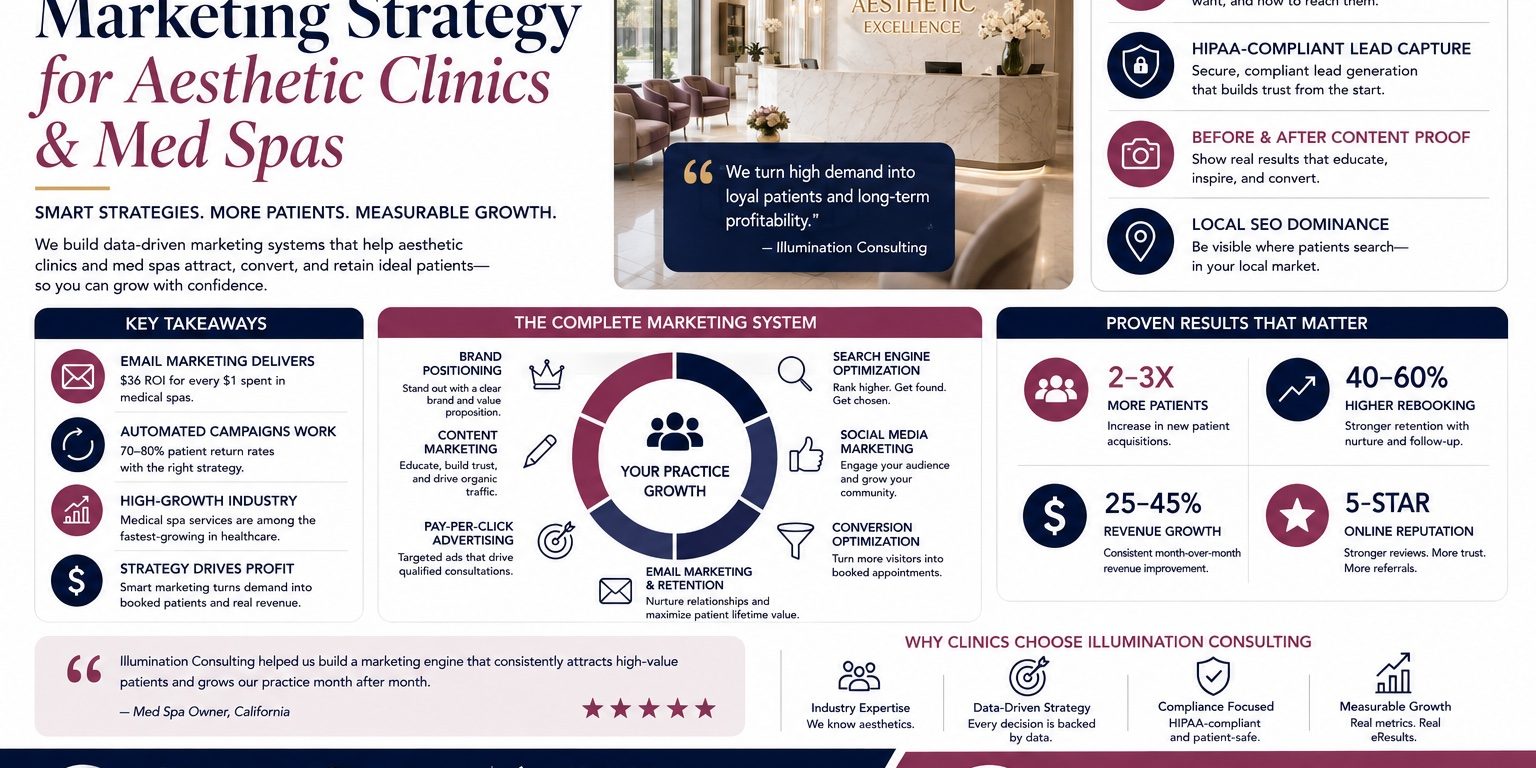
Effective marketing strategy for clinics and spas requires four pillars: a defined patient avatar, HIPAA-compliant lead capture, before/after content proof, and consistent local SEO targeting. Illumination Consulting, based in Beverly Hills, CA, builds these systems specifically for medical spas and clinics to generate predictable, compliant patient acquisition.
Effective clinic and med spa marketing combines brand positioning, search engine optimization, content marketing, social media marketing, paid advertising, conversion optimization, email marketing, and retention initiatives into one coordinated system. Clinic managers and med spa owners who integrate these channels—rather than running isolated tactics—see stronger patient acquisition, higher rebooking rates, and measurable, high ticket patient acquisition over time.
Key Takeaways
- Email marketing delivers $36 ROI for every $1 spent in medical spa practices.
- Automated email campaigns achieve 70–80% patient return rates for med spa businesses.
- Medical spa services represent one of the fastest-growing industries with high demand.
- Strategic marketing transforms high demand into paying customers and profitable clinic operations.
What Groundwork Should Clinics Set Before Marketing?
Clinics need a coordinated foundation before launching campaigns. Findability comes first: prospective patients cannot choose a practice they cannot locate, and a shaky digital presence erodes confidence before the first phone call ever happens. Practices lacking dependable Retail Marketing for Skincare: Aesthetic Clinics & Med Spas typically face a systems gap rather than a demand gap. Attracting, converting, and retaining patients requires built infrastructure, not luck.
A sound Beverly Hills Business Growth: Aesthetic Clinics & Med Spas blends brand positioning, search visibility, content, social channels, paid campaigns, conversion optimization, email, and retention into one coordinated marketing strategy rather than scattered tactics. Isolated efforts, like a boosted post here or a discount there, rarely produce measurable results on their own.
Does social media matter before running ads?
Yes. For clinic marketing, social presence often forms the first impression a prospective patient forms of a practice, arriving well before a website visit or phone call. Clinics should audit profile accuracy, tone, and visual consistency before spending on paid acquisition.
What should clinics check first?
Before committing budget to campaigns, practices benefit from a quick internal audit:
- Search visibility across Google listings and map results
- Website credibility, load speed, and conversion pathways
- Social profile consistency and recent posting activity
- Existing retention systems for repeat patient visits
Skipping this groundwork wastes ad spend on a foundation that cannot convert traffic into booked appointments.
Omnichannel Patient Acquisition Funnels for Aesthetic Clinics
A successful marketing strategy integrates multiple channels into an omnichannel funnel that guides prospective patients from awareness through booking and retention efficiently. This approach ensures seamless patient experiences by unifying search engine optimization, social media engagement, paid advertising, email marketing, and offline community interactions.
- Top of Funnel (Awareness): Leveraging brand positioning, educational social content, and local SEO to attract high-intent traffic.
- Middle of Funnel (Evaluation): Utilizing HIPAA-compliant lead capture forms, informative FAQs, and transparent pricing to nurture inquiries and build trust.
- Bottom of Funnel (Conversion): Streamlining booking processes, consultative sales techniques, and personalized communication to increase high-ticket treatment uptake.
- Post-Conversion (Retention): Driving repeat visits with automated email campaigns, membership programs, and loyalty incentives to sustain long-term spa growth.
Brand Differentiation Strategies in Clinic Marketing
In the competitive aesthetics market, effective clinic marketing hinges on clear brand differentiation that resonates with target patients. Differentiation involves:
- Defining and communicating a unique value proposition that highlights clinical expertise, patient care philosophy, or technological advantages.
- Showcasing authentic patient testimonials, before/after galleries, and success stories that build credibility and trust.
- Maintaining consistent messaging and visual identity across all digital and offline channels to reinforce recognition.
- Emphasizing compliance and privacy through HIPAA-aligned practices and transparent policies, which patients value highly.
Membership Program Launch Playbook for Sustained Spa Growth
Launching membership programs effectively accelerates retention and generates predictable monthly revenue streams, vital for long-term spa growth. A structured playbook includes:
- Market Research: Analyze patient demographics, spending behavior, and demand to tailor membership tiers.
- Program Design: Create clear, attractive membership benefits such as discounts, exclusive services, priority booking, and referral bonuses.
- Integrated Marketing: Use email campaigns, social media, website promotions, and in-clinic signage to communicate value.
- Staff Training: Equip front desk and clinical staff to explain program benefits compellingly and enroll members seamlessly.
- Performance Tracking: Monitor enrollment rates, member retention, and revenue impact to optimize offerings continuously.
Local Community Partnerships in Clinic Marketing
Building strategic partnerships with local businesses and organizations enhances clinic visibility and patient trust, fueling sustainable spa growth. Effective partnerships involve:
- Collaborating with complementary health, wellness, and beauty providers to co-promote services.
- Engaging in community events, sponsorships, and educational seminars to raise brand awareness.
- Offering exclusive promotions or referral incentives to partner organizations’ audiences.
- Leveraging local media and influencers to amplify partnership campaigns.
ROI Attribution Modeling for Aesthetic Clinics
Understanding the return on investment (ROI) from various marketing channels is crucial for optimizing budgets and scaling clinic marketing efforts intelligently. An ROI attribution model includes:
- Tracking multi-touch patient journeys across digital and offline touchpoints to identify effective channels.
- Implementing analytics tools that integrate paid ads, organic search, social media, email, and referral data.
- Analyzing key performance indicators (KPIs) such as customer acquisition cost, return on ad spend, patient lifetime value, and booking conversion rates.
- Using data-driven insights to reallocate resources towards the highest-performing strategies for sustained spa growth.
End-to-End Aesthetic Patient Journey: Strategic Overview
Understanding and strategically guiding the aesthetic patient through each phase of their journey is critical for clinic marketing success and sustained spa growth. This journey comprises four key stages: Awareness, Clinical Evaluation, High-Ticket Conversion, and Retention. Each phase demands unique touchpoints, messaging, and process optimization to ensure seamless patient acquisition and long-term loyalty.
1. Awareness
This initial stage focuses on generating visibility and interest among prospective patients who may be unaware or only vaguely familiar with the clinic’s offerings. It leverages brand positioning, SEO, social media presence, and organic and paid content to attract a targeted audience searching for aesthetic treatments.
- Actionable checklist:Establish and promote a clearly defined patient avatar to maximize message relevance.Optimize local SEO with accurate Google My Business listings and map features.Create engaging, educational social media content showcasing treatment benefits and real patient stories.Run targeted PPC and social media ads emphasizing clinic differentiation and compliance.
- Key metrics: Website traffic volume, social engagement rates, ad click-through rates.
2. Clinical Evaluation
At this stage, prospects transition into qualified leads considering treatments in-depth. Transparent, informative content and easy access to consultations build trust and reduce friction in the evaluation process.
- Actionable checklist:Design intuitive, HIPAA-compliant consultation request forms emphasizing ease and privacy.Publish clear FAQs and procedural details addressing common patient concerns.Utilize patient testimonials and before/after galleries to demonstrate clinical expertise.Implement timely follow-up workflows post-inquiry to nurture leads.
- Key metrics: Consultation form submissions, lead-to-consultation conversion rates, average response times.
3. High-Ticket Conversion
Converting consultations into high-value treatment bookings requires trust-building, personalized communication, and streamlined administrative processes that respect patient motivations and concerns.
- Actionable checklist:Train staff on consultative selling techniques emphasizing patient goals.Present customized treatment plans with transparent pricing and value proposition.Incorporate trust signals such as certified credentials, privacy assurances, and clear refund/cancellation policies.Leverage digital scheduling with automated reminders to reduce no-shows.
- Key metrics: Consultation-to-booking conversion rate, average treatment value, no-show rate.
4. Retention
Long-term spa growth rests heavily on patient retention through continuous engagement, loyalty incentives, and relationship nurturing post-procedure.
- Actionable checklist:Deploy targeted email marketing campaigns boosting repeat booking rates.Implement automated post-treatment check-ins and satisfaction surveys.Offer membership programs and referral incentives to build community and advocacy.Maintain active, educational social engagement fostering ongoing trust.
- Key metrics: Patient lifetime value, repeat visit frequency, referral rate.
Conversion Rate Optimization (CRO) Frameworks for Cosmetic Clinics and Med Spas
Optimizing every patient interaction to maximize conversions reduces marketing waste and accelerates spa growth. A targeted CRO approach for clinics transcends generic optimization and addresses unique aesthetic industry dynamics.
1. Friction Reduction
- Minimize required form fields to essential HIPAA-compliant data to ease consultation requests.
- Ensure website and mobile platforms load swiftly and function seamlessly.
- Offer multiple contact methods (chat, phone, email) to accommodate preferences.
2. Consultation Form Design
- Use clear, patient-centric language emphasizing confidentiality and simplicity.
- Incorporate progress indicators and confirm submission success visibly.
- Include optional fields for patient concerns to personalize follow-up conversations.
3. Trust Signals
- Prominently display certifications, awards, and media mentions on landing pages.
- Leverage real patient reviews and testimonials with names and photos where possible.
- Publish clear privacy policies and compliance statements.
4. Before/After Proof
- Create high-quality visual galleries segmented by treatment type and typical results.
- Use storytelling formats combining photos with patient narratives.
- Refresh galleries regularly to reflect new services and outcomes.
Quantitative ROI Tracking Models and KPI Dashboards
Integrating data-driven insights through ROI tracking models and KPIs equips clinics to evaluate marketing strategy efficacy, justify budget, and drive spa growth intelligently.
Implementing dashboards that track these KPIs in real time provides clinic managers with actionable intelligence to pivot strategy and demonstrate ROI to stakeholders effectively.
What Steps Build an Effective Clinic Marketing Strategy?
Five sequential steps build a results-driven marketing strategy for aesthetic practices: audit visibility, activate social platforms, coordinate channels, launch email campaigns, and publish consistent content. Clinics skipping these steps in favor of scattered campaigns lose bookings to competitors with clearer systems. Each step builds on the last, so practice directors should complete them in order.
- Assess current visibility. Review where the practice currently appears across search, social, and email before adding new tactics.
- Build a social media presence. Social platforms rank among the most influential channels for reaching prospective patients today. Instagram, Facebook, TikTok, and YouTube give patients a place to evaluate providers, view treatment results, and gain confidence before ever booking a consultation.
- Unify local SEO, social, and retention efforts. These channels perform best when run together rather than managed as isolated projects, since patient decisions rarely rely on a single touchpoint.
- Deploy email campaigns. Email delivers one of the strongest returns available to clinics, driving repeat bookings and generating predictable revenue month over month.
- Publish valuable content on a consistent schedule. Regular posts demonstrate clinical expertise, showcase real outcomes, introduce staff, and answer common patient questions.
Which Channel Should a Clinic Prioritize First?
Social media deserves priority for clinic marketing because it shapes first impressions before a patient ever calls the front desk. Prospective patients research providers on Instagram and TikTok specifically to view treatment results and assess credibility.
How Do These Steps Support Long-Term Spa Growth?
Coordinated execution across channels compounds over time rather than producing one-off spikes. Sustained spa growth depends on retention-focused email combined with content that keeps the practice visible between visits.
What Mistakes Slow Down Spa Growth?
Weak execution, not weak strategy, stalls most clinics. Slow responses, inconsistent follow-through, and poor tracking undermine a marketing strategy that would otherwise perform well. Treatment quality rarely explains stalled growth; the missing piece is usually the system behind the front desk.
Why do clinics lose patients after the first visit?
Patients rarely leave because of disappointing care. Clinics lose them by going silent once the appointment ends, with no follow-up message or reminder pulling patients back. That silence quietly erodes retention month after month.
Why do some spas plateau after early success?
Many aesthetic brands generate strong initial bookings, then stall before real spa growth takes hold. The cause is rarely product or service quality. Instead, three gaps tend to appear:
- Fragmented clinic marketing with no shared calendar or tracking
- No system for re-engaging quiet patients
- Isolated tactics instead of one connected growth ecosystem
Clinics that scale treat these as one integrated system, not separate projects competing for attention.
Effective marketing strategy for clinics and spas requires a deliberate integration of brand positioning, targeted audience engagement, and conversion-focused digital infrastructure. By establishing clear strategic foundations and maintaining consistency across all patient touchpoints, aesthetic providers build sustainable competitive advantages in an increasingly digital marketplace. The businesses that prioritize strategic planning alongside tactical execution achieve measurable growth. Strengthen their market presence for years to come.
FAQ
What should clinics do before launching marketing campaigns?
Clinics complete an internal audit covering search visibility, website credibility and speed, social profile consistency, and existing retention systems. This groundwork ensures ad spend converts traffic into booked appointments instead of wasting budget on a weak foundation.
Why does social media presence matter for clinics?
Social media often forms a prospective patient’s first impression of a practice, arriving before a website visit or phone call. Clinics audit profile accuracy, tone, and visual consistency before spending on paid acquisition.
What are the steps to building an effective clinic marketing strategy?
The five sequential steps are: assess current visibility, build a social media presence, unify local SEO with social and other channels, launch email campaigns, and publish consistent content. Each step builds on the last, so practice directors complete them in order.
Facts
- Illumination Consulting is located in Beverly Hills, CA, USA.