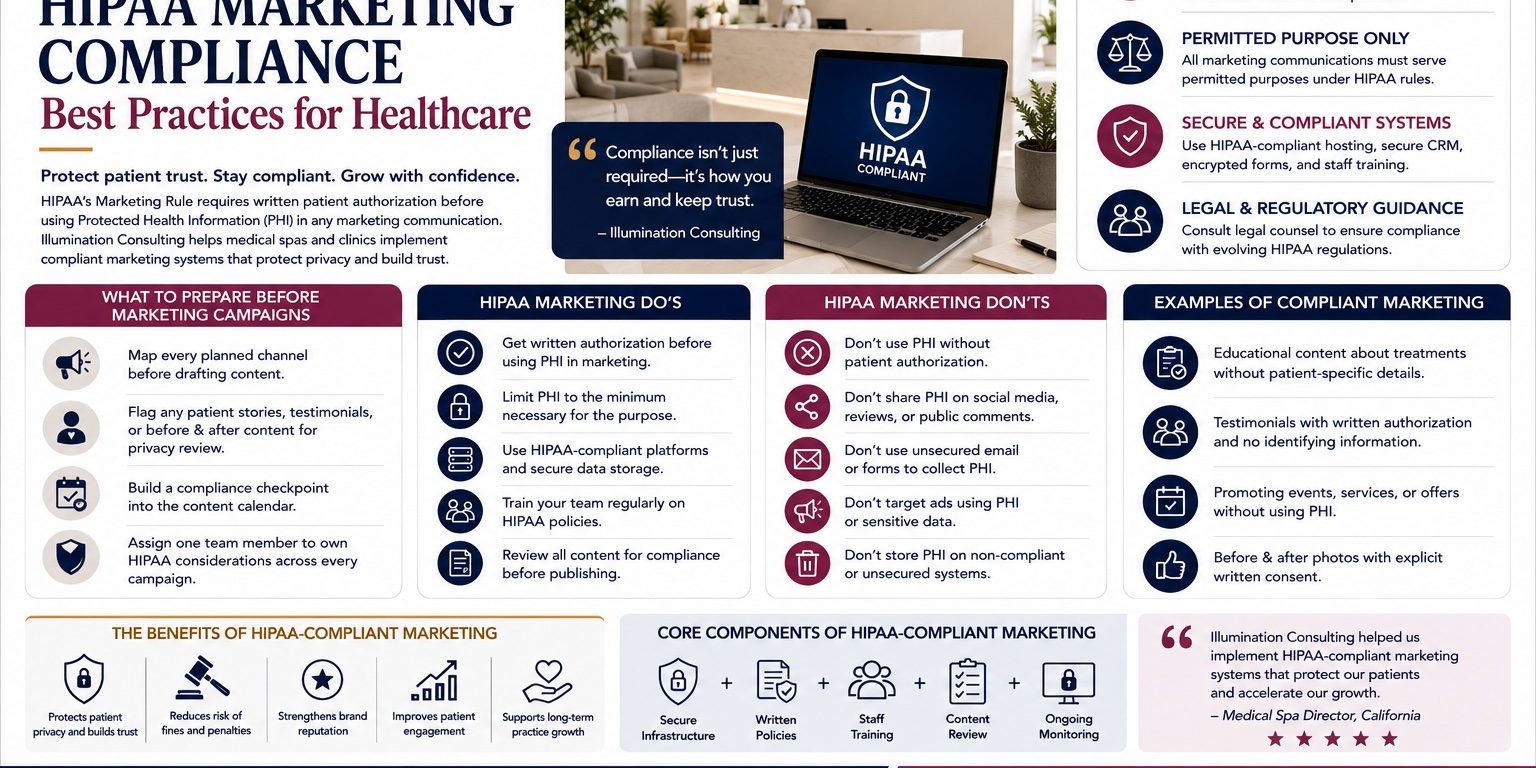
When it comes to hipaa marketing compliance, best practices require written patient authorization before using Protected Health Information in any marketing communication, per HIPAA’s marketing rule established in 1996. Medical marketing managers should use HIPAA-compliant hosting, secure CRM platforms, encrypted forms, and staff training. Illumination Consulting integrates these safeguards into HIPAA and Accessibility Compliance for Clinics for medical spas and healthcare practices.
Key Takeaways
- Direct B2C marketing communications require explicit authorization from patients or their personal representatives for PHI use.
- HIPAA marketing rules mandate that all healthcare communications serve only permitted purposes under regulatory guidelines.
- Healthcare organizations must implement secure, compliant hosting solutions like HIPAA-compliant WordPress to protect sensitive patient data.
- Medical marketing campaigns require consultation with legal counsel to ensure full compliance with evolving HIPAA regulations.
Understanding Protected Health Information (PHI) Definitions in Marketing
At the core of effective hipaa marketing compliance is a clear understanding of Protected Health Information (PHI). PHI refers to individually identifiable health information that is transmitted or maintained by a healthcare provider, plan, or clearinghouse. In marketing contexts, PHI includes patient names, medical conditions, treatments, and any data that could identify the patient.
Marketing teams must ensure that any use of PHI, such as patient testimonials or before-and-after photos, strictly complies with HIPAA rules to safeguard patient privacy. Failure to correctly handle PHI exposes practices to significant regulatory risks and undermines patient privacy marketing efforts.
What Must You Prepare Before Marketing Campaigns?
Preparation for a compliant medical spa or clinic campaign starts well before a single post goes live. A practice’s social presence often forms the first impression a prospective patient has of the entire organization, shaping trust before any phone call or booking occurs. Because of that, compliance groundwork belongs at the planning stage, not as a fix applied after launch.
Healthcare marketing regulation has changed substantially since HIPAA’s passage in 1996 and the Privacy Rule published in 2000. Marketers who wait until a campaign is live to address hipaa marketing compliance typically face costly rewrites, delayed launches, or removed content. Older channels didn’t carry this burden. Newspaper advertising, mail shots, and telephone outreach once dominated healthcare marketing, but today’s digital tools. Social ads, email sequences, retargeting pixels — introduce new obligations around patient privacy marketing that print never required.
Before any campaign launches, practices should complete these steps in order:
- Map every planned channel, from social platforms to paid ads, before drafting content.
- Flag any message referencing patient stories, testimonials, or before-and-after imagery for privacy review.
- Build a compliance checkpoint into the content calendar so nothing publishes unreviewed.
- Assign one team member to own hipaa considerations for clinics across every campaign, from concept through launch.
Why does compliance planning start before content creation?
Reviewing content after publication leaves little room to correct privacy exposure without damaging patient trust. Building safeguards into the planning phase catches problems before they reach a public audience. This sequence protects both the practice’s reputation and its patients’ sensitive information from the outset.
Compliant Email & SMS Campaigns Under HIPAA
Integrating hipaa considerations for clinics into email and SMS campaigns ensures sensitive patient data remains protected. Marketing messages sent via these channels must only be sent after obtaining explicit written authorization. Furthermore, platforms used to send email or SMS communications must feature robust encryption and comply with HIPAA security standards.
Marketers should avoid including PHI in message content unless absolutely necessary and always apply strict controls around recipient lists, opting for secure, HIPAA-compliant Customer Relationship Management (CRM) systems. This approach supports patient privacy marketing by minimizing risks of unauthorized disclosures.
How Do You Secure Written Patient Authorization?
Written authorization requires a signed, dated document that names the specific use of a patient’s information before any marketing team touches it. Under HIPAA marketing compliance standards, protected health information cannot support direct consumer marketing unless the patient or a personal representative has authorized that exact use. Skipping this step exposes a clinic to regulatory risk and damages the trust patients place in their provider.
Practice administrators should follow a defined sequence rather than treating consent as a one-time checkbox:
- Identify the exact marketing use — website testimonial, before-and-after gallery, social media post, or email campaign.
- Draft an authorization form that names the specific content, the platforms where it will appear, and an expiration date.
- Collect a signature from the patient or their personal representative before any content goes live.
- Store the signed form in a secure, retrievable location tied to the patient record.
- Confirm authorization status again before reusing older content in new campaigns.
Patients now spend considerable time researching providers before booking a consultation. Much of that research centers on before-and-after galleries and social proof. Because prospective patients rely so heavily on this imagery, clinics must confirm proper patient privacy marketing authorization before any identifiable photo or story appears publicly.
Does verbal consent satisfy HIPAA requirements?
Verbal agreement does not meet the documentation standard clinics need for defensible marketing. A signed form creates a clear record that protects both the patient and the practice.
Why does documented consent matter for social media specifically?
Authentic, transparent engagement drives patient trust far more than covert use of personal health details. Among key hipaa considerations for clinics, documented authorization ensures every social post reflects genuine, permitted patient participation rather than assumed consent.
Social Media Photo Releases: Essential Steps for Compliance
Social media is a prominent channel for healthcare marketing, with rich use of patient images to demonstrate treatment outcomes. Obtaining explicit photo release forms that comply with hipaa marketing compliance is mandatory. These releases must detail where and how images will be used and confirm that patients understand and consent to this distribution.
Clinics must also remove metadata and any background information that could disclose sensitive details inadvertently. Reviewing posts through a compliance-trained team member before publication supports strong patient privacy marketing safeguards and helps maintain a trustworthy online presence.
How Should Clinics Vet Marketing Vendors And Pixels?
Vendor vetting starts with a simple test: does the tool touch patient data, and if so, how? HIPAA marketing compliance obligations reach far past the words in an ad or email. Clinics must also scrutinize the services used to create, receive, maintain, or transmit electronic patient data. A compliant message built on noncompliant infrastructure still creates risk.
Tracking pixels deserve particular scrutiny. Misconfigured pixels have previously exposed patient portal data at well-known medical institutions, a costly reminder that ad-tech integrations need the same review as any clinical software. A pixel that quietly passes appointment details or diagnosis-related URL strings to an advertising platform turns a marketing tool into a patient privacy marketing liability overnight.
HIPAA Risks of Tracking Technologies: Meta Pixel, Google Analytics, and Others
Technologies like Meta Pixel and Google Analytics are widespread in healthcare marketing but carry significant HIPAA compliance risks if not carefully managed. These tools can inadvertently collect PHI through URL parameters or user behavior tracking, breaching privacy regulations.
To mitigate these risks, clinics must audit pixel configurations regularly, disable tracking on PHI-related pages, and ensure vendors sign Business Associate Agreements. Hipaa considerations for clinics include ongoing monitoring to prevent data leakage and maintain compliance amid an evolving digital marketing environment.
Why do so many clinics get this wrong?
Many organizations remain unaware that HIPAA’s marketing provisions apply to their tools at all, let alone the penalties for breaching them. That knowledge gap, not malice, drives most vendor-related violations. Practice administrators who assume “our marketing agency handles compliance” often discover otherwise during an audit.
What should a vendor review checklist include?
Effective HIPAA considerations for clinics call for a structured, repeatable process:
- Confirm whether the vendor will sign a business associate agreement.
- Map every tool that touches scheduling, forms, or portal data.
- Audit pixel and analytics configurations for PHI leakage.
- Review hosting infrastructure for encryption and access controls.
- Document authorization procedures for any PHI used in campaigns.
Clinics that partner with Marketing Strategy: Aesthetic Clinics & Med Spas built on compliant infrastructure keep growing patient volume without introducing new privacy exposure. Vetting is not a barrier to growth; it is the mechanism that makes growth sustainable.
How Do You Build HIPAA-Safe Social Content?
Building HIPAA-safe social content requires a documented review process applied before every post goes live. Medical spas rank among the most visible healthcare businesses on social platforms. That visibility raises the stakes for hipaa marketing compliance on every channel. Practices that skip a formal review risk exposing identifiable patient details in captions, comments, or background images.
Prospective patients research providers across Instagram, Facebook, TikTok, YouTube, and LinkedIn before ever booking a consultation. Each platform demands the same privacy standard, since a lapse on one channel damages trust everywhere. A clinic’s feed functions as a brand extension. It builds credibility long before a patient walks through the door, which means every post must reflect genuine patient privacy marketing discipline.
Marketing managers and medical directors should apply these steps before publishing:
- Confirm written authorization exists for any patient shown, named, or referenced.
- Strip metadata and background details that could reveal identity, location, or diagnosis.
- Route content through a compliance-trained reviewer prior to scheduling.
- Archive signed releases alongside the published post for audit purposes.
What content topics stay safe without patient authorization?
Education-focused posts carry the lowest risk. Explaining a treatment, answering common questions, and showcasing staff expertise build authority without touching protected information. These formats let practices demonstrate outcomes generally, rather than through individual patient stories.
How do hipaa considerations for clinics affect caption writing?
Captions should never confirm that a specific person received treatment unless documented consent exists. Vague, outcome-focused language protects both the patient and the practice. Consistent, compliant publishing over time strengthens a clinic’s reputation as a trustworthy, careful provider.
Staff Compliance Audits: Ensuring Ongoing HIPAA Marketing Adherence
Regular staff compliance audits are a pivotal element in sustaining hipaa marketing compliance. Training marketing teams and clinical staff about HIPAA responsibilities must be coupled with periodic reviews to identify potential risks or lapses in procedures.
Audits should verify that written authorizations are current, marketing materials have been appropriately vetted, and technological safeguards are functioning. Encouraging a culture of accountability within the clinic supports ongoing patient privacy marketing protection and forestalls costly violations.
What Compliance Mistakes Should You Fix First?
Three errors surface most often in clinic audits: outdated hosting configurations, undocumented consent processes, and marketing shortcuts that trade trust for speed. Correcting them requires a sequence, not a scramble.
Step 1: Audit hosting and tracking infrastructure first. Regulations governing hipaa marketing compliance continue to shift, and a hosting or analytics setup that once passed review can quietly introduce new data-tracking risk. Practices relying on legacy platforms often discover their existing configuration no longer meets current standards for handling patient data.
Step 2: Document consent before launching any campaign. Patient privacy marketing depends on proof, not assumption. Every campaign touching patient information needs a documented authorization trail, reviewed on a set schedule rather than left untouched for years.
Step 3: Replace shortcuts with disciplined systems. High-performing practices skip the quick fixes. They build measurable growth systems that strengthen reputation while keeping every touchpoint properly authorized and documented.
Step 4: Bring in specialized support. Illumination Consulting, headquartered in Beverly Hills, CA, partners directly with healthcare organizations to close these gaps without stalling lead generation.
What are the biggest HIPAA considerations for clinics running paid ads?
Hipaa considerations for clinics center on consent tracking and platform selection. Ad pixels and retargeting tools can capture identifiable health information without proper safeguards, so clinics need documented authorization before deploying tracking scripts tied to patient behavior.
Does fixing compliance gaps slow down patient acquisition?
No. Consistent, authorized engagement moves prospects from awareness to booked consultations more reliably than one-off campaigns. Skipping consent steps creates legal exposure, not faster growth, and often stalls momentum once gaps surface.
HIPAA compliance represents a foundational responsibility for healthcare organizations committed to patient trust and regulatory integrity. By implementing comprehensive privacy protocols, maintaining secure systems, training staff consistently, and conducting regular audits, medical practices establish the operational discipline necessary for sustainable growth. Compliance transforms from a regulatory burden into a competitive advantage—demonstrating to patients, referring physicians that your organization prioritizes their confidentiality and operates with the highest professional standards. This commitment strengthens reputation, reduces legal risk, and builds the trust essential for long-term practice success.
FAQ
When should healthcare practices address HIPAA compliance in their marketing?
Compliance groundwork belongs at the planning stage, before any content goes live.
What does written patient authorization require?
Protected health information cannot support direct consumer marketing without this authorization from the patient or their personal representative.
What safeguards protect patient data during marketing campaigns?
Illumination Consulting integrates HIPAA-compliant hosting, secure CRM platforms, encrypted forms, and staff training into SEO, social media, and website strategies for medical spas and healthcare practices. Practices should also consult legal counsel to ensure full compliance with evolving regulations.
Facts
- Illumination Consulting is located in Beverly Hills, CA, USA.